BlockRun ignites demand, AWS and Cloudflare have entered the game one after another, what does x402 still lack for large-scale adoption?
Written by: David Christopher
Translated by: Saoirse, Foresight News
x402 experienced rapid business growth in June.
The protocol's trading volume has significantly increased, stabilizing at about twice the volume of May, a clear practical scenario emerges: the vast majority of trading activities are concentrated on a single service provider — the inference routing project BlockRun. Enterprises continue to adopt this technology: Amazon has completed integration with the protocol, and Cloudflare has also officially announced the launch of a content monetization gateway. A series of technological upgrades have greatly improved x402's stability and transaction traceability as it enters summer, and these features are essential for facing the practical tests that Cloudflare will soon bring.
Next, we will summarize the latest developments, validated viable directions, and hypotheses that still need verification.
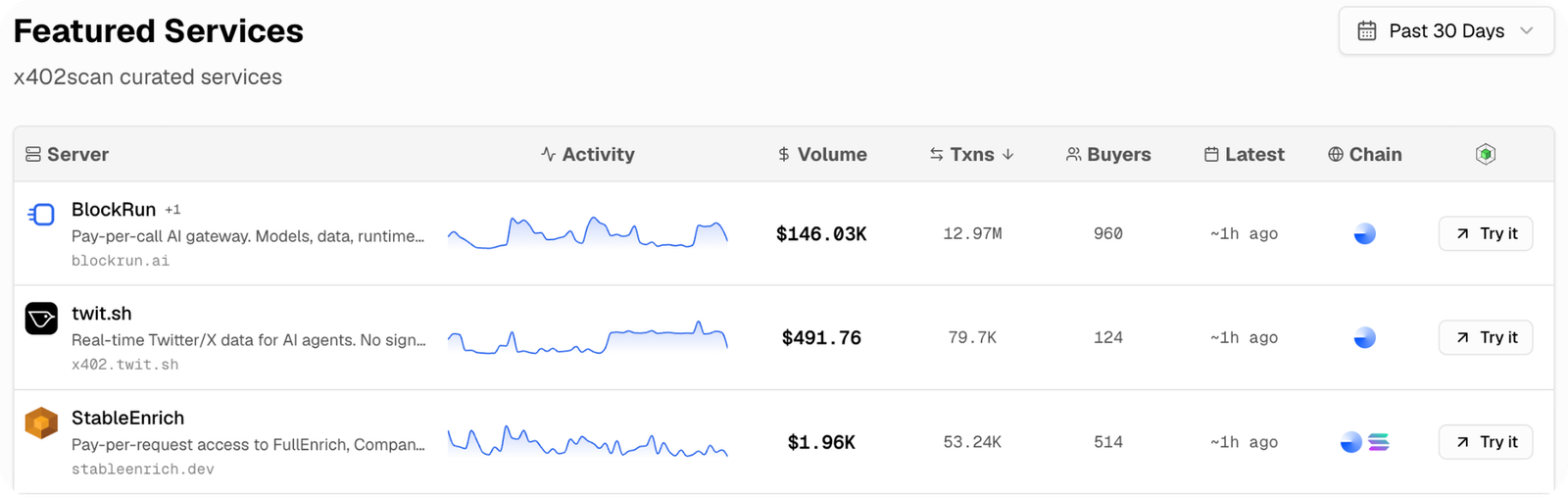
x402scan platform selected service list (statistical data from the last 30 days), showcasing the activity, transaction amounts, number of transactions, number of buyers, and other operational indicators of AI data / gateway service providers charged based on calls: BlockRun, twit.sh, StableEnrich
More service providers connect to the ecosystem
If you are using x402, this section is worth paying close attention to.
In June, Apify announced its integration with x402. Developers can use the USDC stablecoin on the Base chain to call upon its web automation and data scraping tool library (Base is still the main operating network for this protocol). Users can now scrape data from platforms like Twitter (X), Reddit, TikTok, and Facebook using stablecoins, although the quality of various automation scripts (referred to by Apify as Actors) varies.
Following that, AI search engine Exa expanded x402 payment support to the Solana chain, allowing users to pay for web search and content search services on this public chain. It is very suitable for in-depth information research, especially for due diligence on new projects.
The personal AI assistant platform Seal launched a function module called Hacks: it can bundle multiple API requests into a custom automated task capability. This product is based on x402, establishing a trading market, which is the practical scenario I was very much looking forward to in my previous article “My x402 Development Wish List.” I am pleased to see the product officially launched, and I plan to experience it myself.
In addition, the Merit Systems team continues to launch a new data information stream available for its dialogue application Poncho, which is equipped with the x402 protocol.
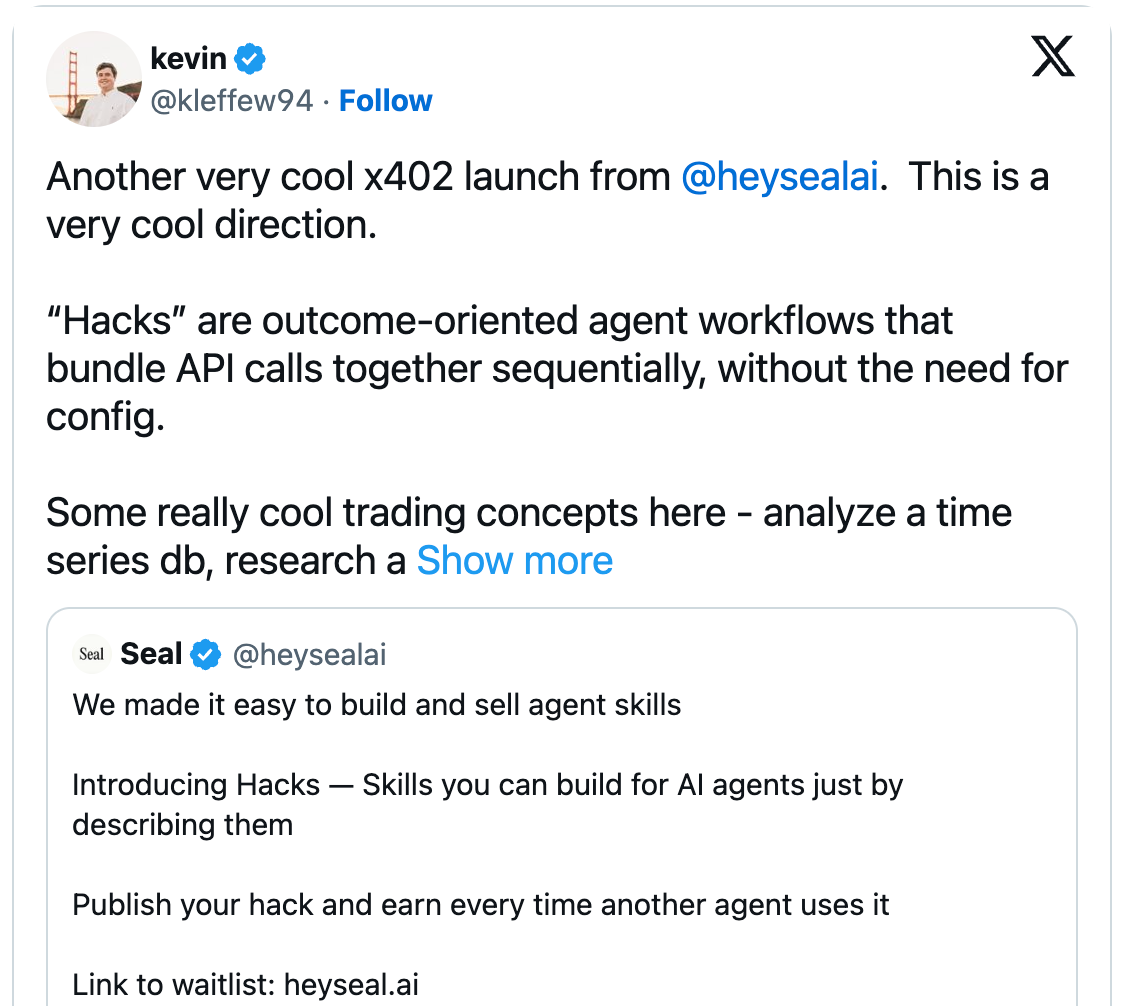
x402 white paper co-author Kevin Leffew shares and comments on Seal's Hacks function based on x402: Users can create AI agent automation skills and sell them externally with just a text description, earning revenue per call. Kevin believes this direction has broad prospects.
Practicality of payment infrastructure significantly enhanced
There are two major updates at the protocol level that are particularly critical:
- Builder Codes: x402 payment transactions can now mark the application, client, or service intermediary initiating the payment. This function allows for the establishment of distribution commissions and revenue-sharing systems, clearing obstacles for various trading market ecosystems.
- Batch settlement: There is no need to settle each small request on-chain individually. Buyers only need to pre-load their accounts and authorize multiple consecutive purchasing actions, after which the service provider aggregates funds uniformly. For high-frequency small payment scenarios, such as AI inference and information retrieval, it is infeasible to chain each transaction due to cost and delay; batch settlement makes high-frequency micropayments a reality.
In addition, x402 has added support for more programming languages and multiple blockchains, effectively lowering the integration threshold for various service providers.
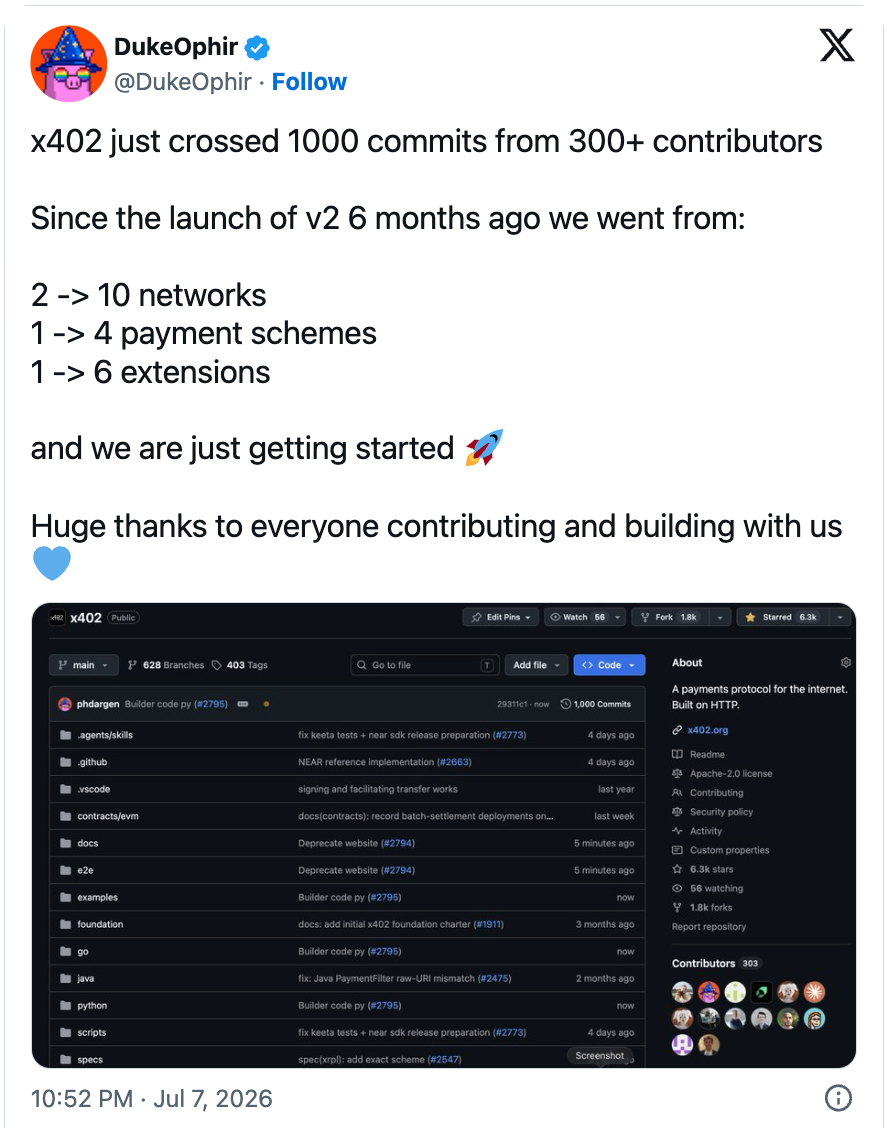
The core member and actual maintainer of the x402 ecosystem, DukeOphir, announces project development progress, with code submission exceeding 1000 times and over 300 developers, and the technical support scale for v2 has doubled within six months.
Mainstream internet giants bring channel dividends
The most impactful developments do not come from the crypto-native industry.
AWS launched an edge node AI traffic billing plan. When users request protected resources, AWS edge nodes can return pricing and payment terms, verify payment receipts, and then grant access to resources. Any content site or API interface deployed on AWS can now view AI agents as paying customers.
The highlight comes from Cloudflare. On July 1, its content monetization gateway officially opened for applications. With this gateway, customers can charge for all resources hosted on Cloudflare: web content, datasets, various APIs, and tool services can all be included in the billing. Transactions are settled using stablecoins through x402 and payment verification is completed at the edge nodes.
Content monetization is indeed the core application scenario that initially attracted attention to x402. The current internet business model is already unbalanced: various crawling bots occupy the majority of access traffic, and bots only scrape content and do not generate ad clicks, while website operators continue to bear bandwidth costs without receiving income compensation. Cloudflare handles about 20% of global website traffic, so this gateway will be the first large-scale real test for the bot payment model for internet content scraping.
The biggest question right now is performance scaling. The CEO of Cloudflare publicly supports x402 as a solution in a podcast but also points out the core bottleneck: existing blockchain throughput currently cannot support the required transaction scale. Even just monetizing a small portion of Cloudflare traffic needs processing power for millions of transactions per second, far beyond the performance of all public chains he has tested. This performance gap must first be bridged.

Source:Cloudflare co-founder and CEO Matthew Prince's interview on Bankless
Which application track will ultimately emerge victorious?
Currently, multiple practical tracks have emerged for x402.
The AI inference routing track seems to lead in scale, with BlockRun already validating market demand: users want to access various inference services in one place without needing to separately set up and manage multiple subscription accounts. The quality data payment track closely follows, as developers are willing to pay for high-quality input data, which can significantly enhance the output effects of large models.
Both tracks have real and sustainable demand, but relying solely on them is insufficient for x402 to become an indispensable foundational component of the next generation of the internet. In contrast, the content monetization track possesses this potential. If various AI agents need to pay for the web content they scrape, this scenario will propel x402 from being just a handy tool to widespread adoption. The practical implementation of the Cloudflare gateway will test whether this path can work.
免责声明:本文章仅代表作者个人观点,不代表本平台的立场和观点。本文章仅供信息分享,不构成对任何人的任何投资建议。用户与作者之间的任何争议,与本平台无关。如网页中刊载的文章或图片涉及侵权,请提供相关的权利证明和身份证明发送邮件到support@aicoin.com,本平台相关工作人员将会进行核查。


