Recently, the news that Byte employee Leto Bao made 30 million dollars from stock trading before leaving the company went viral on social media. The popularity of AI-related stocks goes without saying, and many people's first reaction is that employees of large companies have more principal, making it naturally easier to make money.
However, the reality is not so simple. According to the blogger's own description, he initially accumulated his first round of capital from tens of thousands to millions of dollars through options, and afterwards achieved new wealth leaps by leveraging the storage stock market trend. Regardless of whether the details are completely accurate, this story points to the same reality: in the U.S. stock market, what truly changes the funding curve is often a combination of industry main lines, core targets, and highly elastic tools.
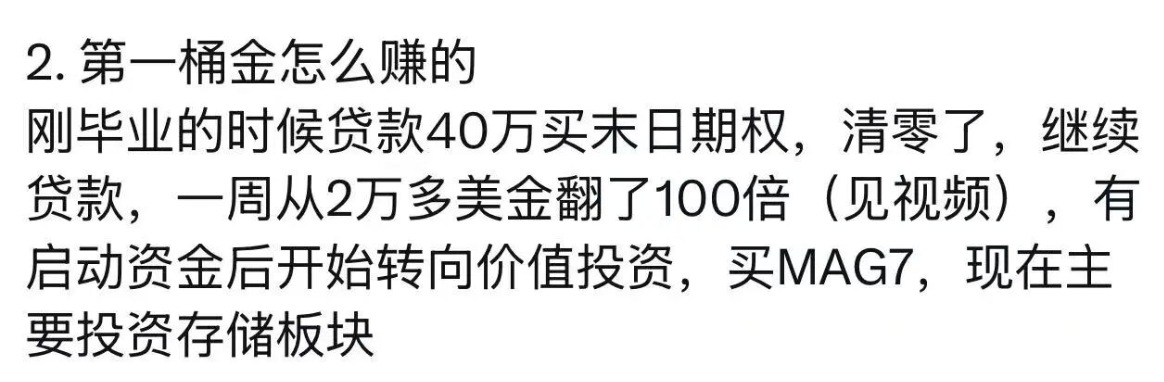
Leto Bao Xiaohongshu
In the past, this method could only be a game for traditional U.S. stock traders. Users need a brokerage account, U.S. dollar funds, familiarity with U.S. stock trading rules, and access to derivative tools like options. But with Bitget announcing the launch of the industry’s first U.S. stock options function in the crypto space, the entire process can now be completed in one go on Bitget.
Why Options Are Amplifiers of Wealth Effect in U.S. Stocks
If stocks determine the direction, options determine the elasticity, which is the wealth effect.
In the U.S. stock market, options have always been one of the tools that can maximize capital efficiency. If users are optimistic about a stock, they can directly buy the underlying stock or purchase call options. Buying the underlying stock requires full payment of the stock price, while buying options only requires paying the premium to gain exposure to price changes of the same underlying asset.
For high-priced or highly volatile stocks like Nvidia, Microsoft, Micron, and SanDisk, the appeal of options is very direct. Users do not need to put out a large amount of capital to participate in stock price fluctuations. If the directional judgment is correct, the timing is right, and volatility aligns, the returns from options can be much higher than from the underlying stock, even surpassing contract trading well-known in the crypto community. This is also why options frequently appear in many stories of rapid wealth accumulation in the U.S. stock market.
Once the price of the underlying asset exceeds the strike price, the intrinsic value of the option starts to increase, and the price rises rapidly.
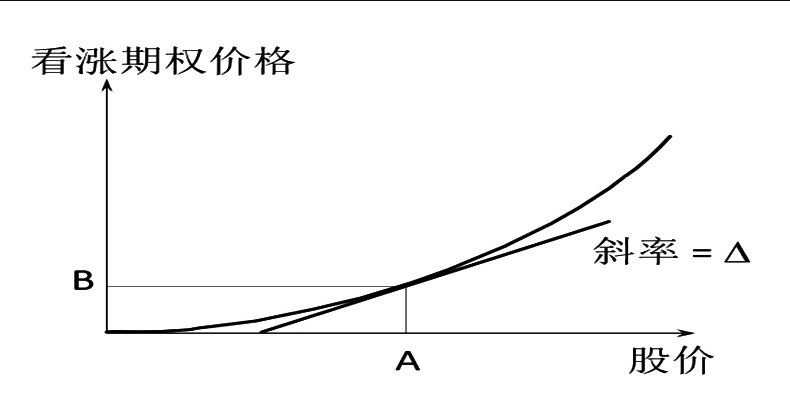
Of course, the other side of options is also quite obvious: both gains and risks are extremely compressed. Especially zero-day options (0DTE), which are options bought and expired on the same day, have low prices, high volatility, and fast decay, becoming one of the most popular intraday trading tools among retail investors in the U.S. stock market. They can turn hundreds of dollars into thousands or tens of thousands in a few hours, but they could also lead to the premium becoming worthless in a few hours.
However, whether liked or not, options have become one of the most important ways to express capital in the U.S. stock market. The total trading volume of U.S. options has surpassed 15.2 billion contracts year-round, with an average daily trading volume exceeding 61 million contracts. In the average trading volume of S&P 500 index options, over half comes from 0DTE options, which inherently favor high-risk high-volatility preferences typical of the crypto industry.
Bitget Brings U.S. Stock Options to the Crypto Trading Platform
According to information from Bitget, they first launched over 540 stock options, covering core indices such as the S&P 500, NASDAQ 100, and Dow Jones 30, with further gradual rollout of more stocks and ETF options.
U.S. stock spot trading addresses the issue of buying assets, while options deal with expressing elasticity. Users can buy Nvidia, Apple, and Tesla, or they can express their judgments on short-term fluctuations, earnings volatility, and market sentiment changes related to these stocks through options. For crypto users accustomed to highly volatile assets, options are not unfamiliar. Much like perpetual contracts, they compress direction, time, and leverage into a single trading tool. The difference is that stock options are backed by some of the most mature underlying assets in the U.S. stock market.
Moreover, there are many ways to play options. For example, value investor Duan Yongping habitually uses options for investment, significantly building positions in Pop Mart by selling put options, while Leto Bao mentioned above is also a professional user of options.
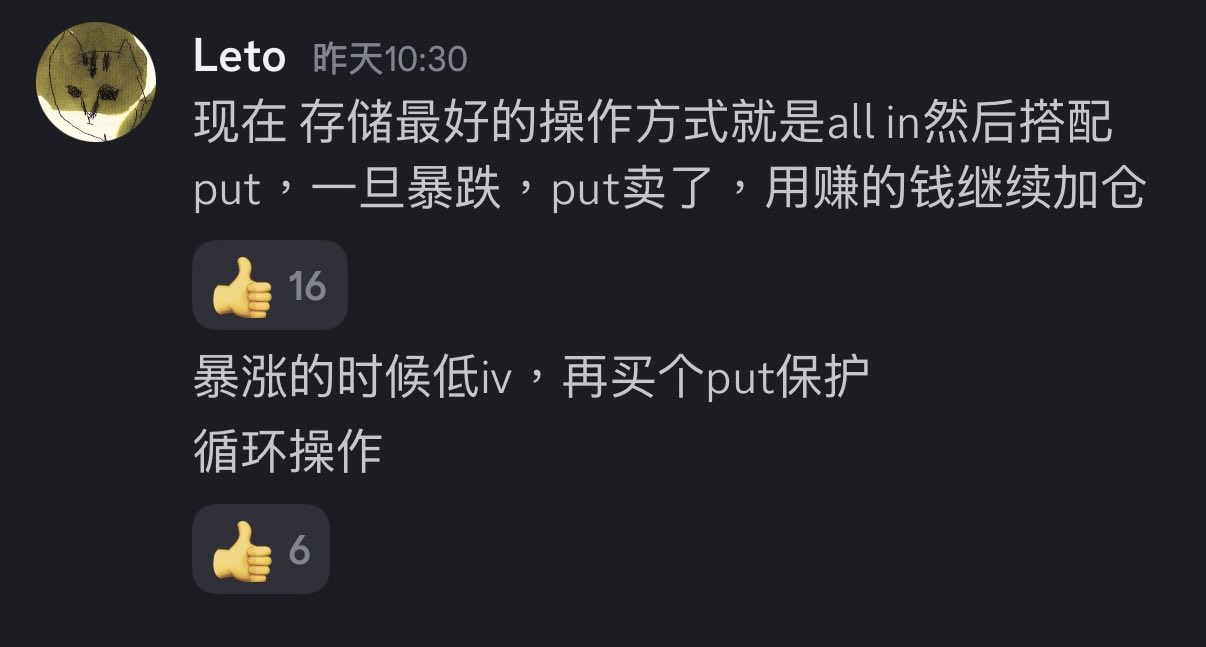
Leto Bao: Classic Gameplay of Roller Coaster Market
However, the first round of options rules from Bitget does not directly maximize complexity.
The trading hours for the launched options are from 9:30 AM to 4:00 PM EST, supporting only cash transactions, with no margin purchases of options. The margin rate for Long call and Long put is 100%, meaning that buying options requires full premium use without additional leverage. The settlement cycle is T+1, consistent with U.S. stocks.
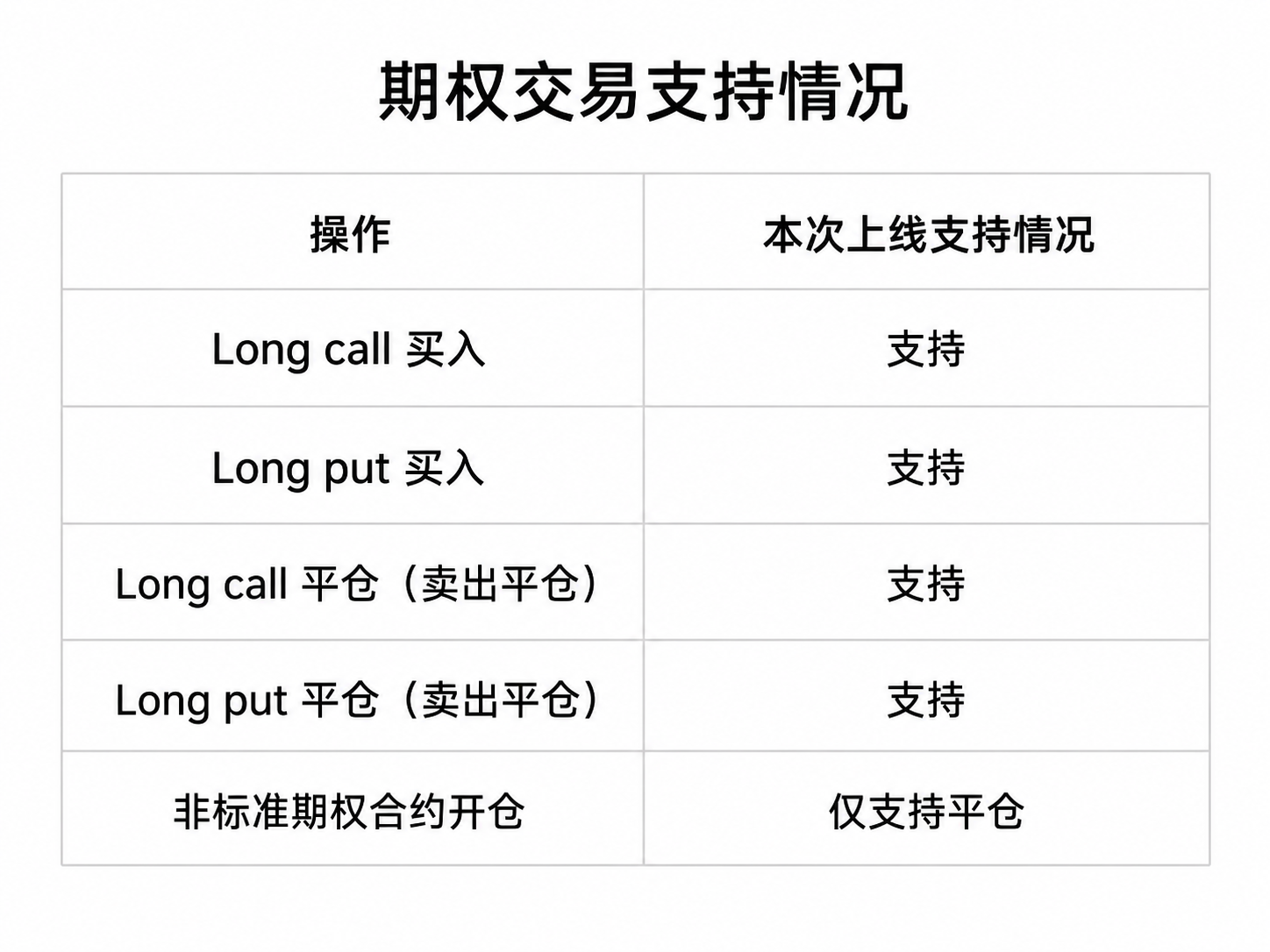
Additionally, the product supports estimated profit and loss for orders, showing maximum profit and maximum loss predictions, and also supports order modification, cancellation, and order record queries. For first-time crypto users dealing with U.S. stock options, these functions are important. Because for options trading, whether bullish or bearish does not differ from spot trading, yet specific risk boundaries can vary greatly.
This set of rules essentially reduces the probability of misuse when users first enter the options market. Bitget first introduces important capabilities like buying calls and buying puts, allowing users to express directional judgments with premiums while limiting maximum losses within the premium range.
Bitget's U.S. Stock Layout Is Not a One-Time Launch
Over the past period, Bitget has made continuous layouts around U.S. stocks and RWA: launching Ondo U.S. stock tokens → capturing about 90% of trading volume on the entire network → Pre-IPO access → launching U.S. stock rToken, integrating exchange ecology → direct connection to U.S. stocks, and now U.S. stock options—Bitget is building a complete product line for U.S. stocks.
The reasons are obvious. Crypto users genuinely need to capture global risk asset opportunities more efficiently. Previously, funds in trading platforms mainly flowed between BTC, ETH, and altcoins. But when tech stocks in the U.S. stock market become the focal point of global capital, users naturally hope to trade Nvidia, Micron, Apple, Microsoft, and S&P 500 ETF using the same account framework.
The U.S. stock market is the deepest pool of risk assets globally. AI, semiconductors, cloud computing, software, and consumer technology are sectors that global capital cannot bypass. The crypto market has high volatility and capital efficiency, but asset quality is unstable. Conversely, the U.S. stocks have high asset quality and deep liquidity, but traditional trading processes are not friendly to crypto users.
What Bitget wants to solve is this disconnection.
Starting with tokenized stocks, users can access U.S. stock exposure in their crypto accounts; through Pre-IPO, users can tap into pre-listing opportunities; through direct connection to U.S. stocks, users get closer to a real and secure stock market; and with U.S. stock options, users gain access to trading tools with greater elasticity.
Looking back at this series of layouts, Bitget's goal has become very clear: to bring the main trading dimensions of the U.S. stock market into crypto accounts—spot exposure, pre-listing opportunities, real liquidity, and options tools.
rToken Is the Foundation of Bitget's U.S. Stock Product Line
In Bitget's U.S. stock product line, the core product is rToken.
Many people, upon seeing tokenized stocks, easily misunderstand them as the synthetic assets most familiar to the crypto world, which are counterpart trades without real sources. However, Bitget's positioning of rToken is completely different. rToken is backed 1:1 by actual U.S. stock shares, regulated by the laws of the State of New York, with shares held by licensed U.S. brokers, and custody and brokerage infrastructure provided by regulated partner Alpaca Securities. Alpaca is registered with FINRA and protected by SIPC.
This means that rToken is not simply a synthetic exposure, but an RWA product supported by real underlying stocks.
The biggest difference from previous stock tokens is the source of liquidity. Many RWA stock tokens rely on on-chain liquidity and secondary market trading, and prices may require additional mechanisms to track underlying stocks. Once on-chain liquidity is insufficient, prices may diverge from the real U.S. stock market.
During U.S. stock trading hours, rToken spot orders will be routed directly to the NASDAQ and NYSE order books through brokers, for standard trading, pre-market, after-hours, and overnight sessions. Once orders are executed in the U.S. stock market, trading results will be reflected back into Bitget's spot order records.
In simple terms, rToken connects to native U.S. stock market liquidity through partners, allowing its latest prices, bid-ask spreads, and order books to completely match the underlying stock market, while other issuers' stock tokens still rely on market makers for liquidity. Theoretically, NASDAQ naturally has the best liquidity in the entire market, but how significant is this gap?
Practical test data shows that, taking SanDisk (SNDK) as an example, from the bid-ask spreads during the same period, the rToken and bStock differences are not obvious, but from the order depth and 24h trading volume, rToken has a clear advantage, leading by 260x and 1000x respectively. This means that if trading smaller amounts (within a few hundred dollars), the experience and cost differences between the two are not significant; but for larger trades (thousands or even tens of thousands of dollars), bStock will incur extremely severe slippage losses, while rToken's capacity is clearly better.
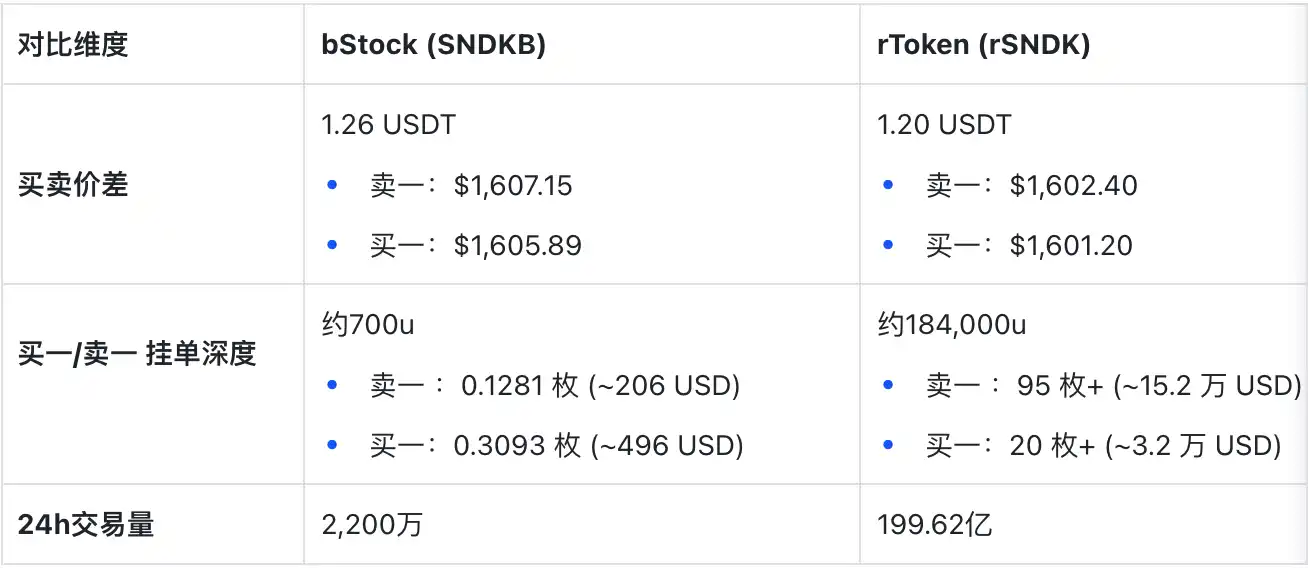
This is also why rToken is the foundation of Bitget's U.S. stock product line. With rToken, Bitget can weave together U.S. stock exposure, trading liquidity, account capital efficiency, and subsequent derivative tools.
Three Key Advantages of rToken
The new landscape brought by Bitget's rToken can be summarized in three aspects: native U.S. stock market liquidity, extreme capital efficiency, and higher compliance standards.
First is liquidity.
If one opts for the world's largest stock market, how can it be said to truly leverage it without utilizing its liquidity? rToken supports 5x24 access to the native U.S. stock market liquidity. During U.S. stock trading hours, the prices and liquidity of rToken synchronize with the underlying stock market. Orders are routed directly to U.S. trading platforms, reducing the risk of price divergence or detachment.
Moreover, the primary drawback of tokenized stocks like Ondo lies here. In a U.S. stock direct connection mode, rToken's liquidity aligns with traditional brokers, facing a vast U.S. stock market for user orders, while tokenized stocks mainly engage with crypto industry on-site users and market makers, easily resulting in significant slippage due to liquidity shortages, and potentially causing chain reactions such as liquidation due to liquidity absence.
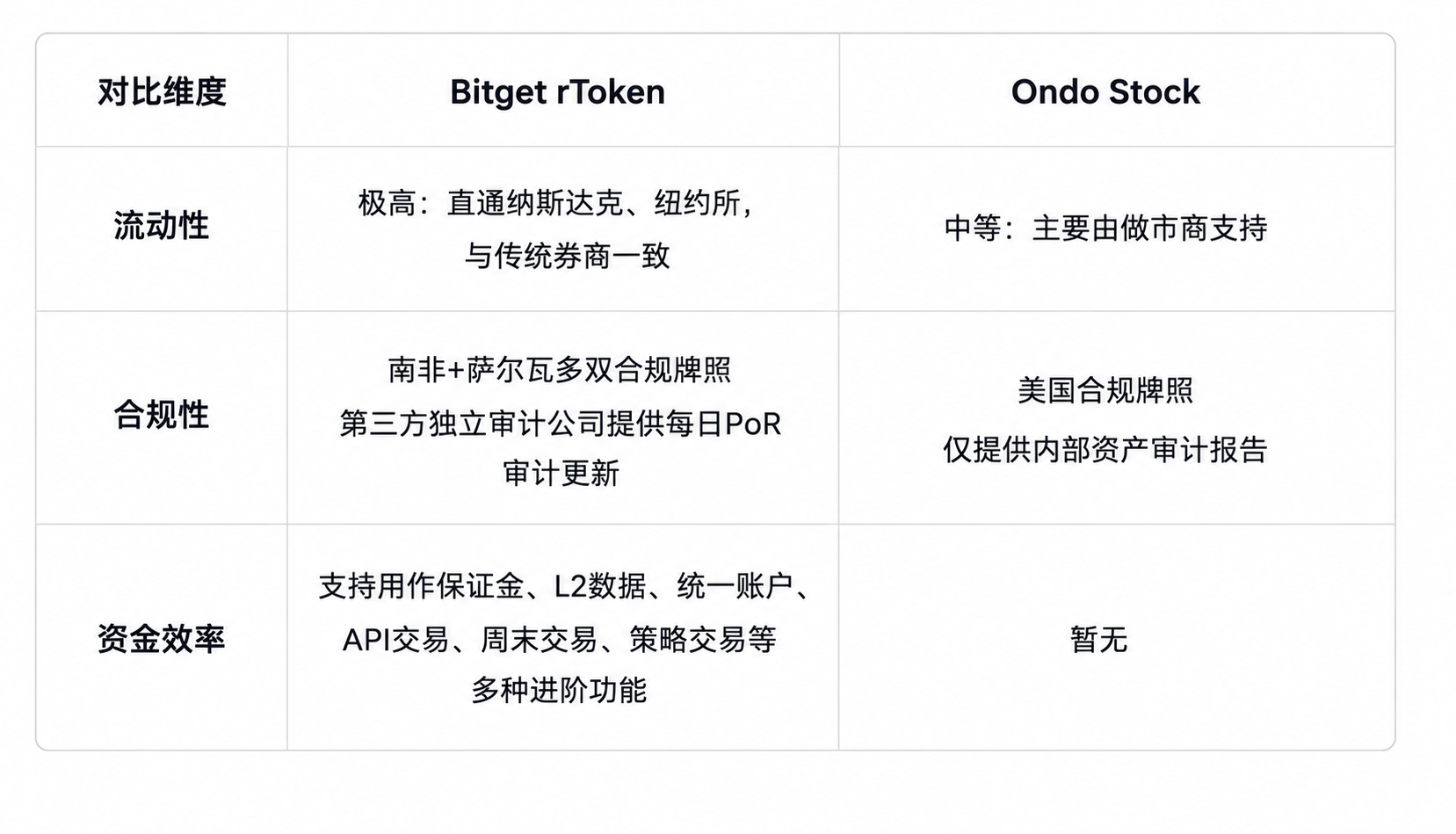
Bitget rToken Compared to Ondo Tokenized Stocks
For some popular stocks, rToken also supports 24/7 trading. This means that during U.S. market closures, including weekends and holidays, users can still trade rToken related to some popular stocks. Bitget provides in-house liquidity during these periods to support continuous price discovery.
This is crucial for crypto users. The crypto market operates on weekends, and news is not waiting for U.S. stock market open. Capex updates, AI orders, chip updates, earnings pre-announcements, macro data, and social media revelations can all occur outside U.S. trading hours. If users have to wait until the next trading day to react, they risk missing first-time pricing. The 24/7 trading capability of rToken fills this gap.
Secondly is capital efficiency.
Once sold, funds from rToken can be reinvested immediately, without waiting for T+1 settlement. rToken can also be transferred, withdrawn, allocated among sub-accounts, or used for different margin models like other crypto assets. Within the unified trading account, the same rToken position can cross-trade in spot, derivatives, and lending.
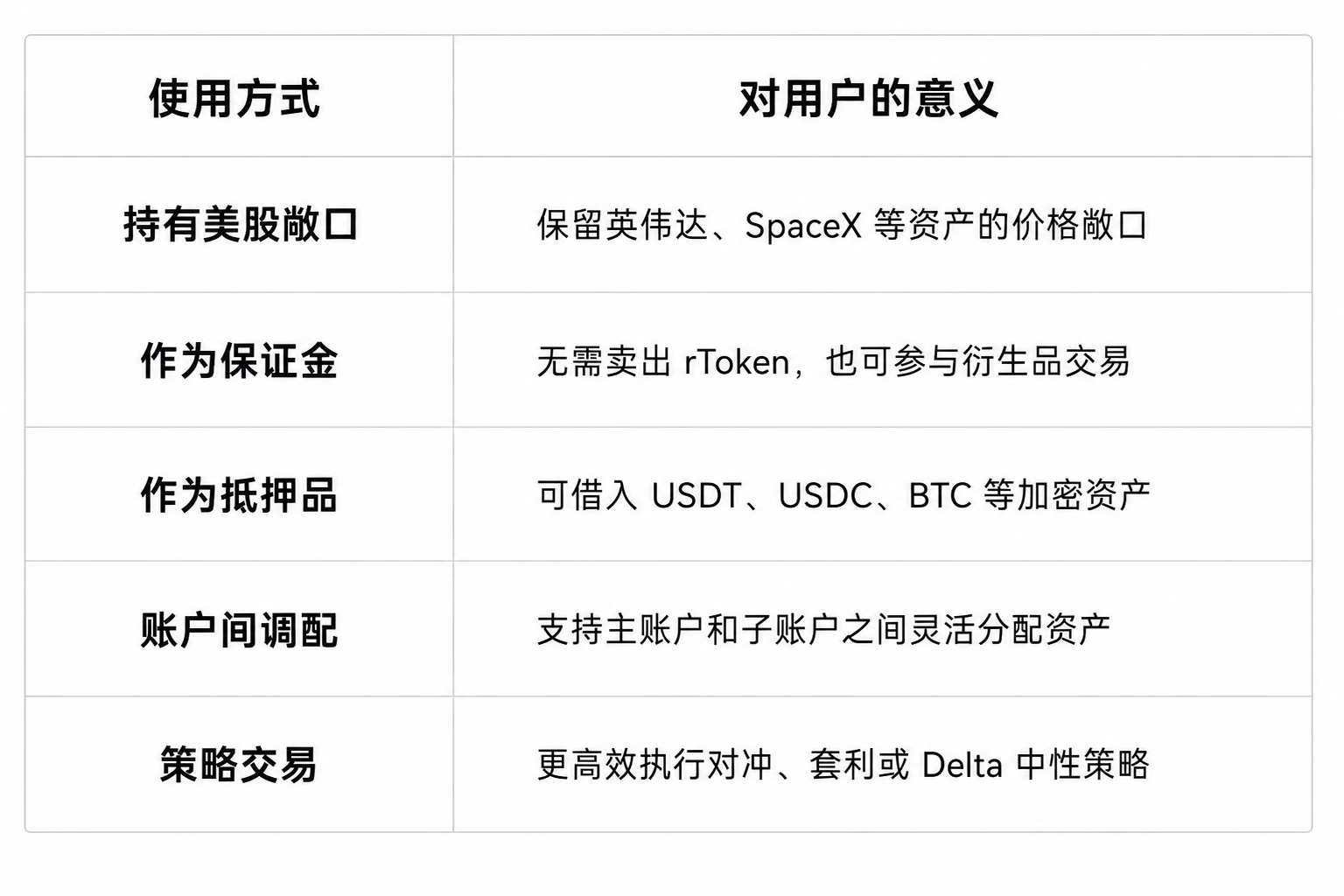
This makes rToken callable collateral. Professional users can maintain U.S. stock exposure while using rToken as margin for futures trading, or as collateral to borrow assets like USDT, USDC, BTC, etc., without selling underlying holdings. Currently, this feature supports about 20 rTokens including Nvidia and SpaceX.
This also highlights Bitget’s strengths compared to most RWA stock products. It is not merely offering "buyable stock tokens," but incorporating rToken into its trading ecosystem, enabling U.S. stock assets to participate in margin, lending, hedging, and multi-asset strategies. For professional users, U.S. stock exposure is no longer just about positioning; it can also serve as a foundational asset to enhance capital efficiency.
Lastly, compliance and transparency.
Reality, launched by Bitget, is the compliance RWA issuance protocol behind rToken, ensuring its issuance is strictly 1:1 pegged to underlying U.S. stocks. Assets are custodied by Alpaca, a FINRA-regulated U.S. brokerage protected by SIPC, with cooperation established with the U.S. auditing firm The Network Firm, making it one of the few RWA products providing audited daily reserve proof (PoR) data.
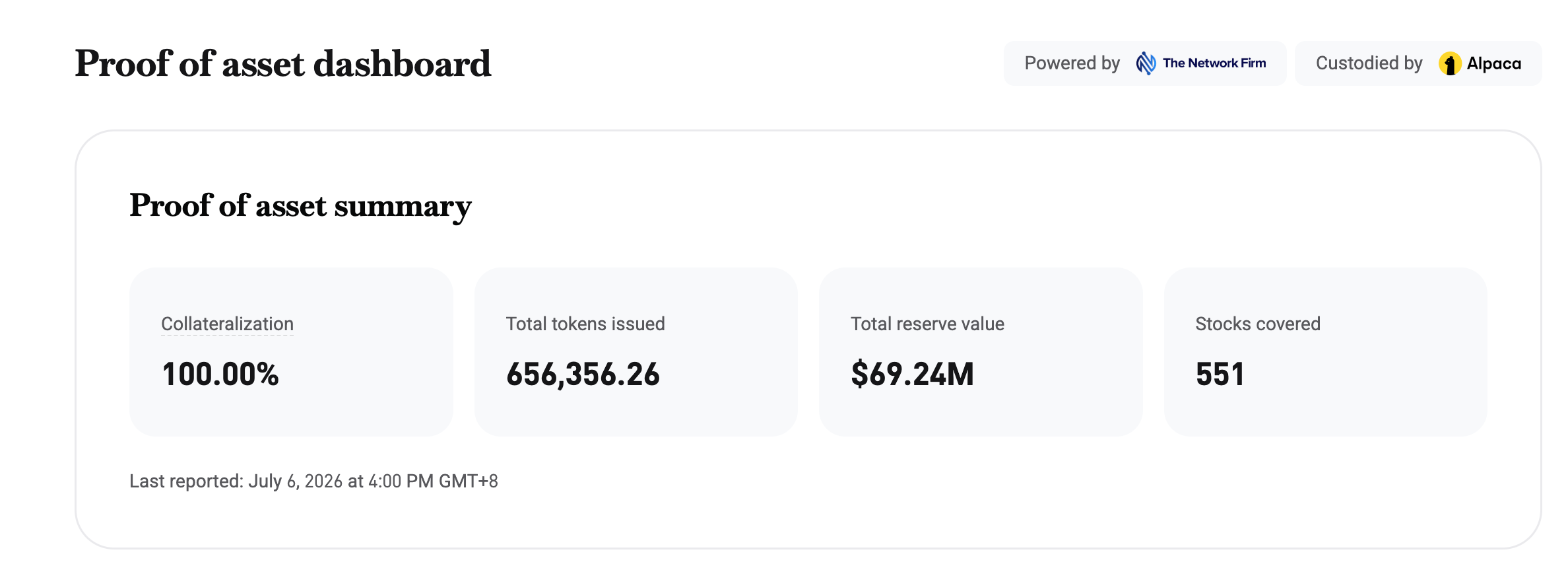
As it is tokenized real stocks, corporate actions like dividends, stock splits, reverse splits, and capital returns will be handled according to traditional U.S. stock market practices. If dividends are paid out from the underlying stocks, eligible rToken holders will automatically receive USDT dividends after applicable U.S. withholding taxes are deducted. If a stock split or reverse split occurs, the rToken balance and price will adjust accordingly while the total holding value remains unchanged. This makes rToken much closer to a complete stock product experience, rather than just a price symbol.
Overall, the significance of rToken is not just about buying and selling U.S. stocks; it is an attempt to combine stock-level trading experiences with the flexibility and transparency of crypto assets.
When the Wealth Path of U.S. Stocks Enters Crypto Accounts
The incident of a Byte employee leaving with 30 million dollars has sparked discussions, partly due to the exaggerated wealth figure and partly because it has made more people reconsider the wealth path in the U.S. stock market during the AI era: first, use options to gain high elasticity, then sustain larger capital scales with industrial main lines and core stocks.
In the past, this path mainly belonged to traditional U.S. stock traders. Now, Bitget is trying to bring it into crypto accounts.
Of course, Bitget's full-chain route for U.S. stocks is not all smooth sailing. First is the fiercely competitive industry, as the entire crypto market is in a downturn, stocks have become a battleground; for instance, industry giant Binance launched its tokenized stock bStocks shortly after Bitget introduced rToken, and also opted for the same service provider, Alpaca. Secondly, crypto users are not sufficiently familiar or trusting of the stock services launched by the platform, requiring lengthy education; the platform itself is also navigating through trial-and-error, and there is a need for gradual mutual adjustment between the platform and users. Additionally, because the conversion cost between stablecoins and fiat currencies is low, traditional brokers have a more significant appeal to high-net-worth users.
However, Bitget's foresight and deep layout in U.S. stock trading have maintained its advantage in the competition. rToken provides U.S. stock exposure and stock-level trading experiences, Pre-IPO supplements pre-listing opportunities, direct connection to U.S. stocks brings users closer to a real market, and options offer tools for higher elastic risk expression. Together, they indicate that the crypto trading platform is no longer just a venue for crypto asset trading but could also become a new gateway connecting global risk assets. This also implies that the platform's next challenge may not only be about liquidity, technical capabilities, and channels for accessing U.S. stocks, but also how to gain the trust of traditional brokerage users in product experience, asset transparency, and long-term stability, and further reach a broader investor group.
免责声明:本文章仅代表作者个人观点,不代表本平台的立场和观点。本文章仅供信息分享,不构成对任何人的任何投资建议。用户与作者之间的任何争议,与本平台无关。如网页中刊载的文章或图片涉及侵权,请提供相关的权利证明和身份证明发送邮件到support@aicoin.com,本平台相关工作人员将会进行核查。


