Written by: Rita
Trend Guide Overview
Bernstein released the CoreWeave (CRWV) 2Q26 earnings preview on July 9, maintaining an underperform rating with a target price of $67, compared to the current $90, implying a 26% downside. 2Q is likely to be a transition quarter, with the real turning point in performance expected to become evident after the power capacity climbs to 1.7 gigawatts in the second half of the year. 1Q has already exposed execution issues, with adjusted operating profit only at $21 million, far below the company's previous guidance of over $100 million. Bernstein is worried that once the supply of data centers is no longer tight after 2028, CoreWeave's business logic may struggle to support its current valuation.
2Q is a Transition Quarter, Power Climb is the Key Variable
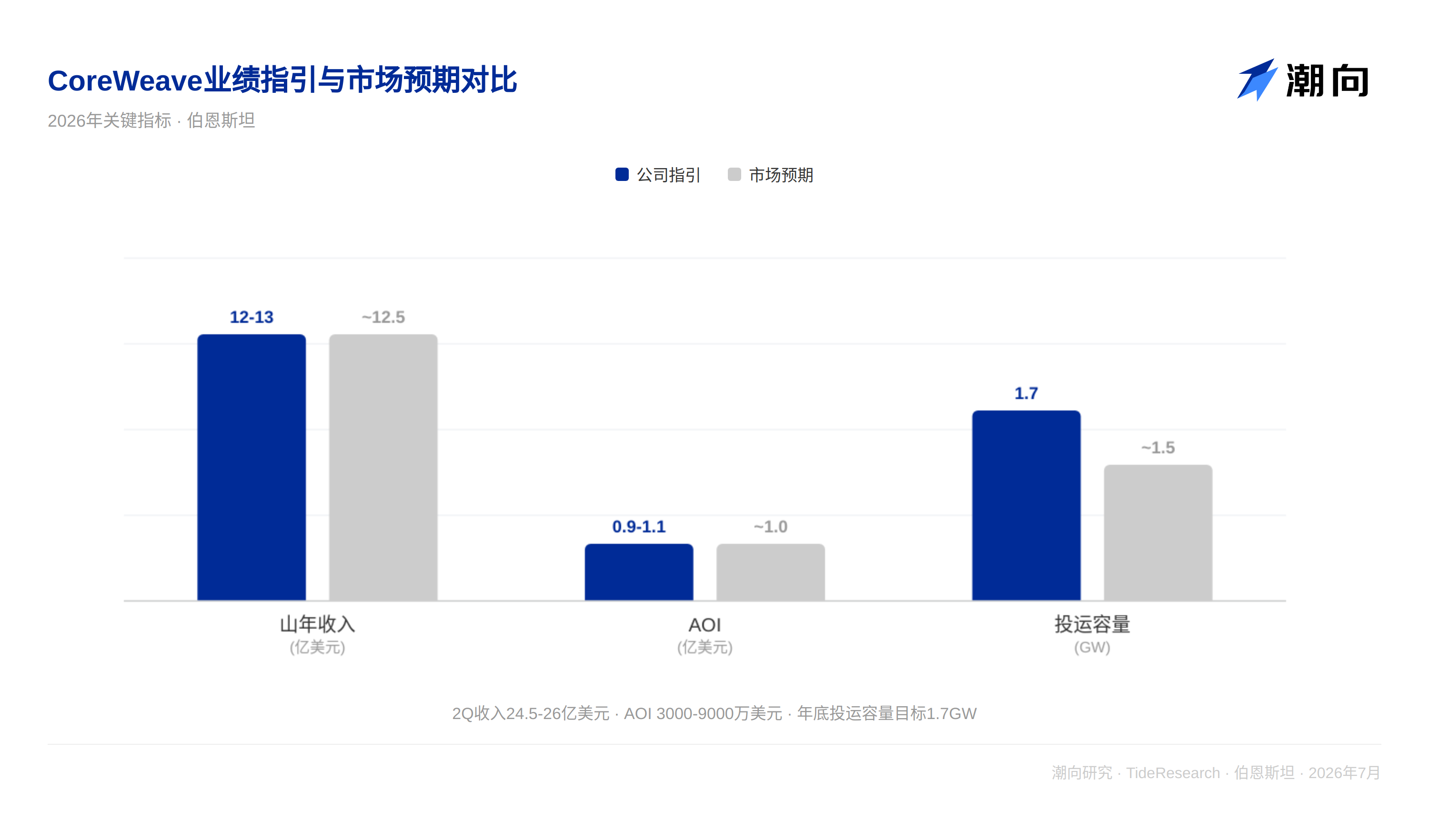
CoreWeave is expected to announce its 2Q results in early August, with revenue guidance for 2Q set at $2.45 billion to $2.6 billion, and adjusted operating profit guidance of $30 million to $90 million. Management reiterated a goal of 1.7 gigawatts of operational capacity by the end of 2026, with full-year revenue guidance for 2026 set at $12 billion to $13 billion, and annual exit revenue target increased from $17 billion to $19 billion to $18 billion to $19 billion.
Bernstein believes that the lukewarm performance in 2Q is in line with expectations. The capacity for 2026 has been fully sold out, and most of 2027 is also locked in, making significant revenue surprises unlikely in the short term. The real variable lies in the delivery pace of power, as true power rollouts will not occur until 2H26; whether the ramp-up of operational capacity goes smoothly will determine if the performance can be realized in the second half of the year.
Management has repeatedly emphasized that there are no signs of a slowdown in AI demand, but the growth rate of operational capacity is the key variable that determines performance. The leasing environment remains hot, but power supply will continue to be tight in the next 6 to 12 months. This supply-demand mismatch is both the source of CoreWeave's current pricing power and the area with the most execution risk.
Execution Issues Exposed in 1Q are Worth Monitoring
Adjusted operating profit for 1Q26 is only $21 million, far below the company's previous expectation of "over $100 million." Management's explanation is that it is "temporal rather than economic," as powered shells start incurring leasing, power, and depreciation costs before contributing revenue, and the gross margin typically returns to normal only in the third month.
Bernstein remains cautious about this. Analysts estimate that if project-level gross margins fall below 21% or the average installation cycle exceeds 8 weeks, FY26's adjusted operating profit may fall short of expectations, and this threshold is not very high. CoreWeave is in an ultra-high growth period, making perfect execution nearly impossible. Historical data shows that stock prices have dropped between 11% and 21% following earnings announcements over the past three quarters, with the decline expanding to between 11% and 38% a week later, and still showing a decline of 14% to 22% a month later. Even if operational data is solid, the earnings season may still pressure stock prices.
Long-Term Concern: Where is the Moat After 2028?
Bernstein's long-term concerns about CoreWeave focus on after 2028. Once the supply of data centers is no longer tight, large-scale vendors are likely to directly compete with Neocloud for enterprise clients. Bernstein questions whether CoreWeave's software moat can withstand the incursions of AWS, Azure, and GCP.
Bernstein does not expect to see a structural change before 2027, estimating that CoreWeave can still sign around $45 billion in new contracts before the end of 2027. However, Bernstein’s forecast begins to diverge from market consensus after 2027, with Bernstein's revenue prediction for 2028 being about 15% lower than consensus, and this gap continues to widen. This time lag means that both bullish short-term and bearish long-term logic can coexist; investors need to clarify which time window they are betting on.
Trend Perspective
CoreWeave's valuation is betting on two things: the speed of growth in AI computing demand continues to outpace the speed of data center supply expansion, and it can defend its niche market as an independent GPU cloud service provider amid the encirclement of large-scale vendors. Bernstein's underperform rating is essentially betting that at least one of these two assumptions will fail.
The most valuable part of this report is not the $67 target price but the clear timeline offered by Bernstein: before 2028, the tight supply story can still support valuations; after 2028, if the supply of data centers is released in large quantities, CoreWeave's moat may be much shallower than the market imagines. The pace of contract signings in 2027 will be an early signal to validate this judgment.

Disclaimer
This article is a整理与解读 of third-party brokerage research reports (Bernstein, July 9, 2026) by Trend Research. The ratings, target prices, earnings forecasts, and related judgments quoted herein are the views of the respective brokerage analysts, representing only their institution's position, do not represent the views of Trend Research, and do not constitute any investment advice.
The market has risks, and decisions must be made independently. This article should not be used as a basis for buying or selling any securities.
免责声明:本文章仅代表作者个人观点,不代表本平台的立场和观点。本文章仅供信息分享,不构成对任何人的任何投资建议。用户与作者之间的任何争议,与本平台无关。如网页中刊载的文章或图片涉及侵权,请提供相关的权利证明和身份证明发送邮件到support@aicoin.com,本平台相关工作人员将会进行核查。


