Author: Gu Yu, ChainCatcher
On July 1, 2026, at the Old Royal Naval College in London, internet brokerage giant Robinhood held a milestone-themed launch event titled "The World is Flat". During this event, the Robinhood Chain public mainnet was officially launched, Stock Tokens were fully opened, Agentic Accounts were rolled out for U.S. crypto users, and Robinhood Earn was simultaneously unveiled. On the same day, the company's stock price rose by 8.35%.
This is not just an update to crypto products. From the launch of cryptocurrency trading features in early 2018 to the introduction of its own Layer 2 public chain today, Robinhood has completed a comprehensive journey from tentative steps to deep dives. This path reflects the evolution of traditional financial giants' perspectives on the crypto world, from cautious observation and engagement to full integration. Robinhood, in particular, is a prime example worth analyzing on this evolutionary curve.
Stage One: Initial Entry into Crypto — From Trading Features to a Proprietary Wallet
Robinhood's first intersection with cryptocurrency began in 2018. At that time, this internet brokerage, which disrupted the U.S. securities brokerage industry with "zero commissions," launched cryptocurrency trading features within its app. This felt more like a natural extension of product boundaries at the time — users could trade stocks, options, and cryptocurrencies in the same account, forming a preliminary one-stop experience.
However, the initial positioning of the crypto business was quite conservative. Robinhood listed only 15 types of cryptocurrencies on its platform and never offered staking services. This caution stemmed from regulatory uncertainties — at that time, the SEC in the U.S. had not clearly defined the regulatory framework for crypto assets, so Robinhood chose to test the waters with a minimal asset list, meeting user demands while controlling compliance risks within manageable limits.
Further progress occurred around 2022. Robinhood launched its own cryptocurrency wallet, marking an upgrade in its crypto strategy from "trading channel" to "asset gateway." The introduction of the wallet meant that users no longer just bought and sold crypto assets on the Robinhood platform, but gained real on-chain autonomy — assets could be deposited, transferred, and even participate in a wider DeFi ecosystem.
The significance of this stage lies in "positioning." Robinhood took four years to complete the construction of its crypto infrastructure from zero to one. Although its functionalities were relatively basic, it laid the groundwork for subsequent comprehensive expansion. More importantly, through the wallet product, Robinhood accumulated experience in operating on-chain users, establishing a cognitive foundation for its future proprietary blockchain strategy.
Stage Two: Embracing Crypto — Acquisitions, Investments, and Ecosystem Alliances
If the first stage was "testing the waters," then from 2024 to 2025, Robinhood truly jumped into the pool.
The most iconic event was the announcement in June 2024 to acquire the established compliant exchange Bitstamp for $200 million in cash. This deal was completed in the first half of 2025. Bitstamp, founded in 2011, is one of the most compliant exchanges in the industry, with operations covering Luxembourg, the UK, Singapore, and the U.S., boasting over 50 global crypto licenses. After the acquisition, the number of crypto assets supported by Robinhood expanded from 15 in the U.S. and over 30 in Europe to more than 85 from Bitstamp.
More importantly, Bitstamp brought institutional trading channels to Robinhood — 90% of its trading volume comes from institutional users, with an average fee of 5 basis points per trade. This means that Robinhood’s crypto business no longer serves only retail investors but has entered the higher-margin institutional market.
Around the same time, Robinhood also announced the acquisition of the Canadian platform WonderFi to expand into the North American market. While expanding internationally, Robinhood's business coverage in Europe increased from 4 countries to 30.
On the investment front, Robinhood participated in a $68 million financing round for Lighter at the end of 2025. Lighter is an on-chain perpetual and spot trading exchange founded by Vladimir Novakovski in 2022, with this round led by Peter Thiel's Founders Fund and Ribbit Capital, resulting in a post-investment valuation of approximately $1.5 billion. Robinhood entered as an investor, not just as a business partner — this represents a deeper alignment of interests.
On the product side, in June 2025, Robinhood launched Stock Tokens in the European Union, allowing users to trade tokenized versions of over 200 U.S. stocks and ETFs. This product marks Robinhood's first attempt to "on-chain" traditional financial assets.
During this stage, Robinhood's crypto business began to contribute substantial financial data. In the second quarter of 2025, the company's cryptocurrency trading revenue reached $160 million, a year-on-year increase of 98%, with a trading scale of $35 billion. In the third quarter of 2025, cryptocurrency trading revenue surged to $268 million, a year-on-year increase of 339%, with a trading volume of $80 billion. The crypto business has become the core engine of Robinhood's performance growth.
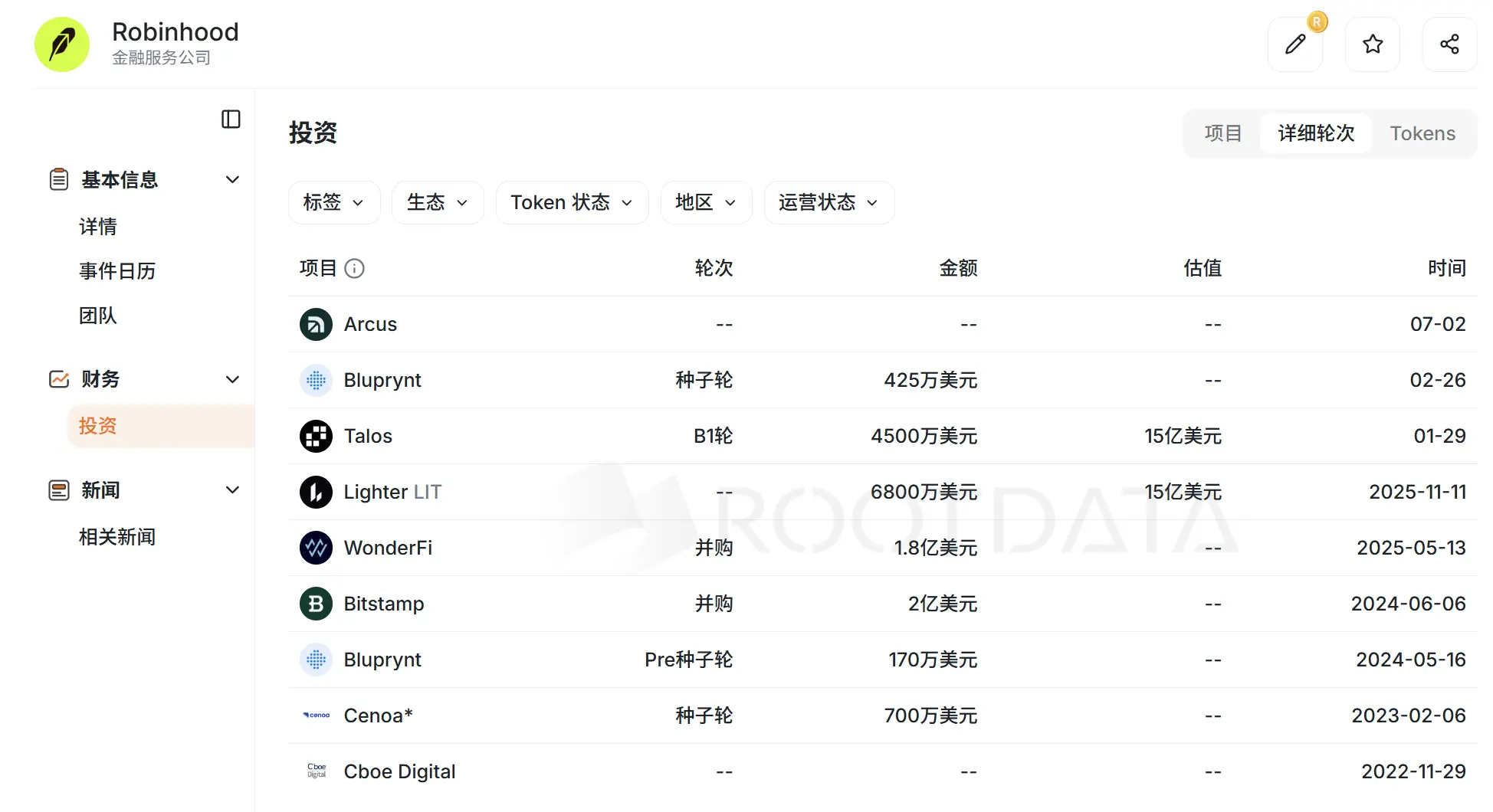
The strategic logic of this stage is clearly visible: acquiring compliant licenses and institutional clients through acquisitions, binding core ecosystem partners through investments, and exploring the possibilities of asset on-chaining through product innovations. Robinhood no longer positions itself as a "stock trading app with crypto features," but begins to systematically build a comprehensive financial platform that covers retail and institutional, spot and derivatives, traditional assets and crypto assets.
Stage Three: Deep Focus — The Ambition of Robinhood Chain and "Everything Exchange"
On July 1, 2026, Robinhood reached a key moment in its crypto strategy — the official launch of the Robinhood Chain public mainnet.
This Layer 2 network is built on the Arbitrum tech stack, aimed at tokenizing real-world assets (RWA) and DeFi applications, and is "very suitable for meme coins" (according to Robinhood CEO Vlad Tenev).
The launch of Robinhood Chain marks the upgrade of Robinhood's crypto strategy from "connector" to "builder".
In recent years, a common approach for financial companies entering the crypto industry has been to connect to existing public chains — the platform handles users, interfaces, and product packaging while settlement, gas, liquidity, and DeFi applications occur on external networks. This model is quick to launch, but for Robinhood, which already has nearly 28 million funded accounts, the long-term pain point is that users trade within its app while assets and settlement happen on others' turf.
Robinhood Chain was created to resolve this contradiction. It transforms Robinhood from an "interface provider" into a "financial rail owner" — trading, settlement, collateralization, yield, and asset flow all operate on its own chain.
Around Robinhood Chain, a complete ecosystem is taking shape. On its first day, dozens of crypto projects such as Uniswap, Chainlink, Lighter, 0x, LI.FI, and Rialto announced their integration with Robinhood Chain, while dYdX outright abandoned its existing brand to launch the new Perp exchange Arcus. Reports stated that the scale of Robinhood Chain's stablecoin reached $246.97 million.
Meanwhile, Stock Tokens were fully opened, allowing users to trade tokenized stocks in over 120 countries through Robinhood Wallet. Robinhood Earn allows users to lend out USDG stablecoins through self-custodied wallets, with an expected annual yield of around 7%. Agentic Accounts enable eligible users to connect AI models to Robinhood's trading infrastructure.
At this point, Robinhood has gradually integrated stocks, cryptocurrencies, tokenized assets, stablecoin yields, perpetual futures, prediction markets, and AI trading tools into the same financial account system.
CEO Vlad Tenev revealed that the company currently has 9 product lines with annual revenues reaching hundreds of millions, covering stock trading, options, cryptocurrencies, Robinhood Gold subscriptions, cash management, instant withdrawal, tokenization, private banking, and prediction markets.
Once a company primarily known as a zero-commission broker, it is now evolving into the ultimate form of "everything exchange".
A Case Study in the Convergence of Traditional Finance and the Crypto World
Notably, while Robinhood launched its own public chain, native crypto exchanges like Coinbase and Binance were also actively promoting the launch of tokenized stocks, trying to bring traditional stock trading onto the chain. Meanwhile, Robinhood is diving deeper into the crypto space by building its own public chain, launching perpetual contracts, and DeFi tools.
The two paths are approaching the same goal from opposite directions: allowing users to transact, hold, and earn returns on traditional and crypto assets within the same system.
More importantly, Robinhood's path reveals an increasingly clear industry trend: traditional financial institutions are entering the crypto world not merely to connect to an existing ecosystem but to leverage their accumulated compliance capacities, brand reputation, user base, and global channels to rebuild their own financial system on the chain. This presents a significant threat to existing crypto giants.
From the cautious listing of coins in 2018 to the self-built public chain in 2026, Robinhood has taken eight years to complete its "turning the tables" in the crypto world. Its journey reveals an unavoidable conclusion: when the ships of traditional finance navigate into the deep seas of crypto, they aim not to integrate into the existing on-chain world, but to reconstruct a new continent beneath their feet with compliance structures and vast user bases. This posture of leveraging users to influence protocols may become the main narrative for the integration of traditional finance and crypto in the next decade.
免责声明:本文章仅代表作者个人观点,不代表本平台的立场和观点。本文章仅供信息分享,不构成对任何人的任何投资建议。用户与作者之间的任何争议,与本平台无关。如网页中刊载的文章或图片涉及侵权,请提供相关的权利证明和身份证明发送邮件到support@aicoin.com,本平台相关工作人员将会进行核查。


