The most exaggerated increase in Meme coins is often the result of severe manipulation.
Written by: Gino Matos
Translation: Chopper, Foresight News
The Meme coin ANSEM has seen an increase of nearly 299% over seven days, driving a revival in the Solana Meme coin market. According to DeFiLlama data, the weekly trading volume for Pump.fun on decentralized exchanges (DEX) was $5.33 billion, with a 30-day trading volume of $18.22 billion.
On July 4, Pump.fun and PumpSwap saw their first single-day trading volume exceed $1 billion since April 8, while the trading volume during the week from June 29 to July 5 broke the $5 billion mark for the first time since late March.
Driven by the ANSEM market, on July 1, the platform for the issuance of Solana Meme coins reached an 80-day high for the number of new tokens launched and projects graduating in a single day. With ANSEM exploding in popularity, a large number of copycat tokens emerged simultaneously, which has historically been a typical signal for a renewed bullish market for Meme coins. A report from Phemex on July 1 indicated that within just two weeks, the issuance fees on the Pump.fun platform had recovered to 62% of their previous peak, and trading volumes rebounded to 55%.
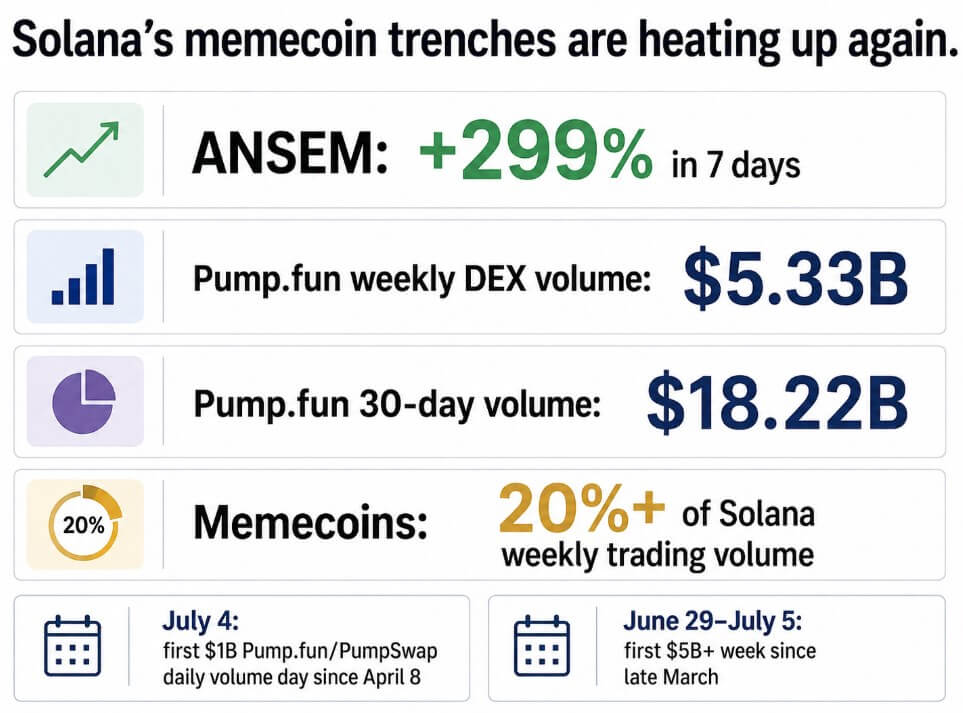
ANSEM surged by 299% in a week, with Pump.fun's weekly trading volume at $5.33 billion, while Meme coins accounted for over 20% of Solana's trading volume
This warming trend is also reflected in the broader market. Data from Blockworks shows that Meme coins accounted for over 20% of Solana's weekly trading volume, the first time this has happened since mid-May.
A Galaxy report from October 2025 noted that in the fourth quarter of 2024, Meme coins accounted for 50% of Solana's weekly trading volume, while the current 20% share indicates that the market has only warmed slightly, with a significant gap remaining from its peak.
Galaxy also pointed out that, compared to various legitimate DeFi products, Meme coins can attract ordinary retail investors to create wallets and use decentralized exchanges and cross-chain bridges more quickly. These types of tokens have very low entry barriers and possess inherent social spreading attributes, directly converting traffic heat into tradable assets.
However, the contradictions in the sector are also highlighted here. While Meme coins can attract new users, the extreme fast-paced trading rules create a severely unequal gaming environment, ultimately rendering retail investors to be the exit buyers for the robot-controlled large holders. The explosive rise of ANSEM once again highlights this contradiction.
Galaxy's statistics show that the average holding duration for Meme coins is currently only 100 seconds, down from around 300 seconds in previous cycles, indicating a significant acceleration in trading pace. Sniping bots and batch wallets accumulate large amounts of chips the moment a token goes live, and upon retail investors entering the market, they directly sell to cash out.
A paper titled "Preventing Manipulation Bots in Follow Trading of Meme Coins" published at the International Computer Society's Networking Conference in 2026 fully deconstructs this harvesting logic: follow trading has become the mainstream way for retail investors to enter the market, but bots can react much faster than humans. The paper surveyed over 6,000 Meme projects, finding that the vast majority of tokens were first scooped up by bots within 1 to 5 blocks after going live.
The MemeTrans platform tracked over 41,000 Solana Meme projects and 200 million on-chain transactions and found that various coordinated control accounts averaged holding 36.5% of the circulating tokens; ostensibly dispersed holdings were in fact highly concentrated. In the survey, 84.13% of projects were marked as high-risk targets. Another research report analyzed 34,988 Meme tokens, revealing that among the top gainers, 82.8% showed signs of artificial volume creation through wash trading, and over 17,000 wallet addresses had accumulated losses exceeding $9.3 million.
These data clearly reflect a rule: the most exaggerated increases in Meme coins are often the result of severe manipulation.
So, has the Meme market revived?
A bull market will be characterized by Pump's daily trading volume consistently exceeding $1 billion and Solana's Meme coins accounting for close to 30% of weekly trading volume.
ANSEM is driving a continuous emergence of popular secondary Meme coins, with user growth, launch speed, and attention mutually reinforcing each other, a situation that more closely resembles the early rise of Meme coins.
In a bear market, ANSEM's copycat versions have diverted investors' attention, leading Pump's weekly trading volume to fall below $3 billion, and the share of Meme coins in Solana's total trading volume has slipped to 15%-18%. Consequently, ANSEM may turn out to be short-lived, and traders will likely revert to SOL, mainstream cryptocurrencies, and other more liquid altcoins.
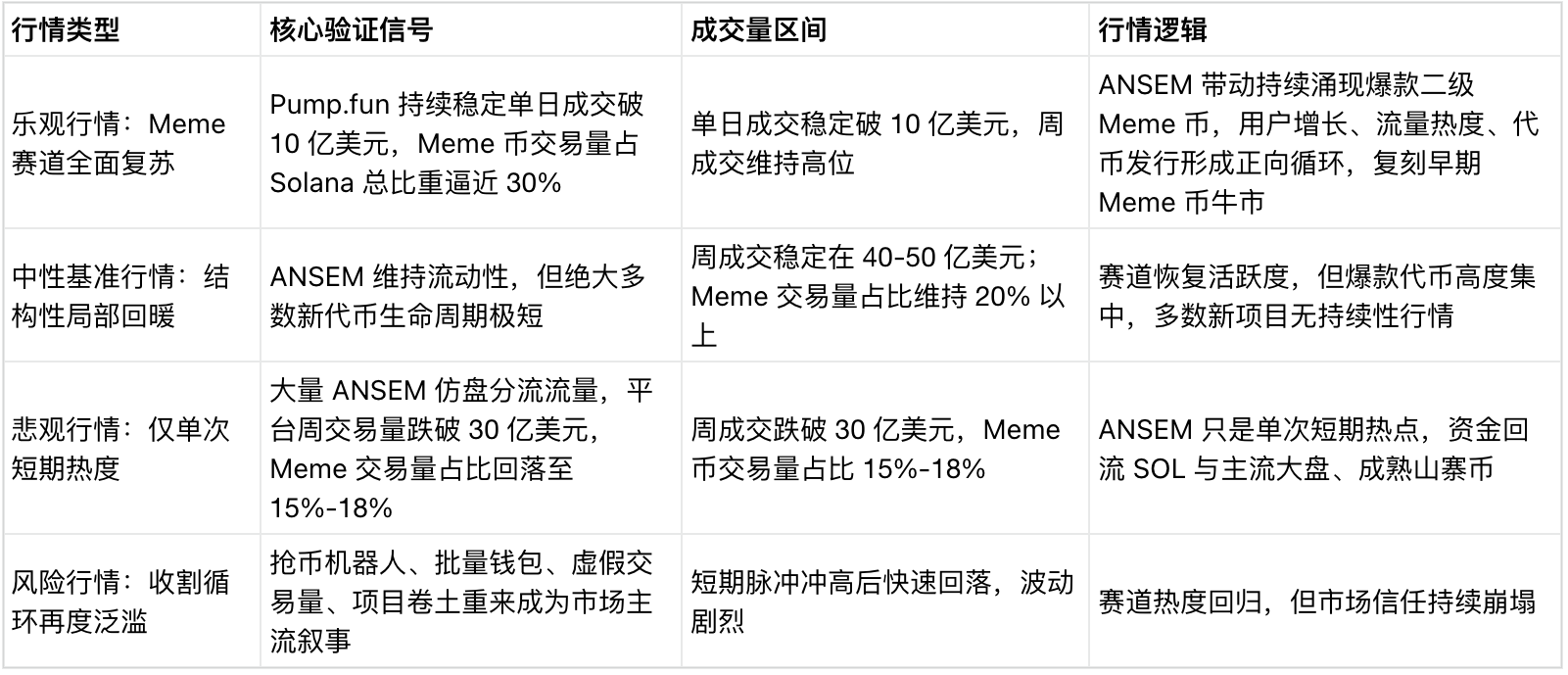
The four scenarios for the subsequent market
It cannot be denied that the Solana Meme sector possesses a strong ability to attract traffic, achieving levels of interest that most legitimate blockchain products struggle to reach. However, regarding the revival driven by ANSEM, the industry needs to consider whether this enthusiasm can break free from the old cycle of robot sniping and large holders controlling the market, so that latecomer retail investors are no longer sacrificed buyers for early-stage funding.
免责声明:本文章仅代表作者个人观点,不代表本平台的立场和观点。本文章仅供信息分享,不构成对任何人的任何投资建议。用户与作者之间的任何争议,与本平台无关。如网页中刊载的文章或图片涉及侵权,请提供相关的权利证明和身份证明发送邮件到support@aicoin.com,本平台相关工作人员将会进行核查。


