It’s never your peers that defeat you.
Written by: Eric, Foresight News
The perpetual contract track is undergoing a quiet revolution.
In the past two years, Perp DEX has grown from a marginal experiment to an undeniable force in the derivatives market. By 2025, the total trading volume of Perp DEX reached $79 trillion, nearly 10% of the total trading volume of centralized exchanges. Amidst this hustle, a fundamental limitation always existed: almost all platforms were trapped in the cage of crypto-native assets, with trading targets limited to Bitcoin, Ethereum, and a few altcoins, and collateral almost entirely consisting of stablecoins.
At the same time, the tokenization track of real-world assets (RWA) is emerging at an astonishing pace, evolving from a proof of concept in 2023 to a market size of over $30 billion today. In this track, Ondo Finance has established an undisputed leading position, with its tokenized stock platform Ondo Global Markets capturing nearly 70% of the market share, about 2.5 times that of the second place.
Since the beginning of this year, precious metals, bulk assets, and stocks have begun to be included in the trading list of DEXs. But the direction we are accustomed to is the launch of tokenized RWA assets on Perp DEX.
When the absolute leader of the RWA track decided to venture into the Perp DEX field, things began to get interesting. The launch of Ondo Perps signifies that the perpetual contract track finally has a player that truly focuses on traditional financial assets and deeply integrates institutional-level asset issuance capabilities with crypto-native trading infrastructure. This may mark a turning point for Perp DEX to evolve from a purely crypto derivatives tool into a truly global asset trading infrastructure.
"Going Against the Grain"
In 2021, former Goldman Sachs employee Nathan Allman and Pinku Surana founded Ondo, initially positioned as a DeFi structured product protocol. From late 2022 to early 2023, the team keenly realized that the internal circulation model of DeFi would eventually hit a ceiling, and the bridge connecting traditional finance with the on-chain world would be the next real opportunity. They decisively shifted to the RWA track, launching the tokenized U.S. Treasury Fund OUSG, followed by USDY aimed at non-U.S. retail investors. These two products precisely addressed the biggest pain point in the market at the time: a massive influx of capital from the crypto world needed to find low-risk, high-yield on-chain landing spots, and the Federal Reserve's aggressive interest rate hikes made U.S. Treasuries the most attractive option.
Unfortunately, at the end of May, Nathan Allman, the founder and CEO of Ondo, and one of the main advocates for the RWA tokenization track, passed away unexpectedly, with long-term president Ian De Bode taking over as CEO. Ondo stated that Ian De Bode has been responsible for the company’s strategy, product, and daily operations for over two years, and his succession as CEO has received full support from the management team.
Ondo's execution capabilities are impressive. In March 2024, when BlackRock launched the tokenized money market fund BUIDL, Ondo quickly shifted the main holdings of OUSG to BUIDL, leveraging the credibility of the world's largest asset management company while maintaining its independence in distribution channels. By 2025, Ondo's Total Value Locked (TVL) surpassed $2.5 billion, with the USDY single product exceeding $1 billion, becoming the world's largest tokenized treasury product targeting retail investors.
The launch of Ondo Global Markets expanded the company's territory from fixed income to equity assets. Launched in September 2025, this platform offers trading for over 260 types of tokenized U.S. stocks and ETFs. Covering hot sectors such as AI, biotechnology, defense, and energy, it includes everything from Apple and Nvidia to the S&P 500 index ETF. The data showing a TVL surpassing $1 billion in less than eight months and a cumulative trading volume exceeding $18 billion reflects a phenomenal growth rate in the history of any financial product. In contrast, stablecoins did not exhibit such a steep adoption curve in the early stages.
More importantly, Ondo is not just a crypto project operating in a gray area. It has obtained regulatory approval in Liechtenstein covering 30 European countries, secretly submitted a registration statement to the U.S. Securities and Exchange Commission (SEC), and completed the first cross-border tokenized Treasury redemption test in collaboration with traditional financial giants like JPMorgan and Mastercard. When established asset management firms like Franklin Templeton choose to tokenize their ETF products through Ondo’s platform, Ondo's pivotal position in the RWA domain becomes self-evident.
This year, exchanges and DEXs are rushing to launch tokenized RWA assets. During the weekend of the U.S.-Iran conflict, Hyperliquid handled trading volumes of gold, silver, and crude oil, leading Bloomberg to report on it twice within a week. This trend is evident, but everyone seems to focus on how exchanges are competing for trading RWA tokenized assets, forgetting to pay attention to the potential of the projects themselves to launch exchanges for RWA tokenization.
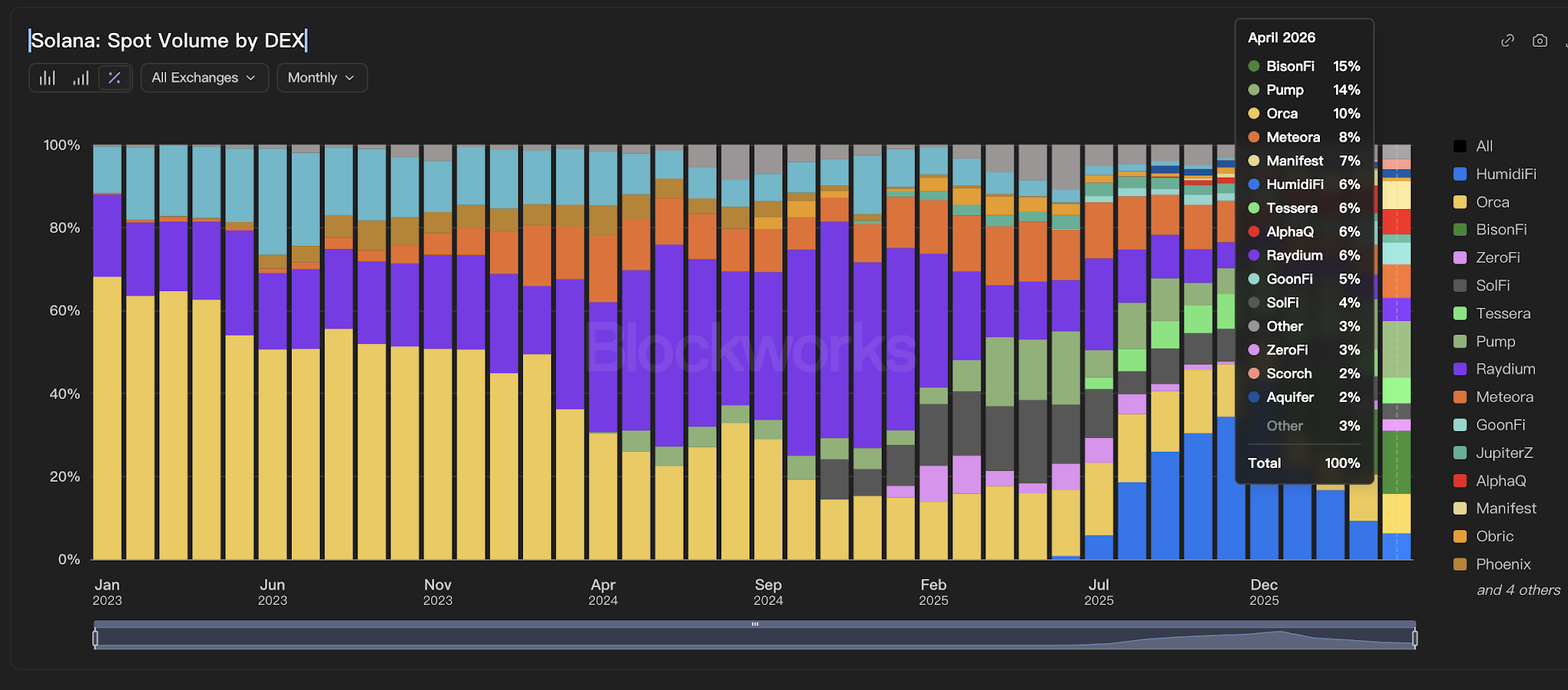
Just like before the launch of pump.fun, DEXs on Solana were frantically competing for the meme token trading market. And just 13 months after the launch of PumpSwap by pump.fun, PumpSwap’s market share based on trading volume has reached second place, nearly matching the first, while the once-dominant Raydium’s market share is down to only 5%.
"Wall Street 2.0"
The core positioning of Ondo Perps is very clear: it is a perpetual futures platform focused on tokenized stocks, indices, and commodities, integrating institutional-grade financial infrastructure with a permissionless global trading platform. To put it more simply, it is a platform that truly brings Wall Street assets into the DeFi perpetual contract track.
The first and most intuitive differentiated advantage brought by this positioning lies in the richness of the asset side. Ondo Perps can directly list the tokenized assets that Ondo has previously completed for trading on Perp DEX. For a trader who wants to flexibly use leverage in global asset allocation, this differential choice space is a qualitative change.
Currently, Ondo Perps is open to all users, and let’s take a look at what highlights it has:
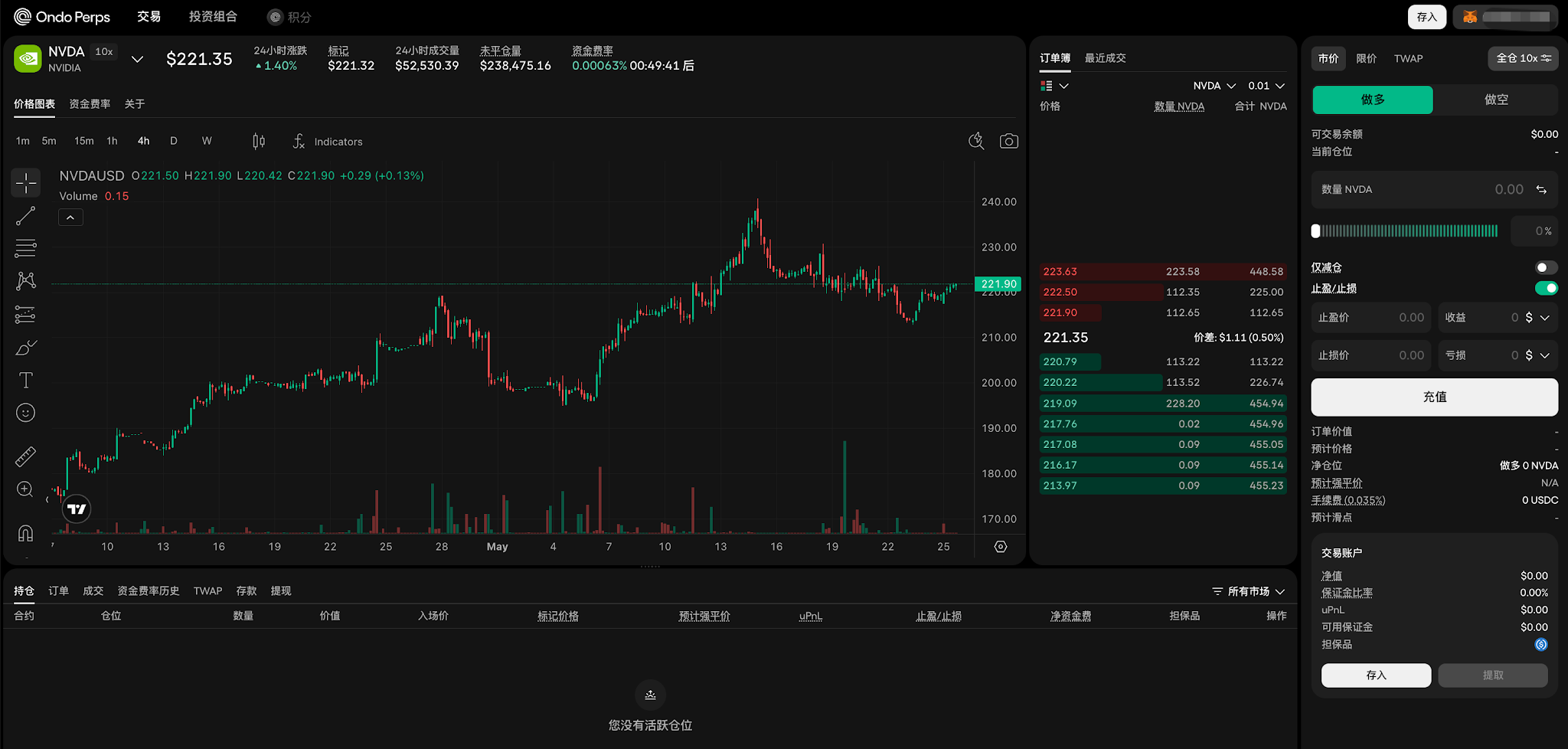
Ondo Perps has all the basic functions expected from a Perp DEX, which will not be repeated here. Currently, the maximum leverage supported by Ondo Perps is 20 times, with most U.S. stock contracts having a maximum leverage of 10 times, while bulk assets, stock indices, etc., have a maximum leverage of 20 times.
Currently, Ondo Perps supports 24/7 trading of 24 perpetual contract markets, including:
16 U.S. stocks: SPCX, MU, NVDA, TSLA, AAPL, MSFT, GOOGL, AMZN, META, NFLX, AMD, INTC, ORCL, PLTR, COIN, HOOD, MSTR, CRCL;
3 commodities: XAU (gold), XAG (silver), WTI (crude oil);
2 indices: US 500, US 100;
1 ETF: Roundhill Memory ETF (DRAM).
In practical use, I have noticed two features: first, users do not trade directly using their own wallets, but need to transfer USDC from Ethereum to the address provided by Ondo to trade; second, Ondo Perps adopts a full margin model, which means that the long and short positions for different assets share the margin.
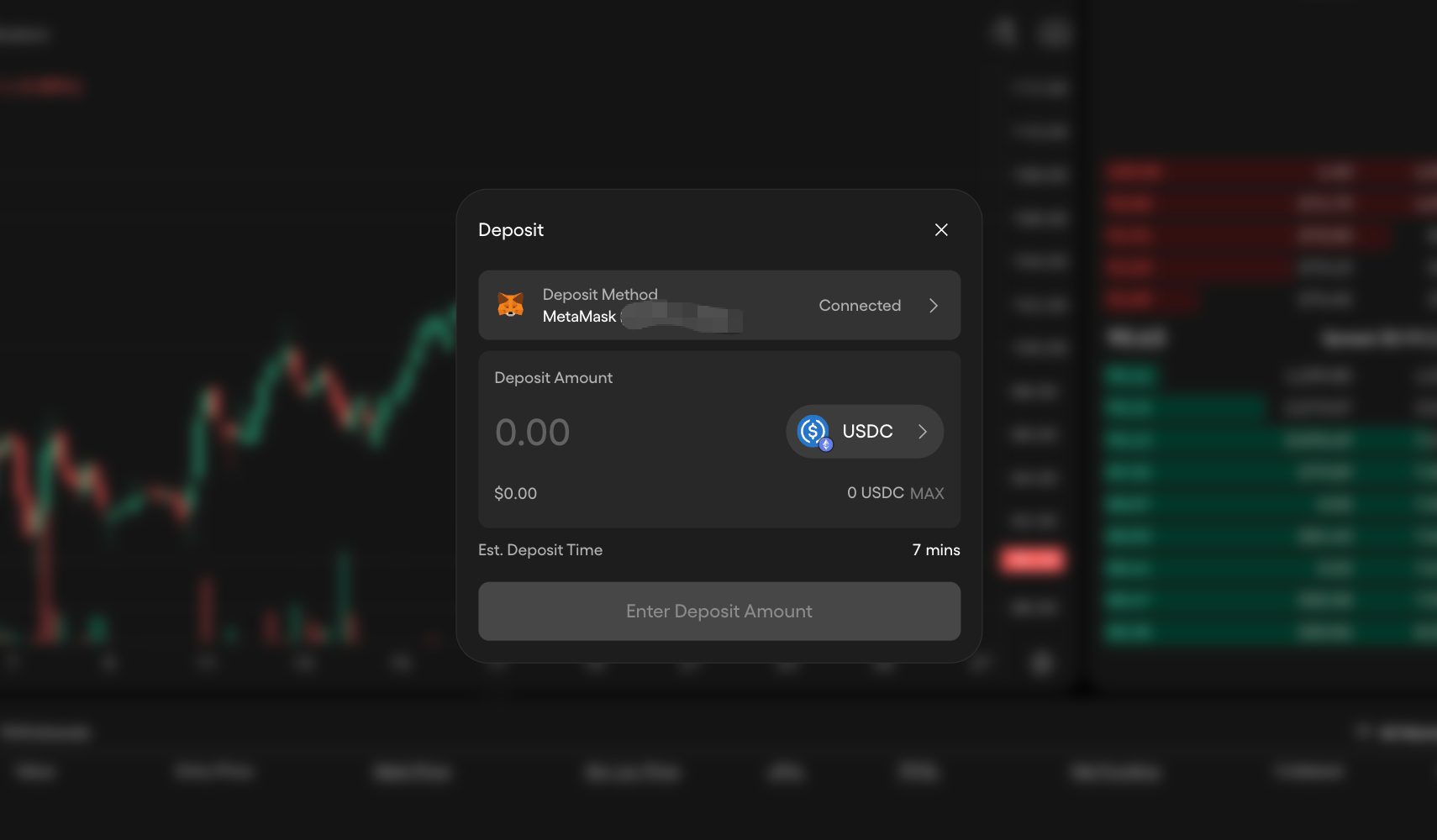
These designs actually correspond to a longer-term plan. According to the provided information, Ondo Perps will adopt a multi-asset collateral system in the future, supporting not only stablecoins but also the U.S. stock and Treasury tokens launched by Ondo as collateral for opening positions. This way, you can hedge without having to sell your investment portfolio.
From the perspective of financial engineering, multi-asset collateral not only adds a functional option but fundamentally reconstructs the risk calculation logic of the entire system. Ondo Perps is closer to the concept of portfolio margin in traditional finance, viewing the entire asset portfolio as a unified risk pool. This means that the natural hedging relationships between different assets can be automatically recognized by the system, such as holding both a tokenized SPY long position and a S&P 500 perpetual contract short position simultaneously, and the system can recognize this hedge and correspondingly reduce margin requirements. While ordinary users may not understand the value in this, it can genuinely serve complex quantitative strategies and basis traders.
In terms of liquidity, Ondo Perps does not start from scratch in building liquidity pools on-chain, but rather, through the issuance and redemption mechanism of tokenized stocks, it directly connects the on-chain market with traditional exchanges. This means that price discovery and liquidity depth can inherit from traditional markets like NASDAQ and NYSE, rather than being reliant on limited on-chain funding pools.
It can be said that the design of Ondo Perps not only meets the basic needs of ordinary investors but also fully considers the needs of professional traders and institutional investors. Additionally, Ondo Perps claims to be the "fastest permissionless perpetual contract trading platform," with order routing, margin updates, and settlements all handled in real-time, while maintaining decentralized security assurances.
The balance between decentralization and user experience, as well as the direct routing of contract trading to traditional financial exchanges, means that Ondo needs to pool funds, handle order routing, trading, and settlements off-chain, and allocate funds on-chain.
More than Just Trading
The flagship trading platform has always been the missing piece for Ondo; Perp DEX is indeed a key part of the financialization closed loop of RWA.
Let’s get back to the overall picture of Ondo’s business. On one hand, Ondo Global Markets is responsible for the issuance of tokenized assets, transforming traditional securities like U.S. stocks, ETFs, and Treasuries into tokens that can circulate freely on the blockchain. These tokenized assets inherently possess two attributes: they represent price exposure to the underlying financial assets and can be combined in DeFi protocols just like any ERC-20 token. But the issue lies in the fact that if tokenized assets can only be "held," their value will remain far from fully realized.
On the other hand, with the recent relaxation of regulatory policies regarding tokenization in the U.S., platforms that collaborate with Ondo and use Ondo's tokenized assets can choose to turn against or issue their own tokenized products at any time. If they cannot hold onto the end trading users, then no matter how high the market share is, it will merely serve others.
The emergence of Ondo Perps injects productivity into these tokenized assets. When a tokenized Apple stock can not only be passively held but also used as collateral to open leveraged positions, to execute complex basis arbitrage strategies, and to hedge investment portfolio risks, its financial attributes are fully activated. This transition from "yield asset" to "credit basis" is a necessary trajectory for the entire RWA track to move from early adoption to mainstream financial infrastructure.
Looking further, what Ondo is building is actually a unified ecosystem that spans spot and derivatives, connecting traditional finance with the on-chain world. Tokenized stocks issued on Ondo Global Markets can previously flow across chains to ecosystems like Hyperliquid's HyperEVM via Ondo Bridge, and now can also be traded directly on their own Ondo Perps. Once this network effect is formed, it will be very difficult for competitors to replicate, as one cannot merely replace a complete ecosystem that is deeply embedded in multi-chain RWA infrastructure by just having a better trading interface.
In fact, this vision is already starting to become a reality. Ondo has partnered with Chainlink to provide institutional-grade price oracles for its tokenized stocks, enabling these assets to be used as collateral in DeFi lending markets for the first time. Integrations with lending protocols like Euler are in progress, and traders will be able to borrow funds without selling their positions in the future. This "holding as capital" experience is the core value of traditional financial prime brokerage services, and is now being moved on-chain by Ondo.
The Era of New Infrastructure
The launch of Ondo Perps, viewed from a macro perspective, is actually the convergence of two historic trends: one is the inevitable process of RWA tokenization moving from a marginal experiment to mainstream financial infrastructure, and the other is the natural extension of Perp DEX evolving from a purely crypto derivatives tool to an all-asset class trading platform. Ondo happens to stand at the intersection of these two trends: it is the largest issuer in the RWA space, with the deepest institutional financial collaborations and the broadest global regulatory footprint.
For traders, Ondo Perps represents a new possibility: a platform where one can use Nvidia stocks as collateral, trade S&P 500 perpetual contracts on Sunday evenings, while enjoying institutional-level liquidity and execution speed. This experience does not exist in traditional finance, nor can it be obtained in existing DeFi. It belongs to the new world that is accelerating towards us: the boundaries between traditional finance and crypto-native infrastructure are gradually dissolving, and the assets themselves become pure financial building blocks that can be combined in any way, at any time, and in any place.
This may be the true significance of Ondo Perps. It is not just a new perpetual contract exchange; in Ondo's own words, it is a "next-generation" platform that brings traditional financial assets into on-chain trading infrastructure.
免责声明:本文章仅代表作者个人观点,不代表本平台的立场和观点。本文章仅供信息分享,不构成对任何人的任何投资建议。用户与作者之间的任何争议,与本平台无关。如网页中刊载的文章或图片涉及侵权,请提供相关的权利证明和身份证明发送邮件到support@aicoin.com,本平台相关工作人员将会进行核查。


