Source: "The Rollup"
Compiled by: Felix, PANews
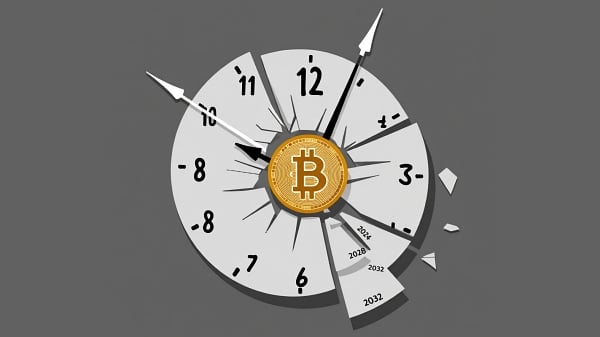
Crypto analyst Dennis Liu (also known as VirtualBacon) recently participated in an interview on "The Rollup" podcast. During the show, Dennis shared his core investment logic, stating that although the market is currently in a deep correction, Bitcoin's four-year cycle remains effective and holds deep value. The interview also delved into macro trends in tokenized assets and stablecoins, indicating that institutional funds are driving crypto assets toward a structure similar to equities.
PANews has compiled key points from the interview.
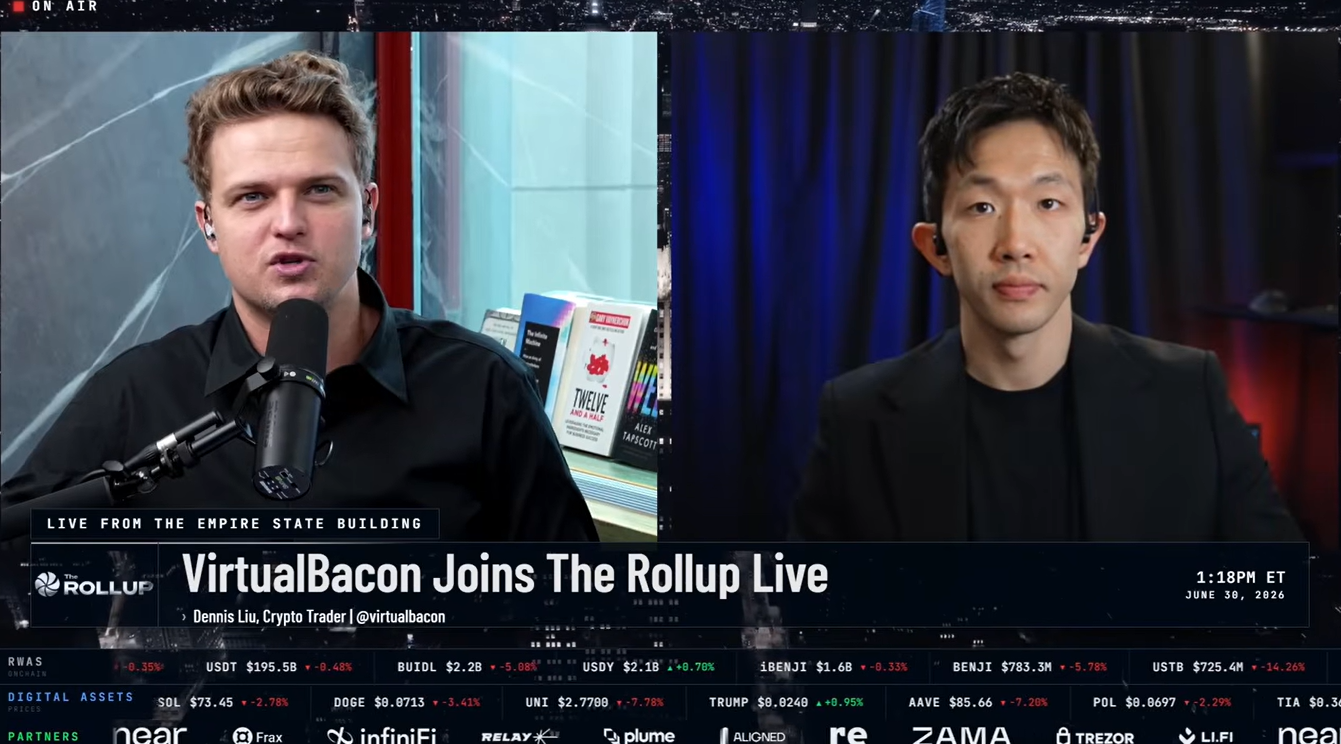
Host:Let's start from a macro perspective. What is your macro view on the current position of mainstream cryptocurrency assets?
Dennis: I hope Bitcoin's price can stay above "30,000 feet," but I believe we might be facing "3,000 feet" altitude right now. I think this position is already low enough. At the level of $58,000, historically, it is far below the 200-week moving average, and everyone has probably heard these moving average support levels too much, so I won't repeat it. Overall, I am a net buyer at this position. I actually have a heavy allocation in Bitcoin, not much in altcoins, but Bitcoin is definitely in a very deep value range right now.
Host: Yes, a lot is happening outside of the crypto space within the broader AI macro trading context, pulling a lot of attention and funds. I feel that people are now looking for a catalyst to draw attention and liquidity back to Bitcoin and mainstream crypto assets. What do you think could be the core driving force for this attention and liquidity transfer? Or can we only rely on the four-year cycle pattern now?
Dennis: It is largely not driven by fundamentals. I tend to favor technical analysis; I initially wanted to believe that the four-year cycle was over, but the fact is, it has completely replayed since October 10, and we have basically returned to the same level of deep retracement after about 6 to 7 months, which makes me believe that it is the four-year cycle driving it. I don't know the specific reason. You know I value liquidity very much, and liquidity cycles typically last 5 years. So this cycle should have been somewhat different, but it hasn’t been.
That being said, you can immediately look at the correlation between Bitcoin and gold and find that both have moved together after the events in Iran due to the strength of the U.S. dollar. I believe this is an entire chain of events that you can trace, from war to inflation, then to the Fed, to interest rates and yields, and then to the dollar index (DXY), and now you see both gold and Bitcoin falling. So I think, once we get through the high inflation and potential interest rate hike period in the coming months, we may see some short-term price rebounds. But beyond that, I think it is still Bitcoin's cycle that dominates.
Host:From a purely equity perspective, how do you view the evolution of this pattern of fundamental investment?
Dennis: That's a great question. I think fundamentally it comes down to why we invest in any asset in the first place. Clearly, narrative speculation will always exist. Even outside the crypto space, there are plenty of low-cap stocks, penny stocks, etc.; even outside of the stock market, people always invest based on supply and demand. But I think in the crypto space, especially now that crypto assets have entered exchanges similar to stock tools with equal treatment, the infrastructure has been built.
For example, Securitize (a tokenization platform) just launched related products on the NYSE; when I looked at it today, I just saw a stock code. I don’t need to dig deep into whether it is a token or a stock; is it trading on this platform? Because it trades on-chain as tokenized equity, while also trading on the NYSE. Similarly, if I want to trade Ethereum, it initially started as a token, but now I can trade it on any traditional finance exchange. So the first part of this equation is that all trading tracks have been opened up, creating a fair competitive environment for all companies, whether tokenized securities or securities being tokenized; it's all the same.
The second part relates to your mention of "returning to fundamentals," which has mainly come about because regulation has allowed us to do that. The quintessential example is Uniswap. It was one of the earliest DEXs, and they have been constantly innovating (v3, v4, etc.). They should have had very high revenues, and if they had wanted to trade as an equity-based company, they could have seen explosive growth a long time ago. But they have never managed to achieve that, because previously you were not allowed to treat your product, your token, or your DEX as equity tools and distribute profit shares to holders.
Therefore, I believe that after this cycle, as regulations become clearer, those companies that want to do this will be able to. Then you will see a huge watershed moment where people return to fundamentals, as that is what can survive in the long term. In contrast, if you look at the smaller projects on-chain, it’s just a matter of time before their narratives capsize, and then you have to look for the next target.
Host:When you consider the flow of funds, buybacks, burnings, and revenues, do you see people in your community shifting toward investing in high-quality assets? Do you see capital withdrawing from Meme coins in favor of more mature assets? Among your community and friends, do you really see a change in investor behavior within the industry?
Dennis: I do believe that, as equity-like tokens mature, earning "Alpha" (excess returns) is becoming difficult. To have equity value and distribute it to holders, you have to be relatively mature as a company and a token first. This usually means you don’t want to issue tokens too early but rather build a revenue base first. Hyperliquid is a great example. For those who received the airdrop, it was a massive wealth creation event; for those who came in later, the returns were also decent, but this mostly came from the exponential growth they maintained post-TGE. You cannot replicate that on other DEXs because it is very difficult to move from the top 100 to the top 20 or 15.
I believe most of the retail investors who initially entered the crypto space still tend to favor low-cap assets and more asymmetric bets, whereas at the institutional level it's different. Institutional investors definitely need assets they can realistically hold for at least several years, assets that have gained "certification" on traditional financial exchanges, and they prefer these projects to have revenue, even if they enter a bit later. So there is some differentiation here.
Host: Interesting. You also know that one dynamic of the current market sentiment is that people are very excited about stablecoins, tokenization, or perpetual contracts. I mean, certainly, you could express a bullish view on tokenization, maybe you'd buy Ethereum, that might be your logic. But clearly, its price performance has been quite disappointing. As mentioned earlier, Securitize listing on the NYSE, this will be a very pure way to express a bullish view on tokenization. For stablecoins, you might buy Circle, buy Ethena, buy Sky (MakerDAO), if you think that’s relevant, perhaps buy Ethereum too. A lot of growth is happening in these areas, and they are undoubtedly super trends. However, as ordinary retail investors, we really don’t have a clean and straightforward way to invest in these trends.
It's like the OpenUSD network being announced by institutions; we simply don’t have a way to invest in it. Tempo and Stripe partnered to launch services, but Tempo didn’t have a pre-sale. We also don’t have channels to invest in Circle’s Arc Chain (they may hold a token sale, but I doubt it). This leads to a strange emotional dynamic: we are very optimistic about these super trends, but we cannot build positions at the ground level like we did with Solana at $2. When we bought Solana, it was because we thought it was a high-performance public chain, so I could buy it at $2. But now I can't buy Securitize at $2; its valuation when it listed on the NYSE might be $1.5 billion. So there is an interesting emotional gap there.
Dennis: Yes, absolutely. I think you hit the nail on the head with the stability coin issue because stablecoins are dollar-pegged; to stand firm in this position, you must be one of the top three or four players. Everyone wants to invest in Tether, but you cannot. This also brings issues like Plasma and other stablecoin projects, which are somewhat valid, but we see they are not pure replacements for Tether; they are more like some related infrastructure. Then there’s Circle, which is quite pure, but the wave of benefits has basically passed; everyone already knows about Circle.
I find Ethena very interesting. They seem to have gone public through a SPAC or something similar on Nasdaq, which is interesting; they are using the same name, but technically they are different entities. What I see is that their governance token is ENA, and their stock market code seems to be USD. Clearly, there's an attempt to provide exposure to these equity-like tools, but this track can only accommodate about five players’ survival space, and that's it for now; it's hard to see major development. I believe stablecoins have already become a settled matter at this stage.
Host: Yes, I completely agree. I mean, our current total issuance is around $300 billion, and I think in the future it could reach $3 trillion or even $5 trillion. The question is how to express this trading logic, and I am still searching for the answer. In the case of perpetual contracts, it is quite clear. You can buy Hype, buy Lighter. These tokens perform exceptionally well; they haven't even experienced a bear market. What do you think of these? Why do they perform better than other assets currently in the market? Is it purely because of the narrative? Or is it due to the economic model? Why have these few assets remained relatively unaffected when the entire market is undergoing a bear market in 2026?
Dennis:At this price, I am not very optimistic about Hype. Considering the previous bear market rebound, Hype might need to pull back to around $30 to $40; at that level, I would be very interested. I believe it should naturally rise to over $100 in the next bull market, but I don't think it can completely escape the pull of Bitcoin. Most coins cannot.
However, I do think their performance is strong because they have a very reliable business model. They have real income, and that income flows into the token. Moreover, they themselves are an exchange, which also helps. We all know in the crypto space that if your token has high trading volume on your own exchange, you can stabilize its price more meaningfully, and that’s perfectly fine. I think Lighter is also very reliable. I have talked a lot with Vlad (the founder), and I received the airdrop fairly early on. The narrative for perpetual contracts exists because perpetual contract exchanges are a great invention; credit goes to Arthur Hayes (who introduced this mechanism into the crypto world). Just like now, the most liquid pre-IPO market for SpaceX is absolutely Hyperliquid. Even traditional pre-IPO markets cannot compete with the pre-market offered by Hyperliquid through Trade XYZ. This is truly a very good thing.
So, I believe perpetual contracts are a huge super trend, but so far they remain token products, and token products usually follow Bitcoin's cycle. Therefore, it is necessary to maintain a degree of caution regarding the so-called "bear market rebounds." But I believe in the next cycle, perpetual contracts will experience explosive growth.
Host: Regarding prediction markets, it is said that Kalshi is applying for an IPO. People speculate that Polymarket might not issue a token, but will also go for an IPO. Polymarket's revenue remains stable in the top five for the last 24 hours, alongside Hyperliquid, Circle, and Tether. Have you gained exposure to these projects via private markets? What do you think of Polymarket?
Dennis:I think with the rise of on-chain Pre-IPOs and Hype, Kalshi, Polymarket, aside from directly purchasing Pre-IPOs or perpetual contracts, you really don’t have much private market trading to do. I indeed see a huge watershed because many people don’t know: since the beginning of this year, Kalshi has overtaken Polymarket in prediction market trading volume, becoming the dominant force. So the bet should really be on Kalshi, not Polymarket, at least as the leading track.
Right now, I think any new player trying to enter the prediction market via traditional finance is a bit late. Look at that giant wanting to create its own prediction market: Meta, you are essentially competing with Zuckerberg in doing prediction markets. Unless you go the token route, I don't see how any other player can take the pure equity path. And on the token route, I do see this space potentially seeing more token plays. For example, Binance's Predict Fund is a very strong example. It has Binance's strong backing, which is obviously a token play. If you were to ask any company of that scale supported heavily by Binance, their ultimate goal is undoubtedly to issue tokens. So that platform may not be aiming to tap into the traditional finance "network gambling" audience but rather focusing more on the crypto audience. I think we, as crypto investors, should pay attention to these projects. Or just go directly to buy Kalshi or Polymarket's Pre-IPO.
Host:What do you think of the predicament faced by Michael Saylor currently?
Dennis: That "liquidation point" doesn't actually exist. I mean, they are indeed obligated to pay yields and dividends, but their leverage's actual liquidation price is below $10,000 for Bitcoin, around $10,400. So, unless you think Bitcoin will drop there (though there is a possibility, the chances of them being liquidated are extremely low).
Now the question is, will they lose a lot of interest? Especially concerning STRC? Yes. STRC may continue to undergo the so-called "de-pegging," but the key word here is, it was never pegged to begin with. They are not obligated to maintain it at 100. So if they don’t want to manage it anymore, they can just let it stay as it is and only pay yields. They only need to pay yields without needing to pull it back to 100.
Stepping back, I think this week looks good for them. They announced they might sell $1.25 billion worth of Bitcoin soon. This only accounts for 2.5% of their total reserves. If you compare this figure with the fund flows of Bitcoin ETFs, it is even lower than the average weekly outflow of Bitcoin ETFs over the past two months. So even if they sell this next week, the scale will not be larger than the outflow of ETFs. This is the first point.
Second, this is only 2.5% of their reserves. They would have to repeat operations of this scale 40 times to liquidate their entire reserve. If they operate once, and the market has already rebounded on STRC, then there is no need for more sales. If STRC can return to 100, they can maintain it there. That may not rekindle enthusiasm for STRC, but as long as it can recover from here, this "bomb" can be defused.
Host:Do you think he will sell this week?
Dennis: Technically, it's hard to predict. It looks like this $1.25 billion sale will definitely happen, but the additional $2 billion earmarked for buybacks is uncertain. We should see this soon because they may want to announce their balance sheet quickly. I agree with you: if they only need to sell $1.25 billion, and STRC rebounds to 85, 87; then sell another $12.95 billion, and it recovers to 100, there is nothing wrong.
Host: Some say he has put himself in a very difficult position because he has to please three parties: STRC holders, Bitcoin holders, and MSTR shareholders. For these three different interest groups, the only situation that can satisfy everyone is if Bitcoin rises, and the MNAV (Net Asset Value) remains above 1. In any other situation (ranging or falling), it is almost impossible to please stakeholders of these three assets simultaneously. Do you agree?
Dennis: To some extent, I agree. I've seen discussions related to this. I believe the main reason is that STRC grew too quickly. If it took three to four years to grow to this $10 billion AUM (assets under management), that would be perfectly fine. He only needs to prove that STRC's target yield is far below Bitcoin’s annual growth rate. But because everyone has been greedy for that return during this period, he has sort of trapped himself. Therefore, after STRC stabilizes, I think he shouldn’t push it as the main product anymore but should revert back to the main strategy itself. That would be better.
Host:At this time in mid-2026, are you still doing angel investing? Are you still investing in the crypto space or other areas?
Dennis: So far, I have about over five years of experience in angel investing, and I have always been investing with a fund using our own money (proprietary capital) like you guys. Initially, this was completely driven by narratives. You enter at the right time (during a Bitcoin bull market) and catch the right narratives: Layer 1, chain games, AI, or later Meme coins, and you are fine. But since the last cycle after the Trump incident, the entire gear has shifted.
As an investor who has been through the industry for five or six years and has built up a lot of connections, you can spot certain specific trading opportunities, and I think overall these investments are still worthwhile. But for newcomers just entering the field, I don’t think it’s a good idea. Because angel investing typically requires you to lock in for at least a year, some even up to three or four years. That is the industry standard. However, the narrative of cryptocurrencies and altcoin cycles is becoming shorter and shorter. By 2025, the situation would be that every three months is a cycle, and you must convert funds back into Bitcoin. So that is my stance in the next cycle. Personally, because I have resources, I will still invest heavily when the timing is right, and I see good projects. But I don’t recommend most people to do this. If you are mainly focused on the ICO phase or want to buy in just before early tokens go live, it’s better still to purchase directly in the secondary liquidity market and only hold for three months each time. If you make a profit, just switch back to Bitcoin. I believe that is the best way.
Host: I completely understand. The narratives of 2023 and 2024 are very different from the narratives now; the changes are substantial. This brings me to some of my views on L1 public chains. Previously, everyone was chasing new blockchains, new assets on new chains, and upcoming L2s. So far, a large part of the valuation premium in this industry has been given to L1, to underlying blockchains. This is a result of the so-called "fat protocol" logic and network effect logic that many believe in and have invested in.
But I think things are undergoing a profound change. I don’t think most blockchains will become the most valuable assets in the market. If there are applications on-chain that can generate significant income, then these applications' valuations may be re-evaluated. For example, Hyperliquid, though technically it’s an independent blockchain, is essentially a decentralized exchange for perpetual contracts. Many other applications are too. So I question whether the era of L1 fat protocols and network effects has passed; I am not sure if L1 can perform as well as it did in the past; I really have my doubts.
Dennis: The topic of income is very easy to talk about. Because it’s hard to find most protocols and tokens with income that can compare to Hype, Lighter, or even projects built on top of Hype. You can see some very simple frameworks with very high income; if these projects issue tokens, they would be exceptionally strong.
But I do think the so-called "fat protocol" theory has always emphasized this: all attention and all users will gather on these L1s. Ultimately, what drives token value? Before any real income is generated, what drives value is how many users you have, how many are willing to bet on it going up when the market is good, and how many can trade it on certain exchanges. From the start, due to ICOs, Ethereum has always played that role. It's the place where you can tokenize anything. Then Solana took a part of that, followed by various L1s, but ultimately, EVM remains dominant. So in the next cycle, apart from the "income" narrative, I think a "digital goods" narrative will emerge to replace the position of L1. Because in my view, why were L1s so popular? Because they all wanted to replicate Ethereum and Solana to trade on mainstream exchanges and survive one or two cycles. Now they have reached that stage.
After regulatory clarity, with our framework identifying those 16 tokens classified as "digital goods" and expecting more tokens to join through this "graduation framework" in the future, we may see this become a race: Which L1s can compete with the existing basket of crypto assets? Which Meme coins and digital collectibles can rival Crypto Punks, Doge, Shiba? These three Meme coins have appeared in the SEC’s rule handbook. It’s just like going back to old days: which coin has Binance listed as Layer 1? That is the next narrative about to explode.
Host: So you place a lot of value on the clarity provided by the SEC regarding which assets are considered digital goods, etc. .
Dennis: Yes, there are some very tangible alpha (excess return opportunities) within that. The SEC specifically mentioned these three Meme coins as well as a bunch of L1s. They obviously like ENS, NFTs, Crypto Punks.
Host: So for you, this regulatory "clarity" will provide clear guidance on investable assets. What about assets that have a lot of institutional adoption cases but whose token economics obviously haven't reached the level of on-chain revenue generation agreements? For example, oracle infrastructure, critical designs for cross-chain bridging, security designs, or Launchpads, etc. At the base are L1 blockchains, and on top are various applications, while in between, there is an entire stack of middleware infrastructure that includes ZK, cross-chain bridges, oracles, etc. The valuations of these assets have been severely downgraded, and it seems people have forgotten about them, even though they continuously prove their importance in constructing the on-chain economy. What do you think of these middleware infrastructures?
Dennis:I think Chainlink is the most worth watching. On the list, aside from L1s, commodities, or Meme coins, Chainlink is the only one that is technically a token but simultaneously has sufficient practicality. First, it uses the LINK token to pay Gas fees and transaction fees; second, you have to hold LINK to become a validation node; more importantly, it is core to DeFi and core cross-chain oracles, connecting all the things, and they have been doing this for the longest time.
So, strictly speaking, the traditional financial world enjoys LINK very much. It has been proven that, once the regulations clarify, they will be seen as digital goods. Any other newcomers, you better pray you can reach the level of middleware like Chainlink. Otherwise, it seems very hard. Creating an L1 is actually easier; there are many L1s on the list, but becoming the dominant middleware layer is very difficult.
Host: So do you think the middleware layer will ultimately integrate into just one protocol like Chainlink? Or will there be several competitors, like LayerZero, which is also cool?
Dennis: LayerZero is very different from Chainlink; it's more crypto-native, like its Zero Network. I think the cross-chain ecosystem is very tricky. Almost everything has encountered hacking, except for Chainlink. Even LayerZero had some issues due to kernel problems (though whether it was their fault is debatable). I wouldn’t consider any protocol related to cross-chain bridges as a good investment target. However, oracles are interesting because the attack surface is smaller.
Host: Considering this wave of tokenization, massive tokenized asset infrastructure is being established, and vast amounts of tokenized assets are entering the blockchain. In the next ten to twenty years, we may see trillions of dollars' worth of tokenized assets on-chain. Assuming we can reach $10 trillion to $20 trillion in the next five years, that is an entire order of magnitude greater than the current total market cap of cryptocurrencies.
Therefore, I believe the market cap structure of the entire crypto market will differ significantly. The current top 50 are almost entirely pure crypto assets. In the future, you will see more tokenized assets, and in the top 15 or 20 in market cap, you may see tokenized versions of stocks, commodities, and other financial products. I believe this is almost inevitable. So my question is: if this is correct: if stable coins grow, tokenized deposits grow, and if trillions of dollars of tokenized stocks, real estate, bonds, and government bonds go on-chain, then who will win? Which companies, which protocols, which blockchains, and which underlying primitives will become the dominant winners in the tokenized asset track? From an investor's perspective, if the tokenization logic is correct, how should we allocate funds to these companies and protocols?
Dennis: I think you really like Hype, and I really like Hype too. The moment that enlightened me was when they secured a partnership with Vanguard. Being able to get SPX (S&P 500) as an officially authorized trading code on Hype is just insane. Thinking from the fundamentals, it’s precisely perpetual contracts that unlock 24/7 trading. I feel it’s not just about tokenized stocks. Many who have never traded may not know, for example, when you trade tokenized stocks, depending on where you trade, some markets still don’t allow you to trade on weekends because they must follow old trading rules. Ultimately, it will definitely turn into 24/7 trading, but this depends more on the attitudes of Nasdaq and the New York Stock Exchange rather than these intermediary providers.
But beneath the providers, I still have a very optimistic view of Ethereum. Because unless Solana completely takes over Ethereum's trading stack, where will every tokenized layer issue its tokens? Some ERC-20 derivative token. Where will people trade it? They will use EVM wallets. The network uses Solidity smart contracts. You use the same nodes and infrastructure. So the adoption of Ethereum technology is already a done deal. It’s just they haven't figured out how to capture that value to ETH tokens. But even if they stop working on Ethereum, I think giants like BlackRock could directly take over Ethereum and turn it into their internal tech stack. It’s that mature now. Therefore, I am hopeful that ETH will still exist and power this layer ten years from now.
免责声明:本文章仅代表作者个人观点,不代表本平台的立场和观点。本文章仅供信息分享,不构成对任何人的任何投资建议。用户与作者之间的任何争议,与本平台无关。如网页中刊载的文章或图片涉及侵权,请提供相关的权利证明和身份证明发送邮件到support@aicoin.com,本平台相关工作人员将会进行核查。


