Written by: Rita
Guided Reading
JPMorgan has deduced the complete power supply chain of AI data centers using first principles, with the core conclusion being that the AI power semiconductor market will reach approximately $2.7 billion by 2025 and surge to $19.2 billion by 2028, marking an 82% compound growth rate over three years. A larger variable is the revolution of the 800V high-voltage direct current architecture, replacing traditional electromechanical equipment with silicon carbide solid-state transformers and gallium nitride converters, causing the semiconductor content to increase from $175 per watt to $260. This means that a value chain illuminated by GPUs is emerging.
Behind 80 GW of computing power, every watt goes through a five-stage relay
Everyone is calculating GPU shipments, but very few are calculating electricity. The current power supply for data centers is an inefficient long chain: the power grid is 10-35kV AC, which is first stepped down to 400-480V through transformers, then into UPS uninterrupted power supplies, through PDU distribution units, to server power supplies converting AC to DC, and finally stabilized to the sub-volt level voltage required by the GPU core via VRM. There are five stages of conversion, with each stage losing 2-5%, resulting in an end-to-end efficiency of only 85-88%. For a single rack of 100kW, 15kW turns into waste heat, which must be managed by a cooling system.
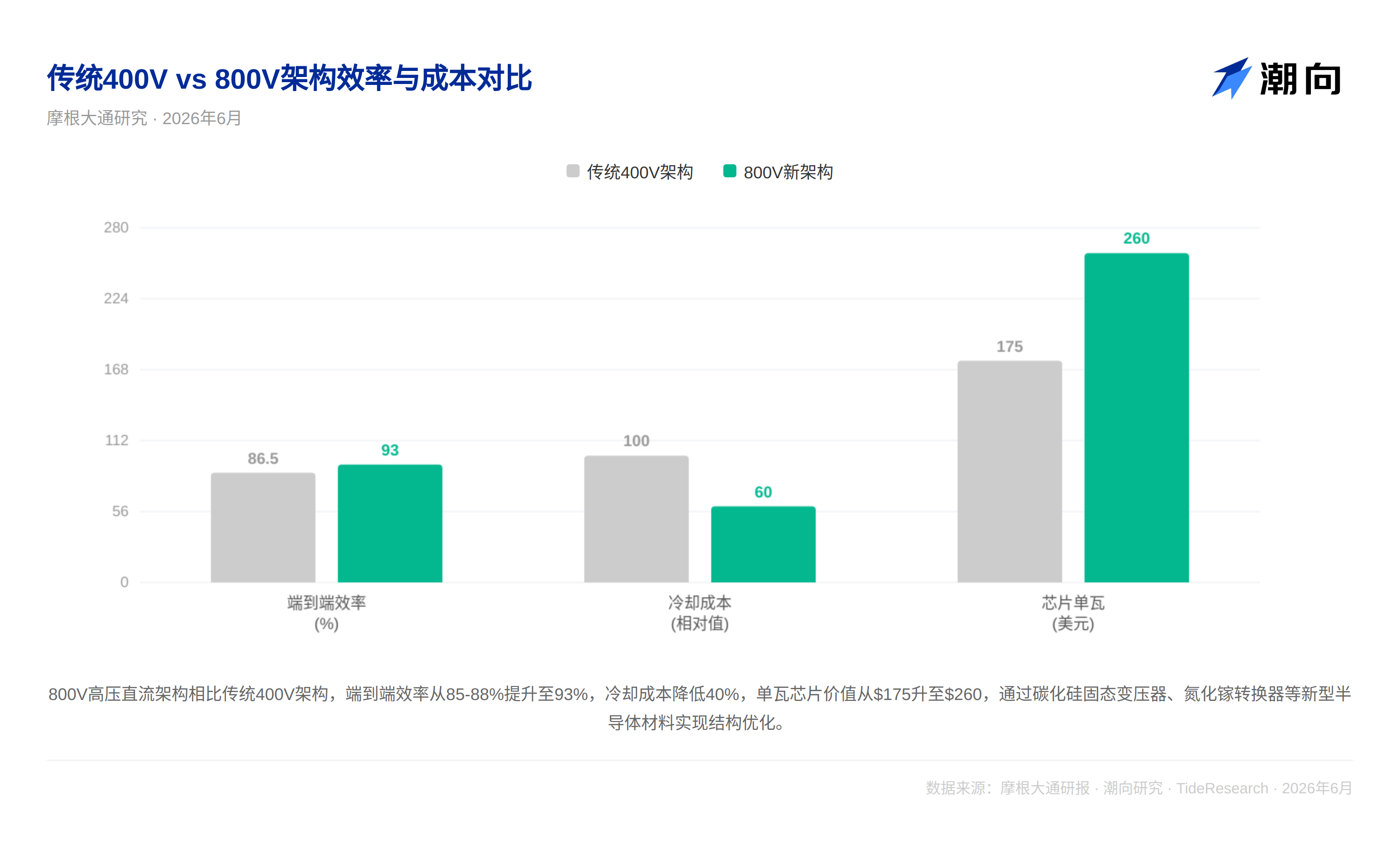
Based on an internal AI server model, JPMorgan estimates that by 2028, the global AI data center will add about 81 GW of installed capacity, including approximately 63 GW of new builds and 18 GW of replacements. The power consumption of AI chips occupies about 54 GW, and after adding network devices and the PUE factor, it reaches the final figure. The power semiconductor market supporting this 81 GW is expected to see the semiconductor content per watt rise from the current $175 to $260, propelling the total market to $19.2 billion.
800V Architecture Revolution: Voltage Doubles, Chips Triple
The most critical technical insight in the report is the replacement of traditional AC architecture with 800V high-voltage direct current (HVDC) architecture. The physical logic is simple: power equals voltage multiplied by current, and heat loss is proportional to the square of the current. Increasing the voltage from 400V to 800V halves the current and reduces copper losses to a quarter. However, the true significance of the architectural switch lies in the qualitative change in semiconductor content.
In traditional architecture, many parts are electromechanical equipment, with semiconductor concentration primarily in the PSU and VRM. The 800V architecture introduces four new nodes: silicon carbide (SiC) solid-state transformers replacing traditional copper-wound transformers; silicon carbide solid-state circuit breakers achieving microsecond-level fault interruption; native DC battery backup units featuring bidirectional DC-DC converters and BMS chips; and rack-level DC-DC conversion from 800V to low voltage.
The report provides a clear timeline: from 2026 to 2027, the traditional 400V architecture will still dominate, but retrofitting has begun, with side-car power racks and power racks gradually appearing. From the second half of 2027 to 2028, NVIDIA's Kyber rack (600kW per rack) will drive the large-scale deployment of native 800V solutions. After 2028, solid-state transformers will mature, merging side-car power racks with transformers into a single SST device.
SiC takes high voltage, GaN takes the middle, silicon holds the last line
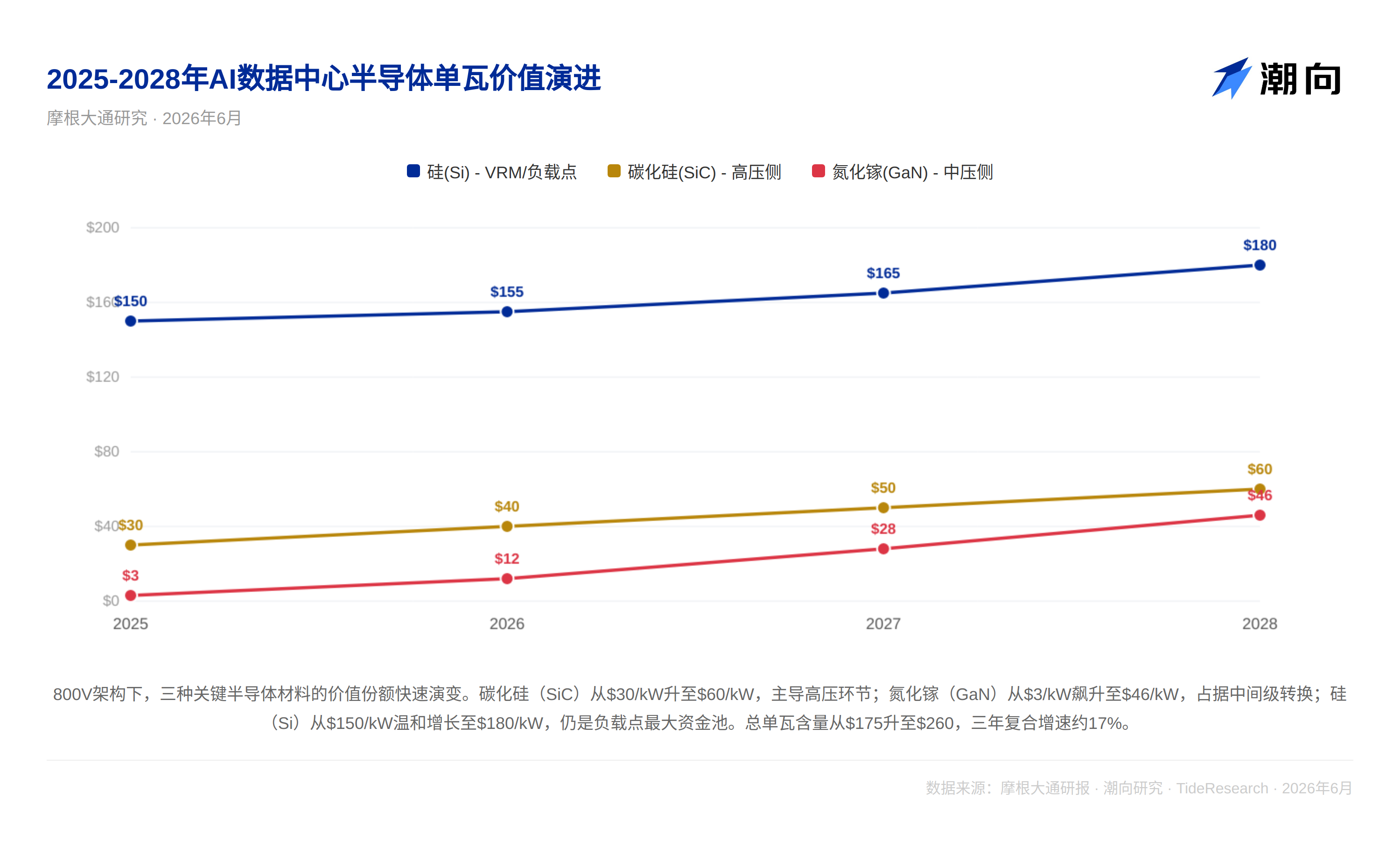
The report quantitatively outlines the shifts in market share of different semiconductor materials. The silicon carbide content per watt is projected to rise from the current $30 to a long-term average of $60, dominating the high-voltage segment from the grid to the rack. Gallium nitride (GaN) will soar from $3 to $46, excelling in the middle-level conversion from 800V to low voltage. Silicon is expected to grow moderately from $150 to $180, still occupying the largest funding pool at the VRM/load point, relying on cost-effectiveness to maintain its position.
The landscape of key players is also taking shape. Infineon (strongest overall supply chain layout), MPS (VRM leader, core supplier to NVIDIA), and Renesas hold the largest shares in the middle-level conversion and load point segments, with NVIDIA having selected multiple companies among them as suppliers. The report covers 12 core companies individually: Infineon, MPS, Renesas, TI, STMicroelectronics, Navitas (leading in GaN technology), ADI, On Semiconductor, Rohm, Innoscience, AOS, and Wolfspeed.
Trends Perspective
The core value of JPMorgan's report lies in building the framework rather than providing a specific target price. The $19.2 billion scale is not considered large within the overall AI infrastructure context, but the key point is: without enough power semiconductors, even the greatest number of GPUs cannot operate.
The report has two assumptions that are not fully explored. First, the delivery cycle for grid expansion (US median 3-5 years) poses a serious mismatch with the two-year construction cycle of data centers, meaning the forecast of 81 GW of installed capacity by 2028 may face execution risks on the grid side, specifically that the US grid's upgrade capability may not keep pace. Second, NVIDIA holds pricing power across the entire value chain, and its choice of power suppliers in the Kyber rack directly affects the competitive landscape. JPMorgan maintains investment banking relationships with companies like Infineon and STMicroelectronics, and this background should be considered when looking at specific company recommendations.
Disclaimer
This article is a compilation and interpretation of third-party brokerage research reports by Trends Study. The ratings, target prices, earnings forecasts, and related judgments quoted herein are the views of the brokerage's analysts and only represent the positions of their respective institutions, not the views of Trends Study, nor do they constitute any investment advice.
Markets are risky, and decisions should be made independently. This article should not be used as the basis for buying or selling any securities.
免责声明:本文章仅代表作者个人观点,不代表本平台的立场和观点。本文章仅供信息分享,不构成对任何人的任何投资建议。用户与作者之间的任何争议,与本平台无关。如网页中刊载的文章或图片涉及侵权,请提供相关的权利证明和身份证明发送邮件到support@aicoin.com,本平台相关工作人员将会进行核查。


