Author: Chloe, ChainCatcher
On June 16, 2026, Reuters quoted two insiders reporting that the Hellenic Capital Market Commission (HCMC) was preparing to reject Binance's MiCA license application; two days after the news broke, OKX founder Star (Xu Mingxing) published a lengthy article on X, dissecting Binance's competitive advantage in regulatory blind spots. As regulatory pressure continued to mount, on June 24, Binance officially announced its decision to withdraw its MiCA license application in Greece and seek authorization from other EU member states.
When we examine the four alleged advantages of Binance: regulatory arbitrage, speculative narrative cycles, social media influence, and superficial compliance, and compare them to the impending MiCA deadline in the EU, we must evaluate how much of the fortress that Binance has built over the past decade is based on real products and technology, and how much is merely the result of regulatory gaps.
Dissecting Binance's Competitive Advantages
Xu Mingxing breaks down Binance's competitive advantages into four parts. When viewed side by side, a common thread emerges: each one is not “a product that Binance has made that others cannot,” but rather “Binance operating unimpeded where others are constrained.”
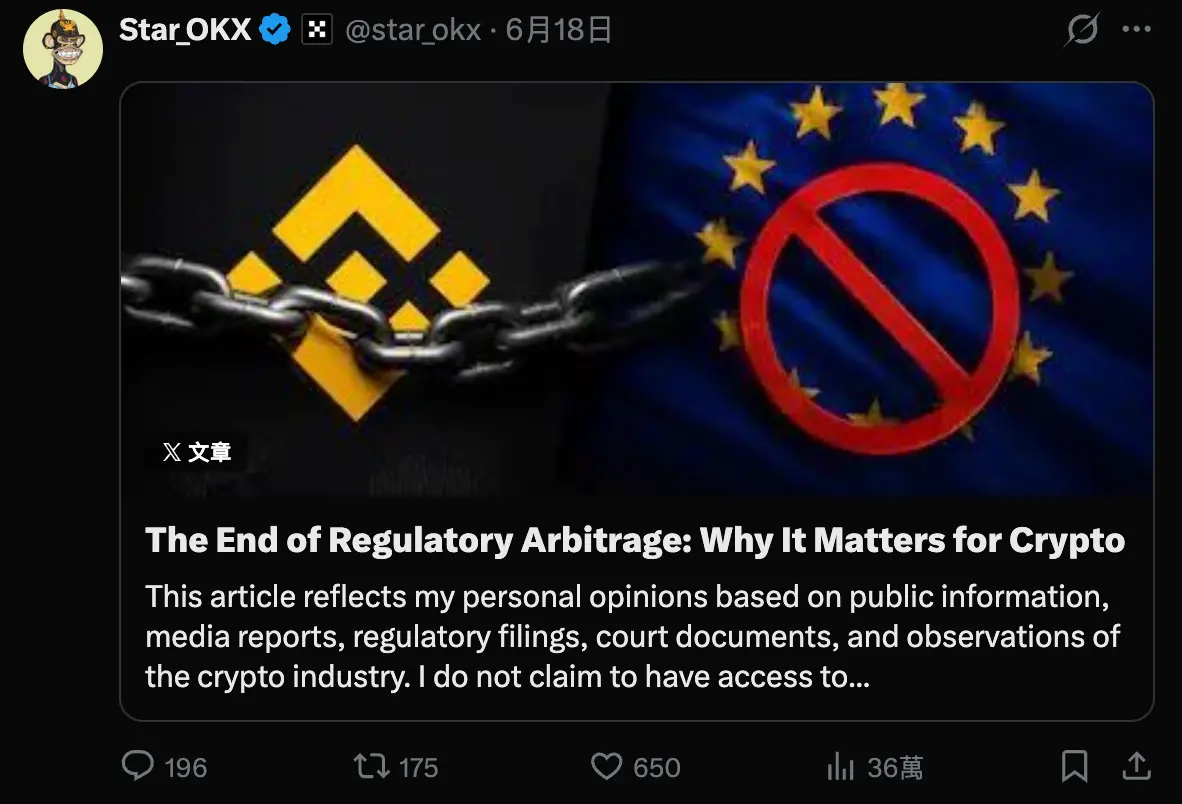
Regulatory Arbitrage: Operating Where There Are Fewest Rules
The core argument is that for more than a decade, competition in cryptocurrency has been heavily influenced by regulatory arbitrage: companies operating under fewer regulatory constraints often enjoy more advantages than those that invest heavily in licensing, compliance, governance, and regulatory engagement.
In other words, when an exchange can serve global users without having a physical presence, without applying for licenses, and without cooperating with regulators, its cost structure is inherently lighter than that of its seriously compliant competitors. This gap does not arise from products, but from the absence of rules themselves.
Speculative Narrative Cycles: There Is Always the Next Get-Rich Opportunity
He describes Binance's business model as “a continuous cycle of promoting speculative assets”: when one asset narrative loses momentum, another quickly takes its place; users might lose money in one cycle, but their attention is swiftly directed to the next token, the next trend, the next opportunity.
He also points out that Binance has built a vast ecosystem over the years, consisting of founders, former employees, venture capital firms, incubated projects, and affiliated market participants, where many projects receive listings and exposure but see prices drop over 95% after launch; critics believe that the real profits are made by insiders connected to Binance and early participants, while a much larger number of retail investors bear most of the losses.
Social Media Machine: Ability to Shape Perception
The third advantage is social media influence. Xu Mingxing emphasizes that Binance has invested heavily over the years to establish connections with KOLs, media organizations, promotional partners, and communities, developing one of the most powerful communication networks in the industry; whenever negative news arises, it is often seen that a number of influential accounts immediately publish positive content, while critical voices are often questioned, rebutted, or attacked.
Supporters view it as strong community building and marketing, while critics see it as narrative management. Regardless of which perspective is valid, hardly anyone denies that Binance has established one of the most efficient social media machines in the history of the cryptocurrency industry, but this, too, is not a product capability, but rather an allocation of influence in the public discourse.
Superficial Compliance: The Paradox of 1,500 Compliance Personnel
The fourth aspect is compliance. Binance often emphasizes that it employs over 1,500 compliance professionals, making it one of the most compliant cryptocurrency companies in the world. Xu Mingxing's rebuttal is that, for any financial institution, compliance is never determined by the number of people employed but depends on whether the organization genuinely values compliance and has established controls to manage actual risk exposure.
He cites reports from media such as The Wall Street Journal, questioning whether Binance's approach to sanction risk exposure, market surveillance, and handling suspicious accounts was “more formal than substantive”, using Binance’s exit from Russia and the subsequent sale of its business to CommEX, as well as its close relationship with Aster, to pose a fundamental question: if a business model carries so much risk that Binance is unwilling to operate it directly, does that make it acceptable to do so via an “independent” entity still closely tied to its ecosystem?
These are one-sided accusations made by Xu Mingxing, to which Binance may not necessarily agree. But the underlying message remains the same: this is not a company that wins through products, but rather one that wins through regulatory loopholes.
MiCA Deadline: The First Major Collapse of Regulatory Arbitrage Advantages
The EU's Markets in Crypto-Assets Regulation (MiCA) is set to come into full effect by the end of 2024, with a transition period ending on June 30, 2026; starting from July 1, only authorized cryptocurrency asset service providers (CASPs) can legally serve EU customers. A MiCA license is valid across all 27 member states, which is why the decision by Greece's single regulatory authority is so impactful across the EU.
By mid-2026, only about 210 to 223 institutions in the EU had obtained full MiCA authorization, while over 3,000 institutions had registered and operated under the old regime. In other words, for every four existing institutions, approximately three will lose their operational qualifications after the transition period ends.
However, rivals like Coinbase, Kraken, and Bitstamp have already obtained MiCA licenses, while Binance may come up empty. It was not until January 2026 that it submitted its application through its Greek holding subsidiary, whereas at that time, Greece had issued zero MiCA licenses, in contrast to Germany, which had issued more than 45, and the Netherlands, which had issued 22. This speaks to Xu Mingxing's mention in the article that Binance excels at establishing itself in countries with regulatory gaps; in places like Germany or the Netherlands, which already have licensing experience, the rules and systems have been fully shaped and there are no regulatory gaps to exploit.
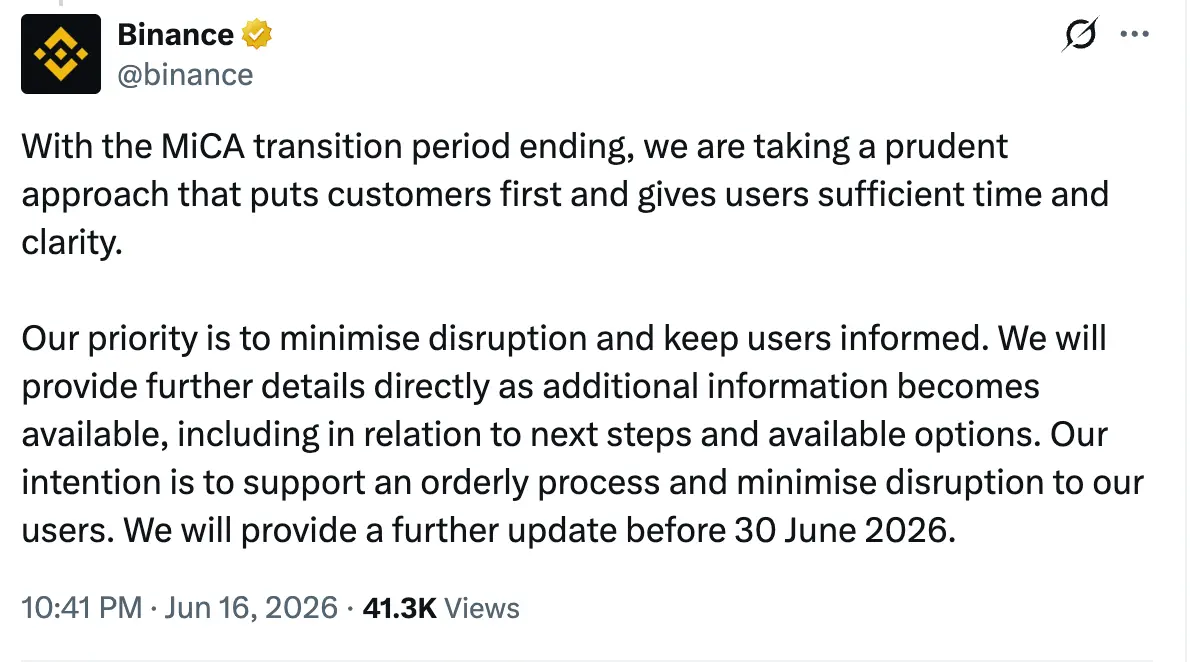
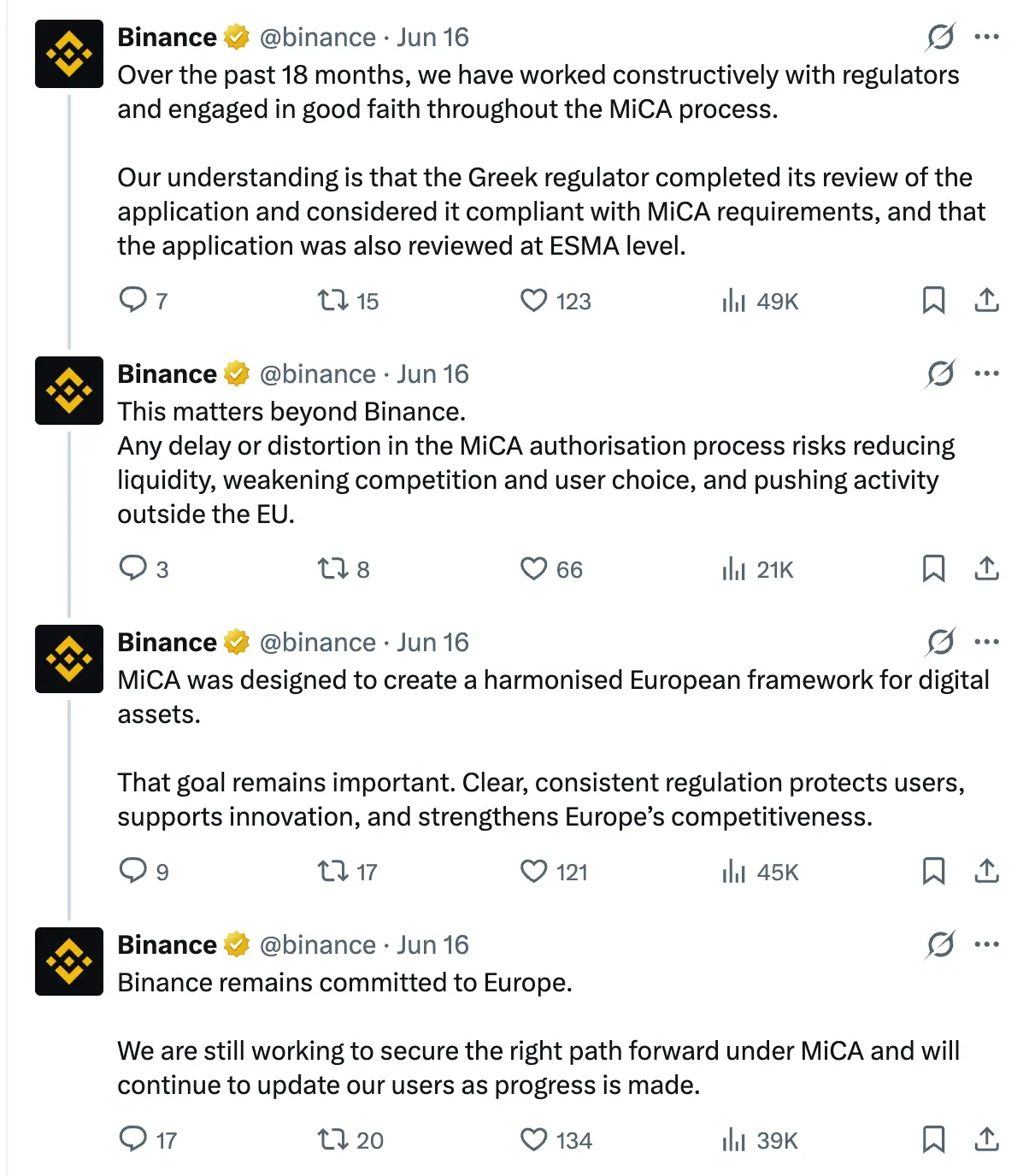
Additionally, Binance disputed Reuters' report, emphasizing that it has had constructive communication with regulatory agencies for over 18 months and believes that the HCMC has completed its review, viewing its application as meeting MiCA requirements, with plans to approve it at the upcoming board meeting. Binance also promised to provide further updates to users before June 30, emphasizing its commitment to minimizing the impact on users through “an orderly process.”
Greece's Setback, France Becomes the Last Entry Point into the EU
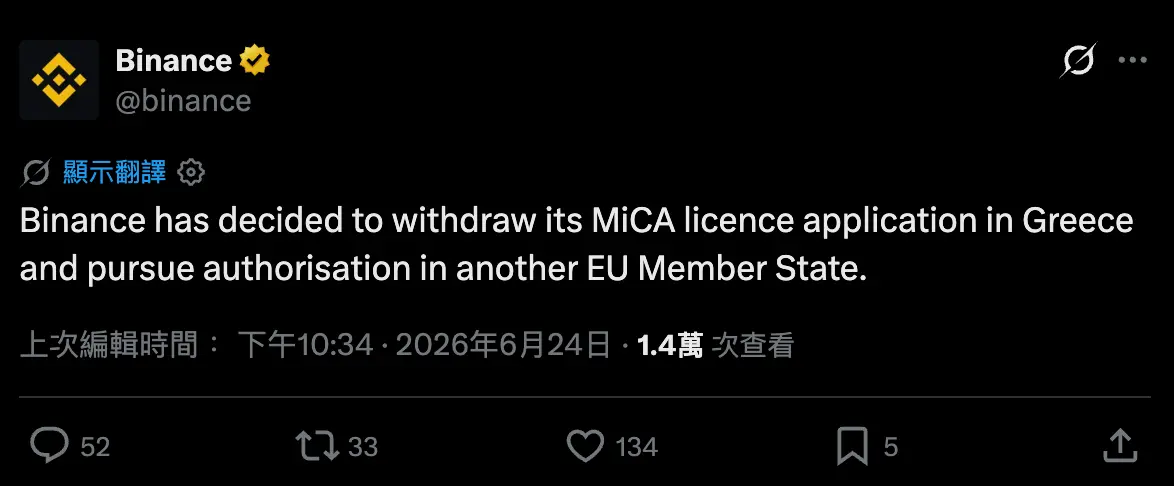
According to a tweet from Binance on the 24th, it has decided to withdraw its MiCA license application submitted in Greece and will seek authorization in another EU member state. On the other hand, reports from The Big Whale point out that Binance is negotiating with the French Financial Markets Authority (AMF), but as of now, has not submitted an official application.
France is already one of Binance's main operational bases in Europe and has previously issued digital asset service registrations earlier than others; under the looming deadline of June 30, France is seen by outsiders as the only jurisdiction that might complete the review in time and allow Binance to regain its EU “regulatory passport.” However, it should be noted that Binance's past national registrations in countries like France do not equate to MiCA licenses and do not grant access across 27 nations; whether this alternative route can be converted into formal authorization in time remains uncertain.
Regardless of the final outcome, the symbolic significance of this situation is clear: in a market where regulations are truly being filled in, Binance's “largest in the world” scale has not afforded them exemptions, but rather made them the most prominent testing subject of the new rules. This is exactly what Xu Mingxing means: when regulation levels the playing field, size itself no longer serves as an advantage.
Once the Fortress Is Levelled, Competition Truly Begins
If these four advantages: regulatory arbitrage, narrative cycles, social media influence, and superficial compliance, are fundamentally based on the disparity of “others being constrained while I am unrestrained,” then what happens when this gap is erased by regulation?
Xu Mingxing's answer is: the focus of competition will shift towards products, technology, execution, customer service, governance, and trust. This is the real purpose of his article: to rewrite the standards of competition from “who can operate under the fewest rules” to “who can create the best products, responsibly serve users, effectively manage risks, and earn long-term trust.”
From this perspective, the MiCA deadline is favorable for Binance's competitors. CCN and Spaziocrypto have pointed out that already licensed Coinbase and Kraken are likely to absorb EU users seeking compliant alternatives due to Binance's exit. For exchanges like OKX, which obtained a MiCA license as early as early 2025, years of compliance investment are now converting into actual market share.
Bringing competition back to “products and trust” benefits all compliant rivals, which undoubtedly includes Xu Mingxing's own OKX.
Binance May Not Necessarily Lose, but the Rules Have Indeed Changed
The failure of MiCA does not equate to the collapse of Binance; Binance's global registered users still exceed 300 million, making it the exchange with the deepest liquidity and largest trading volume in the world. Even if it is blocked from the EU, it still has a vast footprint in Asia, the Middle East, and Latin America; Greece's decision has not yet been formally announced, and Binance is still negotiating, so the outcome before June 30 remains uncertain.
Binance has also made compliance progress. As early as 2023, it reached a settlement of about $4.3 billion with the U.S. Department of Justice and the Treasury, with former CEO Zhao Changpeng (CZ) pleading guilty and resigning, replaced by Richard Teng; since then, the company's strategy has shifted from openly resisting regulation to actively seeking licenses, making it unfair to simply describe Binance as a company that only engages in regulatory arbitrage.
However, Xu Mingxing's core assertion is that a significant portion of Binance's strongest competitive advantage over the past decade has indeed come from regulatory gaps, and this void is being filled by one jurisdiction after another; MiCA is just the first real gate that has been opened, and there are likely to be even more similar cases in the future.
So, returning to the initial question: how should we view Binance's competitive advantages? A more pragmatic view is that there’s no need to glorify or disparage it. What truly deserves tracking is not whether Binance can obtain that license in Greece this time, but whether they can produce product capabilities, governance strength, and trust that match their scale once the benefits of regulatory arbitrage gradually diminish to zero.
免责声明:本文章仅代表作者个人观点,不代表本平台的立场和观点。本文章仅供信息分享,不构成对任何人的任何投资建议。用户与作者之间的任何争议,与本平台无关。如网页中刊载的文章或图片涉及侵权,请提供相关的权利证明和身份证明发送邮件到support@aicoin.com,本平台相关工作人员将会进行核查。


