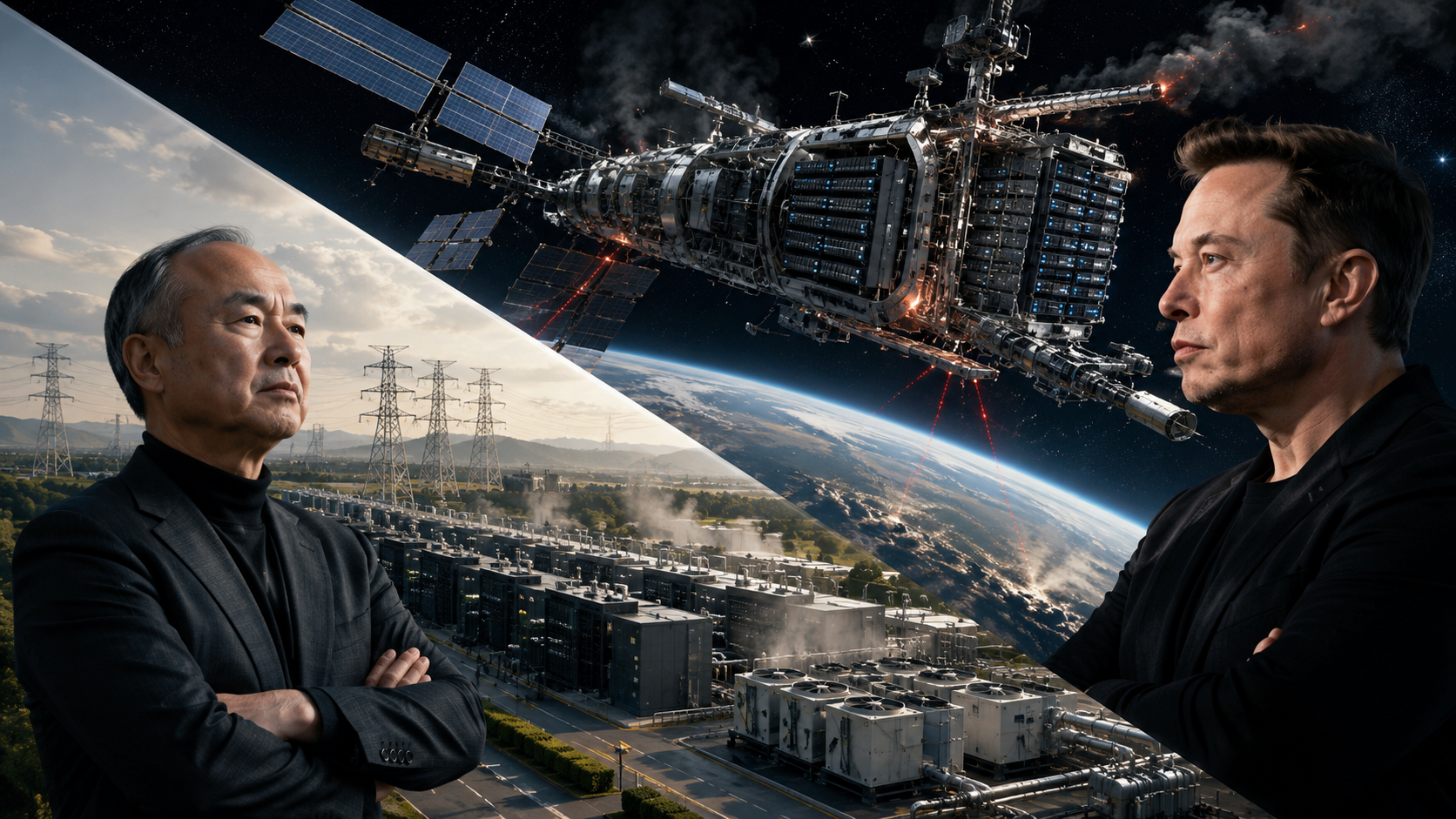
On June 23, 2026, at SoftBank's annual shareholder meeting, Masayoshi Son poured cold water on Elon Musk's "million satellite orbital data center" plan. In response to shareholders' questions about whether SoftBank would emulate this plan, Son explicitly denied it. He pointed out that electricity expenses account for only a small portion of the operating costs of data centers, while relocating to space would bring with it high rocket transportation costs, maintenance difficulties, and communication delays as real obstacles. He emphasized that the competitive landscape of AI in the coming years is far more critical than a decade later, and the ultimate battle for AI will inevitably take place on land.
Whether space data centers are the ultimate solution to escape the constraints of Earth's resources or simply a concept that violates engineering common sense can be validated through comparisons of three sets of hard data regarding computing power cost structure and physical laws.
71% Depreciation and 9% Electricity Costs: The Cost Inversion of Space Computing Power
One of the core premises of Musk's space data center proposal is to utilize the limitless solar energy in space to save on the high electricity costs of Earth data centers. However, in the face of real AI computing power business models, this logic is built on a fragile illusion.
In the era of AI large models, the total cost of ownership (TCO) structure of data centers has undergone fundamental reshaping. According to a teardown analysis by SemiAnalysis of a Meta 24,000-card H100 cluster, hardware depreciation occupies an absolute majority of the AI data center's TCO, amounting to about 71%. This includes capital expenditures for core IT hardware such as GPUs, InfiniBand network switches, and optical modules. Due to the rapid iteration of AI hardware, which typically faces obsolescence every 3 to 5 years, this portion of depreciation is the biggest cost black hole in computing power infrastructure.
By contrast, electricity costs, considered a major operating expense, account for only about 9% of the overall TCO.
To save on electricity costs that make up less than 10% of the total costs, while incurring rocket launch costs of several thousand dollars per kilogram, is a complete inversion commercially. Currently, the launch cost of SpaceX's Falcon 9 rocket to low Earth orbit is about $2,720 to $4,000 per kilogram. The hardware weight of a medium-sized AI training cluster easily reaches hundreds of tons, leading to launch costs in the hundreds of billions of dollars range.
Space is filled with high-energy cosmic rays and solar particles, which can cause single-event upset (SEU) in semiconductors and compromise data integrity. To resist radiation, either extremely expensive and underperforming radiation-hardened chips must be used, or heavy physical shielding must be added. Either choice will lead to skyrocketing hardware costs and decreased performance, further accelerating that 71% depreciation cost.
What enterprises and industrial investors care about is not whether a utopia can be built in space ten years from now, but rather the return on investment for every penny spent today. Punishing with enormous capital expenditures to gain meager operational cost savings cannot close the loop commercially.
100 Tons of Heat Sinks and 10 Tons of Hardware: The Cooling Penalty of a Vacuum Environment
AI infrastructure on Earth does face serious physical resource limitations, particularly in terms of cooling and water shortages. Moving data centers to the cryogenic environment of minus 270 degrees in space seems to be the perfect solution for cooling, but it goes against the most basic thermodynamic principles.
The background temperature of space is extremely low, but the high vacuum condition means that there is no air convection and no thermal conduction medium. In this environment, waste heat can only be dissipated through infrared radiation, which is an extremely inefficient heat transfer process.
According to engineering calculations by the World Economic Forum, a 1-megawatt orbital data center would require approximately 1,600 square meters of radiative heat sinks, an area equivalent to three standard hockey rinks. Referencing the existing heat dissipation system architecture of the International Space Station, the radiative heat sinks and associated piping system required to support 1 megawatt of computing power could weigh as much as 100 tons. In contrast, the computing hardware itself with the same computational power weighs only about 10 tons.
The weight of the heat dissipation system is ten times that of the computing hardware. If estimated by Falcon 9 launch costs, it would take about $300 million just to launch these 100 tons of heat sinks into orbit. This does not include the weight of massive solar panel arrays and necessary energy storage batteries.
In space, solar energy is not available around the clock. Satellites will lose sunlight when passing through the Earth's shadow, necessitating a large battery system for the orbital data center to maintain computing operations, and these heavy batteries also incur expensive launch costs.
The water cooling limitations faced by terrestrial data centers are a "real problem" that can be resolved through engineering optimizations. Whether using cold plate liquid cooling or immersion liquid cooling, the specific heat capacity of water and the heat transfer efficiency of phase change are far superior in engineering compared to vacuum radiative cooling.
1 Microsecond and 40 Milliseconds: The Computing Power Utilization Rate Locked by Network Latency
The issue of communication latency directly condemns space data centers to a death sentence under the current AI technology architecture.
The training of AI large models is not a simple matter of web hosting or data storage; it is a microsecond-level synchronization war among thousands of GPUs. In clusters with tens of thousands of cards, forward propagation and backward propagation are distributed across different nodes, and the gradient updates of model parameters require global synchronization through All-Reduce operations.
This synchronization operation has extremely strict requirements for network latency and bandwidth. Modern AI clusters that rely on RDMA (Remote Direct Memory Access, a technology that allows memory from different computers to exchange data without CPU intervention) and InfiniBand (a high-bandwidth, low-latency dedicated network protocol) typically require end-to-end latencies to be between 1 to 5 microseconds. Only at this latency level can GPUs quickly complete parameter exchanges during computing gaps, maintaining extremely high computing power utilization rates.
The physical latency for communication from low Earth orbit satellites is typically between 20 to 40 milliseconds. One millisecond equals 1,000 microseconds, meaning that the latency of satellite links is nearly ten thousand times higher than that of internal data center networks.
The physical limit of the speed of light determines that this gap cannot be crossed. Low Earth orbit satellites are approximately 500 to 2,000 kilometers from the ground, and even if satellite-to-satellite interconnects use laser communication, the physical distance and routing hops between them guarantee that latencies cannot approach the microsecond level.
Under these latency conditions, costly GPU clusters will remain idle for long periods while waiting for network transmissions. The computing power utilization rate will plummet from over 60% in land clusters to single digits. The computing power that enterprises spend hundreds of millions to acquire will largely be sitting idle, waiting for data packets to travel from one satellite to another.
PUE 1.09: The Engineering Limits and Solutions of Land-Based Computing Power Infrastructure
Masayoshi Son emphasized at the shareholder meeting that SoftBank will focus on the construction of land-based data centers. This is not only SoftBank's judgment but also a consensus among the entire hyperscale computing industry.
Land-based data centers do face real estate selection difficulties, community protests, and electrical grid queuing issues, but there are clear engineering solutions to these problems. Through continuously optimizing cooling technologies and energy management, the PUE (Power Usage Effectiveness, the ratio of total energy consumption of a data center to the energy consumption of IT equipment, the closer to 1, the higher the efficiency) of land-based hyperscale data centers has been compressed to extremely low levels.
Google reports that its large data centers have an average annual PUE of 1.09. This means that less than 10% of total power consumption is used for non-IT equipment such as cooling and lighting, and the vast majority of power is directly converted into computing power. This has been achieved by introducing AI-driven cooling control systems, efficient heat recovery technologies, and large-scale liquid cooling deployments.
In terms of site selection logic, computing power infrastructure is increasingly shifting towards high-latitude cold regions and areas rich in clean energy. By signing long-term power purchase agreements (PPAs) in combination with facility-level battery storage systems, data centers can free themselves from reliance on a single electrical grid, creating a microgrid model. The consumption of water resources is also evolving toward a closed-loop system, with immersion liquid cooling virtually eliminating evaporative water loss.
The evolutionary path for land-based infrastructure is clear, and the cost curve is predictable. Investors and industry observers can accurately calculate the marginal cost of each FLOP of computing power over the next three years; this certainty is an indispensable foundation in the AI race.
The Critical Three-Year Period Ahead: The Time Window for Computing Power Infrastructure
Supporters of Musk often hope that once Starship is mass-produced, launch costs could drop below $100 per kilogram, fundamentally changing the business logic of space data centers. This optimistic long-term perspective overlooks one of the harshest realities of the AI industry: the time window.
Masayoshi Son has pointed out that the competitive landscape for AI in the coming years is far more critical than it will be in ten years. Current AI is in an explosive phase transitioning from large language models to multimodal and reasoning models, with a massive computing gap. Whoever can deploy hyperscale computing clusters on land more quickly and economically will capture the advantage in model capabilities and commercial realization.
Large model companies have capital expenditure cycles measured in quarters, while hardware depreciation occurs within two to three years. Waiting for Starship to mature, waiting for breakthroughs in orbital cooling technology, waiting for the development of radiation-hardened AI chips—these frontier explorations, which can take a decade or more, cannot address today's insatiable demand for computing power. Enterprises require 800G InfiniBand networks and liquid-cooled H100 clusters that can go live tomorrow, not orbital constellations that might be realized in ten years.
Space data centers violate the cost structure of AI computing power TCO, infringe upon the thermodynamic limits of vacuum environments, and are locked in inefficiency by communication delays constrained by the speed of light. Within the foreseeable engineering future, the ultimate physical location for AI computing power must inevitably be on land.
免责声明:本文章仅代表作者个人观点,不代表本平台的立场和观点。本文章仅供信息分享,不构成对任何人的任何投资建议。用户与作者之间的任何争议,与本平台无关。如网页中刊载的文章或图片涉及侵权,请提供相关的权利证明和身份证明发送邮件到support@aicoin.com,本平台相关工作人员将会进行核查。


