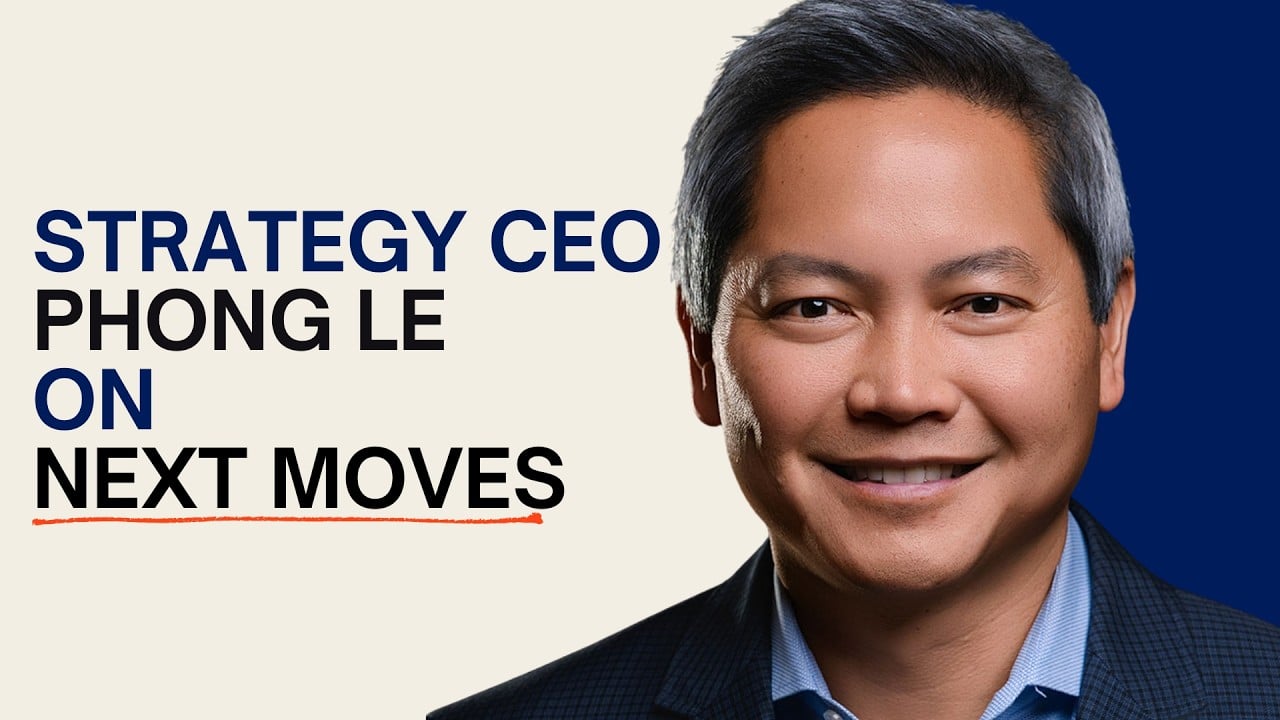
Author|Coinage
Compiled by|Wu Says Blockchain
Market Reaction and Long-term Logic: The Short Term is a Voting Machine, the Long Term is a Weighing Machine
Zack Guzman: The recent sale of 32 bitcoins has drawn global attention. In light of various market reactions, what is the one thing you most want to clarify?
Phong Le: There is an old saying on Wall Street: “In the short term, the market is a voting machine; in the long term, it is a weighing machine.” We are not seeking votes on “how we increase per-share bitcoin holdings”; we simply provide transparency on KPIs and a long-term perspective. There will always be short-term overreactions, but I won’t spend too much time scrolling through every comment on X (Twitter). We make decisions considering daily, annual, and long-term perspectives, with the long-term view being the most important.
What we focus on is whether we are continuously creating value for different categories of shareholders such as common stockholders, preferred stockholders, and debt holders while also advancing the development of the bitcoin ecosystem itself. This is not even the first time we sold bitcoin; in 2022, we sold about $2.5 million worth of bitcoin and bought back later. This time we also sold 32 bitcoins (approximately $2.5 million), bought about $100 million the previous week, and about $1.5 billion the week before that. We voluntarily disclose this information weekly through 8-K forms. As the world’s largest bitcoin corporate holder, enduring the market's positive and negative feedback is a responsibility behind our transparency.
Proving Liquidity to the Market: Breaking the "Death Spiral" Narrative
Zack Guzman: Some see this sale as “vaccinating” the market. Others compare you to Terra, worried that STRC (Strategy Preferred Stock) could trigger a cascading sell-off “death spiral” if leveraged by other DeFi protocols. Was this a concern you heard before the sale?
Phong Le: That was not a driving factor at all. We do not worry that DeFi protocols built on STRC will trigger a cascading collapse because about 80% of STRC is held by retail investors, and a large portion is held by long-term institutions, with DeFi protocols holding a very small portion—less than 10%.
When we say “vaccinating the market,” there are mainly two layers of meaning:
First, our debt holders (digital credit and bondholders) want to confirm that, given that nearly 100% of our assets are in bitcoin, if we really need to pay dividends or for other purposes, we have the ability and willingness to use those assets. Meanwhile, rating agencies want to see that we do not arbitrarily sell bitcoin. So we make a small sale once to prove to creditors that we can sell and also show rating agencies that we are disciplined.
Second, it tests our internal business processes. We made the custodian information public but did not disclose specific bitcoin addresses. Once we move bitcoin from cold storage to a hot wallet, countless people in the market will be watching and trying to guess which are our wallets. We just want to see how the entire selling process operates in a real environment and how the market reacts. Hopefully, in the future, when we sell millions of dollars worth of bitcoin, the market won't react so dramatically.
Farewell to the Black Box: Michael Saylor and the Decision-Making Mechanism of Strategy
Zack Guzman: We have seen various experiments in the crypto space and, frankly, we have also reported on highly centralized founders like SBF and Do Kwon. But Strategy is different; how is the decision-making process for something like “selling 32 bitcoins” decided internally?
Phong Le: As a Nasdaq-listed company, Michael Saylor no longer holds a majority stake. We have 8 board members, including common stockholders, preferred stockholders, and debt holders, and to some extent, we are accountable to the broader crypto community.
On a macro level, we discuss the “optionalities” of funds every quarter during earnings calls and board meetings—whether we can issue stock, preferred stock, convertible bonds, buy and sell bitcoin, or repurchase bonds. Once consensus is reached at this level, we move to the execution level. On a micro level, we run extremely complex financial models each month, analyzing the impact of different operations on stock quality and credit quality; every week, Michael and I discuss our goals for the week; every morning, we meet with the funding team, investor relations team, and traders to confirm daily directives. We even use sentiment analysis from Grok on the X platform, website traffic, and Strategy App usage data to assist in decision-making. This is by no means a whim decision; it is the rigorous practice expected of a data analytics company.
Fundraising Mechanism and Highest Philosophy: "Doing Nothing"
Zack Guzman: Besides bitcoin, if STRC continues to trade below par, what other fundraising mechanisms will you utilize in the future?
Phong Le: We have many options: issuing more stock (our stock trades $2.7 billion daily, one of the most liquid stocks globally), issuing other preferred shares, or issuing more convertible debt; the market is very open to us. But I want to emphasize one thing: we currently hold 845,000 bitcoins, and we can fully choose “doing nothing.” This was indeed our core strategy during the bear market in 2022: we repaid some senior secured notes and bitcoin-backed debts, and then we quietly sat on this massive bitcoin vault. As bitcoin warms up, the company’s valuation and per-share bitcoin holdings will naturally rise.
In a bear market, the most dangerous temptation often is to feel compelled to “do something,” such as a large-scale panic sell-off, but we will never do that. “Doing nothing is one of our extremely important strategic options.
Facing Volatility and Belief: Great Companies Have All Experienced “Near-Death Experiences”
Zack Guzman: When you choose “doing nothing” and watch your paper losses accumulate to billions, how does that feel personally?
Phong Le: People sometimes forget that this company, once named MicroStrategy, was founded by Michael Saylor in 1989 and listed in 1998; we did not add bitcoin to the balance sheet until 2020. From 1989 to 2020, our executive chairman gained rich experience leading the company through countless ups and downs, which is the foundation of the company’s resilience and strength. I have been CFO since 2015 and became CEO in 2022, so I have also experienced 11 years of storms. Michael's hair has turned much whiter, and so has mine.
Look at Amazon; if it hadn’t gone through several near-death experiences and severe fluctuations, it wouldn’t be the Amazon of today; Tesla also had its “funding secured” tweet issues. 2022 was indeed a difficult time, but it forged resilience for those who stuck it out. Why am I unwavering? Because I believe in the underlying logic. I believe bitcoin can create sovereignty and freedom for people around the world, that it is a superior way to circulate funds through digital rails, and a programmatically superior scarce asset. Just like Jeff Bezos firmly believes that Amazon can create real value for hundreds of millions of consumers, as long as you believe in the underlying logic, all other fluctuations will be easily managed.
The Evolution of AI: From Founding STRC to 60 Trillion Agentic Trading on Mars
Zack Guzman: Rumor has it that the inspiration for the STRC product comes from the exploration of internal AI tools; what long-term plans do you have for the integration of AI and finance?
Phong Le: Yes. When generative AI first emerged, many thought it could only write meeting minutes. But we found that it can help us design revolutionary products that would originally take months and may be rejected outright by lawyers and banks. AI helped us find applicable case law and financial KPIs, shortening the development cycle of STRC from three years to eight months.
But this is just the beginning. What’s even more exciting is Agentic AI. Internally, we are deploying agents to automatically summarize information, fix code (self-healing code), etc. Ultimately, the world will evolve from 6 billion humans to 60 trillion automatically deciding agents—imagine if SpaceX deployed a million humanoid robots on Mars and the Moon, when they conduct business interactions and value exchanges, they certainly will not use traditional financial networks like Visa, Mastercard, or SWIFT but will use decentralized crypto rails and seek high-yield products that store value in bitcoin. This is an immeasurable boon for the crypto world and bitcoin.
Breaking the Divide: Crypto Fundamentalism vs Capital Markets
Zack Guzman: There has always been a sense of division in the crypto world: one faction believes only in bitcoin “fundamentalists,” while the other knows it must connect with traditional capital markets. How does Strategy balance the two?
Phong Le: When I deeply engaged with bitcoin, I wanted to promote it to everyone around me, but I never asked them to take an IQ test or loyalty test, nor did I inquire about their religion, nationality, sexual orientation, or professional backgrounds. If bitcoin is to win the world, it must allow as many people as possible to gain exposure in various ways. Whether through self-custodied hardware wallets, buying on Coinbase, holding Strategy stock, holding STRC, or through DeFi protocols or ETFs, all of these are good ways to spread bitcoin. Our philosophy is: “Spread Bitcoin with love.”
Can STRC Return to $100 Par Value?
Zack Guzman: Will STRC compete in the stablecoin market with USDC/USDT? What do you see as the roadmap for it to return to $100 par value?
Phong Le: STRC was just born 10 months ago, while bitcoin has been around for 18 years, it is still in its infancy, and we are constantly learning and improving. Our goal is to have it trade between $99 and $101. Recently, we used dollar reserves to repurchase $1.5 billion in convertible bonds, which led to a decrease in reserves and temporarily put pressure on STRC's price. Next, we will replenish reserves, and with the semi-annual interest payment mechanism that started on June 30, it will gradually return to par value. The product is extremely over-collateralized, paying dividends will be no problem at all; it won't keep me awake at night.
Polymarket Controversy Case Closure
Zack Guzman: The controversy on Polymarket regarding whether you sold bitcoin before May 31 has generated huge debate; did you really sell?
Phong Le: I have been following the whole process. I can state clearly: we did indeed sell bitcoin the week before May 31, and it was accurately recorded in the 8-K filed early the following Monday at 8 AM. As for how the prediction markets interpret the contracts, that is their business, but I know very well what the company actually did internally.
免责声明:本文章仅代表作者个人观点,不代表本平台的立场和观点。本文章仅供信息分享,不构成对任何人的任何投资建议。用户与作者之间的任何争议,与本平台无关。如网页中刊载的文章或图片涉及侵权,请提供相关的权利证明和身份证明发送邮件到support@aicoin.com,本平台相关工作人员将会进行核查。


