Author: Chloe, ChainCatcher
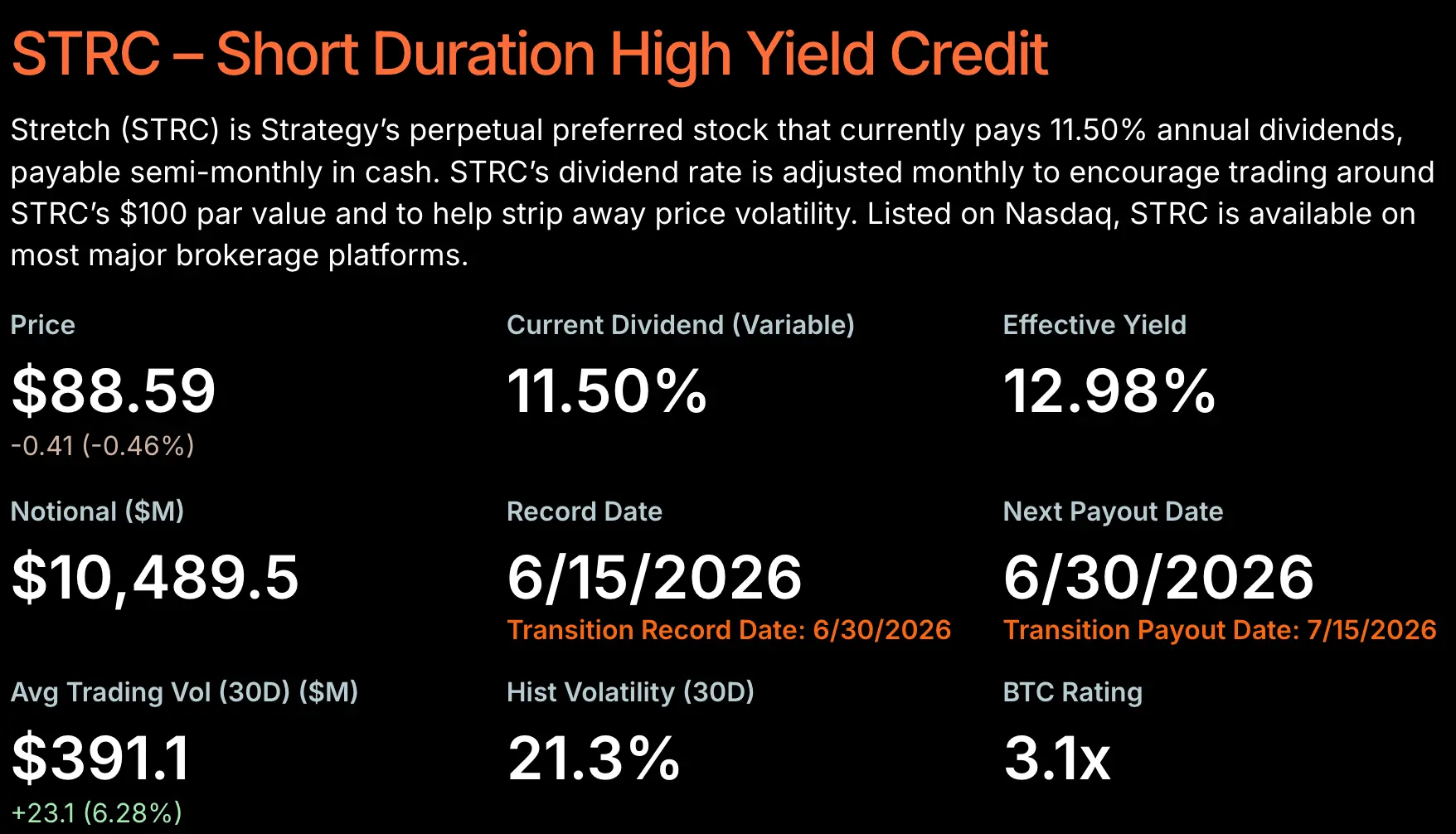
Since the launch of STRC by Strategy at the end of July 2025, Bitcoin has fallen about 40%, nearly 50%. This preferred stock, designed to trade at a face value of $100, is now deeply discounted: last Thursday, it hit a historic low of $82.53 during trading, and it closed at only $88.59, which is still about 13% lower than its face value. As the discount widens, the effective yield of STRC has risen to over 12.9%, approaching 13%.
Jesse Myers, Bitcoin Strategy Director at The Smarter Web Company, stated, "Strategy is fine," while economist Peter Schiff referred to the entire structure as "a typical centralized Ponzi scheme."
Thus, the old questions resurfaced: Will Strategy be forced to sell coins? Is the flywheel it relies on for expansion actually a Ponzi scheme?
Is STRC a mechanism designed by AI?
To discuss STRC, one must first address a detail that is easily overlooked but has resurfaced during this downturn: this structure was developed by Saylor in conversation with AI.
The controversy arises from a segment of a CoinDesk interview from May that has circulated on platform X. In the clip, Saylor admits that he extensively utilized artificial intelligence while developing the Strategy preferred stock product. He stated that during the creation of Stretch, these ideas were all designed with AI, which he could not have accomplished alone, and he spent several hours discussing with AI.
According to him, he constantly threw various structural settings at AI to test whether some unconventional ideas were legally viable. When he proposed, "I want a preferred stock that pays dividends monthly and stabilizes at a price of $100," AI responded: No one has ever done this before, but it is completely legal and reasonable.
Interestingly, when STRC fell below its face value and the market began to question whether this mechanism could hold up, many foreign media outlets turned back to ask AI, including ChatGPT, Grok, and Claude, whether STRC could rise back to $100.
Will Strategy sell coins again?
Not long ago, Strategy sold 32 BTC worth about $2.5 million, which was used to fulfill dividend obligations. This amount is trivial compared to its overall Bitcoin reserves, but it proves one thing: when the financing efficiency dominated by STRC declines, cash obligations can indeed force limited coin-selling actions.
More concerning is the freeze in buying power. Strategy's pace of accumulating Bitcoin has clearly slowed: in April this year, it spent $2.54 billion in a single week to buy 34,164 BTC; in May, it further invested about $2.01 billion to acquire 24,869 BTC. However, by June, the weekly purchase volume shrank to around $100 million. By the week of June 8, it bought 1,550 BTC ($101 million), and by the week of June 15, it purchased another 1,587 BTC ($100 million), bringing the total holdings to 846,842 BTC.
Additionally, the widening discount not only pushed up the yield but also put "at-the-market issuance" on hold, a financing channel that is the key link supporting the entire Bitcoin flywheel.
However, the bulls are not buying into this "death spiral" narrative. Jesse Myers believes that STRC's selling pressure appears more like a leveraged liquidation rather than a deterioration of the fundamentals. He estimates that if conditions remain unchanged, Strategy's current state is sufficient to pay STRC dividends for 32 years; as long as Bitcoin appreciates by about 2% each year, this obligation can be indefinitely covered. Moreover, the tool of issuing stock itself has not disappeared; even if at-the-market issuance is temporarily halted, Strategy still retains multiple backup financing options, including restarting the issuance of MSTR common stock or utilizing cash reserves, which will only move to selling coins when necessary.
On the short side, Schiff follows a classic narrative. He argues that if Saylor raises the yield to 13%, he will have to sell more MSTR at greater discounts to finance; if he does not raise the yield, the STRC price will continue to fall. In his view, the only way to stop this death spiral is to cut dividends directly, but that would immediately collapse STRC and drag MSTR and Bitcoin down with it.
Is this flywheel a Ponzi scheme?
Schiff's accusation is straightforward: STRC is a "typical centralized Ponzi" because its operation depends on whether Strategy can continuously raise new money through another round of stock issuance or simply sell Bitcoin to fulfill its obligations. Even trader DonAlt publicly questioned why STRC's price movement after falling below face value "trades like a Ponzi."
Strategy has not directly responded to such accusations; it only continues to position STRC as a preferred stock supported by its Bitcoin DAT strategy. A more specific action is changing STRC from monthly dividends to bi-monthly dividends, which means issuing dividends twice a month.
The core argument from the opposition is "liquidation of leverage." Myers points out that the problem does not lie within the structure itself, but rather that STRC has been trading closely around $99 to $100 for a long time, enticing investors to leverage heavily, with many presuming this instrument would stay comfortably above $95; once the price slipped, margin calls and forced liquidations amplified and accelerated this downturn.
Analyst Scott Melker offers another perspective: the discount might actually attract yield-seeking buyers. Because the STRC dividend is calculated based on a liquidation preference of $100 rather than market price. With an 11.5% dividend rate, someone buying at $90 actually receives about 12.8% yield, while someone buying at $85 receives about 13.5%. The deeper the discount, the higher the effective yield, which is inherently an enticing offer.
Thus, the question of whether it is a Ponzi scheme ultimately depends on which explanation the market believes: one argument is that this mechanism can only function by continuously pulling in new money, where the money of new entrants is used to pay earlier investors, which is a characteristic of a Ponzi scheme. The other argument is that the tool itself is not problematic; rather, previously, many believed it was stable and borrowed money to escalate positions, and this price drop led those individuals to cut losses, which amplified the decline and is a one-time washout, not a problem with the tool itself.
Bi-monthly dividends officially take effect, will the answer be revealed in June?
Reflecting on the previously mentioned points, since this mechanism was designed by Saylor using AI, many foreign media simply redirected the same questions back to AI: Can STRC return to $100, and what should Strategy do to rebuild market confidence? The common answer from ChatGPT, Grok, and Claude is, "Returning to $100 requires conditions."
ChatGPT believes it is still possible to return to $100, but requires stronger market confidence, sustainable dividend coverage, and a rally in Bitcoin prices, all three must be present. It emphasizes that the fastest path to recovery is restoring investor confidence that dividends can be maintained without relying on asset sales; if more coin sales are indeed needed later, confidence may further deteriorate.
Grok's attitude is the most reserved, bluntly stating, "Maybe, but it will be extremely difficult." In its view, the market is fundamentally asking: can the engine that supplies blood to this Bitcoin-buying machine still run? It believes that a continuous surge in Bitcoin prices would be the most effective catalyst; conversely, prolonged weakness would simultaneously pressure both STRC and MSTR.
Claude points out that preferred stocks can often recover from discounts to face value, but the premise is that investors need to believe that the issuer can fulfill long-term obligations. "Restoration is possible, but the market needs to see evidence that this structure can operate in adversity, not just when Bitcoin is increasing."
So, does this strategy have problems? Whether the bearish Schiff, bullish Myers, or top AI models, they all point to the same decisive variable: Can Strategy continue to meet dividend obligations without selling coins?
The current flywheel is not yet stopped, but it is clearly slowing down: at-the-market issuance is paused, and the speed of buying has shrunk from tens of billions per week earlier this year to about $100 million per week in June; that sale of 32 BTC further proves that when issuing stock is not going smoothly, the door to "selling coins to pay dividends" has already opened. Whether it is a Ponzi scheme or a one-time leveraged washout will depend on whether STRC can return to face value and how Strategy will pay dividends.
The most concrete observation point falls on June 30: on that day, the change to bi-monthly dividends officially takes effect, but the real focus is on the rules for automatically adjusting dividend rates based on price. If the monthly average is below $95, a rate increase is recommended, and it only stops when it exceeds $99. Now that it is deeply entrenched below $95, another rate increase is almost certain, while the dividend rate has climbed from 9% in August 2025 to 11.5%.
This is precisely the core of Schiff's death spiral: the lower the price, the more the mechanism automatically pushes the dividend rate up, the larger the cash bill, and ultimately it can only rely on issuing more stock or selling more coins to fill the gap. Whether this mechanism is a "stabilizer" or an "accelerator," the answer lies in the upcoming prices and rates.
免责声明:本文章仅代表作者个人观点,不代表本平台的立场和观点。本文章仅供信息分享,不构成对任何人的任何投资建议。用户与作者之间的任何争议,与本平台无关。如网页中刊载的文章或图片涉及侵权,请提供相关的权利证明和身份证明发送邮件到support@aicoin.com,本平台相关工作人员将会进行核查。


