Why does SpaceX not have enough quotas in the cryptocurrency circle and what is Xstocks' position in the SpaceX IPO underwriting consortium
This time many exchanges opened the subscription entrance for the SpaceX IPO, but in the end, users were unable to obtain quotas, and the core is to first look at the upstream structure.
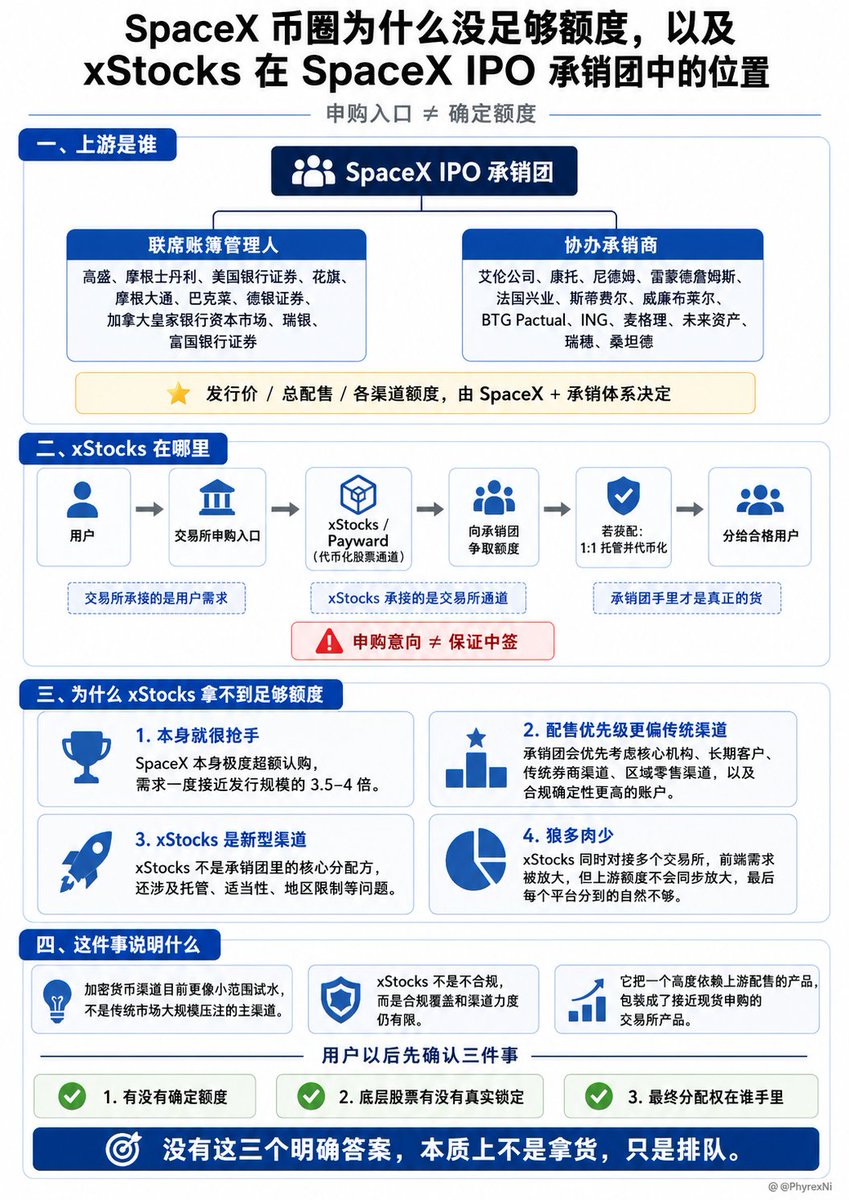
The true upstream of SpaceX this time is the underwriting syndicate of SpaceX, let me briefly introduce:
The joint book-running managers include Goldman Sachs, Morgan Stanley, Bank of America Securities, Citigroup, JPMorgan Chase, Barclays, Deutsche Bank Securities, Royal Bank of Canada Capital Markets, UBS, and Wells Fargo Securities.
Co-managers include Allen & Company, Cantor, Needham, Raymond James, Société Générale, Stifel, William Blair, BTG Pactual, ING, Macquarie, Future Asset, Mizuho, and Santander.
Therefore, the true issue price, total allocation, and quotas from various channels are ultimately determined by the issuer and this underwriting system, not something that xStocks can unilaterally decide.
Thus, the role of xStocks is essentially not about “holding a bunch of SpaceX stocks to distribute to exchanges,” but rather a tokenized stock channel that needs to seek shares from upstream.
In fact, xStocks has already clarified this.
Partner exchanges first open a subscription intention window, users submit non-binding purchase intentions, and xStocks collects these demands to work with the underwriting syndicate to secure quotas on behalf of the alliance platform. After the final allocation is confirmed on the listing day, the actual shares obtained will be custody and tokenized on a one-to-one basis, and then distributed to qualified users.
To put it simply, the exchanges accept user demands, xStocks accommodates the channel for the exchanges, while the real owner of the goods is the underwriting syndicate.
Why can't xStocks obtain that many quotas? The reasons are also very realistic.
First, SpaceX itself was extremely oversubscribed, with demand at one point approaching 3.5 to 4 times the issuance scale.
This means that it was already very popular.
Second, when the underwriting syndicate allocates shares, the priority will definitely revolve around core institutions, long-term clients, traditional brokerage channels, regional retail channels, and accounts with higher regulatory certainty.
This represents a preference for fixed cooperative clients and high-quality clients.
Third, xStocks is a new type of tokenized channel and is not a core allocation participant in the underwriting syndicate, and it also involves issues such as custody, compliance, suitability, and regional restrictions; in terms of compliance, xStocks cannot provide services to some regions such as the United States, the United Kingdom, Canada, and Australia.
This indicates that xStocks is just an emerging channel and is not strong enough compared to the older channels. Furthermore, there are still gaps in compliance.
Fourth, xStocks has taken on multiple exchanges, increasing front-end demand significantly, but the quotas provided by upstream will not automatically increase just because front-end demand increases. The larger the demand pool, the smaller the actual quotas; naturally, each platform will not have enough to distribute in the end.
Where there are many wolves and few sheep, coupled with the essential nature of not being a channel defined as high quality by tradition, the distribution rights are also not in hand.
To summarize, this means that the traditional market can only treat cryptocurrency play as a small-scale trial without heavily investing in this field, especially since the compliance of xStocks is relatively not as comprehensive as larger institutional players; it is not that it is non-compliant, but that it is not sufficiently compliant, or there are still restrictions in compliance.
The issue with xStocks this time is not entirely a scapegoat, but it has indeed packaged a product that heavily relies on upstream allocation as a trading product that appears very close to spot subscription.
For users, when seeing such tokenized IPOs in the future, the most important things to confirm are:
1. Is there a confirmed quota?
2. Are the underlying stocks genuinely locked?
3. Ultimately, who holds the distribution rights?
Without clear answers to these three questions, it is essentially not a trade, just a queue, that’s all.
免责声明:本文章仅代表作者个人观点,不代表本平台的立场和观点。本文章仅供信息分享,不构成对任何人的任何投资建议。用户与作者之间的任何争议,与本平台无关。如网页中刊载的文章或图片涉及侵权,请提供相关的权利证明和身份证明发送邮件到support@aicoin.com,本平台相关工作人员将会进行核查。


