Original text丨Li Hailun, Tencent Technology
Oracle has delivered a record earnings report. However, behind the data growth, AI cloud orders are driving up the company's data center investments and capital expenditures, with free cash flow for the year also turning negative.
On June 10 local time in the United States, Oracle released its financial report for the fourth quarter of fiscal year 2026 (corresponding to February 2025 to May 2026) and the full year report.
The report shows that Oracle's total revenue for the fourth quarter was $19.2 billion, a year-on-year increase of 21%. After adjusting for the impact of exchange rate fluctuations, revenue grew by 20% year on year, exceeding market expectations. According to data provided by LSEG, analysts had previously expected Oracle's fourth-quarter revenue to be $19.1 billion.
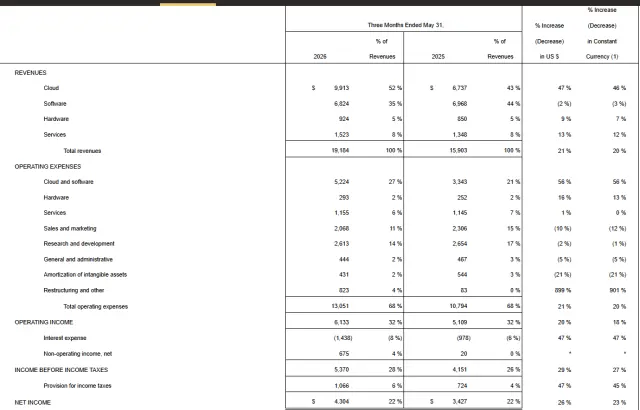
Oracle's fourth-quarter financial data
Operating profit was $6.1 billion, a 20% increase compared to $5.1 billion in the same period last year; excluding U.S. GAAP, Oracle's adjusted operating profit for the fourth quarter was $8.6 billion, compared to $7 billion in the same period last year.
Operating profit margin was 32%, compared to an operating profit margin of 33% in the same period last year. Excluding U.S. GAAP, Oracle's operating profit margin for the fourth quarter was 45%, compared to 44% in the same period last year.
Net profit was $4.22 billion, a 23% increase compared to $3.43 billion in the same period last year. Excluding U.S. GAAP, Oracle's net profit for the fourth quarter was $6.2 billion, a 26% increase compared to $4.9 billion in the same period last year.
Diluted earnings per share were $1.45, a 21% increase compared to diluted earnings per share of $1.19 in the same period last year. Excluding U.S. GAAP, diluted earnings per share were $2.11, a 24% increase compared to $1.70 in the same period last year.
For the full year, Oracle's total revenue was $67.4 billion, a 17% year-on-year increase, setting a record high. Among them, cloud business revenue for the year was $34 billion, a 39% increase, while software revenue was $24.5 billion, a 1% decline.
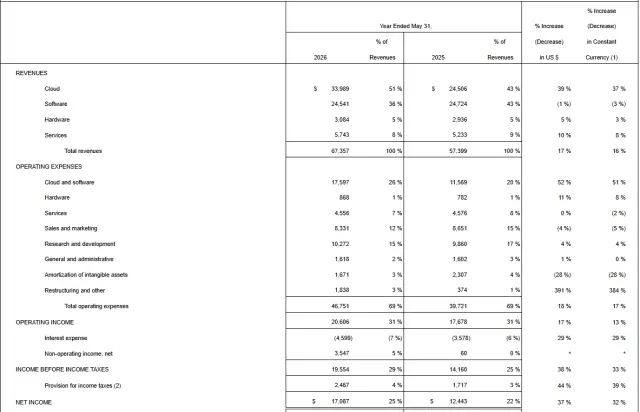
Oracle's full-year financial data for fiscal year 2026
Net profit was $17 billion, a 36% year-on-year increase. Excluding U.S. GAAP, net profit was $22.2 billion, a 29% year-on-year increase. Earnings per share were $5.83, a 34% year-on-year increase. Excluding U.S. GAAP, earnings per share were $7.63, a 27% year-on-year increase.
Behind the record revenue, AI is pushing Oracle's revenue ceiling and also increasing its capital expenditure pressure.
Oracle's operating cash flow for fiscal year 2026 was $32 billion, a 54% year-on-year increase. Free cash flow was negative $23.7 billion, and capital expenditures were $55.7 billion.
Oracle also announced a quarterly dividend of $0.50 per share, to be paid on July 24, 2026, to shareholders registered at the close of business on July 10, 2026.
After the earnings report was released, Oracle's stock price fell by as much as 5%. Previously, Oracle's stock price had risen 3% for the year, underperforming the S&P 500 index, which rose by 6% during the same period.
01 Cloud Business Supports Half of Oracle's Revenue
Oracle's cloud business (IaaS plus SaaS) contributed $9.9 billion in revenue in the fourth quarter, a 47% year-on-year increase, accounting for half of the company's total revenue.
Among these, the real driver of growth was the cloud infrastructure business (IaaS), which generated $5.8 billion in revenue in a single quarter, a 93% year-on-year increase. This growth slightly exceeded market expectations of 91%, placing it at the top level within the entire cloud computing industry. The company achieved a total annual IaaS revenue of $18.1 billion, a 77% increase.
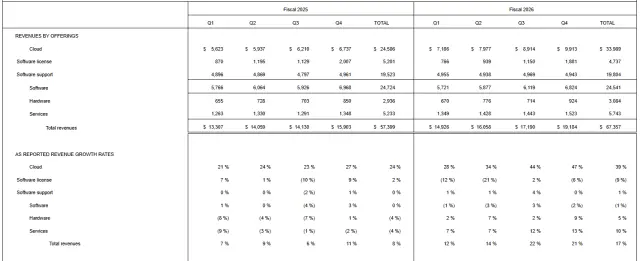
Oracle's Financial Data by Business Segment
In contrast, cloud application business (SaaS) revenue for the fourth quarter was $4.1 billion, with a growth rate of 10%, indicating steady but unremarkable performance.
Meanwhile, revenue from traditional software licensing and support continued to decline, with quarterly revenue of $6.8 billion, a 2% year-on-year decrease, indicating that the trend of customer migration to the cloud has not stopped. Services and hardware businesses grew by 13% and 9%, respectively, which are smaller in scale and have limited impact on the overall trend of the company.
Both database and application businesses benefited from Oracle's early adoption of AI. Revenue from Oracle's multi-cloud AI database grew by 404% in the fourth quarter, with order volume increasing by 325% year-on-year, making it the fastest-growing business in the company's history. This growth validates that AI-related demand is not only limited to the infrastructure level but is also penetrating upstream into data management.
In the earnings report, Oracle attributed its performance growth to the widespread demand for the company's cloud technologies and application suites. From the changes in revenue structure, Oracle has basically completed its transformation from a database software company to a cloud infrastructure provider, with the demand for computing power driven by AI being the biggest thrust behind this transformation.
02 $638 billion in Orders Based on AI Bets
The most striking figure in the earnings report is the remaining performance obligations, which is the total amount of orders that have been signed but not yet recognized as revenue.
As of the end of the fourth quarter, this figure reached $638 billion, up from $553 billion a quarter earlier, representing a net increase of $85 billion in three months, and a year-on-year increase of 363%. Wall Street analysts had previously predicted this figure to be around $590 billion to $600 billion, and the actual data far exceeded expectations.
Bank of America analysts pointed out a key piece of information in their report: over half of this $638 billion comes from OpenAI. In other words, Oracle's largest customer is an AI startup, which is itself burning through a lot of cash.
Oracle explained the composition of these orders in a statement. Most of the new RPO comes from large-scale AI contracts, which are either prepaid GPU purchases by customers or GPUs that customers themselves have bought to deploy with Oracle. Currently, these contracts, which involve customers bearing hardware costs, have a cumulative amount of $75 billion. Oracle explained that this arrangement significantly alleviates the financial pressure on the company to raise funds for building AI data centers.
This structure reduces some financial risk for Oracle. However, the problem arises if the biggest customer faces financial pressure itself or if overall demand in the AI industry fluctuates; a highly concentrated order structure can be a risk point.
Reuters analysts noted that the software industry is facing investors' concerns that AI tools may replace traditional software products, which could pull enterprise customers away from the traditional software space, posing an additional challenge to Oracle.
03 Huge Orders Come with Heavier Capital Expenditures
The $638 billion orders supporting Oracle come with enormous capital investments. Oracle's capital expenditures for the fourth quarter were $15.9 billion, totaling $55.7 billion for the year, significantly exceeding Oracle's own previous guidance of $50 billion.
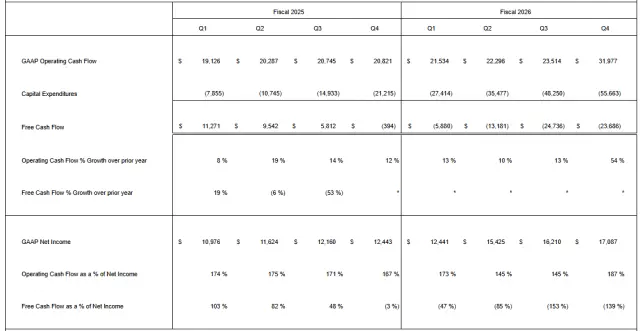
Oracle's free cash flow turned negative $23.7 billion.
This directly led to a deterioration in free cash flow. Although operating cash flow of $32 billion for the year set a record, free cash flow turned negative $23.7 billion after deducting capital expenditures.
To fill the funding gap, Oracle raised $43 billion through debt financing and $5 billion through equity financing in fiscal year 2026.
The company also announced a plan to raise another $40 billion in fiscal year 2027, including previously disclosed equity financing of $20 billion. Oracle stated that it will not issue new debt in the second half of 2026, but this news did not stabilize market sentiment.
CNBC believes that the previous fundraising actions have raised investor concerns, as there is uncertainty over whether market demand for AI can absorb such huge additional capital. When the company increases its financing scale again, such concerns are further exacerbated.
Reuters further analyzed that Oracle's performance may intensify investor concerns in two areas: first, the disruption of traditional software demand driven by AI could pull enterprise customers away from the traditional software field; second, the high debt levels on Oracle's balance sheet themselves could constitute financial risk.
TD Cowen analyst Derrick Wood pointed out that Oracle's stock price previously rose, possibly due to investors being more optimistic about the prospects of cloud service providers and Oracle's most important customer, OpenAI.
In other words, the market had accumulated certain gains and optimistic expectations before the earnings report was released. When new financing plans and higher-than-expected capital expenditures became public, some investors chose to reassess risks or take profits, which amplified the pullback in stock price.
04 FY2027 Revenue Target $90 Billion
Oracle has provided clear expectations for its next phase of growth.
In the first quarter of fiscal year 2027, total revenue growth is expected to be between 27% and 29%, with adjusted earnings per share between $1.72 and $1.76. The median of these two guidance figures is above analysts' expectations. Additionally, the revenue growth guidance for the cloud business is set at 57% to 63%, continuing to maintain a high growth trend.
For the entire fiscal year 2027, Oracle reiterated its revenue target of $90 billion while raising its adjusted earnings per share guidance to $8.05.
This growth rate is calculated after excluding one-time items such as the sale of the Ampere chip business and Bloom Energy warrants from fiscal year 2026, resulting in an actual year-on-year growth rate of about 18%. Analysts had previously expected earnings per share of $8.01 and revenue of $88.9 billion.
05 Focused Bet on AI in Healthcare
In addition to cloud infrastructure and AI computing orders, Oracle is trying to extend its AI capabilities to more specific industry applications, with healthcare as one of its emphasized directions.
Oracle's health application suite will launch an AI-based Cerner patient care management system for hospitals and clinics, and this product is expected to push the overall growth rate of the health business into double digits in fiscal year 2027. Oracle emphasized in its statement that this is just the beginning of the health business expansion.
In the long-term technology outlook, Oracle believes that AI is about to completely change healthcare. The company outlined three specific directions: the Oracle Health AI system will reduce the time doctors spend in front of computers, allowing more time for patients; AI molecular design models are expected to accelerate the development of life-saving drugs by researchers; and the new AI clinical trial system aims to enable regulators to quickly review and approve clinical trial results, allowing patients to access new drugs more quickly.
Oracle does not want to be just an AI computing supplier; it also hopes to integrate AI capabilities into specific processes such as healthcare software, drug development, and clinical trials. However, compared to cloud infrastructure orders, this part of the business is still at an earlier stage, and whether it can truly translate into scalable revenue still needs time to verify.
免责声明:本文章仅代表作者个人观点,不代表本平台的立场和观点。本文章仅供信息分享,不构成对任何人的任何投资建议。用户与作者之间的任何争议,与本平台无关。如网页中刊载的文章或图片涉及侵权,请提供相关的权利证明和身份证明发送邮件到support@aicoin.com,本平台相关工作人员将会进行核查。


