The most cruel aspect of AI is not that it doesn’t provide answers to the poor.
On the contrary, it gives answers to everyone.
It provides students with essay frameworks, employees with email templates, entrepreneurs with business plans, and ordinary people with legal explanations, investment advice, and career planning. For the first time, answers are so cheap, so abundant, and so realistic.
But here lies the problem: when answers are accessible to everyone, what becomes truly scarce is not the answers but the ability to evaluate them.
The new information poor are not those shut out from AI, but those who have received answers yet lack the ability to evaluate them and the means to turn those answers into real opportunities.

1. The Information Gap in the AI Era
The information poor in the internet age were those excluded from the web. The solutions seemed clear: connect the internet, promote devices, improve literacy. The search engine era was a bit more complex, requiring users to learn how to extract keywords, filter sources, and judge credibility, ideally also knowing a bit of English. But these barriers were visible and quantifiable.
The information gap in the AI era has a completely different structure.
Large language models are not search engines; they generate conclusions directly for you. You no longer need to "find" answers—answers are organized into smooth paragraphs, clear steps, and confident tones, delivered right to you. On the surface, the barriers have greatly decreased. But hidden within is a harsh structure: when answers become cheap, so do mistakes; yet the ability to discern "whether this answer is trustworthy" becomes scarcer and more valuable than ever before.
Historically, every diffusion of general technology has followed the same logic: new technology first rewards those who already possess complementary capital. The printing press first benefited literate individuals; computers first benefited those who understood office software and programming; the internet first benefited those with strong English skills and proficient search abilities. The complementary capital for AI includes educational background, professional knowledge, critical thinking, organizational authorization, payment capacity, and that most difficult to quantify—judgment.
New technologies rarely reward those who need them most first. They typically reward those who can leverage them most effectively.
2. The First Divide is the Path to AI
The first fissure of inequality has been drawn before you open the application.
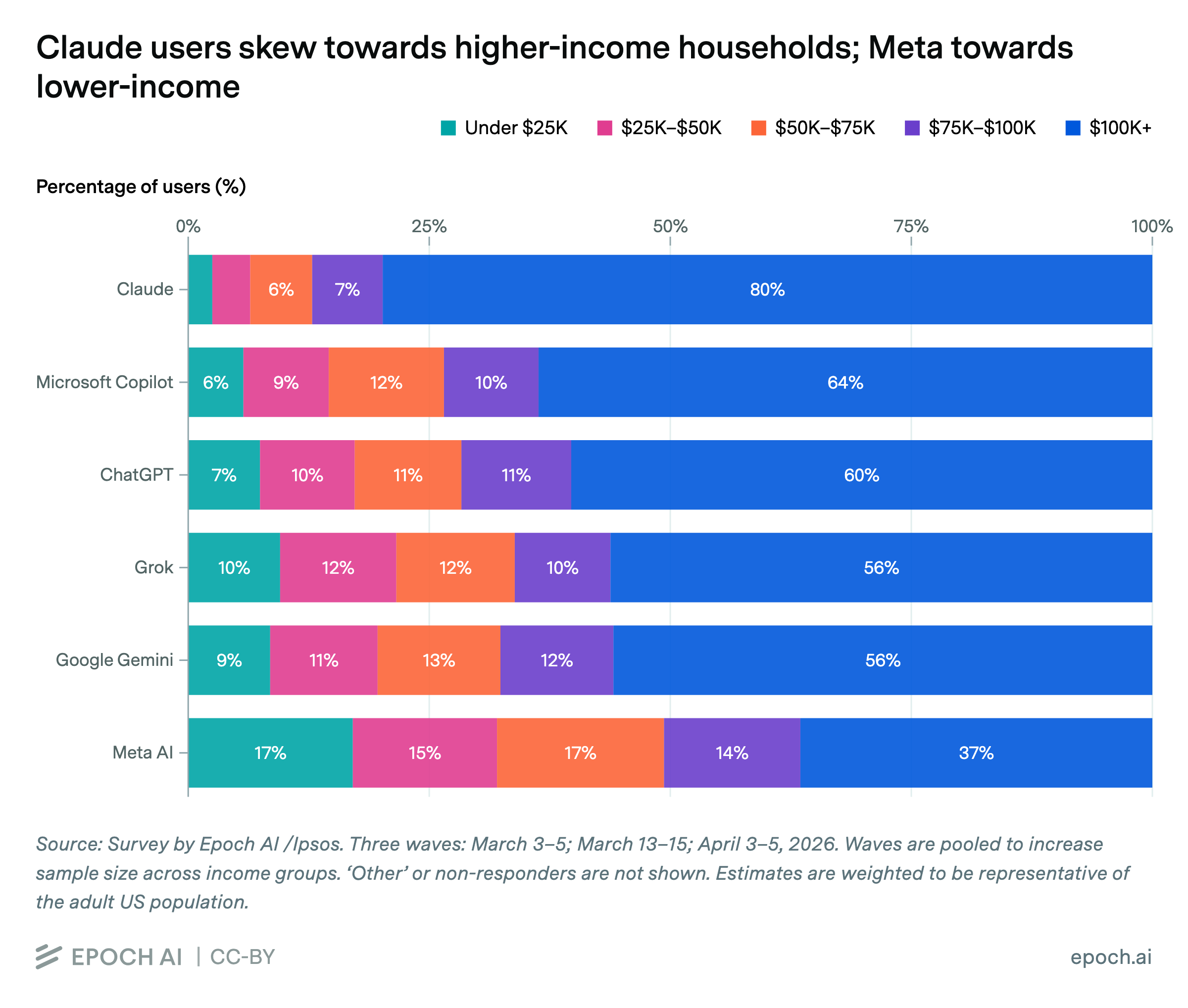
In April 2026, the AI research institution Epoch AI and polling company Ipsos released a survey of about 5,000 American adults. The three rounds of questionnaires asked a seemingly ordinary question: What AI services have you used in the past week? However, the answers revealed not just simple product preferences but a map intertwined with income, access, and distribution.
Approximately 80% of Claude's weekly active users come from households with annual incomes over $100,000; among Meta AI users, this proportion is only 37%. Conversely, about 32% of Meta AI users come from households with annual incomes below $50,000, while this ratio among Claude users is just 7%.
The importance of these numbers is not that they prove "wealthy people use advanced AI, the poor use free AI." That is the shallowest interpretation. A more pertinent question is: why do different people encounter different AIs in their daily lives?
One person asks AI to suggest a dinner for leftover food in the fridge, to brighten the background of a photo, or to refine a text message. Another person has AI organize client interviews, compare vendor quotes, and identify weak assumptions in a report. Both are utilizing the same technology. However, one usage stops at convenience, while the other enters into a cycle of income, position, and negotiation power.
The differences lie not only among users but also at the entry points. Using Claude requires actively searching, comparing products, understanding capability differences, choosing to pay, and embedding tools into workflows—each step filters people out. Meta AI’s pathway is almost the reverse: it is embedded within social platforms, free and low friction, often encountered passively while users scroll through updates, send messages, or view photos.
This is not a market about taste; it is a market about distribution. Users appear to be choosing tools, while the price and access of the tools are also choosing the users.
Source: epoch.ai
3. The Second Divide is the Use Cases of AI
Even if you find a good AI tool, the second divide awaits you in the workplace.
In ordinary offices, the emergence of AI rarely takes the form of "layoff notices." It first takes over meeting minutes, email drafts, data organization, client categorization, and report preliminary drafts. For managers, this automation frees up time to make judgments; for newcomers and entry-level employees, this automation takes away their opportunities to prove themselves, practice judgment, and access higher-level work.
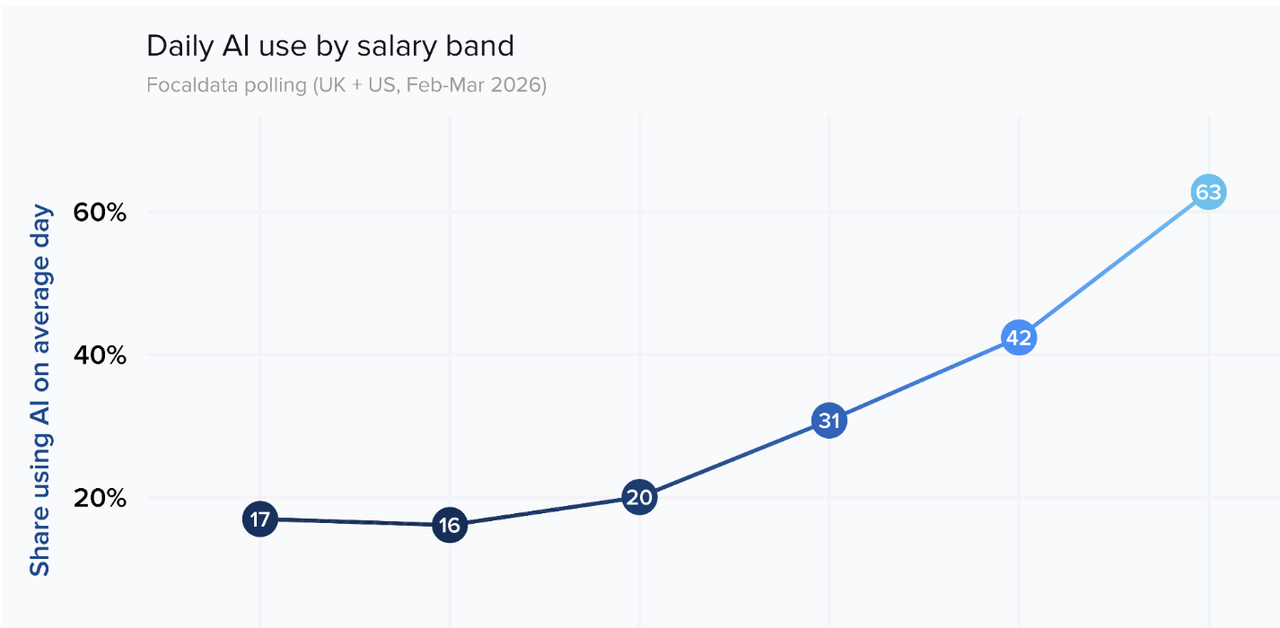
The data reflect a colder reality: a tracking survey on AI usage in the UK and US labor markets conducted by the Financial Times and research institutions (February-March 2026, covering over 4,000 respondents in the UK and US) showed that 63% of workers in the highest pay bracket use AI on regular workdays, whereas the proportions for the lowest two brackets are only 17% and 16%. This is not a gentle slope; it is a cliff.
The more critical discovery lies in the driving factors. A regression analysis of this workplace survey reveals that after controlling for other variables, the effect of salary on AI usage nearly disappears—what truly drives usage are four factors: age, tenure, industry, and training. Among these, training has the largest effect: employees in companies that provide formal AI training have a daily average AI usage rate 37 percentage points higher than comparable companies without training. Even informal guidance leads to a 24 percentage point increase.
However, the reality is that by early 2026, only 14% of employees reported having received formal AI training from their employers, while two-thirds had received no training at all.
AI training is not a technical issue but a distribution issue. Those selected for training are allowed to enter the track of productivity growth; those who are not have tools that are just icons on a screen that can’t be authorized open.
AI is an application on the consumer side but a privilege on the workplace side. And privileges are never evenly distributed.
Source: Focaldata
4. The Last Divide is the Ability to Judge AI
This is the most subtle divide, yet also the most fundamental.
Imagine a recent graduate just entering a consulting firm. They use AI to generate a draft of an industry analysis report, complete with structure, sufficient data, and a confident tone. Their supervisor—a person with ten years of experience in this field—glances at it and points out that two data source citations have methodological defects and that the causal relationship in the third conclusion is flawed. The supervisor’s superiority arises not from working harder but from having that foundational knowledge—knowing where mistakes are likely to occur, understanding which fluency is genuine, and discerning which smoothness is merely an AI filling in the blanks.
This is the real meaning behind the counterintuitive findings in workplace survey data: the heaviest users of AI in the workplace are not the youngest employees but those who have been in their current positions for 2 to 10 years. The relationship between AI usage rates and tenure remains significant, even after controlling for age. This is not because young people don’t want to use it, but because AI's value heavily relies on the existing judgment capacity of the user.
Experience is the most important complementary capital for AI, and experience cannot be subscribed to.
AI lowers the cost of "sounding competent" but does not equally lower the cost of "truly understanding." There is, in fact, an even more dangerous consequence: the less foundational knowledge a user has, the more likely they are to accept AI's output unquestioningly; and the more they accept without questioning, the harder it becomes to cultivate judgment. When agents make judgments for you, you are consuming intelligence rather than accumulating it.
Nobel laureate and MIT professor Daron Acemoglu bluntly states: using AI tools requires a certain level of education, abstract thinking, quantitative ability, and familiarity with technology. "AI is almost certain to increase inequality," he states.
The new information poor are emerging here: they are not those without AI, but those who have AI, access, and answers, yet lack the training to judge those answers; those with tools and scenarios but cannot turn tool outputs into opportunities; those who consume intelligence daily yet have never accumulated it.
5. The Boundaries of Equalization Effects
However, the relationship between AI and inequality is not solely one of widening the gap.
Multiple experimental studies have found that under controlled conditions, AI often provides greater improvements for lower-skilled individuals—this applies to call center employees, junior writers, and entry-level consultants alike. This is understandable: the marginal gains top experts receive from AI are limited; for someone who has never been able to afford professional services, using AI to understand a contract for the first time represents a qualitative leap.
However, a crucial distinction needs to be made: experimental studies measure "improvements after use," while real-world data measures "who actually uses," "who is permitted to use," and "who can turn results into opportunities after using." Both sets of data are truthful; they measure entirely different things.
A technology can narrow the gap in a laboratory while simultaneously widening it in the real world—if the adoption itself is unequal, if the scenarios themselves are unequal, if the judgment itself is unequal.
AI possesses characteristics of equalizing technology but operates within unequal social structures. Both can be true simultaneously, which is the real shape of the problem.
6. Technology Will Diffuse, but the Benefits Will Not Reach Everyone Equally
Each generation tends to believe that the general technology of their era will break old orders.
After the invention of the printing press, literate individuals benefited for several centuries. At the dawn of computerization, it amplified the abilities of those already skilled in office software and coding. The early benefits of the internet flowed to those who understood English, could search effectively, and had the time and motivation to exploit arbitrage opportunities. In every wave of technological advancement, the proclamations of "this time is different" are loud, while structural diverging often takes decades to gradually become visible.
The pace of divergence with AI may be faster and deeper since it impacts not just certain tasks but nearly all jobs reliant on judgment and language. And this is precisely the type of ability that is hardest to standardize and redistribute.
Some believe the gaps will eventually narrow. Economic historian and professor at the Oxford Internet Institute, Carl Benedikt Frey, holds this view, basing it on history: the inequalities brought about by the rise of computers gradually dissipated over decades as the barriers to use lowered. This analogy is not without merit.
The issue is that even if we accept this optimistic historical analogy, Frey himself acknowledges a key limiting condition: "It depends on how long it takes to close the gap. If it's ten or twenty years, that's more concerning."
Ten or twenty years is not a timeframe that can be waited out easily—especially for those who need to find jobs, negotiate salaries, and accumulate experience during that period.
Conclusion
This is a peculiar moment in history: we have for the first time a technology that makes everyone feel like they are becoming smarter.
That feeling is often the endpoint.
The problem is that in an era where success is determined by judgment, treating feelings as the endpoint may be the most costly mistake.
免责声明:本文章仅代表作者个人观点,不代表本平台的立场和观点。本文章仅供信息分享,不构成对任何人的任何投资建议。用户与作者之间的任何争议,与本平台无关。如网页中刊载的文章或图片涉及侵权,请提供相关的权利证明和身份证明发送邮件到support@aicoin.com,本平台相关工作人员将会进行核查。


