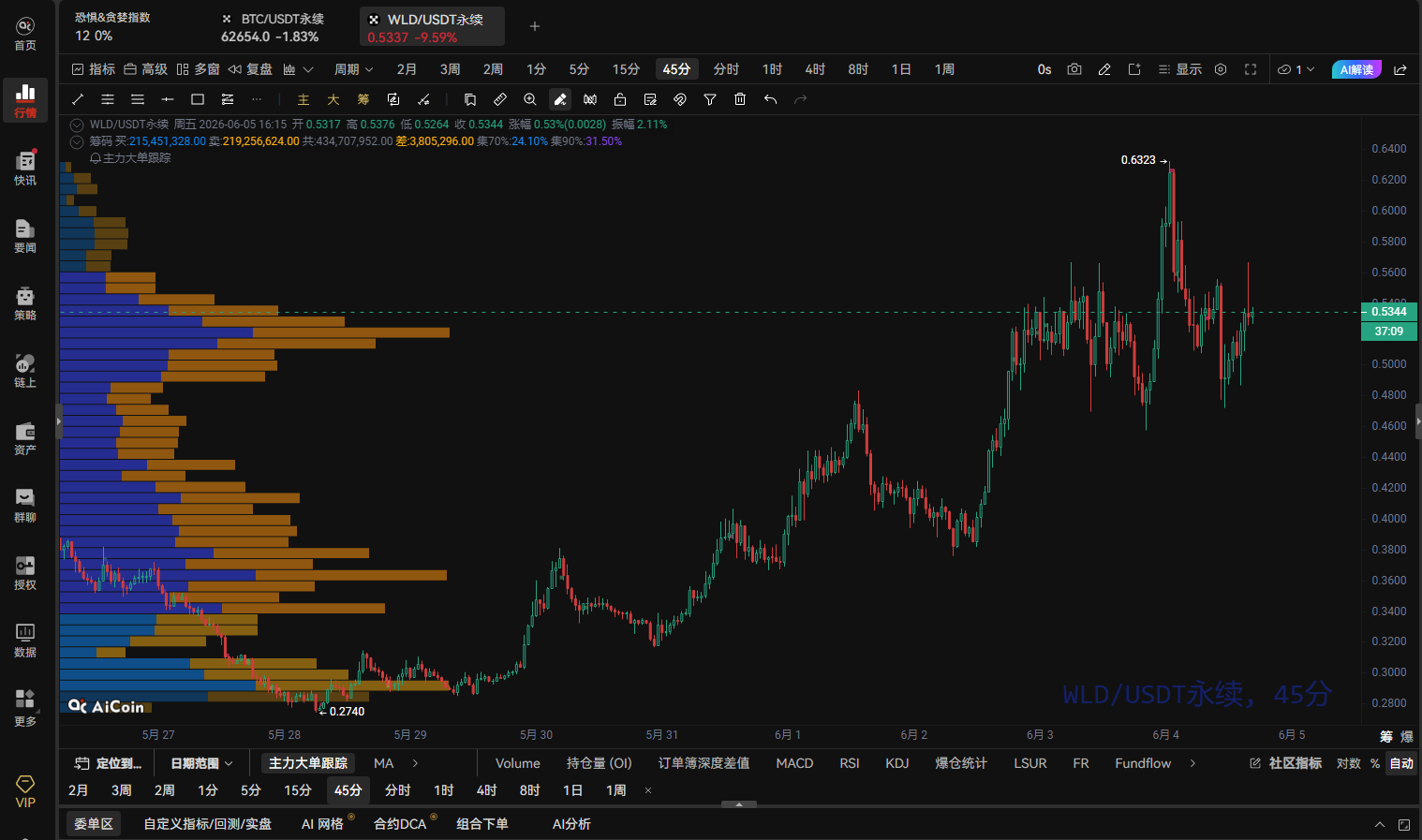
On June 5, 2026, the market woke up with a jolt: the price of Bitcoin fell below the $62,000 mark, momentarily dropping to around $61,9xx within the day, with a 24-hour decline of about 3.5%–3.8%. Not only did it draw near the low range from February, but it also clearly broke below the short-term holders' cost basis of approximately $76,000. CryptoQuant analyst Axel Adler Jr pointed out that the seven-day net realized losses for Bitcoin had expanded to about $7 billion, and when the price approached what was seen as a "potential bottom," selling pressure not only did not weaken but continued to increase. This was interpreted on-chain as a signal of rising risk aversion. At the same time, one of the representatives of privacy coins, ZEC, plummeted about 43% within 24 hours, crashing to about $327. According to on-chain analyst Ai Yi's monitoring, trader Garrett Jin held about $19.45 million in ZEC shorts on the Hyperliquid exchange, realizing a floating profit of approximately $16.48 million in this round of plummet, with a return of about 137.8%. This sudden expansion of profits in a critical time window triggered market debates about his trading timing and sources of information, intertwining Bitcoin's systemic correction with ZEC's extreme volatility into a risk signal that needs to be seriously interpreted.
Failure of 62,000: Bitcoin Bulls Forced to Retreat
On the same timeline as ZEC's crash, Bitcoin's "main front" also clearly faltered. CryptoQuant analyst Axel Adler Jr indicated that Bitcoin was testing around $62,000, the phase low from February 2026, and by June 5, this level, once seen as a "trench" for the bulls, was completely breached, with intraday prices falling into the range of about $61,9xx and a 24-hour decline of about 3.5%–3.8%. Unlike the rapid recovery after a quick dip in February, this time, when the price returned to the same defensive line, it awaited not enthusiastic buyers but larger selling pressure and weaker willingness to absorb.
According to several Chinese media reports, the current cost basis for short-term on-chain holders is roughly around $76,000, meaning a significant portion of recently entered funds is deeply in the red. Some market views have thus shifted downward, suggesting that after breaching $62,000, only two main support areas remain below, with approximately $54,000 seen as the "last line of defense" for this round of bulls. A breach below this level would be interpreted as a signal of comprehensive retreat for the bulls. Coupled with Axel Adler Jr's disclosed data of about $7 billion in seven-day net realized losses, it can be seen that when the price nears what is perceived as a "potential bottom," sellers have not pulled back but rather continued to increase their positions. This combination of price breaching old lows, the expansion of on-chain losses, and the withdrawal of emotional defenses systematically undermines the bulls' confidence in this market cycle.
Seven-day Losses of 7 Billion: Atypical Selling Pressure Increase
The seven-day net realized losses have expanded to approximately $7 billion, essentially meaning that over the past week, the Bitcoin sold was mostly at prices below the purchase price. In other words, it wasn't "locking in profits," but rather massive "cutting losses." CryptoQuant analyst Axel Adler Jr pointed out that when the price returns to about $62,000, regarded as a potential bottom, the selling pressure has not weakened; instead, it continues to increase in this area. This behavior of actively taking losses at potential support levels often occurs in a risk-averse environment—investors prefer to lock in existing losses rather than endure potentially larger drawdowns in the future.
Axel Adler Jr also compared this to the correction in February: at that time, when the price first dipped to the same price area, selling pressure eased near the bottom, with some chips choosing to remain inactive or were absorbed. The market formed a fragile balance between panic and tentative bottom-fishing. However, now the same price range has witnessed an increase in selling pressure, suggesting a change in the behavior of current holders; more individuals view the past "bottom" as this round's "emergency exit," leading what was previously regarded as support to become a concentrated exit for locking in losses. This behavioral difference itself serves as a direct annotation of the weakening of bullish confidence.
ZEC Plunging 43%: Privacy Coins Bear the Brunt of Selling
When Bitcoin fell below $62,000 and slowly slid towards the $61,900 range on June 5, ZEC's movement completely went out of control: it fell about 43% within 24 hours, reaching about $327, significantly outpacing the declines in Bitcoin and most mainstream assets. In the midst of panic, funds prioritized shedding high-volatility, high-controversy tracks, causing the privacy coin sector to become the hardest-hit area of selling in this round of correction. Previously regarded as "highly elastic," these tokens were quickly reevaluated by the market as burdens needing immediate liquidation in a rapidly shrinking risk appetite environment.
Notably, there are currently no publicly confirmed technical or fundamental negative factors that could independently explain this price crash. The Orchard Pool security vulnerability in the Zcash ecosystem was disclosed on May 29 and declared fixed on June 2; this timeline intersects with the price crash on June 5, but whether there is a direct causal relationship between the two is still unverified information. On the other hand, according to on-chain analyst Ai Yi's monitoring, trader Garrett Jin's previously established ZEC shorts worth about $19.45 million on Hyperliquid realized a floating profit of about $16.48 million with a return of approximately 137.8%. This highly "timely" short profit amplified market sensitivity to information asymmetry, but in the absence of more evidence, it resembles a mirror reflecting the emotions and distrust that privacy coins carry during this wave of selling, rather than a concrete case of insider trading.
Dispute Over Hyperliquid ZEC Short's Floating Profit
According to on-chain analyst Ai Yi's monitoring, trader Garrett Jin held about $19.45 million in ZEC shorts on Hyperliquid, and during the same time window of ZEC's 24-hour plunge of about 43% to approximately $327, the floating profit on this position quickly surged to about $16.48 million, corresponding to a return of approximately 137.8%. This “timely” short selling rhythm, set against the backdrop of Bitcoin breaking below $62,000 and already fragile market sentiment during the US session, was quickly interpreted by the community, with some labeling him a "whale" or "seasoned trader," believing he had preemptively bet on the cliff of privacy coins.
The focus of the controversy lies in whether he possessed additional information: on one hand, this short position coincided almost perfectly with ZEC's plunge, viewed as another annotation of information asymmetry; on the other hand, rumors suggested that Garrett Jin might hold a large Bitcoin long position on other platforms with floating losses of approximately $17–18 million and used the ZEC short as a hedge. However, whether as a "whale" or the data concerning Bitcoin long losses currently lacks cross-verification from on-chain or official channels, and there is also no publicly available evidence linking this ZEC short to insider information. Therefore, the more prudent conclusion is to regard the discussions surrounding Garrett Jin as the market's instinctive skepticism towards "precise trading" during periods of high volatility, rather than an established characterization of misbehavior.
Test of Bitcoin and Privacy Coins Under Heightened Risk Aversion
In this round of decline, Bitcoin fell below about $62,000, far below the short-term holders' cost basis of about $76,000, while seven-day net realized losses ballooned to approximately $7 billion, and selling pressure near potential bottoms increased instead. Coupled with ZEC's daily plunge of about 43% and the approximately $19.45 million ZEC shorts on Hyperliquid recording a floating profit of about $16.48 million in a short time, multiple signals point towards a more typical risk-averse environment: high leverage and weak fundamental assets are first concentrated for disposal, while mainstream assets are passively absorbing selling pressure near critical support. What is revealed here is the structural characteristic of privacy coins exhibiting higher volatility and faster liquidation speed under extreme conditions, meaning that the risk pricing and position management for this sector may need to be recalibrated from the notion of "thematic elasticity" to that of "high volatility and high drawdown." Looking forward, variables worth continuous tracking will be whether Bitcoin can hold what some opinions view as the "last line of defense" around the $54,000 range, whether net realized losses gradually converge, the subsequent technological and regulatory developments and impacts on privacy coins, and whether large derivative positions in places like Hyperliquid continue to undergo concentrated adjustments. These changes will collectively determine whether the current risk aversion sentiment is a temporary release or evolves into deeper cyclical adjustments.
Join our community to discuss and grow stronger together!
Exclusive Hyperliquid benefits for AiCoin: https://app.hyperliquid.xyz/join/AICOIN88
Exclusive Aster benefits for AiCoin: https://www.asterdex.com/zh-CN/referral/9C50e2
On-chain Telegram community: https://t.me/AiCoinWhaleData
On-chain community: https://www.aicoin.com/link/chat?cid=N6OVMor5g
AiCoin on-chain Twitter: https://x.com/aicoinwhaledata
免责声明:本文章仅代表作者个人观点,不代表本平台的立场和观点。本文章仅供信息分享,不构成对任何人的任何投资建议。用户与作者之间的任何争议,与本平台无关。如网页中刊载的文章或图片涉及侵权,请提供相关的权利证明和身份证明发送邮件到support@aicoin.com,本平台相关工作人员将会进行核查。