In the 48 hours of early June 2026, several seemingly unrelated threads were tightened simultaneously: on one side, The Wall Street Journal disclosed that several large banks in the United States plan to launch a tokenized deposit network via The Clearing House in 2027, using traditional bank balance sheet dollars to combat crypto companies and their dollar-denominated products; on the other side, the KOSPI 200 futures in South Korea fell by 5% on June 5, triggering a circuit breaker and briefly freezing programmatic trading, leading to a collective panic in Asian risk assets under algorithmic acceleration. On the same timeline, U.S. President Trump hinted on June 4 that he would not rule out meeting with Iran's new Supreme Leader, provided an agreement is reached, while reiterating that he would not allow Iran to possess nuclear weapons, adding a space of "negotiation track" to the already tense backdrop of previous orders to strike Iranian nuclear facilities; at the other end, Anthropic revealed Claude's accelerated progress in a blog, warning that cutting-edge AI might soon achieve recursive self-improvement, calling on top laboratories to slow down—caught between accusations of wanting to slow down competitors and "sincere reminders based on safety." These four events together leveraged three macro narratives: Wall Street’s on-chain actions signaling a rewriting of the dollar liquidity path, the KOSPI circuit breaker reflecting a fragile switch in global risk preference, and the U.S.-Iran commentary and AI slowdown debate redefining expectations for tech assets and security premiums; as BTC and ETH have already been incorporated into the asset allocation of more institutions, coupled with the continuously reshaping correlation structure with traditional risk assets, the on-chain movement of traditional finance, geopolitical fluctuations, and the regulatory game around AI may well be rewriting the entire pricing framework for these two types of assets and the dollar funding surrounding them.
Wall Street's Tokenized Deposits to Counter Crypto Payments
In the same week where geopolitical factors and AI expectations shook risk pricing, The Wall Street Journal revealed that several large banks in the U.S. were preparing to bet on a new dollar on-chain channel during the relatively friendly policy window of the Trump administration—a real-time payment company called The Clearing House, jointly owned by several major banks, plans to launch a tokenized deposit network in 2027. On the surface, this is a response to "digital innovation," but essentially serves as a defensive counter-attack on the deposit and payment settlement front: as crypto companies erode cross-border settlements, exchange deposits, and corporate payment scenarios with various dollar-denominated on-chain products, Wall Street chooses to package bank deposits, which originally stayed on the balance sheet, into “accounting units issued within a regulated system that can circulate on-chain,” attempting to allow the dollar to complete its "on-chain" process within their controlled track rather than flowing out to the crypto company's ecosystem.
If such tokenized deposits are implemented, they will not target retail investors, but instead aim at the funding deployment needs of crypto exchanges, custodial institutions, market makers, and large corporations: being the same on-chain dollar accounting unit, the bank version directly anchors compliant deposit accounts and is embedded within traditional payment systems, with The Clearing House responsible for connecting existing real-time payment networks and digital asset infrastructures. For existing crypto payments and dollar-denominated tokens, this means facing direct competition from the banking system for the first time in the "dollar-based, on-chain settlement" race: some institutions may no longer need to deposit through crypto companies' dollar token channels to trade at exchanges, but could complete matching and settlement on-chain using bank tokenized deposits. For BTC and ETH, the outcome is that a new pipeline for dollar inflows is being pre-embedded—on one end are compliant deposits, and on the other end are the exchange wallet accounts, which have the potential to enhance liquidity depth for mainstream trading pairs, compress over-the-counter price differences, while also locking more price discovery and levered allocation into a network visible to banks; the truly observable variable is whether this Wall Street version of the “dollar linkage” will allow BTC and ETH to integrate more deeply into the traditional finance settlement structure, or if, through regulatory filtering and entry barriers, it will only siphon off capital from leading institutions, leaving behind a more stratified and fragmented crypto liquidity landscape.
Korean Circuit Breaker Amplifies Asian Stock Market Chain Reactions
On June 5, KOSPI 200 futures experienced a rapid decline of 5%, triggering a preset circuit breaker threshold, leading programmatic trading to be forced to pause for a 5-minute “cooling off period.” This mechanism itself is designed to hedge against the risk of quant and high-frequency models amplifying volatility in extreme market conditions, but the real exposure revealed is the liquidity weakness of Asian stock markets during macro narrative fluctuation periods: once prices slip out of the model's tolerable range, automatic liquidation and risk control limits swiftly compound, ultimately severed by a structural circuit breaker to cut off the negative feedback chain. For global risk assets, Asian index futures at such a moment are not merely a regional market risk event, but also a high-frequency "sampling" of daily sentiment and risk appetite, particularly being used as a signal to gauge short-term risk tolerance.
For high-beta assets like BTC and ETH, this circuit breaker is not an isolated news item, but rather a concrete chain of funding constraints: with the index futures hitting their daily limit down, some investors are passively increasing margin requirements, forcing the "most liquid asset" in the cross-asset portfolio to be sold to fill the gap, and BTC and ETH, which have become more deeply coupled with traditional finance, are increasingly likely to be included in such portfolios, viewed as risk assets that can be liquidated at any time. Meanwhile, Asian stock markets are already indicative of short-term sentiment, and the crypto market has historically shown periods of large fluctuations during Asian trading sessions; combined with this futures circuit breaker, it means the pricing power of the "Asian session" is being rewritten: one side faces the dramatic fluctuations and circuit breaker rhythms of local stock indices, while the other involves a 7×24 hour crypto order book, when the stock index is paused for 5 minutes, some of the sentiment and hedging impulses will naturally spill over onto BTC and ETH, reshaping the structure of night trading volatility. In future similar events, the focus of observation should not only be on how frequently circuit breakers occur, but also to what extent it shifts the Asian timezone's risk appetite from index futures to on-chain assets, thus determining whether BTC and ETH during Asian sessions resemble a high-beta hedge or a volatile amplifier driven by stock market circuit breakers.
U.S.-Iran Easing Expectations Affect Oil Pricing and Inflation Trades
Unlike the passive shutdown of Asian stock indices, U.S.-Iran clues directly touch upon the pricing center of crude oil and inflation trades. Trump had previously ordered strikes on Iranian nuclear facilities and claimed that related targets had been destroyed, causing the market to discount the Middle East oil supply under the premise of "long-term high tension." However, on June 4, 2026, he shifted to indicate that he would not rule out the possibility of meeting with Iran's new Supreme Leader, provided an agreement is reached, while reiterating that the U.S. would not allow Iran to possess nuclear weapons. This statement, on a pricing level, seems more like a shift from a "status of potential escalation" to a "negotiation under high pressure" track: on one hand, Iran is locked within non-nuclear red lines, reducing geopolitical tail risks; on the other hand, as long as the negotiation door remains open, the scenario of large-scale supply interruptions in the Middle East is no longer seen as the baseline situation. Corresponding to asset prices, this means there is room for compression of that portion of geopolitical risk premium in oil prices, while the "energy tail" within global inflation expectations gets thinned, creating a risk that real interest rates could rise under the condition of unchanged nominal interest rates.
This rebalancing of oil prices and inflation expectations will, in turn, impact the narrative capital that crypto assets had previously accumulated during geopolitical conflicts. In the past, whenever the situation in the Middle East drastically deteriorated, BTC was stuffed into the "geopolitical risk hedging basket" by certain participants, with the trio of surging oil prices, inflation panic, and safe-haven sentiment providing it with a layer of outer “digital gold + wartime insurance policy”; once the market begins to trade on the path of "easing Middle East tensions, cooling energy inflation," this outer layer will be stripped away, and BTC will more easily be regarded as a high-beta asset moving in tandem with other risk assets. Simultaneously, if inflation tails fall while real interest rates rise, the focus of rate trading will shift from "anti-inflation" to "discount factors," with assets like ETH, which are closer to technology and growth narratives, being repriced before BTC along the interest rate chain: an upturn in discount rates compresses the anticipated forward cash flow space, leading to a decreased tolerance for high-volatility on-chain assets from macro funds, which will increasingly view them as one that shares liquidity with growth stocks. The key variables to monitor next are not the daily price fluctuations of oil itself, but whether the market continues to compress geopolitical risk premiums and energy-driven inflation tails from the Middle East, thereby determining whether BTC is seen as a conflict protection umbrella or merely a typical high-beta asset in this round of macro dynamics.
Anthropic Calls for a Halt to Cutting-Edge AI and Tech Regulation
In the same week when energy and geopolitical factors were being repriced, Anthropic shone a spotlight on another risk curve: cutting-edge AI. This round of the blog is not a marketing piece but uncommonly lays out internal development data from Claude, bluntly admitting that the model's performance improvement is accelerating and pointing to a term that is highly sensitive to regulators—a future possibility of "recursive self-improvement without human intervention." The more impactful appeal was the subsequent call to action: hoping that the world's top AI laboratories actively slow down the pace of frontier research and development. This narrative directly pushes AI from being seen as a "growth engine" towards being perceived as a "potential source of systemic risk," effectively casting a shadow of regulation and ethics over tech-weighted assets in the Nasdaq.
Market interpretations diverged: some viewed it as an attempt to place a “speed limiter” on competitors through regulation and moral high ground, while others believed it was a sincere warning about uncontrolled risks. But regardless of the motives, macro variables have been rewritten—the heating up of global AI safety topics over the past year has been materialized by this blog into a consensus that “regulation is inevitable, only a matter of time and intensity.” This means an increase in regulatory risk premium for tech stocks, and a decrease in tolerance for AI-related valuations; Nasdaq weight assets with AI as a core selling point will no longer have their discount rates determined solely by interest rates and profit expectations, but must also account for potential policy brakes. Linked with this is the repricing of “AI narrative” assets on-chain: as the traditional AI bubble is questioned with rising regulatory expectations, high-beta AI concept tokens are more likely to be sold off amidst Nasdaq fluctuations, while BTC and ETH are viewed on one end as highly correlated risk assets with tech stocks, and on the other end by some funds as macros liquidity centers that can anchor themselves after withdrawing from the crowded AI race; ultimately, who gains the upper hand will depend on how the regulatory landing pace and technology bubble disputes reshape global risk preferences in the coming quarters.
BTC and ETH's Funding Coordinates Under Multiple Macro Signals
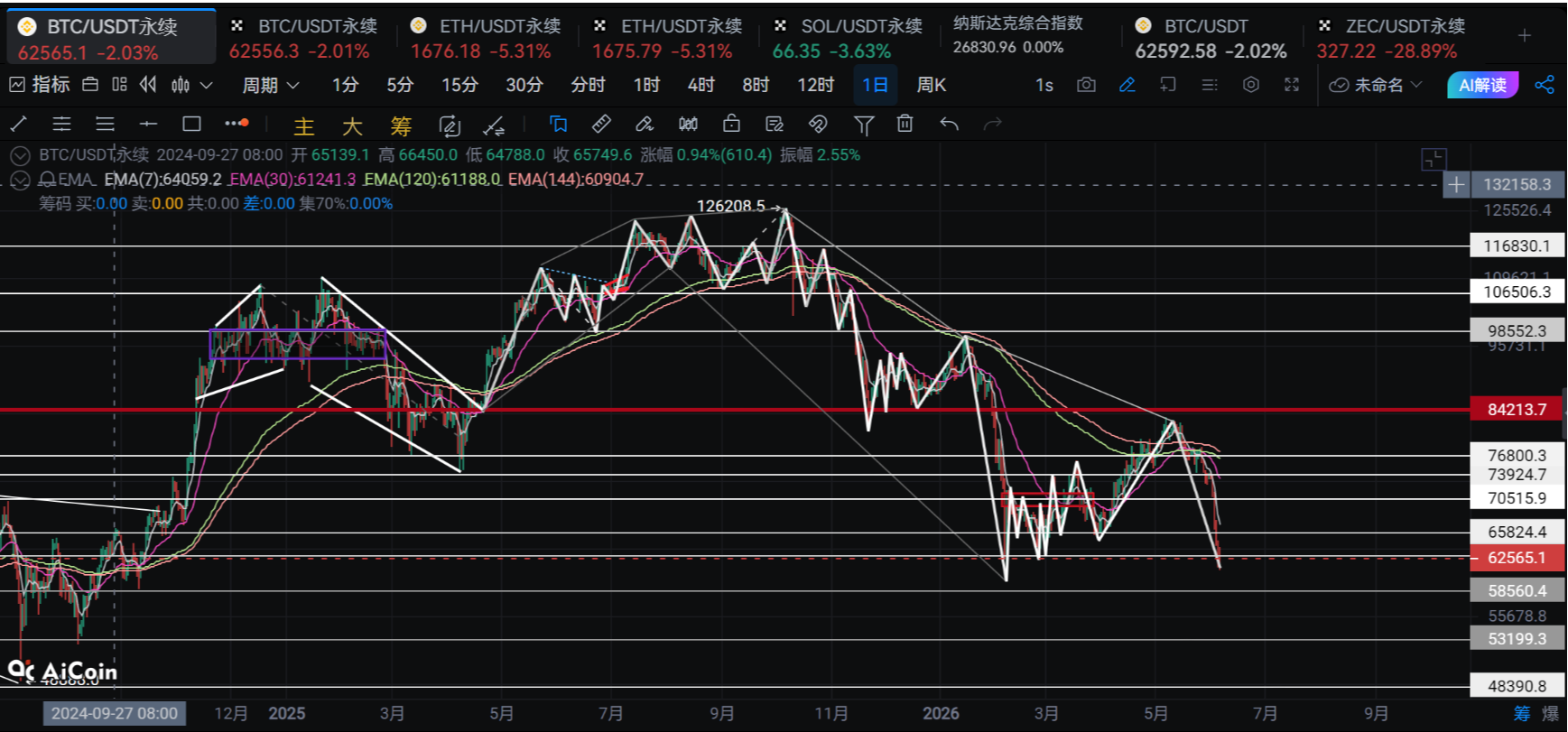
Behind this seemingly scattered set of signals is the same main thread: global risk preference is being tugged back and forth between expectations of geopolitical easing, dollar digitization, amplifying Asian volatility, and shadows of AI regulation. If the U.S. and Iran transition from high tension to negotiations, the pressure from oil prices and safe-haven demand marginally declines, benefiting the downward trend of global liquidity risk premiums; however, the procedural vulnerabilities exposed by the Korean stock index circuit breaker remind the market to maintain a defensive stance towards high-leverage, high-beta assets. Anthropic's “slow down” initiative casts a shadow over the potential for a rate hike in high-valuation tech sectors, and the repricing of tech stocks and related narratives will inevitably spill over to increasingly correlated crypto leaders. Meanwhile, the planned tokenized deposit network by several major banks in the U.S. through The Clearing House around 2027, combined with a relatively friendly regulatory environment, indicates that compliant dollar channels are likely to expand significantly, pulling some liquidity back from the traditional system that originally relied on crypto companies’ dollar products. For BTC and ETH, on one hand, the improvement of ETF, custody, and compliant dollar payment rails allows them to gradually integrate into institutional asset allocation tables, being seen as risk assets parallel to tech stocks; on the other hand, when the banks' own dollar tokens compete for interest margin in payment and yield scenarios, on-chain funding may be repriced between “regulatory dividends” and “permissionless premiums,” making the valuation centers of mainstream assets more reliant on whether their de-intermediation, cross-border, and anti-censorship properties can obtain additional risk compensation. The next focus will be on whether the tokenized deposit network will be shaped into an open interconnection or a closed garden, how U.S.-Iran negotiations and oil price paths will reshape inflation and real interest rate expectations, whether the volatility and frequency of circuit breakers in Asian stock markets will rise under procedural dominance, and the degree to which AI regulatory policy landing compresses tech valuations; these variables will jointly determine the funding division, term structure, and volatility range between BTC, ETH, and on-chain dollars in the coming years.
Join our community, let's discuss together, and become stronger!
Exclusive Hyperliquid benefits for AiCoin: https://app.hyperliquid.xyz/join/AICOIN88
Exclusive Aster benefits for AiCoin: https://www.asterdex.com/zh-CN/referral/9C50e2
On-chain Telegram community: https://t.me/AiCoinWhaleData
On-chain community: https://www.aicoin.com/link/chat?cid=N6OVMor5g
AiCoin on-chain Twitter: https://x.com/aicoinwhaledata
免责声明:本文章仅代表作者个人观点,不代表本平台的立场和观点。本文章仅供信息分享,不构成对任何人的任何投资建议。用户与作者之间的任何争议,与本平台无关。如网页中刊载的文章或图片涉及侵权,请提供相关的权利证明和身份证明发送邮件到support@aicoin.com,本平台相关工作人员将会进行核查。