McKinsey predicts that by 2030, artificial intelligence agents will facilitate between $3 trillion and $5 trillion in global consumer commercial transactions.
Written by: Prathik Desai
Translated by: Block unicorn
In March of this year, OpenAI shut down a feature that allowed AI agents to shop on behalf of users. Since its launch, in just five months, fewer than 30 Shopify merchants had used this feature. There is no issue with the payment infrastructure itself; the problem lies in the lack of rules to ensure a smooth shopping experience. Questions such as what products agents can purchase, who collects sales tax, how to identify fraud, and who handles returns—all these issues have not been adequately resolved.
Providing wallets for agents or building payment infrastructure is relatively easy. However, enabling individuals or businesses to use agents for consumption in a trustworthy and regulated manner is not a simple task. Only programmability and rules can ensure a trustworthy environment. This lack of governance presents opportunities for the agent economy.
Last year, artificial intelligence agents processed 176 million transactions totaling $73 million. Although this number seems insignificant now, McKinsey predicts that by 2030, AI agents will facilitate between $3 trillion and $5 trillion in global consumer commercial transactions.
Companies building this economic system are competing to control the governance layer, including expenditure controls, identity verification, and policy enforcement, which determine which agents have the authority to manage budgets.
Today, we will analyze who is building the banking layer for robots and what benefits those who dominate that layer can gain.
Why have a multi-layer architecture?
The economic benefits of processing agent payments are very low. In the past 12 months, the average payment amount for AI agents was only 31 cents.
Think about it: a 31-cent payment leaves very little profit for those handling transactions in the background through multi-level processing. Stripe's standard pricing is a 2.9% fee plus a 30-cent fixed charge, which results in merchants receiving less than a tenth of a cent. Visa's interchange fees then swallow a third of that. On the other hand, Layer-2 stablecoin payment systems process the same transactions for just $0.0001.
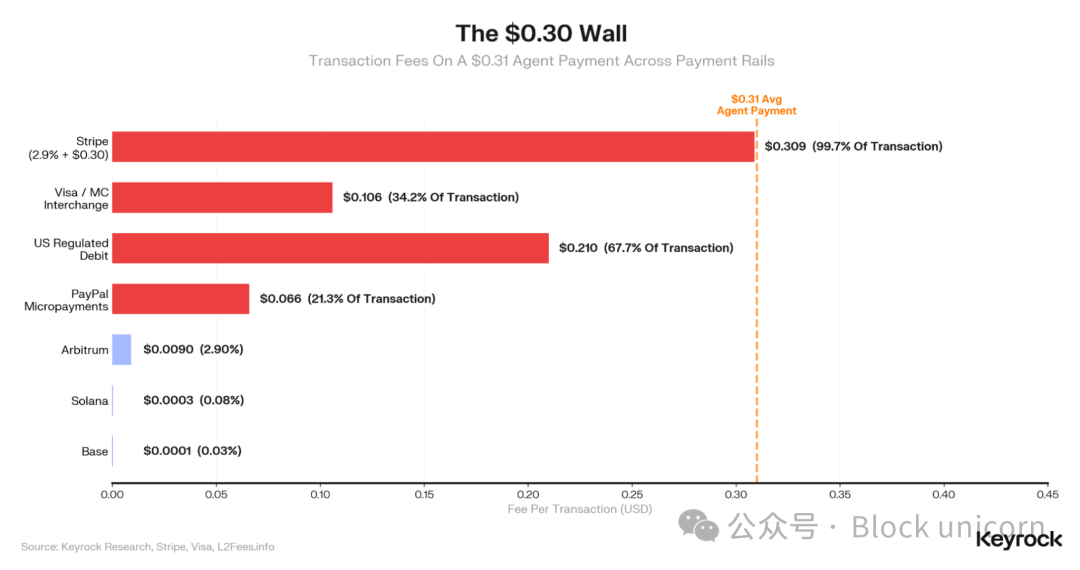
These economic factors provide the basis for the application of cryptocurrency at the settlement layer.
The payment infrastructure at the settlement layer is mostly complete. Coinbase's x402 protocol handled the vast majority of the 176 million transactions last year, and approximately 3,900 merchants currently accept agent payments. Stripe and Tempo collaborated to develop a competing protocol—the Machine Payment Protocol (MPP), launched in March, integrating over 100 services. Google, Visa, and Mastercard also launched agent payment products around the same time. This means that within just 12 months, five competing payment architectures have emerged.
However, the problem with agent payments is that no one can get rich processing 31 cent payments. Thus, the value is concentrated on the circulating funds and the enforcement of rules about how agents are to be paid.
Last week, we explained how businesses can gain value by having a wallet layer that stores AI agent stablecoin balances. But the floating balance is just one of many value layers to capture. Another value layer is the rules governing the use of the floating balance.
These rules include expenditure controls, agent identity verification, policy enforcement, audit trails, and liability allocation when transactions fail. This layer is completely open.
In April of this year, American Express launched the Agent Purchase Protection plan, an insurance product aimed at covering losses incurred by AI agents due to erroneous purchases. This essentially acknowledges the current state of governance concerning AI agents. In an industry projected to reach a scale of $3 trillion to $5 trillion within five years, addressing governance deficiencies holds significant value.
This is why current government officials are vying for control of the governance layer.
But at which layer should this layer be constructed? It could be at the bank level, developer API, or even the wallet.
The Wallet as the Governance Layer
Every transaction made by agents must pass through a wallet. Therefore, the wallet is the best entry point for implementing spending limits, identity verification, and manual approvals. Once you control the wallet, you gain management authority. Payment infrastructure company Stripe recognized this early on.
In June 2025, Stripe acquired Privy, a company that builds embedded wallets for consumer-facing apps. Through this acquisition, Stripe gained 75 million wallets spread across over 1,000 development teams. These wallets are now at a critical junction for cash flow, where all policies, spending limits, and manual approvals must be executed before funds move.
Stripe also built a complete technology stack for agent payments. It acquired Bridge to handle stablecoin coordination and fiat conversions. Additionally, it partnered with Paradigm to incubate Tempo, a Layer-1 blockchain focused on payments. Stripe and Tempo jointly authored the Machine Payment Protocol (MPP), which is an open standard for regulating how agents request, authorize, and settle payments.
Stripe's agent-ready financial solutions now support software for balance inquiries, bill payments, fund storage, virtual card creation, and transfers. Agents can autonomously execute routine payments, but any action that exceeds their policy limits will be flagged for manual review. Fund balances are supported by non-custodial Privy wallets across more than 150 markets.
Even Amazon, when needing to allow its developers to grant AI agents consumption capabilities, chose two wallet companies—Privy and Coinbase. Instead of experienced financial institutions like banks or credit card networks, it went with a wallet provider that has only been established for five years.
This is because wallets serve as ideal checkpoints, allowing for a proper degree of human intervention to ensure necessary checks and balances.
Keyrock noted in its report "Who Pays for the Agents" that the agent commercial market will "tend toward equilibrium, where agents have substantial autonomy, but operate within the boundaries enforced by cryptographic measures, which can be audited and revoked by humans."
This is the position of Privy within the Stripe technology stack. Wallets are responsible for setting the boundaries within which agents must operate.
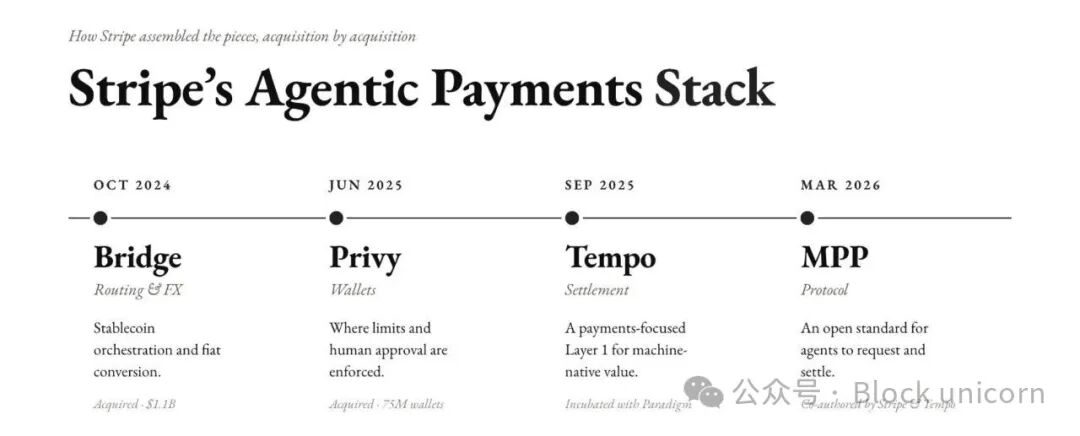
Here is how the governance strategy on that technology stack works.
Privy provides two smart wallet models. In the first model, the agent has complete control of the wallet and executes transactions within the constraints of the policy without human approval. This model is best suited for fully autonomous agents such as trading bots and portfolio managers. In the second model, the user retains ownership of the wallet but grants the agent limited permissions to operate as a signer. Users can revoke access at any time.
Stripe's MPP follows a similar governance strategy.
MPP introduces a feature called "session" for high-frequency agent tasks. In session mode, the agent pre-authorizes a spending budget, then continues to make payments within that limit without having to issue individual requests for each on-chain transaction. MPP has achieved billing for LLM inference at less than a cent and per-query billing for data APIs.
This level of governance granularity is something card organizations cannot support.
Vertically Expanding the Stack
Although Coinbase's x402 currently leads the AI agent payment field, Privy's advantage is less about cryptocurrency itself and more about the distribution moat created through Stripe.
Coinbase has 3,900 merchants accepting agent payments. In contrast, Stripe has about 1,000 merchants compared to each Coinbase merchant that accepts agent payments. In February of this year, Privy stated that if all Stripe merchants opted to accept machine payments, agent commerce could scale today through the Privy wallet. Stripe merchants would not need to build custom crypto infrastructure.
Competition between Stripe and Coinbase is intensifying, with other traditional giants joining the vertical expansion race, seeking growth across the entire technology stack.
Keyrock mapped 179 projects across the six levels of the agent payment stack (settlement, wallets, routing, protocols, governance, and applications).
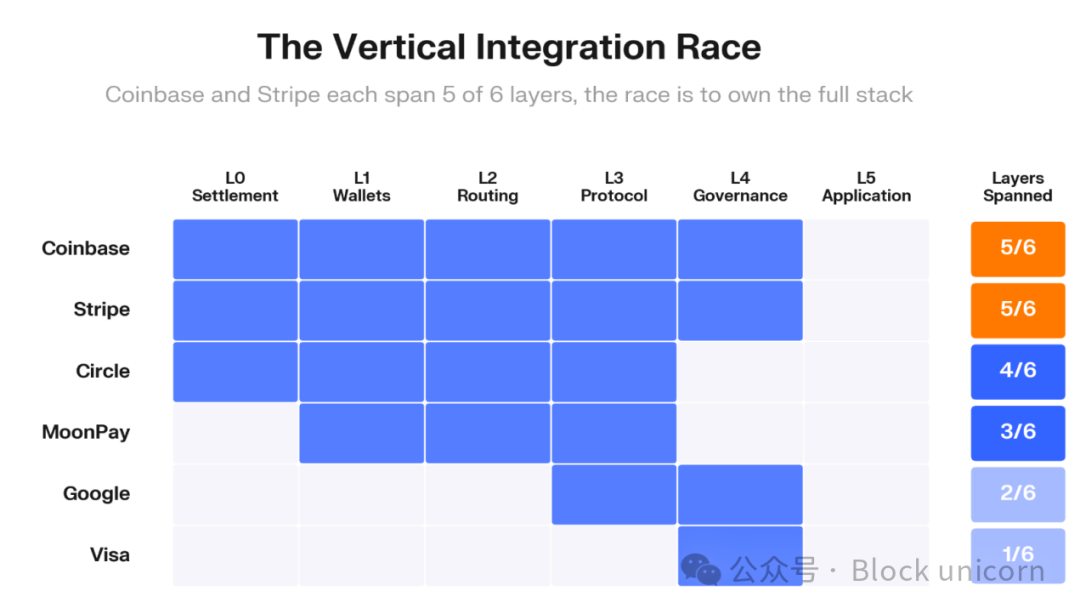
Coinbase and Stripe each cover five of the six layers of this network. Circle covers four layers. Despite its size, Google only covers two layers, and Visa only covers one layer.
In the past twelve months, existing payment giants have spent over $8 billion to fill gaps in their technology stacks. Capital One acquired the artificial intelligence-native software platform Brex for $5.15 billion. Mastercard acquired BVNK for $1.8 billion. Of these, the wallet layer and the artificial intelligence software layer attracted the most active acquisition activity. Stripe acquired Privy, Fireblocks acquired Dynamic, and Arbitrum acquired ZeroDev. In these cases, payment infrastructure providers acquired an independent wallet provider.
These transactions collectively indicate that the market has identified a scarce resource hierarchically. Settlement fees have become cheap and interchangeable, but licensing for program production, budgeting, and liability represent where the value truly lies.
Vertical integration across multiple layers also has compounding effects.
Whoever owns this checkpoint can set the spending rules, intercept them before funds flow, determine which merchants, agents, and applications gain trusted access, and charge fees to make all of this happen. We see this in the Privy-Stripe distribution moat.
Even Coinbase’s position reflects this operational mechanism. Every x402 payment generates demand for USDC on its second layer Base, creating floating revenue. This revenue funds more agent tools through AgentKit, which has built-in session limits, per-transaction limits, and allowlists that restrict transfers to audited contracts. The more agents on AgentKit, the more x402 payments occur. Each layer influences the others.
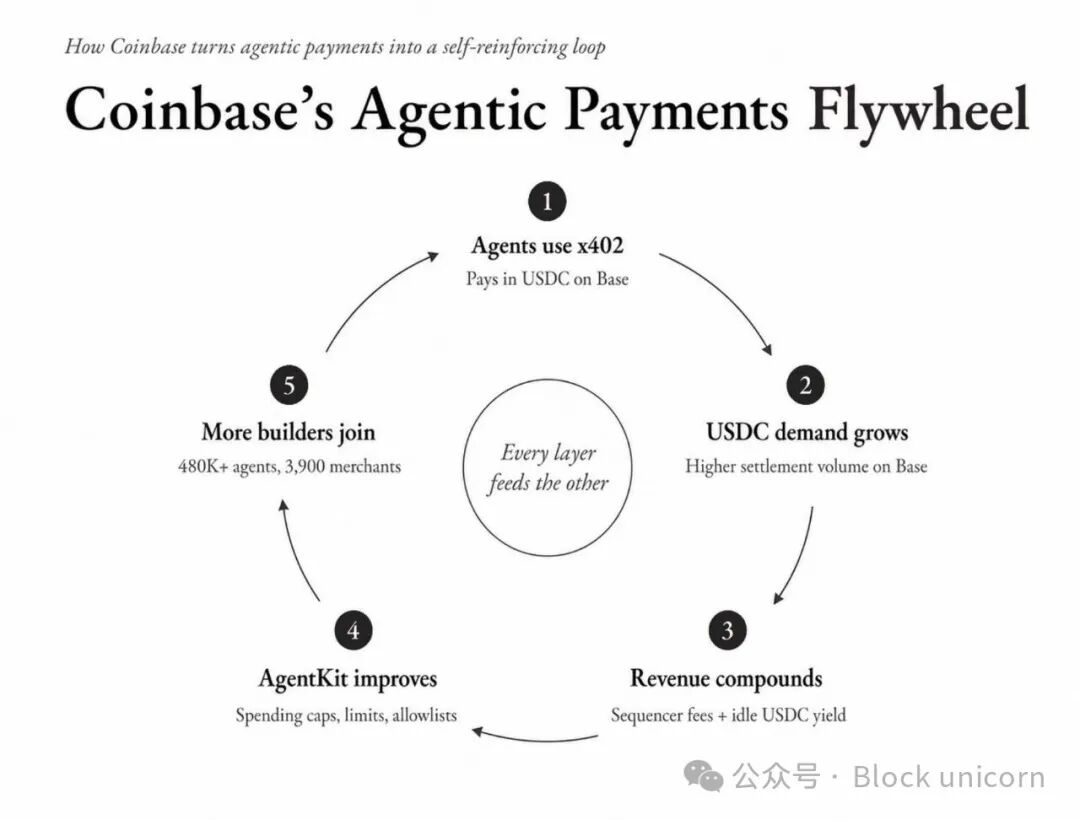
Investment activity among existing enterprises is much more vibrant.
Coinbase Ventures has also invested in Catena Labs, Skyfire, and Payman, three of the most well-known independent governance startups. Sean Neville, co-founder of Circle, founded Catena, and Circle also invested in Skyfire. a16z led the funding rounds for both companies. Visa provided support for Payman and formed a partnership with Skyfire.
The same batch of companies building payment settlement infrastructure is funding the governance layer. The idea is that if governance functions remain part of the existing infrastructure, as Privy has structured in its two models, then existing institutions can maximize their returns. If governance functions become a separate layer, they will profit through their portfolios.
What Does Mastering the Governance Layer Mean?
Payment processing has never been the most valuable position because the financial system ultimately tends toward homogenization. Once this occurs, profit margins shift to the segments that determine whether transactions are allowed to occur and under what conditions.
Historically, many industries have undergone the same commoditization process.
Think about what happened when the internet commoditized cable television. All internet service providers (ISPs) became interchangeable and almost identical. Consequently, telecom companies had to pursue vertical expansion to remain competitive.
The two major telecom operators in India, Jio and Airtel, began bundling hundreds of TV channels, six OTT platform subscription services, unlimited voice calls, set-top boxes, and free routers into a broadband package. Similarly, AT&T spent $85 billion acquiring Time Warner to become a media and telecom giant. The goal was to combine Time Warner's premium content, such as HBO, Warner Bros, and CNN, with AT&T's extensive distribution network to compete against streaming platforms like Netflix and Amazon.
When broadband connections (the underlying infrastructure) became the least valuable part of the package, the value shifted toward the content, relationships, and deal combinations that attract customers the most.
We see this dynamic in the cryptocurrency space as well.
Settlement should ideally take place on a protocol level. One can imagine Ethereum as a shared ledger where everyone settles. After Coinbase launched Base as a faster, less congested Layer-2 chain, it began charging gas fees from every transaction settled on its own chain. Today, Coinbase earns approximately $60 million in sequencer revenue annually by processing transactions on Base.
Participants building agent payment systems have drawn lessons from this.
In the book "Active Buoy," we explained how to build an economic system by controlling the stablecoin balances held by agents between transactions. This allows companies that control the technology stack wallet layer to increase their revenue sources.
The governance layer adds another revenue source, possibly a larger one.
Visa processes $14.2 trillion in payment transaction volume annually, earning a 0.28% commission from this. This rate not only includes transaction fees but also implicitly incorporates management fees derived from the trust established by Visa through fraud prevention, dispute resolution, and network rule enforcement.
Even applying a small portion of this rate to agent transactions reveals the immense value it brings to companies built on the governance layer. McKinsey predicts that by 2030, the volume of agent transactions will reach $3 trillion, meaning that even if the governance fee rate is only 0.1% (about 35% of what Visa charges), it could generate $3 billion in revenue annually. For context, Coinbase's total subscription and service revenue is about $2.8 billion in 2025. Just the governance layer income from agent transactions could rival the total revenue Coinbase currently earns from staking, custody, and Coinbase One.
Companies operating across the wallet, settlement, and governance layers of the agent financial stack can profit from idle agent balances (floating income), settlement fees (sequencer revenue per transaction), and compliance fees (governance enforcement).
That is why vertical integration across the entire tech stack will be the only business model that allows companies to remain competitive in the era of agents.
免责声明:本文章仅代表作者个人观点,不代表本平台的立场和观点。本文章仅供信息分享,不构成对任何人的任何投资建议。用户与作者之间的任何争议,与本平台无关。如网页中刊载的文章或图片涉及侵权,请提供相关的权利证明和身份证明发送邮件到support@aicoin.com,本平台相关工作人员将会进行核查。


