The market's leading edge has narrowed extremely, the AI theme is highly concentrated, and the trend closely resembles the late stages of the 1999 bubble, with three major fractures quietly expanding.
Written by: Zhao Ying
Source: Wall Street Watch
The market's fear of downside risk has nearly vanished, and a core pricing mechanism in the options market is failing.
Goldman Sachs derivatives strategist Brian Garrett pointed out in the latest weekend report that the volatility skew of S&P 500 options has fallen to an 18-month low, with nearly equal pricing probabilities for a 10% decline and a 10% rise, both around 8%—this phenomenon has been directly termed "Skew Failure" by Goldman’s volatility team. Meanwhile, the Goldman Fear Index closed in single digits, reaching a two-year low, indicating that the market's demand for hedging against tail risks has dropped to extremely low levels.
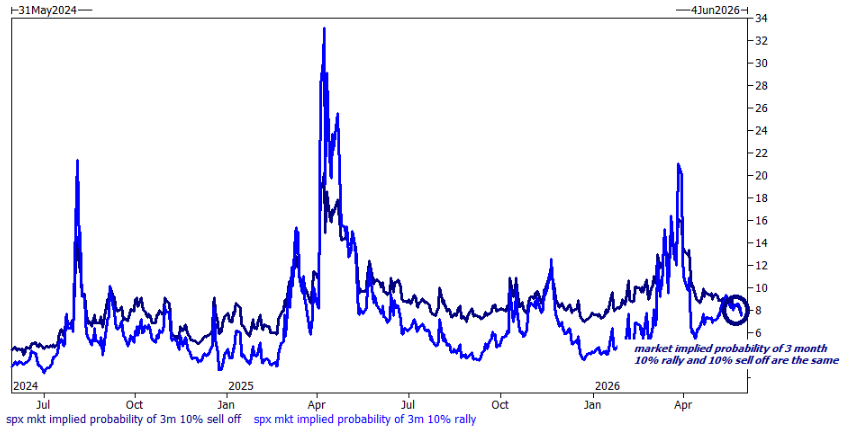
This signal has emerged against the backdrop of a continuous surge in U.S. stocks. Since the beginning of this year, the S&P 500 index has set a historical high approximately every five trading days, with Micron's stock price surpassing $1000 for the first time after hours on Sunday.
Garrett admits that internal discussions have evolved from "let it stop" in March to "is this still rising?" in May. However, his own stance is shifting from cautiously bullish to increasingly bearish, clearly listing multiple bearish reasons.
Three Major Bearish Signals Emerge, Market Sentiment and Fundamentals Show Fractures
Garrett outlined three main concerns regarding the current market.
Firstly, the market’s leading edge is extremely narrow. The top ten weighted stocks in the S&P 500 currently account for 40% of the index's weight, and the last four instances of historical highs occurred while the overall market breadth was negative—this phenomenon has never been seen before.
Secondly, the theme is highly concentrated. This year, the S&P 500 index, excluding AI-related stocks, has lagged the overall index by 700 basis points.
Thirdly, price trends are highly similar to history. Garrett pointed out that the trajectory of 2026 closely matches the price patterns observed from late 1998 to 1999.
Despite bearish voices flooding media headlines and social media, Garrett emphasized that this concern has not reflected in the pricing of the options market—at least, the fear of downside risks has almost vanished.
Skew Failure: Downside Hedging Costs Fall to Historical Lows
Goldman’s volatility team provided three key observations from the options market perspective.
First, the S&P 500 volatility skew has dropped to an 18-month low, driven by two forces: the put wing of bearish options is unusually cheap, while the call wing is relatively expensive.
Second, the Goldman Panic Index closed in single digits last Friday, reaching a two-year low. This index combines the two-year percentile rankings of VVIX, VIX, Skew, and at-the-money volatility.
Third, and most crucially: the pricing probabilities for a 10% decline and a 10% rise are exactly the same, both around 8%. This means that the options market no longer assigns any extra premium for downside risks, and the protective function of Skew has effectively failed.
Garrett pointed out that the direct implication of this phenomenon is that for investors wishing to hedge correlation risk, the current hedging costs are extremely low.
Low-Cost Hedging and Right-Tail Positioning Go Hand in Hand
Based on the above judgments, Garrett provided several specific trading recommendations.
For investors optimistic about market style rotation, believing that the trend will shift from concentration to dispersion, Goldman recommends buying RSP (Invesco S&P 500 Equal Weight ETF) outperformance options relative to SPX, with a one-month 100% outperformance option cost of approximately 145 basis points; simultaneously, it recommends buying VIX call options as a hedging tool, noting that the term structure for August and beyond is extremely flat, with VVIX closing at 86.
For investors seeking simple downside protection, Garrett recommends directly buying S&P 500 put options—given the current low bearish skew, the payout structure is quite attractive.
Additionally, Goldman also recommends going long on Bitcoin ETF volatility and performing delta-neutral hedging. Garrett noted that Bitcoin historically behaves like a "leveraged Nasdaq," but the current pricing is at a two-year low and is about 10 volatility points lower than SMH.
Capital Flows: Hedge Funds Net Buying for Two Consecutive Weeks, Single Stock ETF Size Doubles
According to Goldman’s latest Prime Brokerage data, hedge funds have net bought for two consecutive weeks, and the buying speed is the fastest of the year, primarily reflecting long positions and macro shorts being covered. There is a noticeable rotation at the industry level: financial stocks (down 6% year-to-date) have seen net buying, while industrial stocks (up 11.5% year-to-date) have faced net selling.
On the futures side, end-user holdings have risen close to 2024 peak levels. The Goldman team specifically pointed out that leveraged ETFs are mechanically expanding their balance sheet size; CTA strategies are currently close to neutral, but systematic strategies show a significant asymmetry to the left tail—buying about $12 billion in a one-month flat scenario, while selling about $100 billion in a one-month decline scenario.
It is worth noting that the assets under management of global leveraged and inverse single stock ETFs have surpassed $60 billion, doubling in two months, and this segment of the market is no longer to be ignored.
免责声明:本文章仅代表作者个人观点,不代表本平台的立场和观点。本文章仅供信息分享,不构成对任何人的任何投资建议。用户与作者之间的任何争议,与本平台无关。如网页中刊载的文章或图片涉及侵权,请提供相关的权利证明和身份证明发送邮件到support@aicoin.com,本平台相关工作人员将会进行核查。


