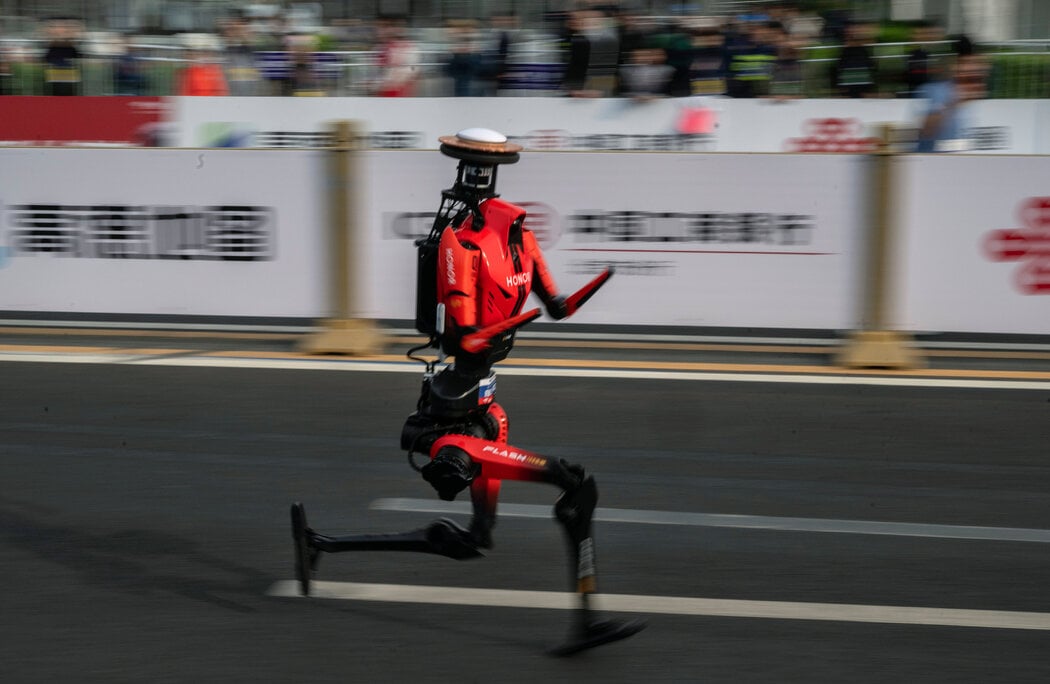
Author: Dean Fankhauser, Robozaps
Translator: Felix, PANews
The best humanoid robot of 2026 is Figure 03, followed by Tesla Optimus Gen 3 and Agility Robotics Digit. For buyers on a budget, the Unitree G1 (starting at $16,000) offers the best value. The cheapest humanoid robot is Noetix Bumi, priced at $1,400. This ranking guide covers all 34 mainstream humanoid robots and provides verified specifications, actual prices, and availability.
Key Points:
- Overall Best: Figure 03, advanced AI + hardware, suitable for industrial automation
- Best Value: Unitree G1 (starting at $16,000), complete humanoid functionality at an affordable price
- Cheapest: Noetix Bumi ($1,400), a humanoid robot aimed at education/hobbyists
- First Home Robot: 1X NEO ($20,000), aimed at early adopters
- Mass Production: Tesla Optimus Gen 3 will start mass production in January 2026; a public auction is expected to occur at the end of 2027.
The humanoid robot industry is reaching a turning point at the beginning of 2026. Tesla is ramping up production of Optimus Gen 3 at its factory. Boston Dynamics' electric Atlas has been shipped to Hyundai's Georgia Metaplant for real factory operations. Figure AI's BotQ factory has the capacity to produce 12,000 units of Figure 03 annually. 1X Technologies has started delivering the $20,000 NEO household robot to early adopters. A number of new faces emerged at the 2026 CES: Unitree's full-sized H2 priced at $29,900, NEURA Robotics' 4NE1, designed by Porsche, starting at €19,999, and the LG CLOiD home robot that demonstrated real household handling capabilities.
This is no longer hype, but a genuine delivery of hardware. This authoritative guide (updated to March 2026) ranks and reviews 34 mainstream humanoid robots, covering robots that are on the market or being deployed, and provides verified specifications, actual prices, availability, and application cases. Whether you are a buyer, investor, researcher, or just curious about the future of robotic technology, this is the most comprehensive humanoid robot ranking on the internet.
Overview: List of the Best Humanoid Robots 2026
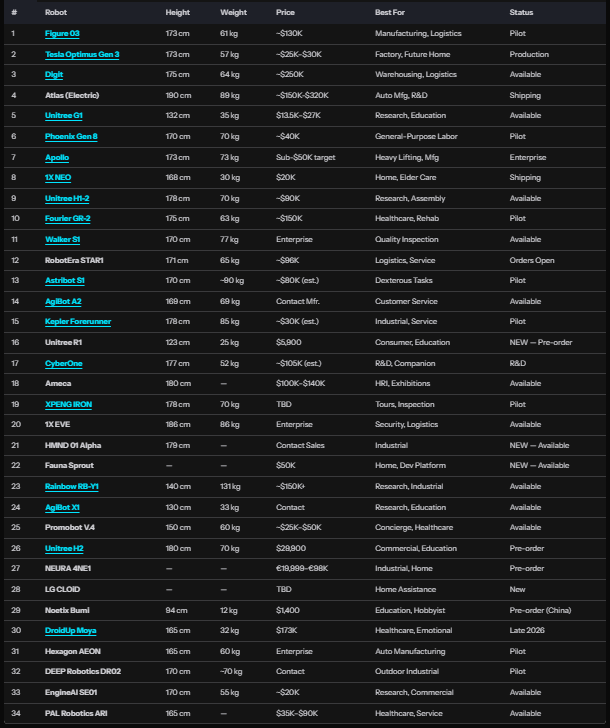
Evaluation methods for each humanoid robot ranking are assessed based on five equally weighted criteria (last updated: March 22, 2026):
- Real-world Application (20%): Does it really operate in a production environment? Deployed robots score higher than prototypes.
- Technical Capability (20%): Dexterity, mobility, AI maturity, degrees of freedom, sensor suite.
- Commercial Availability (20%): Can it be purchased or leased now? Public sales are preferred over pilot projects available only to invited users.
- Value for Money (20%): Performance per dollar spent. A $16,000 robot with excellent performance scores higher than a $500,000 robot performing the same tasks.
- Industry Impact (20%): Market influence, partnerships, financing, ecosystem maturity.
AI Platforms Driving Humanoid Robots
Behind every powerful humanoid robot is an AI platform that grants the robot the ability to perceive, reason, and act. The following three technology providers are becoming the "operating systems" of the humanoid robot era:
NVIDIA Isaac + GR00T
NVIDIA's Isaac GR00T (General Robot 00 Technology) is the first open foundational model for humanoid robots. Released at GTC 2024 and updated to N1.6 in January 2026, GR00T enables robots to learn from imitation, reinforcement learning, and video data. The Isaac Sim platform trains robots at a real-time speed of 1000 times via GPU-accelerated simulation. Partners include Figure AI, Apptronik, Sanctuary AI, Agility Robotics, and 1X Technologies.
Google Gemini Robotics
At the 2026 International Consumer Electronics Show (CES), Google's DeepMind and Boston Dynamics announced a partnership to integrate Gemini Robotics' AI technology into the electric robot Atlas. The models from Gemini Robotics enable the robot to perceive, reason, utilize tools, and interact naturally with humans, giving Atlas an intelligent foundation beyond its excellent physical mobility.
OpenAI Robotics Investment
OpenAI led a $675 million Series B funding round for Figure AI (currently valued at $39 billion), introducing GPT-based multimodal AI into humanoid robots. The Helix platform of Figure 03 integrates visual language models for real-time speech and task reasoning. OpenAI provides the "brain," while the partners handle the "body."
Humanoid robot hardware is becoming homogenized. Differentiation will increasingly come from artificial intelligence. These platforms are on track to become the Android, iOS, and Windows of the robotics field.
1. Figure 03: Best Humanoid Robot
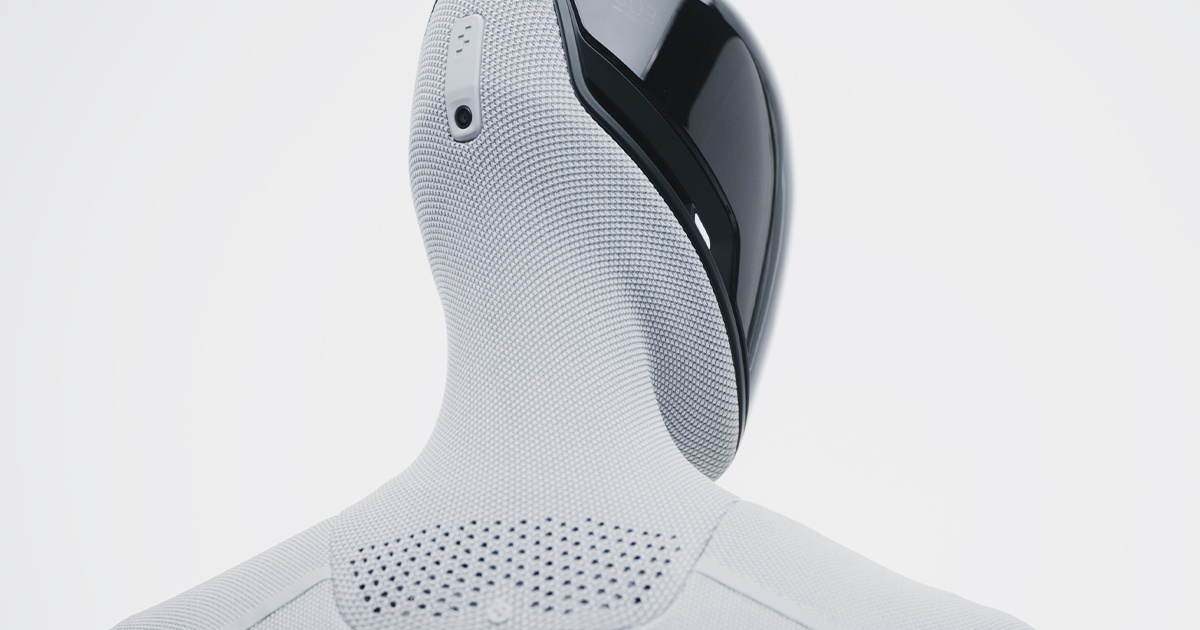
Humanoid robot Figure 03 manufactured by Figure AI
Manufacturer: Figure AI (Sunnyvale, California) | Founded: 2022 | Funding: Over $1.9 billion | Valuation: $39 billion (September 2025) — backed by Microsoft, OpenAI, NVIDIA, Jeff Bezos.
Figure AI's third generation humanoid robot represents the most significant leap in the commercial humanoid robot field so far. Figure 03 was released in October 2025, featuring a newly designed body with natural human proportions, the smoothest movement capabilities among mass-produced humanoid robots, and an upgraded AI stack built on the company's proprietary Helix platform: supporting real-time speech, multi-step task reasoning, and autonomous error correction.
What sets it apart is its combination of embedded palm cameras for high-precision operations, wireless charging capabilities, and a visual motion neural network that provides high frame rates with low latency. During an 11-month pilot at BMW’s Spartanburg factory, the Figure robot participated in the production of over 30,000 vehicles. This represents the most significant integration of humanoid robots in automobile manufacturing to date. Figure AI's new BotQ manufacturing plant has the capacity to produce 12,000 units annually and plans to produce 100,000 units over the next four years. CEO Brett Adcock stated that the company's goal is to achieve full household autonomy by the end of 2026, with household testing users expected to participate soon.
Key Specifications:
- Height: 173 cm
- Weight: 134 lbs (61 kg)
- Degrees of Freedom: 48+ (including 24+ per hand)
- Battery: 2.3 kWh, up to 5 hours of autonomy, wireless charging
- Payload: 20 kg
- AI: Helix platform, integrated visual language model for speech recognition, task planning, and autonomous reasoning
- Sensors: Embedded palm cameras, stereo vision, depth sensors, Inertial Measurement Unit (IMU)
- Price: Approximately $130,000
- Availability: Currently piloting deployments with BMW and other automotive/tech manufacturers. BotQ plant is gradually ramping up production. Commercial orders for 2026 are now open.
- Applicable Scenarios: Manufacturing assembly, logistics, quality inspection
- Advantages: Most complete AI + hardware combination; already deployed in factories; BotQ factory for mass production; palm cameras for precise location; strongest investor support in the industry
- Disadvantages: Not yet available to the general market; limited track record in logistics compared to Digit; price still too high for small to medium enterprises
2. Tesla Optimus Gen 3: Beginning Mass Production
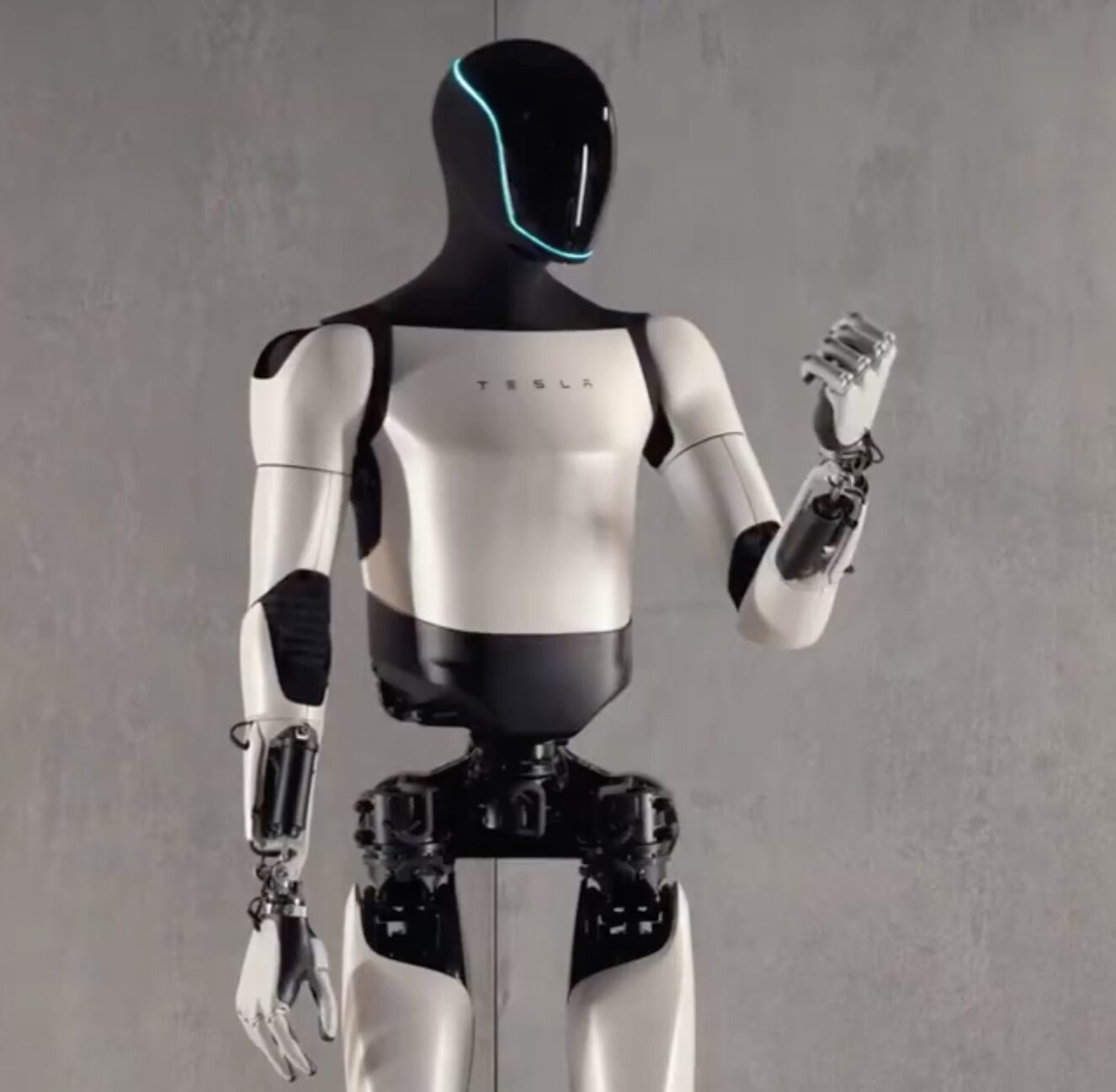
Tesla Optimus Gen 3 humanoid robot is now in mass production at the Fremont factory
Manufacturer: Tesla (Austin, Texas) | Valuation Background: Some analysts estimate the valuation for Tesla's robotics division at up to $1 trillion
Tesla's Optimus robot made its most significant leap yet in March 2026. The company officially began mass production of Optimus Gen 3 at its Fremont factory in California. This is the same factory that previously produced the Model S and Model X, which Tesla halted to make room for robot manufacturing. Musk referred to this as the "real beginning of the physical AI era."
Gen 3 Optimus features redesigned actuators, an improved 22-degree of freedom hand, and proprietary Tesla FSD (Full Self-Driving) neural networks trained on real factory data. Currently, over 1,000 units of Optimus are being tested at Tesla's Austin and Fremont factories, performing tasks such as battery sorting, part handling, carton handling, and quality inspections. It has demonstrated fluid bipedal running, autonomous office navigation, and multi-step task execution capabilities.
Musk confirmed that Tesla plans to conduct limited external sales by the end of 2027, with a long-term consumer target price below $20,000. The designed production capacity for the Fremont assembly line is 1 million units per year.
Key Specifications:
- Height: 173 cm
- Weight: 57 kg
- Degrees of Freedom: 28+ (including 22 in the hands)
- Walking Speed: 5 km/h | Running Speed: Up to 8 km/h
- Payload: 20 kg
- AI: Tesla FSD neural networks for operations, navigation, and object recognition
- Sensors: 8 cameras (sourced from Tesla's autonomous driving system), Inertial Measurement Unit (IMU), hand force/torque sensors
- Price: Approximately $25,000–$30,000 (initial estimated commercial price); long-term goal under $20,000
- Availability: Limited internal production ongoing. Expected limited external sales to begin by the end of 2027.
- Applicable Scenarios: Factory automation, repetitive assembly, future domestic assistance
- Advantages: Mass production ongoing; unmatched cost-effectiveness upon scaling; Tesla’s manufacturing expertise; massive AI training data; annual production target of 1 million units
- Disadvantages: Not yet available to the public; Musk's timelines have historically been overly optimistic; limited third-party verification
免责声明:本文章仅代表作者个人观点,不代表本平台的立场和观点。本文章仅供信息分享,不构成对任何人的任何投资建议。用户与作者之间的任何争议,与本平台无关。如网页中刊载的文章或图片涉及侵权,请提供相关的权利证明和身份证明发送邮件到support@aicoin.com,本平台相关工作人员将会进行核查。


