Author: Willo, Arkham
Compiler: Yuliya, PANews
Editor's Note: Zcash, launched in 2016 as a cryptocurrency focusing on privacy protection, is built on the codebase of Bitcoin. Although its core vision is to obfuscate transaction information, in practice, most ZEC transactions can still be traced on-chain. This article will analyze how Zcash works and explore why most ZEC on-chain transactions can still be tracked, illustrating that the level of actual privacy protection Zcash can provide depends entirely on how users choose to use it.
Zcash is a digital currency built on Bitcoin's underlying technology, designed to address what its creators see as the biggest flaw of Bitcoin: the complete public transparency of transaction information. Like Bitcoin, Zcash has a hard cap of 21 million tokens, halves the block reward every four years, and operates on a proof-of-work (PoW) consensus mechanism. At the architectural level, it also shares Bitcoin's UTXO transaction model. In most cases, Zcash transactions look identical to Bitcoin transactions; the difference is that some Zcash transactions are designed to be completely invisible.
In the current crypto cycle, privacy is one of the most iconic themes. With increasing global regulatory pressure and stronger on-chain monitoring tools, more individual and institutional users are questioning: does the public blockchain expose too much information about users and their transactions? Against this backdrop, privacy coins have jumped from being a niche category in the market to a highly watched focus. Consequently, Zcash has become one of the top-performing assets in the market by 2025.
History and Evolution
Zcash was launched in October 2016 by the Electric Coin Company (ECC), founded by cryptographer Zooko Wilcox-O'Hearn, along with a team of experienced academic cryptographers. The project's roots trace back to a 2014 paper introducing the Zerocash protocol, co-authored by researchers from MIT, Johns Hopkins University, and Tel Aviv University, which theorized a protocol that allows users to make private payments while maintaining Bitcoin-equivalent processing speeds.
The core technology of Zcash, zk-SNARK cryptography, did not emerge with cryptocurrencies but is based on decades of theoretical research in computer science. The contribution of the Electric Coin Company lies in turning this theory into a practical technology that can operate efficiently on an actual blockchain. In 2016, the team held a cryptographic ceremony to generate system parameters; subsequently, in 2018, a second ceremony named Sapling was held, which significantly improved the processing efficiency of shielded transactions to meet everyday usage needs.
Zcash's governance system consists of two organizations: the Electric Coin Company, responsible for maintaining and developing the protocol, and the independent non-profit Zcash Foundation, responsible for overseeing the development of the wider ecosystem. A portion of newly minted ZEC tokens is allocated as operational funding for these two organizations, ensuring the project's continued development without reliance on external investment.
Zero-Knowledge Proof
The core technology enabling Zcash's privacy protection is known as "zero-knowledge proof." Specifically, Zcash employs a derivative technology called zk-SNARK (zero-knowledge succinct non-interactive argument of knowledge).
This concept may sound abstract, but its core idea is quite easy to understand. Zero-knowledge proof allows one party to prove to another that something is true without disclosing any specific information. In the case of Zcash, network nodes can verify the legality and validity of a transaction (for example, confirming that the sender indeed has sufficient funds and that no tokens are fabricated) without needing to know who the sender or receiver is, or the exact transaction amount.
This technology is a significant breakthrough in the field of cryptography. While Bitcoin's transparency helps with auditing and tracing, it poses a major pain point for users who desire to protect their financial privacy. The Zcash development team cleverly layered zk-SNARK technology on top of Bitcoin's codebase, providing users with an optional privacy protection barrier.
Transaction Types
The Zcash system contains two types of addresses: transparent addresses (t-address) and shielded addresses (z-address).
Transparent addresses operate exactly like Bitcoin addresses, and all transaction activities are publicly visible on the blockchain.
In contrast, shielded addresses exist in an encrypted pool of funds, where the sender, receiver, and exact amount of the transaction are hidden from external observers.
The combination of these two address types generates four different transaction types, each with varying levels of privacy protection:
t→t (transparent to transparent): completely public. The sender, receiver, and amount of the transaction are clearly visible on the blockchain. This is indistinguishable from a standard Bitcoin transaction.
t→z (transparent to shielded): The amount of funds entering the shielded pool is public, but the recipient's information is hidden. It's like watching money go into a door: the outside can see the money go in but does not know who ultimately receives it.
z→t (shielded to transparent): The recipient and amount of the transaction are public, but the sender's information is hidden. The funds flow out of the encrypted pool, but the outside cannot trace its original source.
z→z (shielded to shielded): completely private. The only public information on the blockchain is the transaction fee. The sender, receiver, and amount of the transaction are thoroughly hidden using cryptographic techniques.
In practice, based on historical data, the vast majority of Zcash transaction activity remains transparent. Because regulatory compliance requirements must be met, most cryptocurrency exchanges and institutional participants default to using transparent addresses (t-address). This means that the proportion of publicly readable data in Zcash's transaction history is far greater than what people expect from a "privacy coin."
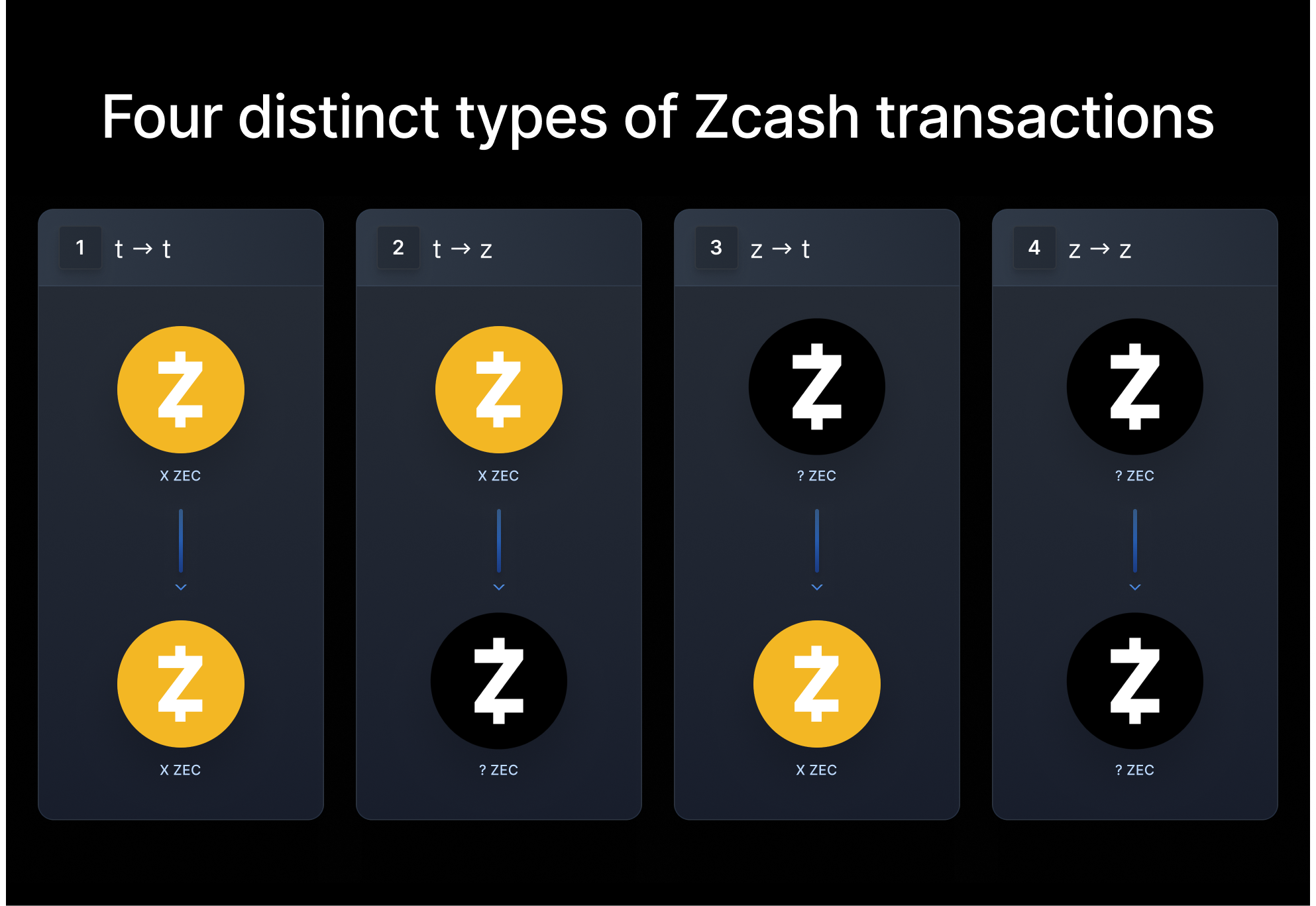
ZEC transaction types
Using Arkham to Track Zcash
Traditional beliefs generally hold that privacy coins cannot be traced, but the actual situation of Zcash breaks this inherent perception.
Currently, the blockchain data analysis platform Arkham has successfully tagged more than half of Zcash on-chain activities and confirmed the identities of known individuals and institutions behind transactions worth up to $420 billion. For a blockchain network designed specifically to conceal transaction data, this figure is undoubtedly shocking. The reason this tracing is possible is that the majority of Zcash transactions still use a transparent mode. Additionally, cryptocurrency exchanges, custodians, and large financial institutions, as channels for funds to enter and exit, typically retain and use transparent addresses for easier transfer and management of funds.
Of course, shielded transactions themselves still maintain a high level of opacity: z→z (shielded to shielded) transaction activities cannot be traced, and such shielded addresses are simply marked as "SHIELDED" on the Arkham platform. However, the nodes where funds enter and leave the encrypted pool are often publicly visible, which is where data intelligence analysis finds its breakthrough.
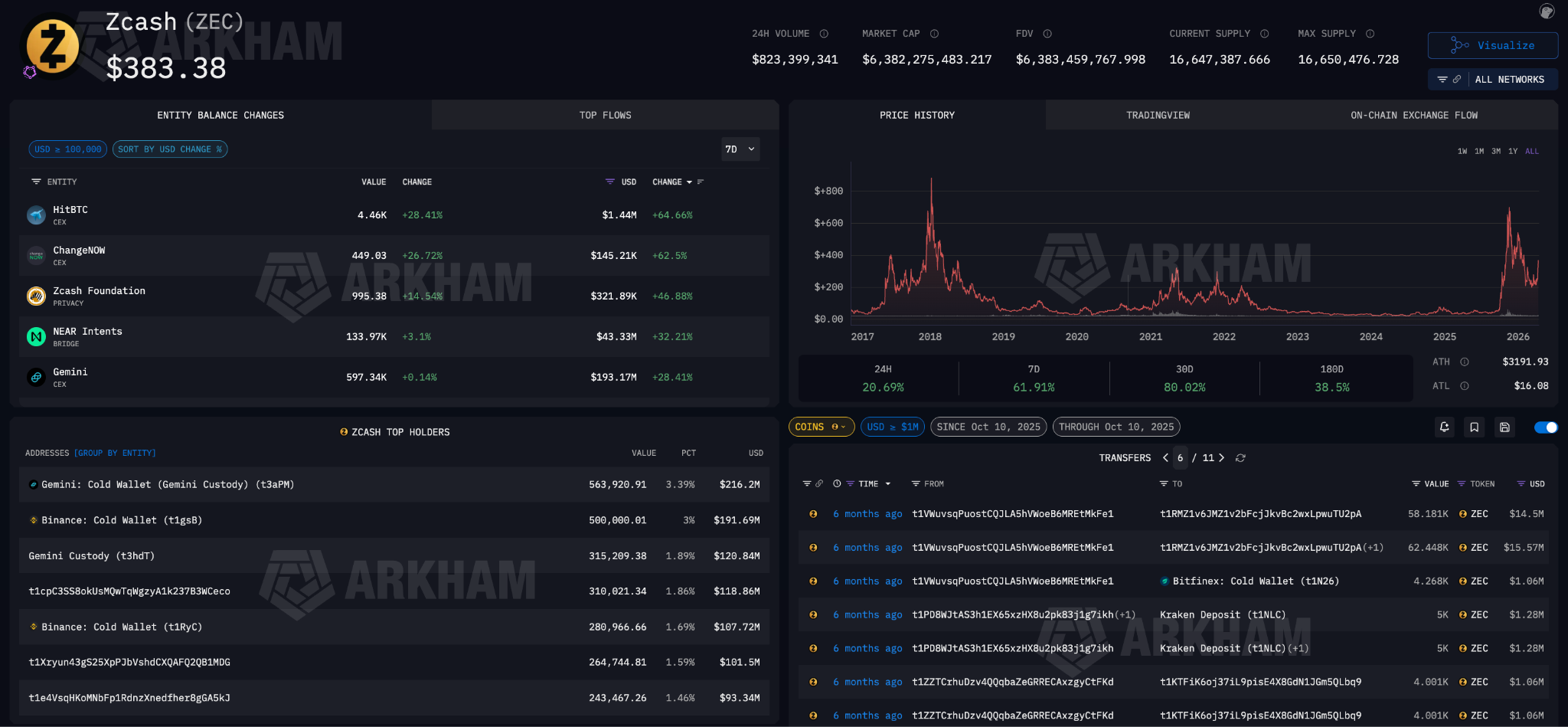
Zcash on Arkham
Case Study: The U.S. Government's Zcash Holdings
In Arkham's Zcash data records, one particularly notable entity is the U.S. government. The U.S. government's wallet holds Zcash seized from Alexandre Cazes, the founder of the dark web trading platform AlphaBay, who was arrested in 2017. When the asset was seized, the value of this Zcash was approximately $737,000. For eight years, this asset has remained unmoved, and its market value has since doubled. The public can track the dynamics of this wallet in real-time through the Arkham platform.
Case Study: A Trade Profiting $6.6 Million
Arkham's data can also reveal the movements of large amounts of funds by individual traders. For example, an address purchased $4.49 million worth of Zcash during a market downturn on October 10. After holding for five and a half weeks, the address transferred these tokens to Gemini exchange. Assuming this trader sold the tokens upon deposit at the exchange for cash, this transaction would yield a net profit of $6.6 million, meaning their initial investment saw a return of over double. On the Arkham platform, the complete historical trajectory of this transaction is clearly visible, including the specific time of each fund transfer and the name of the exchange where the tokens ultimately flowed into.
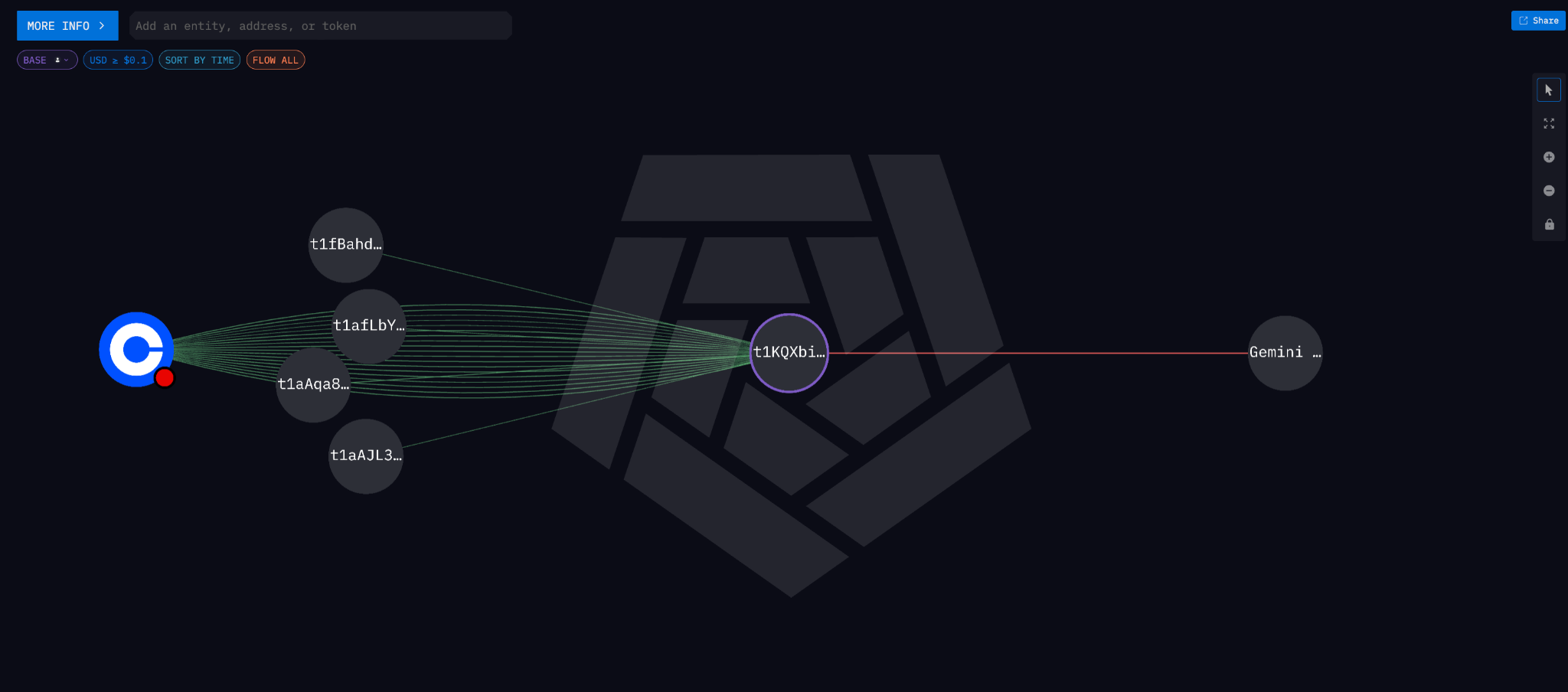
Arkham visualization tools
Conclusion
Zcash occupies a very unique position. It is both one of the most complex privacy protection tools in the cryptocurrency field and one of the most easily misunderstood projects. People often assume that privacy coins are completely untraceable by default, but this view is inaccurate. In practice, the vast majority of Zcash's fund movements have gone through transparent addresses; to meet compliance requirements, major exchanges also default to using public transparent addresses. As a result, blockchain intelligence analysis platforms like Arkham have successfully associated over $420 billion in transaction volume with known entities on a blockchain that is explicitly designed to resist data analysis.
However, this does not mean that Zcash's privacy protection capabilities are flawed. Pure shielded transactions (z to z) remain cryptographically unbreakable and unobservable. All of this indicates that the actual level of privacy protection Zcash can provide depends entirely on how users choose to use it.
For anyone looking to personally explore Zcash on-chain activities, Arkham's extensive data coverage offers the most comprehensive information landscape available. Users can track ZEC transaction records, entity identities, and account balances, set alerts for important fund movements, and leverage Arkham's artificial intelligence technology to deeply mine potential information across the entire blockchain network.
免责声明:本文章仅代表作者个人观点,不代表本平台的立场和观点。本文章仅供信息分享,不构成对任何人的任何投资建议。用户与作者之间的任何争议,与本平台无关。如网页中刊载的文章或图片涉及侵权,请提供相关的权利证明和身份证明发送邮件到support@aicoin.com,本平台相关工作人员将会进行核查。


