
Author: Nancy, PANews
Recently, Ethereum's price has consistently underperformed against mainstream assets, with multiple attempts at upward breakthroughs failing. Meanwhile, as spot demand for Ethereum has fallen to its lowest level of the year, market concerns regarding further declines are intensifying, and institutional movements are gradually becoming the focus.
Spot demand hits a new yearly low, Ethereum enters a headwind cycle
Since July of last year, the ETH/BTC exchange rate has continued to weaken. Particularly in the recent recovery trend, Ethereum's rebound has been significantly weaker than that of Bitcoin.
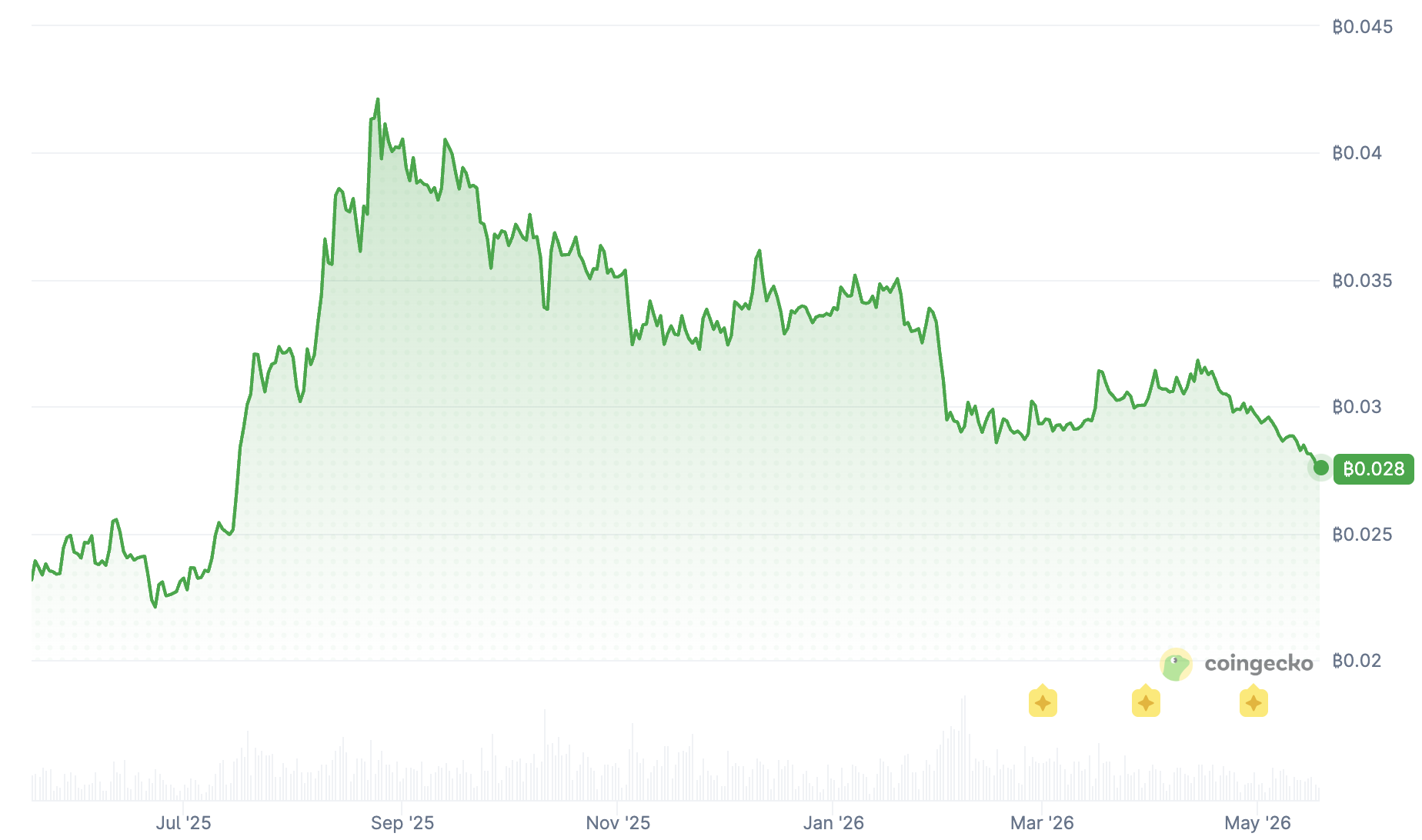
From the demand side, according to crypto analyst Crypto Rover, spot demand for ETH has dropped to its lowest level of the year, even below the cyclical bottom on February 6. Historical experience shows that weakening spot demand often indicates that prices may further explore the bottom.
In terms of performance, CoinGecko data shows that Bitcoin’s Q1 and Q2 returns were -22.2% and 12.96%, respectively, while Ethereum's during the same period were -29.26% and 0.85%.
Financial indicators also confirm this trend. In the spot ETF area, Bitcoin ETFs have seen net inflows for several months since March this year; in contrast, Ethereum ETFs recorded net inflows only in April, and experienced net outflows or weakness during the rest of the time.
The sell-off actions by the Ethereum Foundation and Vitalik also pose a certain impact on market confidence. Although their sales are primarily used for operational expenses, protocol development, and ecosystem funding, they still exert pressure on secondary market sentiment. For example, according to Ai Aunt's data monitoring, the Ethereum Foundation has sold a total of 30,000 ETH since March 15, with a total value exceeding 68.92 million USD. Approximately 25,000 ETH were sold OTC to BitMine to minimize direct impacts on the public market.
As for the factors behind Ethereum's poor price performance, BIT (formerly Matrixport) analysis indicates that Ethereum's recent price performance has increasingly been dominated by ETH capital flows into mainstream assets. Over the past year, the 30-day average of daily net inflows into ETH ETFs has been highly synchronized with Ethereum's price movements, and Ethereum's sensitivity to institutional funds has significantly increased. One of Ethereum's core narratives is about a net staking yield of approximately 2.5%. However, in an environment where inflation is accelerating again and the yield on US 10-year Treasuries has risen above 4.6%, Ethereum's staking yield advantage is diminishing compared to risk-free assets like US Treasuries. In May, Ethereum ETFs turned to net outflows again, consistent with the aforementioned logic. If this trend continues, Ethereum is likely to remain in a phase of oscillation and consolidation.
Tom Lee, Chairman of BitMine, stated that Ethereum is currently facing selling pressure, with the biggest headwind stemming from rising oil prices, which are at historically high levels of negative correlation with Ethereum prices. During the past six weeks of rising oil prices, Ethereum's price has fallen; however, if oil prices retreat, Ethereum is expected to recover. Nevertheless, he emphasized that this is a short-term tactical fluctuation; the greater driving forces for Ethereum come from tokenization and AI agents, which have now been put in place, with expectations for Ethereum's price to strengthen by 2026.
Morgan Stanley pointed out that although the overall crypto market has rebounded after the Iran conflict, ETH and other altcoins continue to underperform BTC, a trend that has been noticeable since 2023. Unless there are significant improvements in network activity, decentralized finance, and real-world applications, it might be difficult to change in the short term. Additionally, the upgrades Ethereum underwent in the past few years have not significantly increased on-chain activity; rather, they have weakened the mainnet’s fee and destruction mechanism due to lower Layer 2 costs. The bank also noted that the capital flows of spot ETFs and CME futures positions indicate that institutions have a stronger risk exposure repair to BTC than to ETH.
Some are increasing their positions against the trend, while others are retreating urgently
As Ethereum prices remain under pressure, institutions are adopting various tactics.
Some funds choose to increase their positions against the trend or to buy the dip, enhancing returns and hedging volatility through the introduction of staking products; meanwhile, another group of institutions is taking a more cautious approach, including actively reducing exposure or completely liquidating their positions.
It should be noted that reducing positions is not entirely synonymous with bearish sentiment. In the current macro and market environment, it is more about risk control, position balancing, and liquidity management needs. Moreover, some liquidations may not necessarily stem from a negative outlook on Ethereum's future; for example, Harvard University's liquidation is more due to pressures and funding needs from its endowment fund's operations.
Additionally, 13F filings are a lagging quarterly snapshot, only reflecting the positions at the end of the previous quarter, and not the institutions' real-time trading behavior.
Institutions increasing positions/buying the dip
Jane Street
In Q1 2026, Jane Street increased its allocation to ETH.
The 13F filing reveals that as of Q1, Jane Street held approximately 11.09 million shares of ETHA, representing a quarter-on-quarter growth of about 87%, with a holding value of approximately 176 million USD; the number of call options held decreased by approximately 13%, valued at around 144 million USD, while the number of put options increased slightly by about 8%, valued at around 129 million USD.
Additionally, the institution reduced its holdings in ProShares EETH put options by about 16%, with a holding value of 49.99 million USD; simultaneously, it significantly increased its holdings in Fidelity FETH, with the number of shares surging by 1926% compared to the previous quarter, bringing the holding value to approximately 43.64 million USD.
Wells Fargo
The 13F filing shows that Wells Fargo increased its exposure to ETH in Q1 2026.
Specifically, it held 17.57 million USD worth of ETHA, with the number of holdings increasing by about 65% quarter-on-quarter; at the same time, its holdings of Bitwise's ETHW also increased, with a 38% quarter-on-quarter growth, valued at around 3.86 million USD.
BitMine
As one of the most aggressive bulls, BitMine continues to accumulate Ethereum.
Data from Blockworks shows that BitMine has accumulated more than 967,000 ETH since the beginning of 2026. Although the purchasing pace has slowed compared to the previous two quarters, it still presents a monthly increasing trend. Currently, BitMine holds over 5.2 million ETH, valued at over 11 billion USD.
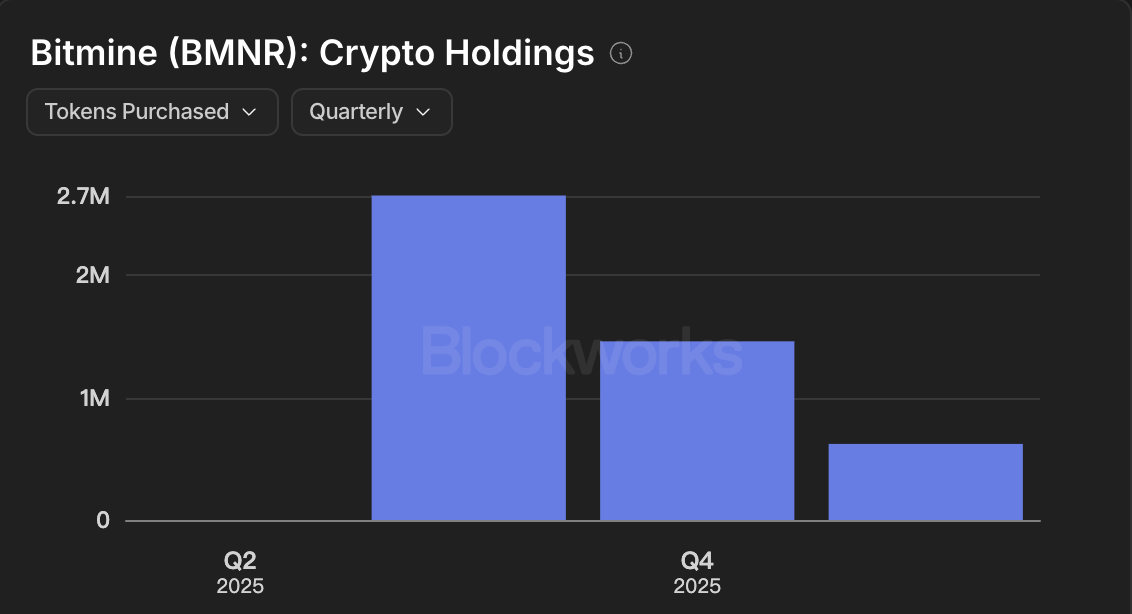
Facing significant unrealized losses, BitMine has also increased its returns through staking. Meanwhile, Tom Lee recently disclosed that BitMine is assessing whether to slow down its purchasing pace and instead redirect capital towards a 4 billion USD buyback plan.
BIT (Matrixport)
Latest data from Lookonchain shows that whales associated with BIT continue to increase their long positions in ETH amid a market downturn. Currently, they hold 120,000 ETH (254 million USD), with an unrealized loss exceeding 17.5 million USD.
ShapeShift
During the rapid market drop, monitoring by Onchain Lens revealed that a mysterious whale from ShapeShift invested 5.88 million USD to buy 2,656 ETH at the dip. This whale now holds 129,667 ETH, valued at over 274 million USD.
It is worth noting that this whale was previously believed to be associated with ShapeShift founder Erik Voorhees, but the latter has since denied this.
Reducing positions or shifting to defensive strategies
Goldman Sachs
From the changes in ETH holdings in Q1 2026, Goldman Sachs shifted to a defensive allocation strategy, significantly reducing spot exposure, increasing bearish hedging, and introducing staking assets.
The 13F filing shows that Goldman Sachs significantly reduced its ETHA holdings this quarter, with the number of shares decreasing by around 74% quarter-on-quarter, and the holding value dropping to about 114 million USD. At the same time, its holdings in ETHA put options increased by about 69%, with a holding value reaching 60.31 million USD, while the call options holdings decreased by about 67%, with a holding value of about 3.44 million USD.
Additionally, Goldman Sachs established a new position in BlackRock's staking ETF ETHB this quarter, corresponding to a holding value of about 66.89 million USD, and liquidated its position in Fidelity FETH valued at 390 million USD.
Susquehanna International Group
As of Q1 2026, the hedge fund Susquehanna International Group shifted its Ethereum allocation strategy from directly holding spot ETFs to managing risks through options, while also increasing the allocation in staking products with yield attributes.
Specifically, SIG’s spot position in ETHA has decreased to about 3.13 million shares, down approximately 75% compared to the previous quarter, corresponding to a holding value decrease of about 82% to around 49.62 million USD; simultaneously, its holdings in ETHA call options increased by about 41% to 14.39 million contracts (worth approximately 228 million USD), and put options holdings also grew by about 23% to 11.12 million contracts (valued at about 176 million USD). Additionally, SIG significantly increased its holdings in Grayscale’s staking ETF product ETHE, with the number of shares increasing drastically by about 795% to approximately 5.31 million shares, valued at around 106 million USD.
Citadel Advisors
The hedge fund Citadel, under Citadel Advisors, overall reduced its risk exposure related to Ethereum assets in Q1 2026.
The 13F filing indicates that the number of ETHA shares it held decreased by roughly 40% this quarter, with the holding value dropped to approximately 40.97 million USD; at the same time, the value of ETHA call options holdings was around 109 million USD, declining by about 21%, while put options were around 72.51 million USD, down by about 44%.
Millennium Management
The 13F filing indicates that hedge fund Millennium Management moderately reduced its Ethereum spot ETF holdings in Q1 2026, but overall still maintained a core exposure.
This quarter, the fund held about 16.47 million shares of BlackRock ETHA, valued at about 260 million USD, a decrease of about 34% from the previous quarter; at the same time, it held Fidelity FETH valued at around 77.15 million USD, a decrease of about 4% from the previous quarter.
Liquidation
Harvard University
The 13F filing shows that as of Q1 2026, Harvard University liquidated all of its ETHA, which was valued at approximately 86.82 million USD at the end of the previous quarter. The management of Harvard University's positions is primarily influenced by operational deficits of its endowment fund, interruptions of federal funding, and political pressures, making crypto ETFs, as high liquidity assets, a priority for liquidation.
免责声明:本文章仅代表作者个人观点,不代表本平台的立场和观点。本文章仅供信息分享,不构成对任何人的任何投资建议。用户与作者之间的任何争议,与本平台无关。如网页中刊载的文章或图片涉及侵权,请提供相关的权利证明和身份证明发送邮件到support@aicoin.com,本平台相关工作人员将会进行核查。


