Author: Dean Fankhauser, Founder of Robozaps
Translator: Felix, PANews
Editor's Note: The year 2026 is a crucial year for humanoid robots transitioning from laboratories to actual commercial deployment. The founder of humanoid robot market platform Robozaps reviewed the global applications of humanoid robots, highlighting 11 major industries that will undergo transformation first, with a focus on real deployment cases, specific robots in use, measurable outcomes, and an analysis of the future direction of this technology. Here are the details.
From threading needles in factory workshops to guiding patients through rehabilitation training, humanoid robots crossed a critical threshold in 2025. According to Counterpoint Research, the global installation was estimated to reach 16,000 units in 2025, with cumulative installations expected to exceed 100,000 units by 2027. Investment in the robotics sector in China alone has surpassed $7 billion. Once limited to research laboratories and science fiction scenarios, their use has now extended to manufacturing plants, hospital corridors, classrooms, and even outer space. As we enter 2026, the question has shifted from "Can humanoid robots function in the real world?" to "Which industries will they transform first?"
This guide explores all major application areas for humanoid robots in 2026, covering 11 key industries, providing real deployment data, specific robot models in use, named companies, measurable results, and expert predictions for future developments.
Global Market Overview for 2026
- 2025 global deployment reached 16,000 units (Counterpoint Research data)
- China accounted for over 80% of deployments.
- AgiBot led with a 31% market share, followed by Unitree Robotics (27%), UBTECH (about 5%), Leju (about 5%), and Tesla (about 5%).
- In the first nine months of 2025, China achieved over 610 agreements in the robotics field, with investment reaching $7 billion.
- Counterpoint Research predicts that by 2027, cumulative installations will exceed 100,000 units.
- By 2027, logistics, manufacturing, and automotive industries are expected to account for 72% of the annual total installations.
Manufacturing and Industrial Automation
The manufacturing sector presents the largest short-term opportunity for humanoid robot applications. The human-sized design of these robots enables them to operate in facilities designed for humans without the need for expensive modifications, such as going through doorways, climbing stairs, and using standard tools.
Automotive Assembly Lines
The automotive industry is leading the way in the application of humanoid robots. BMW is piloting the use of the Figure 02 robot for material handling and parts delivery at its plant in Spartanburg, South Carolina. Mercedes-Benz has partnered with Apptronik to deploy Apollo humanoid robots for assembly line support. Tesla is using the Optimus Gen 2 robot within its Fremont factory to deliver parts to assembly workers.
According to IDTechEx, Chinese automaker BYD is expected to scale from 1,500 humanoid robots in 2025 to 20,000 units in 2026, integrating them into its electric vehicle production line. UBTECH's Walker S robot is already performing quality inspection tasks in automotive factory workshops.
Warehouse Logistics Operations
Agility Robotics' Digit is currently the most advanced commercial warehouse humanoid robot. Digit is being tested by Amazon and has been deployed commercially in GXO Logistics and a Spanx warehouse in Georgia. This is the first recorded commercial humanoid robot deployment generating revenue. It is responsible for material handling, moving boxes and storage bins along a mapped route, and can handle payloads of up to 35 pounds (approximately 16 kilograms) within a 6-foot (approximately 1.8-meter) reach.
Agility Robotics operates a factory in Oregon that can produce over 10,000 Digits annually. Figure AI announced its BotQ manufacturing facility in Austin, Texas, with an initial capacity of 12,000 units.
Key Manufacturing Data
Manufacturing costs decreased by 40% year-on-year, from $50,000 to $250,000 per unit in 2023 to $30,000 to $150,000 per unit in 2024.
Unitree Robotics launched the R1 humanoid robot in mid-2025 at a price of just $5,900.
Normal operating time target for commercial deployment: 85% to 95% availability.
Typical return on investment period: 18 to 36 months.
Healthcare Applications
The application range of humanoid robots in healthcare is vast, covering surgical assistance, patient interaction, and rehabilitation support. Their humanoid form makes them particularly suitable in environments that prioritize patient comfort and trust.
Surgical and Clinical Support
Moxi, a robot from Diligent Robotics, handles daily logistics tasks in hospitals, such as transporting lab samples, medications, and supplies, allowing nurses to focus on patient care. In clinical trials, Moxi took over routine tasks that consumed up to 30% of nurses' time. Humanoid robot platforms are also being tested for telemedicine, allowing remote doctors to conduct physical examinations of patients via robotic assistants.
Rehabilitation and Therapy
Humanoid robots can act as rehabilitation coaches, guiding patients through rehabilitation exercises and providing ongoing posture correction and motivational interaction. Japan's Pepper robot has been deployed in healthcare institutions across Asia and Europe for patient interaction, providing cognitive stimulation training for dementia patients, and offering companionship during long hospital stays.
The Mirokaï robot in France assists caregivers at the Broca Hospital (AP-HP) in supporting patient interaction and care coordination efforts.
Education and Academic Research
The application of humanoid robots in education is transforming the way students learn STEM subjects, languages, and social skills. Their human-like appearance creates natural interactions that screen and traditional teaching tools cannot match.
Classroom Applications
SoftBank's NAO robot is used in thousands of schools worldwide for interactive language teaching, math tutoring, and programming education. Students can program NAO using a visual block interface or Python, making it an effective bridge between abstract coding concepts and tangible outcomes.
The open-source platform Poppy Humanoid is widely adopted in engineering schools, maker spaces (FabLabs), and secondary education. Its fully customizable design allows student teams to build, modify, and write specific robot component programs: from designing mechanical parts to adding sensors and writing behavior programs.
Research Platforms
Booster Robotics' K1 (95 cm tall, weighing 19.5 kg) serves as a portable research and educational platform (transportable in a suitcase) ideal for robot competitions like RoboCup. Booster T1 provides an open-source humanoid robot for advanced research, including testing navigation algorithms and human-robot interaction paradigms.
Boston Dynamics' Atlas (now fully electric) remains a leading research platform, pushing boundaries in dynamic motion, full-body manipulation, and AI-driven autonomous behavior.
Elderly Care and Assisted Living
As the global population ages, the application of humanoid robots in elderly care helps address the increasingly severe shortage of caregivers. Japan alone is expected to face a shortfall of 700,000 caregivers.
Companionship and Monitoring
Pepper and NAO have been deployed in nursing homes in Japan and Europe for daily companionship, medication reminders, cognitive training, and fall detection alerts. Research published in the International Journal of Social Robotics shows that older residents who interact with humanoid robots experience decreased loneliness and improved moods after 12 weeks.
Physical Assistance
Toyota's Human Support Robot (HSR) helps elderly individuals with limited mobility retrieve items, open doors, and assist with daily tasks. Pollen Robotics' Reachy kitchen assistant features: opening the refrigerator, cleaning the countertop, hinting at the future development direction of home care robots.
The "Robot as a Service" (RaaS) model is gaining popularity in elderly care, reducing the threshold for adoption for care institutions that cannot afford the upfront capital expenses of robots.
Military and Defense
In military and defense applications, humanoid robots aim to reduce risks to soldiers in dangerous environments while utilizing their humanoid features to operate equipment and navigate buildings designed for humans.
Development from 2025-2026
In February 2026, Foundation's Phantom MK-1 became the first humanoid robot deployed to a combat zone, with two robots arriving in Ukraine for battlefield testing. The Phantom MK-1 robot is 175 cm tall, capable of carrying a rifle, breaching doors, and providing reconnaissance support. The Foundation plans to scale production to 10,000 units by 2026 and reach 50,000 units by 2027.
During exercises between 2025 and 2026, the U.S. Army tested humanoid robot platforms in collaboration with manned units through the Joint All-Domain Command and Control (JADC2) network. The Chinese People's Liberation Army is also continuously showcasing humanoid robots for reconnaissance and equipment operations. The Phantom MK-2 robot, expected to launch in April 2026, promises waterproof capabilities, longer battery life, and an 80 kg payload capacity.
Explosive Ordinance Disposal and Reconnaissance
Humanoid robots can enter buildings, climb stairs, and manipulate objects in ways that wheeled robots cannot. These capabilities are crucial for bomb disposal, hostage rescue, and urban combat reconnaissance. They can use human tools and equipment without modifications, easing the logistical burden of specialized robot accessories.
Retail and Customer Service
Humanoid robots in retail can serve as interactive staff members, product demonstrators, and customer engagement tools. Their novelty attracts foot traffic, while their AI functionality provides genuine utility.
Real-World Application Cases
Pepper has been deployed in over 2,000 retail stores in Japan, Europe, and the United States, serving as greeters, product guides, and information kiosk attendants. SoftBank reports that stores deploying Pepper are able to extend customer dwell time and achieve higher participation in promotional products.
In China, humanoid robots from AgiBot (expected to lead the global market installation in 2025 with a 31% market share) are deployed in retail environments, shopping malls, and promotional activities. The Robot as a Service (RaaS) leasing model allows retailers to deploy humanoid robots for seasonal events or special occasions without long-term capital investment.
Hospitality and Tourism
Hotels, airports, museums, and entertainment venues are increasingly deploying humanoid robots to provide customer service. Their multilingual capabilities and 24/7 availability make them ideal for high-traffic venues.
Notable Application Cases
Japan's "Henn-na Hotel" chain pioneered humanoid robot staff, using robots for check-in, concierge services, and luggage assistance. Airports including Tokyo Haneda and Munich have deployed humanoid robots for route guidance, flight information inquiries, and passenger assistance.
Museums worldwide are using Pepper and custom humanoid robot platforms as interactive guides, delivering exhibit information in multiple languages while collecting visitor analytics data. Booster Robotics demonstrated a humanoid robot collecting trash at live events, showcasing that reception applications extend beyond guest interactions.
Agriculture and Food Production
While traditional agricultural robots are specialized machines, humanoid robots provide unique advantages in unstructured farm environments, where terrain, crop diversity, and task variety necessitate the adaptability of real humans.
Emerging Applications
Humanoid robots are being tested for fruit picking, as their dexterous hands and bipedal walking capabilities allow them to navigate uneven orchard terrains and handle fragile fruits. Agility Robotics has explored the application of Digit robots in agricultural logistics, including transporting harvested crops between collection points.
Greenhouse operations represent a near-term feasible application scenario: controlled environments reduce navigation complexity, while tasks such as trimming, pollination monitoring, and plant inspection can fully leverage humanoid robot operational capabilities.
Disaster Response and Search and Rescue
Disaster areas are characterized by unstructured, human-designed environments where humanoid robots have an advantage over wheeled or tracked robots. Stairs, ladders, narrow corridors, and rubble piles are more suited for bipedal walking.
Practical Application Capabilities
Boston Dynamics' Atlas robot has demonstrated abilities to traverse rubble, open doors and window valves, and use power tools in simulated disaster scenarios. The HRP series of robots developed by the National Institute of Advanced Industrial Science and Technology (AIST) is specifically designed for disaster response in earthquake-prone environments.
DRC-HUBO from the Korea Advanced Institute of Science and Technology (KAIST) proved the feasibility of humanoid robots for disaster response by completing a complex process (including driving a vehicle, navigating rubble, cutting through walls, and climbing stairs autonomously). These capabilities are directly applicable to emergencies involving nuclear facilities, building collapses, and hazardous material spills.
Space Exploration
Since spacecraft, living quarters, and equipment are designed for human operation, space agencies are investing heavily in humanoid robots. Humanoid robots can use tools, panels, and controls identical to those used by astronauts.
Active Space Humanoid Robots
NASA's Robonaut 2 (R2) operates on the International Space Station, performing daily maintenance tasks and testing human-robot collaboration in microgravity environments. NASA's next-generation humanoid robot Valkyrie (R5) is designed for deep space missions, where such robots must operate autonomously in living quarters months before humans arrive.
China is developing a semi-humanoid wheeled robot for its lunar research station (target: 2035), which may be deployed as early as 2028 in the Chang'e 8 mission. The Indian Space Research Organisation (ISRO) will launch the humanoid robot Vyomitra (meaning "space friend") in its G1 unmanned orbital mission, preparing for the launch of the manned spacecraft Gaganyaan. The European Space Agency continues to fund studies on humanoid robots for Mars surface operations, as communication delays make remote control difficult.
Entertainment and Social Interaction
Entertainment remains one of the most captivating application areas for humanoid robots, encompassing everything from theme park performers to social media celebrities.
Famous Cases
Sophia from Hanson Robotics has become the world's most famous robot, having appeared on talk shows, delivered speeches at the United Nations, and even gained citizenship in Saudi Arabia. Although primarily a social AI showcase platform, Sophia has sparked global public interest in humanoid robotics.
In 2025, AgiBot deployed over 5,000 humanoid robots in entertainment, dining, and live performance venues across China. Disney's theme parks use advanced electric humanoid robots to provide character experiences, with increasingly integrated AI facilitating unscripted guest interactions.
Live performance robots are thriving: humanoid robots can serve as DJs, stage performers, and event hosts, while the Robot as a Service (RaaS) model enables applications in corporate events and trade shows.
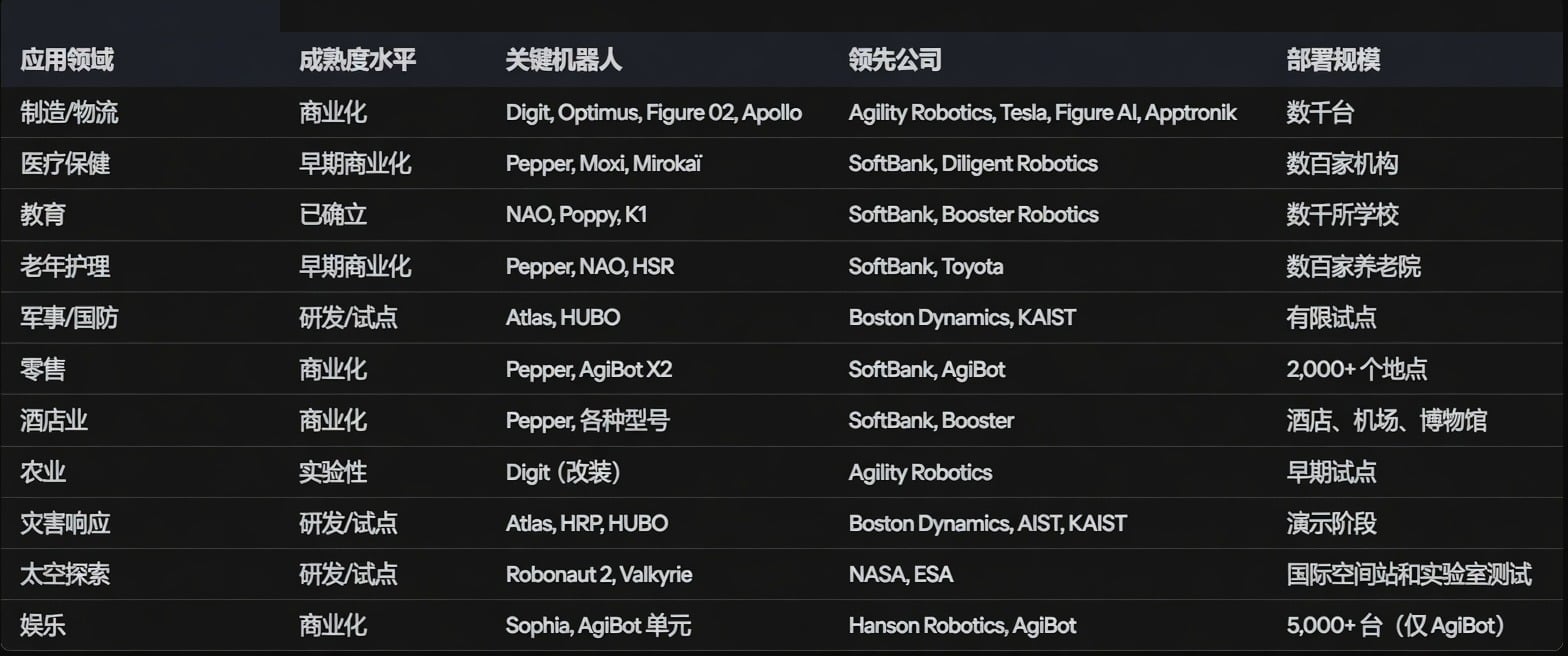
Application Comparison Chart
What changes can we expect at CES 2026?
CES 2026 (January 2026) marks an important turning point in the field of humanoid robot applications. The following key releases are reshaping the industry landscape:
- AgiBot debuted in the U.S. market with its most comprehensive humanoid robot product lineup to date, including A2 (service type), G2 (industrial/home type), X2 (entertainment type), and D1 (quadruped type). Bloomberg confirmed AgiBot as the leading humanoid robot manufacturer by shipment.
- Unitree Robotics showcased the H2 robot for industrial applications and confirmed a "Robot as a Service" model for global commercial deployment, now equipped with easily replaceable batteries and enhanced payload capacities.
- LG Electronics launched the CLOiD, central to its "zero-labor home" vision. This marks a significant entry of major consumer electronics companies into the humanoid robot sector.
- 1X Technologies confirmed that its NEO robot has been delivered to user homes, marking the first true mass-scale deployment of consumer-grade humanoid robots.
- 免责声明:本文章仅代表作者个人观点,不代表本平台的立场和观点。本文章仅供信息分享,不构成对任何人的任何投资建议。用户与作者之间的任何争议,与本平台无关。如网页中刊载的文章或图片涉及侵权,请提供相关的权利证明和身份证明发送邮件到support@aicoin.com,本平台相关工作人员将会进行核查。


