

Author: Jae, PANews
On May 14, the significant news of Hyperliquid's native stablecoin USDH being "acquired" by Coinbase was reported. Instead, Coinbase became the official treasury deployer of USDC on Hyperliquid, while Circle's USDC became Hyperliquid's Aligned Quote Asset (AQA).
On the same day, Hyperliquid launched its first Pre-IPO perpetual contract CBRS, which became a major hotspot as it achieved efficient price discovery first, resulting in a surge in trading volume.
Following multiple positive news, the HYPE token quickly broke through the $40 mark, increasing more than 20% within 24 hours, attracting many large whale bulls to build positions.
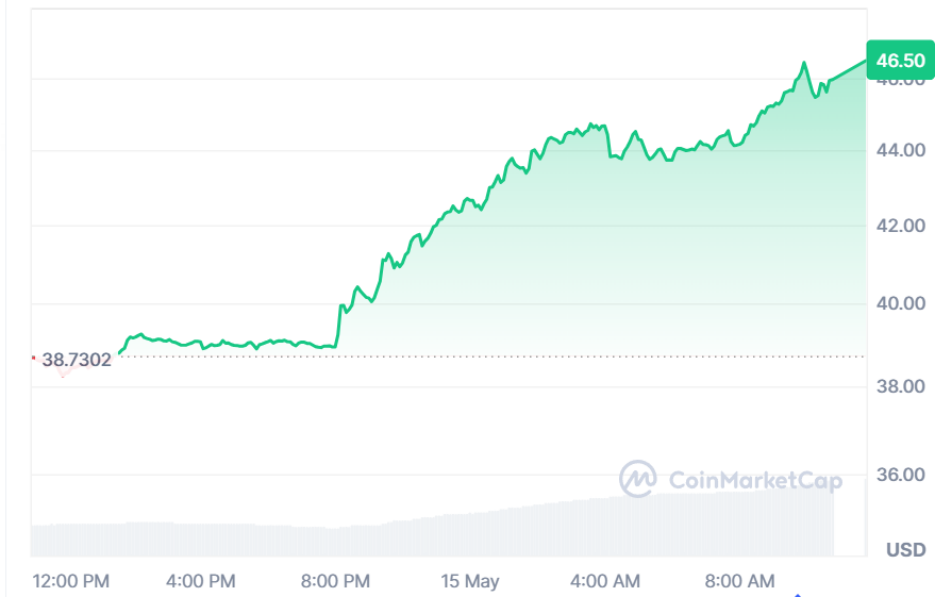
USDH officially cedes position to USDC, Hyperliquid secures 90% of reserve income
As the undisputed leader in the Perp DEX track, Hyperliquid, with its vast user traffic and trading scale, has long been a battleground for giants to integrate or adopt.
Hyperliquid's relinquishing of the USDH business line and its pivot to Coinbase and USDC must have deep strategic considerations behind it.
With this cooperation with Coinbase and Circle, the Hyperliquid ecosystem not only gains mature deployment technology but also saves costs in stablecoin issuance, compliance, and reserve management.
Especially since the original intention of USDH is to serve as Hyperliquid's native stablecoin, aiming to reduce dependence on external USDC, capture reserve income, and provide users with a better on-chain trading experience. However, since its launch in September 2025, despite some support from the platform, USDC has still firmly occupied the dominant position in the ecosystem, with slow growth of USDH liquidity, failing to effectively form scale. This directly led to liquidity fragmentation and a fragmented user experience.
Therefore, the issuer of USDH, Native Markets, chose to partner with Coinbase. According to the agreement, Coinbase will acquire the USDH brand assets, and USDH will gradually exit the stage. Users can exchange for USDC with zero fees during the transition period or redeem directly for fiat currency.
More importantly, there are also profit considerations behind this collaboration. According to the Hyperliquid official AQA document, as a stablecoin deployer, 90% of the reserve income must be directly returned to the protocol for HYPE token buybacks, ecosystem incentives, etc.
As of May 15, the circulating USDC on Hyperliquid exceeded $5 billion. Based on a 3.6% federal funds rate, the protocol's annual revenue could reach $180 million, approximately $490,000 of continuous net inflow per day.
At the same time, after purchasing HYPE tokens for the first time in September last year, Circle is set to stake another 500,000 HYPE tokens, further binding the interests of both parties. Of course, for Circle, this collaboration essentially sacrifices some marginal profit in exchange for greater network effects and a long-term moat.
CBRS on-chain pre-pricing, HIP-3 trading volume increases
On the same day, Hyperliquid also attracted further attention due to the AI newcomer CBRS (chip company Cerebras Systems) Pre-IPO perpetual contract. This contract was launched by TradeXYZ on the platform and completed a round of price discovery before the company’s official IPO.
Cerebras Systems had an issuance price of approximately $185, with the highest price on the first day of trading approaching $386. However, before trading launched, the price of this perpetual contract had already been pushed up on-chain to a range of $270 to $350, reflecting the premium space after listing to some extent.
This price performance has made the contract a popular trading target on the platform, and has led to more discussions about Hyperliquid's IPO pricing power. According to ASXN data, the trading volume of CBRS exceeded $280 million in the past 24 hours, ranking as the ninth largest trading asset on the platform.
In fact, as global macro conditions fluctuate dramatically, the demand for on-chain perpetual contracts for RWAs such as oil, gold, and the S&P 500 index has surged.
The HIP-3 market took advantage of this trading frenzy. During the escalation of the Middle East war, the trading volume of crude oil perpetual contracts on the platform once exceeded $1 billion within 24 hours. According to Artemis data, Hyperliquid's HIP-3 positions surpassed $2.5 billion, continuously setting new highs. Since the beginning of this year, the volume of HIP-3 positions on Hyperliquid has increased by over $2 billion.
HypeStats data shows that RWA perpetual contracts continue to contribute approximately 30% of the platform's position volume.
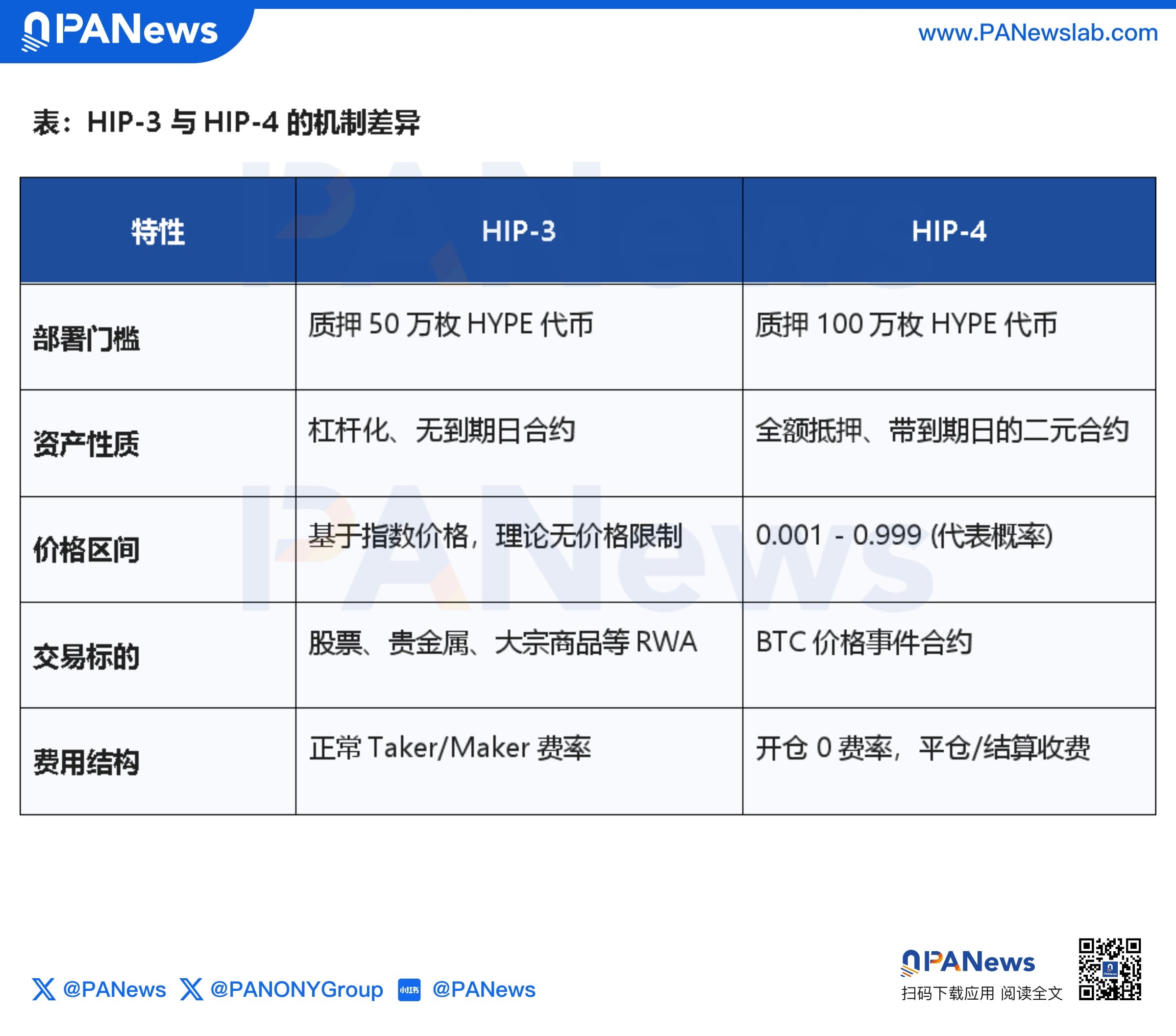
Meanwhile, Hyperliquid officially launched the HIP-4 (Outcome Trading) market on May 2, which is Hyperliquid's attempt to catch up with pioneers like Polymarket and Kalshi in the prediction market track.
Unlike traditional prediction markets with isolated asset pools, HIP-4 has dual competitive barriers:
Unified margin: Theoretically, traders can use the same margin account to hold positions in both perpetual contracts and event contracts, significantly improving capital efficiency.
On-chain CLOB matching: Different from the off-chain matching logic of Polymarket, HIP-4's order book is fully on-chain, ensuring that every transaction of event contracts is transparent and traceable.
According to Predictefy's disclosure, HIP-4's BTC price event recorded a transaction volume of $6.15 million on its first day. Although this surpasses similar markets on competitors like Polymarket and Kalshi, it only accounts for about 0.7% of the overall prediction market share.
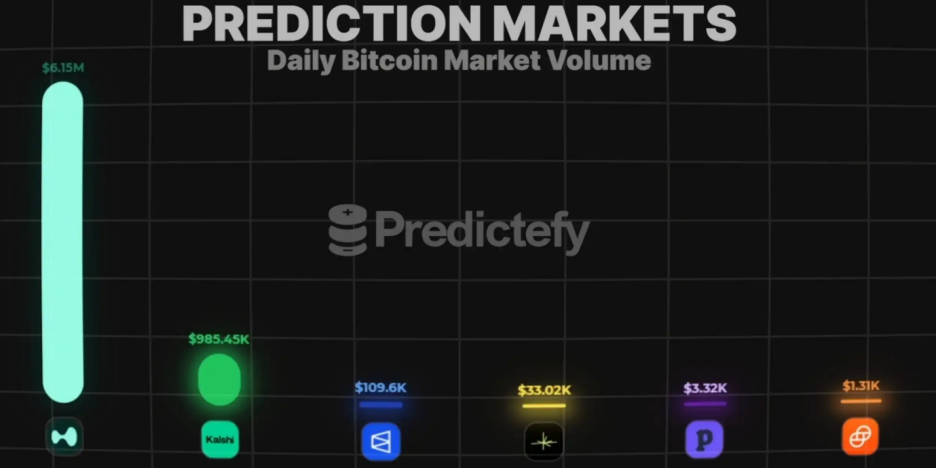
Additionally, deploying the HIP-4 market requires staking 1 million HYPE tokens. Due to funding cost constraints, the HIP-4 market currently focuses on BTC price event contracts and has yet to incorporate themes from traditional prediction markets like politics, sports, and entertainment, resulting in a scarcity of trading targets.
Rising bullish sentiment coupled with ETF catalysis, HYPE attention increases
Due to positive news boosts, market confidence in the fundamentals of HYPE has significantly strengthened.
On one hand, with the surge in trading volume and the sharing of reserve income, Hyperliquid's revenue has greater growth potential, providing more support for the valuation of HYPE.
It is well known that Hyperliquid's performance directly reflects in the value capture of the HYPE token, and the protocol adopts a fairly aggressive revenue return policy.
More than 97% of the platform's fee income is deposited into the Assistance Fund. This fund will buy back and destroy HYPE tokens in the open market daily.
Cumulative buyback scale: As of May 15, the Assistance Fund has cumulatively bought back and held over 44 million HYPE tokens, with a total value exceeding $2 billion, and an average buyback price of around $45;
Annualized income: Based on the current fee rate, Hyperliquid's annualized income will exceed $600 million, becoming the most profitable crypto protocol in the entire market, aside from stablecoin issuers;
Deflationary pressure: The buyback funds derived from organic trading activity will also provide strong bottom support for the HYPE token, translating into direct buying pressure.
It is important to note that while the HYPE token has a powerful destruction mechanism, its future unlocking plan still hangs over the price like the sword of Damocles.
Undistributed supply: Approximately 38.9% of the supply remains in the treasury for future emissions and community incentives, with its FDV (Fully Diluted Valuation) reaching as high as $17.5 billion, while the current market value of HYPE tokens is less than $12 billion.
Team lockup: About 17.6% of tokens held by core contributors will continue to unlock in batches. Although previous large unlocks were smoothly absorbed by the market, if the market enters a low-volatility period afterward, it may create ongoing supply pressure.
Moreover, HYPE is also making its way into mainstream capital markets through ETFs.
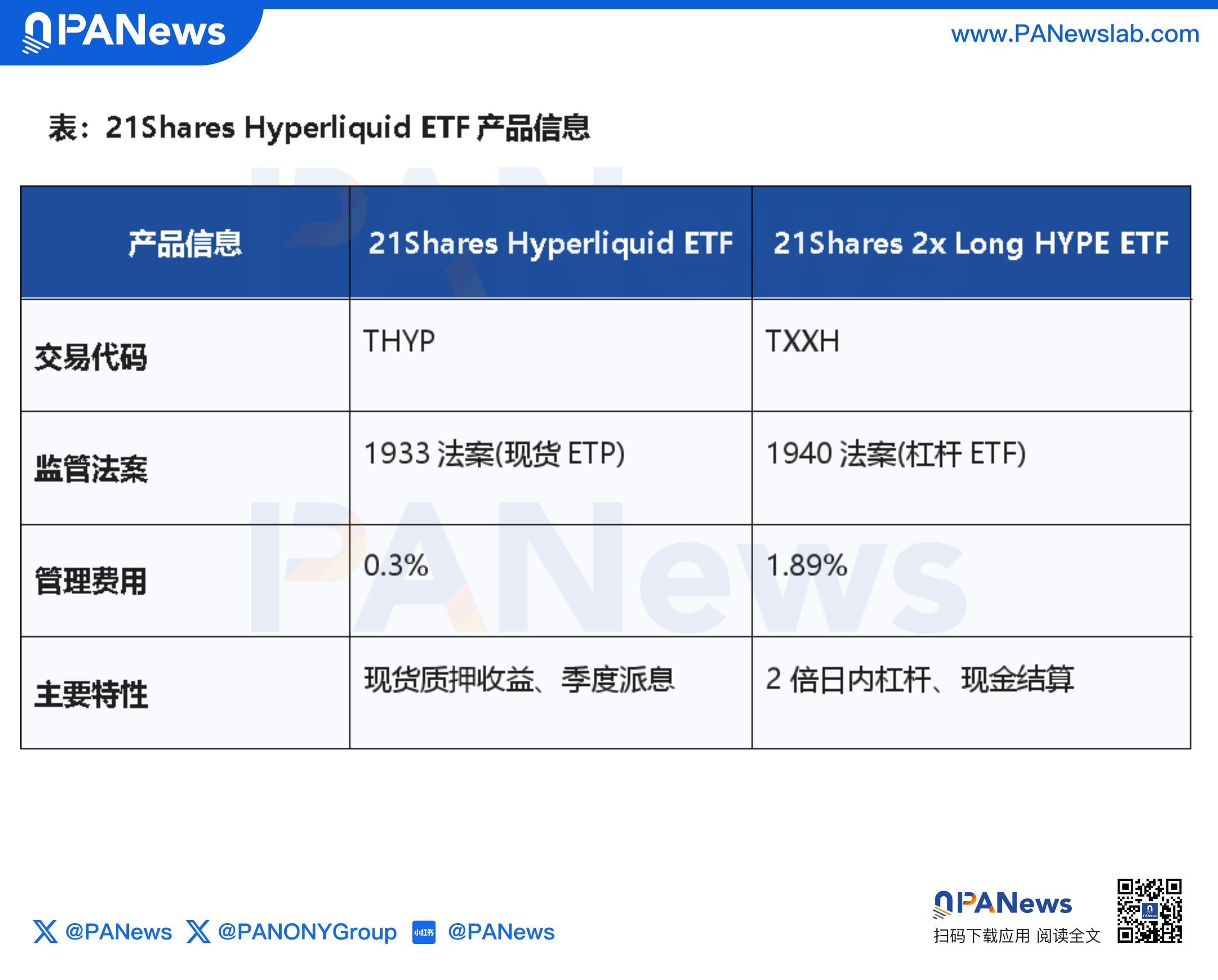
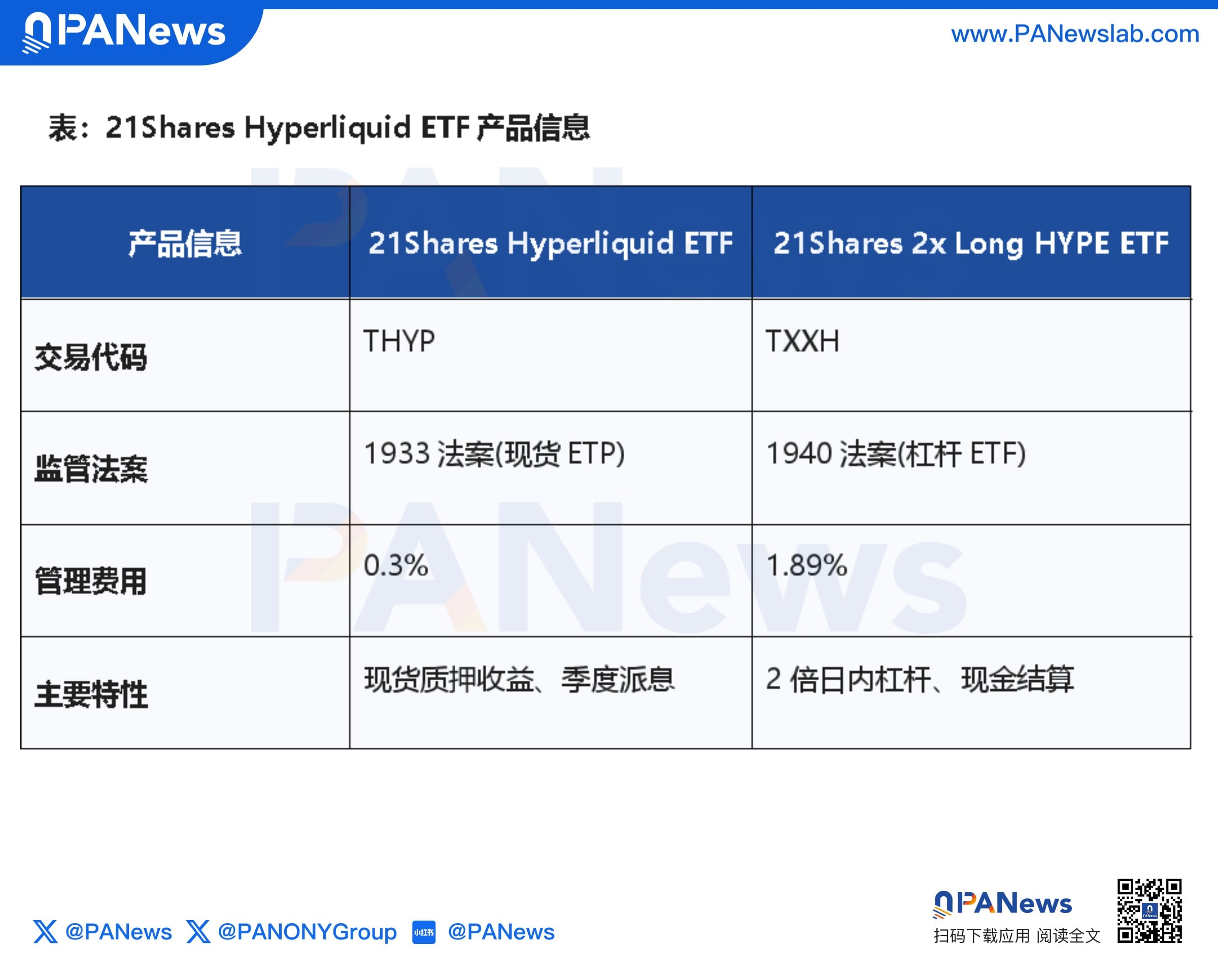
On May 12, two Hyperliquid-related ETF products launched by crypto asset management firm 21Shares were also officially listed on the Nasdaq Stock Exchange on May 12. This move represents institutional recognition of the protocol and will significantly lower the entry barrier for traditional investors to participate in the Hyperliquid ecosystem.
21Shares Hyperliquid ETF (THYP): This is a spot ETP (Exchange Traded Product) that integrates native staking income. The product trust will stake the held HYPE tokens with professional validators like Figment, and the rewards will be distributed to investors in quarterly dividends, with about 70% distributed to holders and 30% to service providers;
21Shares 2x Long HYPE ETF (TXXH): This is a leveraged ETF that provides investors with double the profit or loss on HYPE token price fluctuations through derivatives, suitable for short-term trading.
Bitwise followed closely, with its staking ETF BHYP set to begin trading on the New York Stock Exchange on May 16, and Grayscale has also submitted an application for GHYP. This ETF race suggests that traditional financial institutions are viewing the HYPE token as an asset with inherent yield capabilities.
According to 21Shares' disclosure, THYP achieved a transaction volume of $1.8 million on its first day of listing, with a net inflow of $1.2 million.
From the performance of altcoin ETFs upon listing, the first XRP spot ETF's transaction volume on its first day reached as high as $58 million, while the first SOL spot ETF was slightly lower at about $57 million.
THYP still has a significant gap compared to them. It can be said that while Hyperliquid has obtained a ticket to Wall Street, obtaining acceptance from a broad range of investors still remains a long way off.
With nearly 40% of on-chain perpetual share, Hyperliquid rakes in fees
Hyperliquid's valuation is driven by revenue, with protocol revenue primarily coming from perpetual contract trading. The high leverage nature of derivatives trading means its nominal trading volume is usually several to dozens of times that of spot scale, thus generating richer spreads and fee income under the same level of activity.
As of May 15, Hyperliquid has captured about 38% of the on-chain perpetual contract market share.
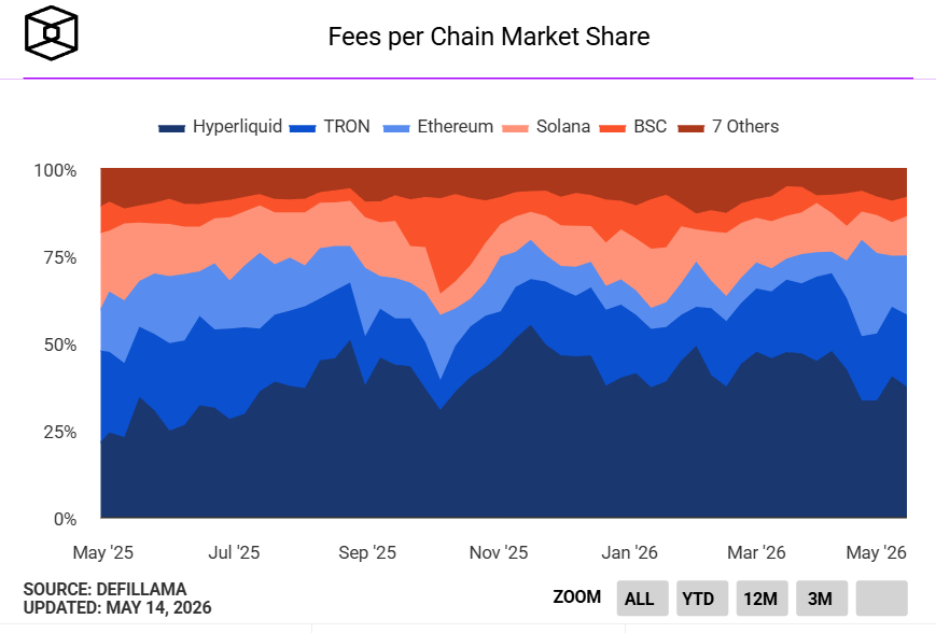
Ethereum once dominated fee income due to its strong application ecosystem. The Fusaka upgrade is regarded as a significant technological advancement, further reducing L2 data availability costs through the introduction of PeerDAS.
However, fee compression has also led to Ethereum mainnet fees entering a "depression period." As a large volume of transactions shifts to L2, the mainnet's ability to capture Gas income has significantly declined, with its share of application layer revenue distribution shrinking from about 50% at the beginning of 2024 to around 25% by the end of 2025.
In the Ethereum ecosystem, fees generated from a Perp DEX trade will be split among L2, sequencers, validators, and the mainnet layer. This fragmented profit distribution mechanism struggles to compete for revenue efficiency with Hyperliquid's "vertical integration" structure. The application of sovereign chain model ensures that every cent of fees flows directly back into the ecosystem.
Solana, on the other hand, maintains trading volume and activity through the meme coin craze, but its revenue structure heavily relies on low-price, high-frequency speculative spot trading. When the market returns to a steady state, the rate cap of spot trading becomes its revenue ceiling.
Additionally, while Solana also excels in handling high-concurrency transactions, Hyperliquid's trading engine offers a finality of 0.07 seconds in high-frequency order book matching that provides a superior trading experience.
Overall, Ethereum and Solana struggle with low-profit dilemmas, while Hyperliquid gallops ahead with high cash flow.
In fact, Hyperliquid's revenue explosion is inseparable from its rapid iteration on the product dimension. By building a series of HIP markets, the protocol has extended its business reach from crypto derivatives to RWAs (real-world assets) and prediction markets, gradually expanding into a full asset trading platform.
In this process, Hyperliquid's pricing logic has shifted to the paradigm of "revenue defines valuation." The protocol is using substantial high cash flow to erode the fee moats of platforms like Ethereum and Solana.
In the second half of the competition, protocols capable of creating sustained revenue for users are the true value assets.
免责声明:本文章仅代表作者个人观点,不代表本平台的立场和观点。本文章仅供信息分享,不构成对任何人的任何投资建议。用户与作者之间的任何争议,与本平台无关。如网页中刊载的文章或图片涉及侵权,请提供相关的权利证明和身份证明发送邮件到support@aicoin.com,本平台相关工作人员将会进行核查。


