Author: Zhou, ChainCatcher
In May 2026, Hyperliquid officially launched the HIP-4 event contract on the mainnet, introducing the prediction market feature called Outcomes.On the first day of its launch, the nominal trading volume reached 6.05 million contracts, accounting for about 0.7% of the total prediction market volume that day.In comparison, Kalshi had about 546 million, and Polymarket around 190 million, showing a stark volume disparity.
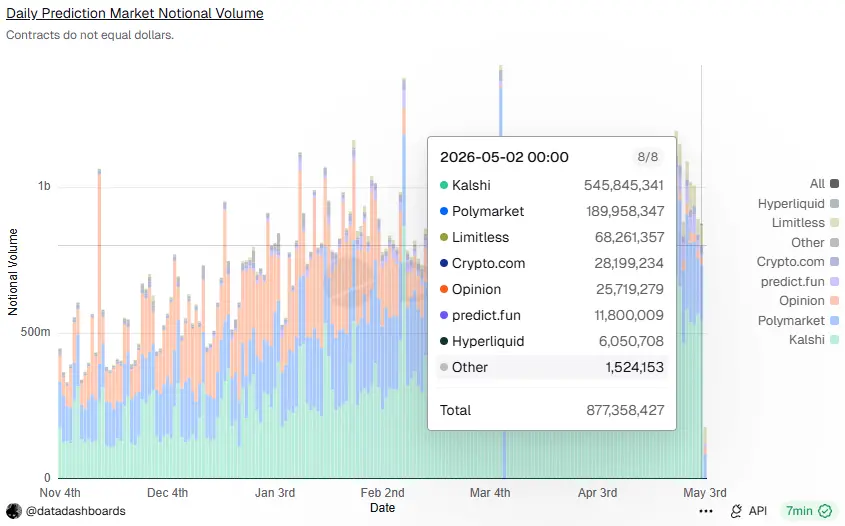
However, according to DL News, its first BTC price direction binary contract recorded a daily trading volume about three times that of similar markets at Polymarket and Kalshi combined.
Coinglass data shows that the HYPE token has risen nearly 60% year-to-date, with an approximately 42% increase over the past 90 days.
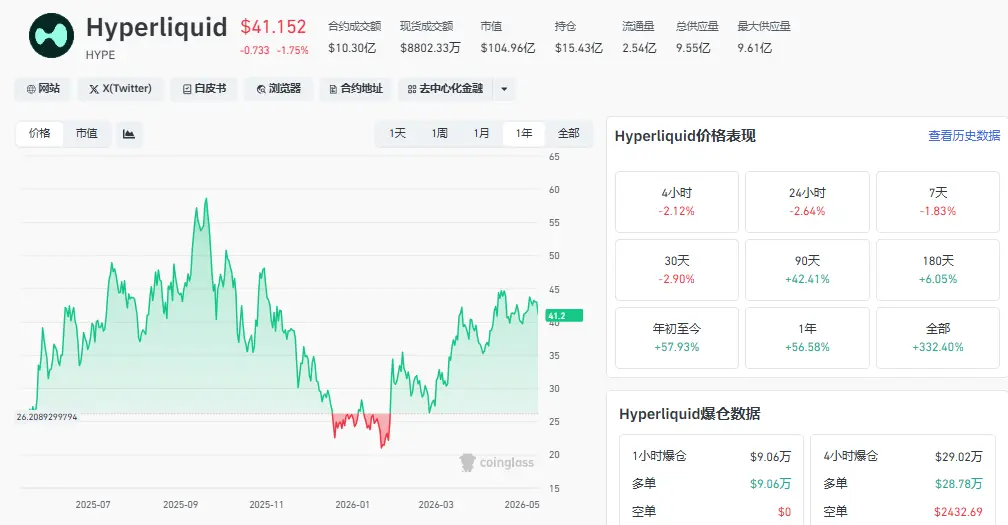
A platform that has captured over 70% of the perpetual contract market is now officially venturing into the prediction market, which has an entirely different logic.Hyperliquid last opened the commoditized battlefront successfully with HIP-3; can it replicate the myth once more this time?
1. From Perpetual DEX to HIP-3: Hyperliquid's ExpansionConfidence
Hyperliquid’s expansion is built on the actual accumulation of the past few years. It has attracted professional traders and market makers gradually since the beginning of 2023 by relying on a high-performance order book, extremely low fees, and the decentralized attribute of no KYC, forming a strong liquidity foundation.
The success of HIP-3 is an important precedent. After its launch in October 2025, Hyperliquid opened permissionless commodity and stock perpetual contracts. At the time, commodities and US stocks were experiencing significant market movements, and the platform quickly capitalized on this wave of traditional asset dividends.
Data shows that itsopen interest exceeded $1 billion at its peak, with 24-hour trading volume repeatedly surpassing $4.8 billion, among which, silver perpetual weekly trading volume was about $3 billion, gold around $700 million, and stocks like Nvidia had a cumulative trading volume exceeding $1.2 billion.
Under the influence of geopolitical situations, this advantage became more pronounced. During the escalation of the Iran situation, crude oil prices experienced sharp fluctuations, with Hyperliquid's crude oil perpetual contract daily trading volume briefly exceeding $2.2 billion, making it the second-largest trading variety on the platform after Bitcoin.
This fully demonstrates that Hyperliquid’s liquidity flywheel can operate not only within crypto categories but also successfully absorb spillover demand from traditional financial markets, attracting many centralized exchange users and traditional traders.
The HIP-4 prediction market is yet another expansion attempt following the same logic.However, this time, the nature of the moat it faces is entirely different from before.
2. Differentiation of HIP-4 in Trading Infrastructure
On the surface, HIP-4 is a prediction market; in essence, it is a binary option and bounded option embedded in Hyperliquid’s complete derivatives system.It adopts a fully collateralized mechanism, with no leverage or liquidation risk; the contract price reflects the implied probability of the event occurring in real-time, ranging from 0.001 to 0.999, while also supporting non-linear settlement methods, providing users with greater strategic flexibility closer to traditional options.
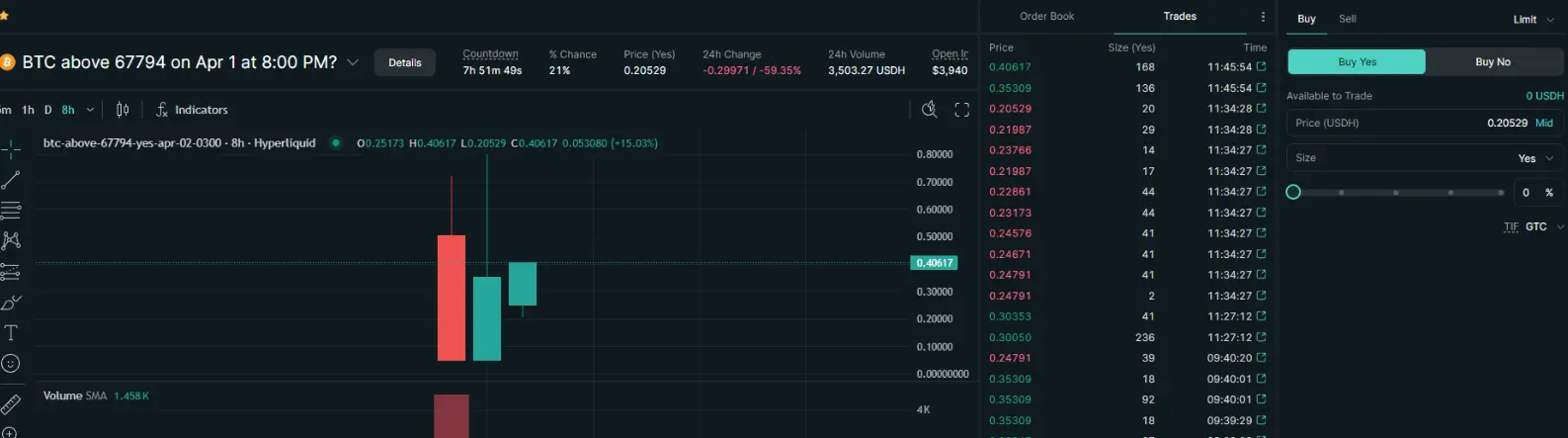
Hyperliquid did not simply replicate Polymarket's approach but instead integrated this tool native within the existing high-performance CLOB order book and matching engine of the platform.
This means that HIP-4 shares the same account, the same margin pool, and the same liquidity environment with spot and perpetual contracts, allowing users to achieve true cross-product hedging and capital reuse.
Among them, the cost advantages are the most direct. According to official documents, opening HIP-4 contracts is free, with only a small fee charged when closing or settling, and minting is also free. Compared to Polymarket's maximum 2% winning fees, this design offers significant cost advantages for high-frequency traders and large players.
Bernstein analysts highlighted in a report that binary contracts provide funds focusing on macroeconomics with a clearer event risk hedging method than traditional tools, where premiums, maximum losses, and returns are all known in advance, which reinforces the value of the zero opening fee structure.
Account integration is also a structural highlight. Traders can simultaneously hold BTC perpetual positions and prediction outcome contracts within the same USDC margin account, for example hedging non-farm payroll data or Federal Reserve resolutions while being bearish on BTC through HIP-4 contracts. This frictionless combination strategy is currently challenging to implement in the independent account systems of Polymarket and Kalshi.
In terms of institutional support, the three platforms are taking different paths.
It is reported that Hyperliquid is relying on existing derivatives infrastructure; FalconX has launched main brokerage financing services for it, Ripple Prime has listed it as its first partner DeFi platform, and Anchorage Digital also supports HYPE custody and staking.
Kalshi took the lead in institutional trading by completing the first customized bulk trade facilitated by Greenlight Commodities, with Jump Trading participating, and the institutional broker Clear Street became the first futures commission merchant to provide regulated prediction market clearing services for hedge funds.
Polymarket, on the other hand, secured over $1.6 billion in investment from ICE, with shareholders including General Catalyst, Point72, Founders Fund, and introduced professional market making services through equity liquidity partnerships with Jump Trading, with its valuation now approaching $15 billion.
3. True Barriers Beyond Technology
The core competitiveness of prediction markets extends far beyond technology; it is also a content and operation business, requiring the continuous provision of attractive hot topics to maintain order book depth and user activity.
Galaxy Research pointed out in a report that the current largest constraint on prediction markets is liquidity, and the root of liquidity lies in topic supply. Most markets have limited order book depths, where a few thousand dollars in trading can cause significant fluctuations in odds. Only by continuously attracting participants to hot markets can reliable probability signals be formed.
Real data also verifies this challenge. According to Dune Analytics data, after HIP-4 went live, Hyperliquid accounted for only about $3.95 million of the overall nominal trading volume in the prediction market, representing less than 0.02%. The cumulative nominal trading volumes of Polymarket and Kalshi have both exceeded $80 billion. Although Hyperliquid has achieved early highlights in BTC price contracts, the overall scale is still in its infancy.
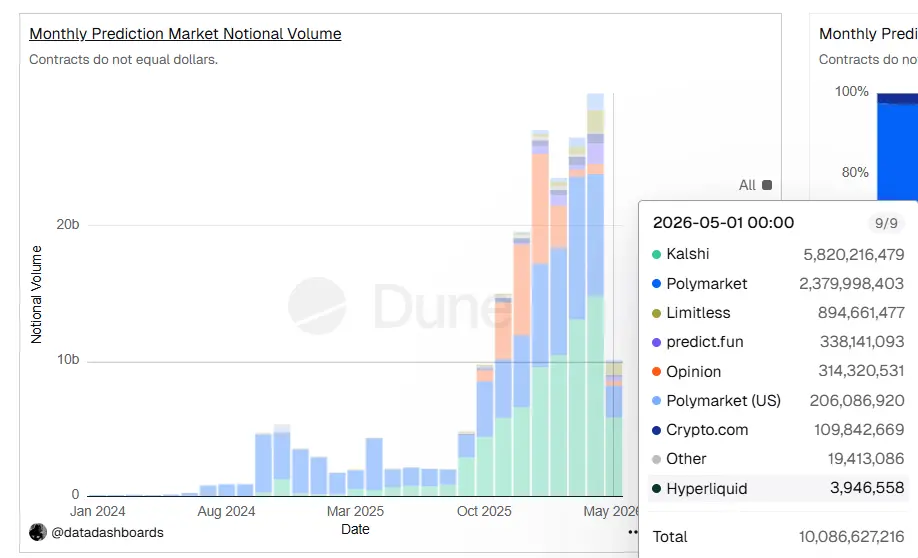
Currently, the HIP-4 market still primarily focuses on BTC price direction contracts, with insufficient coverage of longer-tail topics like politics, sports, and entertainment.According to a Chainstack technical report, deploying new markets requires staking 1 million HYPE, which is twice the threshold of HIP-3, leading to early content being primarily provided by a few financially strong large developers, potentially limiting the speed of content diversity expansion.
Cases in the industry have shown that topic management capability is harder to maintain than infrastructure. For example, Opinion once had a market share of 26% in January, but rapidly dropped to around 3.3%. Dragonfly partner Haseeb Qureshi also predicted that 90% of prediction market projects may face neglect by the end of the year.
The adjudication mechanism also poses potential risks. Price-related contracts can be objectively settled via oracle, but when political or sports events lead to disputes, credibility will be tested. The Chainstack technical report mentioned that early community documentation for HIP-4 primarily came from reverse analyses of the testnet, and the official specification documents are still being gradually improved. In contrast, Polymarket has accumulated experience in handling multiple disputes through community voting mechanisms.
Moreover, user demographics exhibit structural misalignment. Galaxy Research’s report shows that Kalshi is benchmarking its model against FanDuel and DraftKings, designing primary, intermediate, and advanced interfaces tailored for users with varying complexity. Hyperliquid’s core users are hardcore traders accustomed to high-frequency trading, while the main incremental users for prediction markets often prefer entertainment and event-driven gameplay. This disparity cannot be quickly bridged simply by adjusting the interface.
In summary, Hyperliquid holds certain competitiveness in crypto price-related and macro-data prediction markets. However, replicating the dominant success of the perp DEX era will not be easy; it needs to prove its capabilities in topic management, credibility building, and user demographic adaptation which are not traditional strengths of Hyperliquid, making quick success unlikely.
4. This is a Competition of Bidirectional Invasion
From an industry-wide perspective, the overall prediction market landscape is rapidly expanding. According to on-chain data, since 2026, prediction market trading volume has exceeded $10 billion for four consecutive months. Bernstein Research has identified it as one of the three core trends in the digital asset space, alongside tokenization and stablecoins.
In market share, Kalshi has shown relatively strong performance, increasing from 29.4% in January to 47%, achieving multiple monthly trading volume records consecutively. Polymarket experienced a slight decline in trading volume in April compared to March after initiating comprehensive fees at the beginning of this year, yet still exceeded $4 billion, with a market share increase from 27.9% to 38.9%, remaining securely in second place.
The duopoly structure is further solidified amidst rapid growth, which implies that Hyperliquid enters a market highly concentrated at the top, with traditional capital accelerating its flow in, and the competitive threshold has significantly increased.
Centralized exchanges are also quickening their layout in prediction markets.According to public information, MEXC launched native prediction market functionality in March 2026, while Gate became the first centralized exchange to directly integrate Polymarket; Binance integrated on-chain prediction markets through Predict.fun in April and covered part of the fees, whereas Crypto.com is also advancing CFTC-compliant prediction contracts; Coinbase has partnered with Kalshi and launched prediction market functionality in all 50 states in the United States.
Simultaneously, the boundaries between prediction markets and derivatives tracks are being broken down. Polymarket is preparing to launch leveraged BTC, Nvidia, and gold contracts; Kalshi has introduced a perpetual contract product called Timeless and has completed its first customized institutional bulk trade. While Hyperliquid is invading the prediction market, its opponents are also invading its home turf.
Notably, one of the co-authors of the HIP-4 proposal is John Wang, the head of crypto business at Kalshi, indicating that there is not purely a competitive relationship between Hyperliquid and Kalshi, and there may be some space for future cooperation and integration.
Delphi Digital noted that the real breakthrough is not in competing head-on with top platforms but in dividing the tech stack and serving different types of users. Aggregated terminals and advanced analytical tools cater to professional traders, while a socialized interface leverages a broader public entertainment market.
The entire industry is heading towards an infrastructure layer that integrates prediction markets and derivatives, and the platform that first seamlessly connects both will gain a structural advantage in this track.
Conclusion
Overall, Hyperliquid's comprehensive infrastructure advantages stand out, with its powerful liquidity, shared margin structure, and zero-cost opening design providing competitive advantages in crypto price-related and macro data prediction markets. However, completely replicating the dominating success of the perp DEX era poses significant challenges.
Prediction markets fundamentally are also a content and operation business, and HIP-4 needs to prove its capabilities in topic supply, credibility building, and user demographic adaptation. These areas are not Hyperliquid’s traditional strengths, making swift achievements difficult.
Nevertheless, Hyperliquid has become one of the on-chain competitors that centralized exchanges like Binance should be most wary of. Each of its category expansions is compressing the survival space of CEX and reshaping the entire derivatives market landscape.
With the World Cup set to open in June 2026, this will be the first major test for HIP-4 after the permissionless creation is fully opened. At that time, if stable and scaled liquidity can emerge in the political and sports markets, Hyperliquid is likely to transform local advantages into overall breakthroughs. Otherwise, it may only provide an additional hedging tool for existing perp users without becoming a true player in the field.
免责声明:本文章仅代表作者个人观点,不代表本平台的立场和观点。本文章仅供信息分享,不构成对任何人的任何投资建议。用户与作者之间的任何争议,与本平台无关。如网页中刊载的文章或图片涉及侵权,请提供相关的权利证明和身份证明发送邮件到support@aicoin.com,本平台相关工作人员将会进行核查。


