Since its launch in September 2025, OKX Boost has become a bridge between on-chain innovation projects and real users. For ordinary users, it provides a low-barrier, high-transparency participation channel; for project parties, Boost serves as an initial field to observe user interest and market response, as well as a outpost to enter OKX's main liquidity market, providing a reference for future spot or contract listings.
Currently, what level of user participation is there in OKX Boost? How does the overall transparency of the projects perform? How many projects have successfully "graduated" to enter the main site of OKX?
Recently, RootData launched the OKX Boost Project Compilation and conducted a systematic analysis of the projects launched in Q1 2026, providing a more complete data perspective for the industry. Below are the core data and main observations:
1. OKX Boost Q1 Participation: An average of over 20,000 addresses per session, total prize pool exceeds 11 million USD
According to statistics from RootData's OKX Boost Project Compilation, OKX Boost has launched a total of 62 projects, of which 23 project activities launched in Q1 2026 (some projects are divided into two sessions), accounting for nearly 37%.
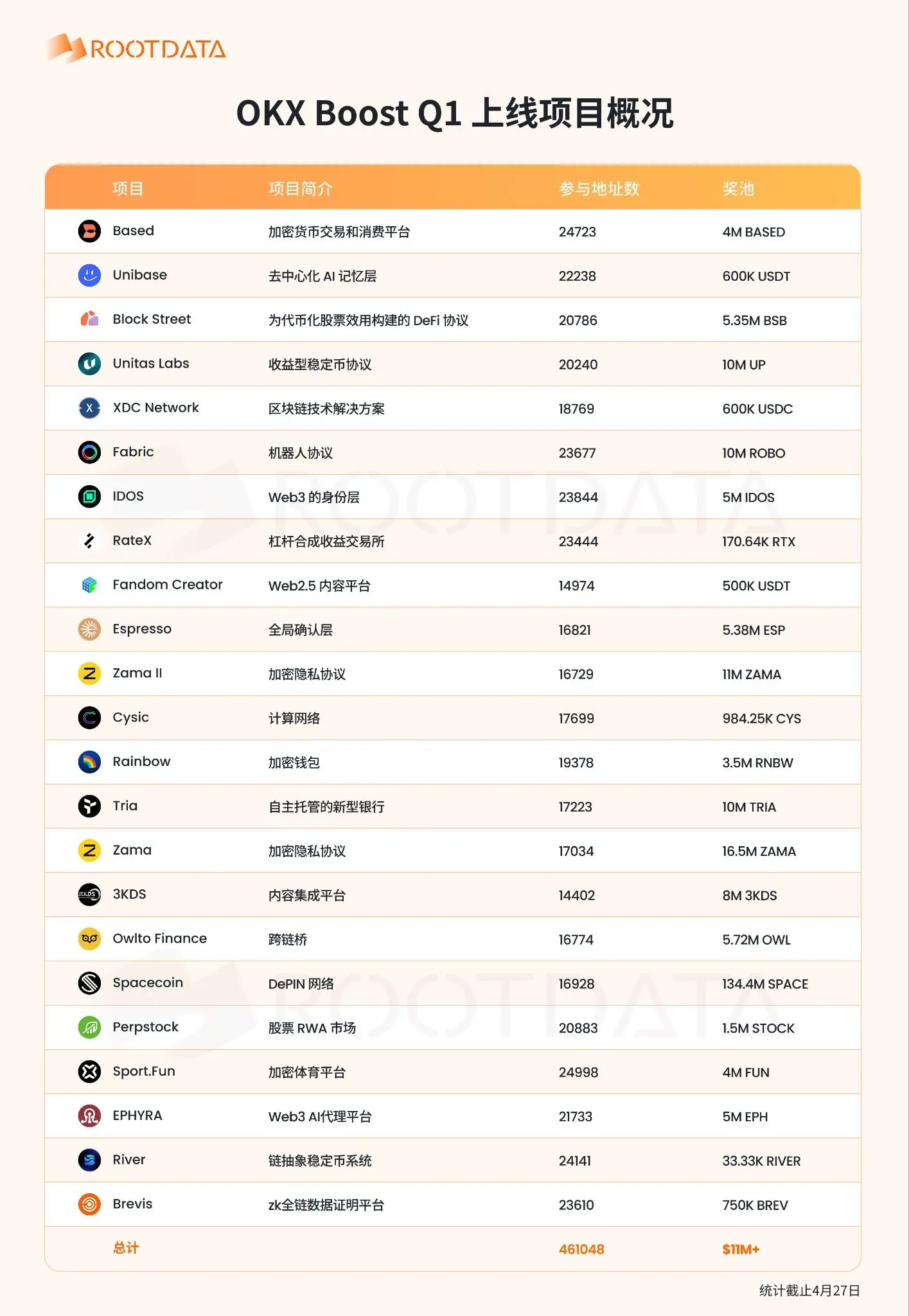
These activities collectively provided a total prize pool of over 11 million USD (the token price calculated at the closing price when users claim the tokens), attracting 461,048 participants, with an average of about 20,000 participants per activity, and each project's average prize pool value is approximately 500,000 USD.
It is worth mentioning that during the activities, some projects that used their tokens as rewards saw a significant price increase compared to before the activities started, resulting in the market value when users actually claimed being significantly higher than the initial prize pool set. For instance, based on the closing price of the tokens users claimed, the single session prize pool for Spacecoin ultimately reached 2.31 million USD.
Additionally, projects like XDC Network (600,000 USD), Unitas Labs (550,000 USD), River (540,000 USD), EPHYRA (500,000 USD), and Fandom Creator (500,000 USD) also provided considerable valued prize pools, which were equally impressive.
2. RootData Average Transparency Exceeds 70%, Overall Disclosure Level is High
RootData's transparency score (full score 100%) measures the openness of projects in dimensions such as team, funding, and on-chain data. Higher transparency usually indicates that the project is more reliable and more willing to accept market supervision.
The average transparency score of Q1 Boost projects is 71.8%, which is above average. This indicates that the projects launched on OKX Boost have a relatively sufficient information disclosure, and the platform has certain threshold requirements for project quality. Among them, the projects ranked in the top 10 transparency are as follows:
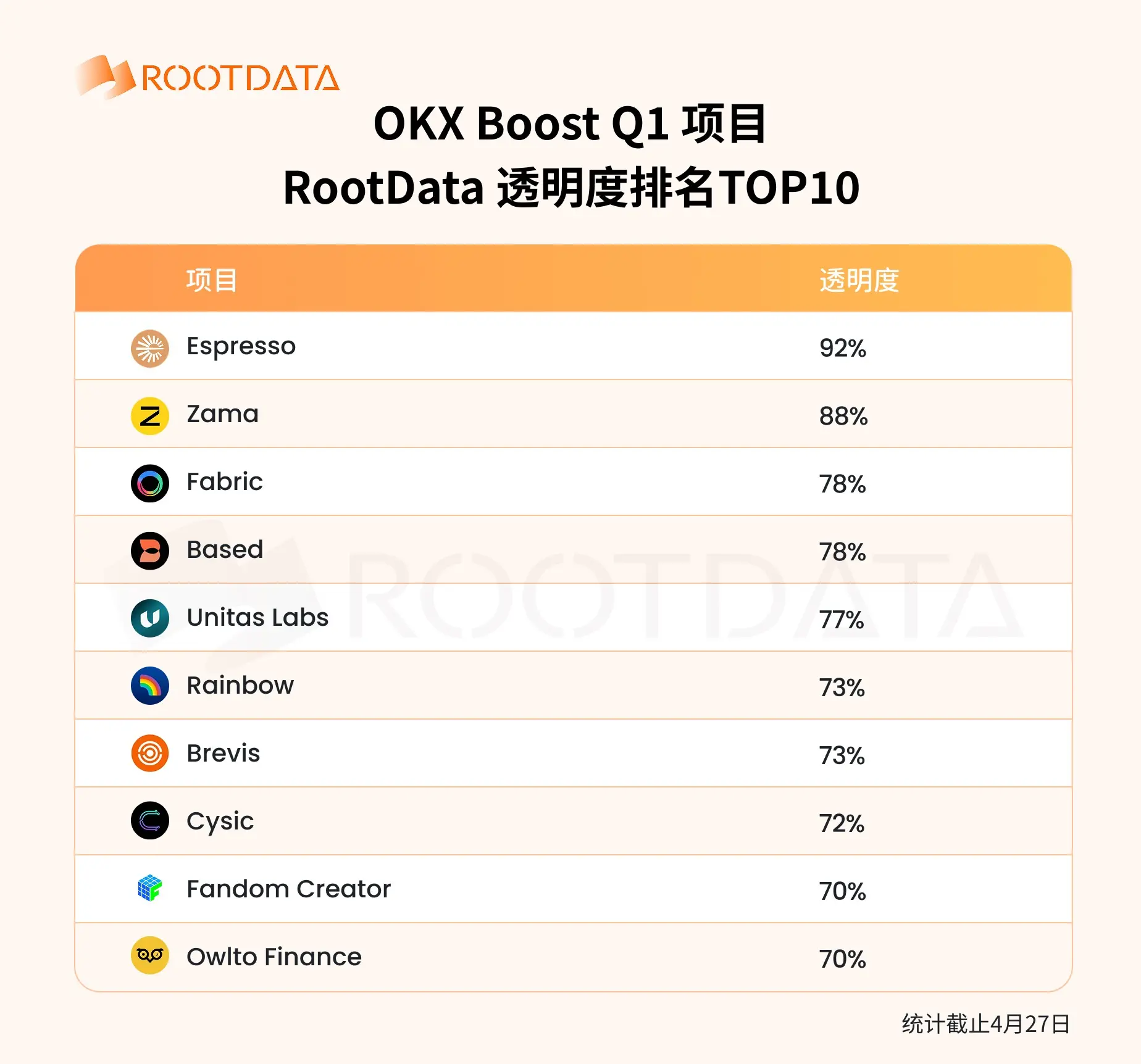
It can be seen that most of them are infrastructure, ZK privacy or AI projects, as these tracks typically have longer verification cycles, and the community may have higher information disclosure requirements.
Recently, OKX Boost and RootData announced a data cooperation around project transparency, and in the future, the information disclosure of Boost projects will become more standardized and verifiable. This cooperation will further compel project parties to improve transparency, making the decision basis for ordinary users participating in Boost clearer and more reliable.
3. Graduation Rate is 45%: Transparency has become an important selection criterion
Before entering the analysis, let’s clarify the definition of "graduation": a project successfully goes live on OKX's spot or perpetual contract, indicating a shift from Boost to a larger liquidity market. As of April 23, the total number of Q1 activities is 23, with the duplicate counts removed, there are 22 projects, among which 10 projects have "graduated", resulting in a graduation rate of 45%.
This means that nearly half of the projects can complete the migration path from activity incentives to spot or contract listing. As OKX Boost strengthens its role as the "outpost" of the main site, it is providing potential project sources and data references for subsequent main site trading as an early participation and screening mechanism designed for interaction between on-chain innovation projects and users.
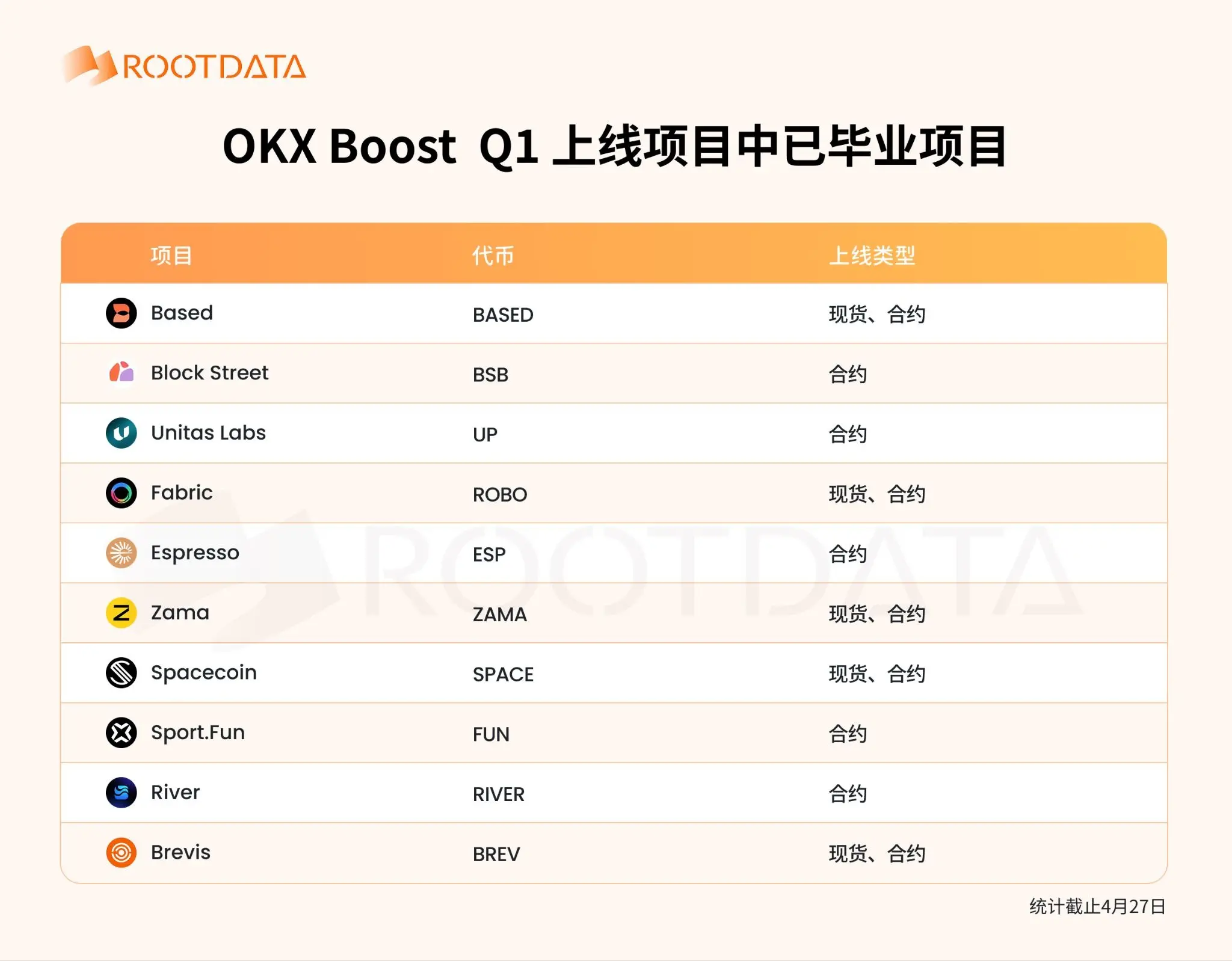
From the perspective of graduation types, perpetual contracts have become the mainstream channel for Boost projects to reach the main site. All 10 graduated projects successfully launched perpetual contracts, with half of the projects further attaining spot trading pairs based on this. It is noteworthy that the number of projects transitioning directly from Boost to perpetual contracts showed a significant upward trend during Q1, and some projects' graduation periods have shortened to about a week, indicating that OKX is accelerating the provision of contract liquidity support for high-quality early projects.
In terms of track distribution of graduated projects, they cover three major areas: infrastructure, DeFi, and AI. The infrastructure category (Espresso, Brevis, Spacecoin) focuses on ZK privacy and Layer2 scaling, DeFi projects (Unitas Labs, River) concentrate on stablecoins and lending protocols, while AI projects (Fabric, Based) lean towards AI agents and robotics.
Moreover, from the perspective of transparency, transparency is highly positively correlated with graduation quality. Among the 10 graduated projects, 7 have a transparency score exceeding 70%, with an average transparency of 74.5%. The highest transparency projects, Espresso (92%) and Zama (88%), not only graduated smoothly but also launched contracts and spot trading.
Overall, transparency has become an important accelerator for projects to move from Boost to the main site. As the cooperation between OKX Boost and RootData deepens, the standardization of information disclosure will further increase, and in the future, the weight of transparency in graduation decisions is expected to continue rising, potentially becoming the core competitiveness for project parties to compete for user trust and platform resources.
4. Track Trends: Infrastructure and DeFi account for over 70%, AI and Social Heat Up
In terms of track distribution, Q1 Boost projects cover multiple fields, including infrastructure, DeFi, AI, and social entertainment. Among them, projects in the infrastructure category lead with 9 projects (41%), covering sub-divisions such as Layer1/L2, cross-chain, DePIN, wallets, and ZK identities, reflecting OKX Boost's emphasis on underlying technology innovation.
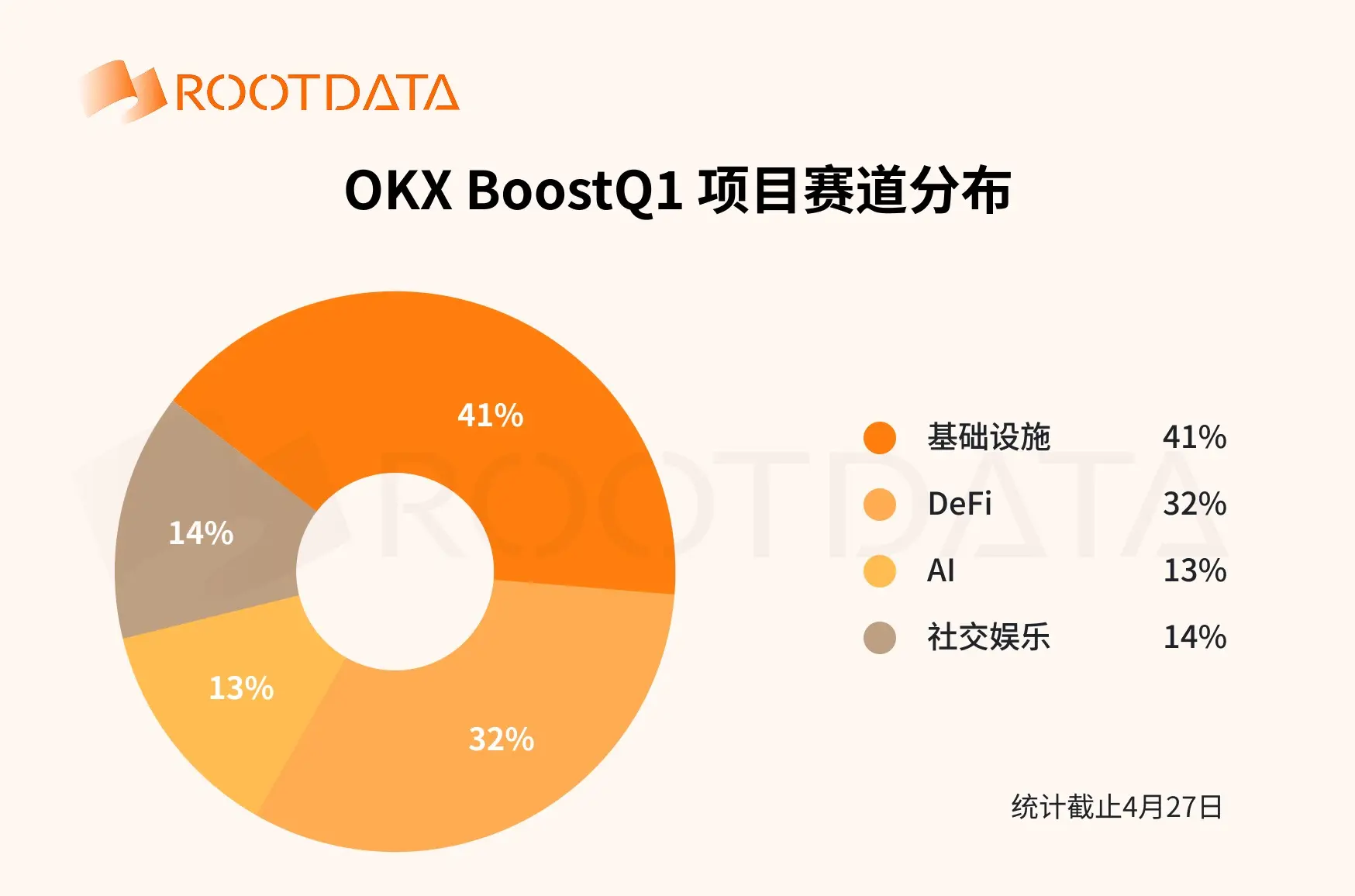
DeFi category projects total 7 (32%), primarily focused on stablecoins, lending, and derivatives. Notably, among them are 2 RWA projects, PerpStock (stocks RWA market) and Block Street (tokenized stocks DeFi protocol), indicating that OKX may recently attach significant importance to the RWA track. As one of the most mature tracks in Web3, DeFi remains a category with high user participation and fast liquidity conversion rates.
AI/AI agents (3 projects, 14%) and social entertainment (3 projects, 14%) tie for third place. In the AI track, Fabric has high participation, having launched both spot and contracts; while EPHYRA has only launched Boost activities, it still saw over ten thousand participants, indicating that the AI narrative has a natural appeal to users. Social entertainment projects are represented bySport.Fun with participation reaching 25,000, making it one of the most popular projects in Q1; Fandom Creator also offered a 500,000 USD prize pool, highlighting the importance of IP and user operational capabilities in the entertainment track.
Overall, the projects launched on Boost do not chase short-term hot Meme coins but lean towards "useful" practical projects, which highly aligns with the relatively rational user profile of the OKX platform.
Summary
In the first quarter of 2026, OKX Boost achieved breakthroughs in participation scale, project quality, and listing conversion rates. Behind over 460,000 addresses and an 11 million USD prize pool is a strong demand from users for high-quality early projects; and a graduation rate of 45% validates the effectiveness of Boost as a project "incubator".
What’s more noteworthy is that transparency is becoming a core benchmark for distinguishing project quality - high-scoring projects significantly excel in the graduation process. As the cooperation between OKX Boost and RootData deepens, information disclosure will transition from a "bonus" to a "must-have," further raising the project's entry threshold on the platform.
It can be foreseen that Boost will not only be a channel for users to capture early value but also become a standardized data window to observe trends in the Web3 primary market.
免责声明:本文章仅代表作者个人观点,不代表本平台的立场和观点。本文章仅供信息分享,不构成对任何人的任何投资建议。用户与作者之间的任何争议,与本平台无关。如网页中刊载的文章或图片涉及侵权,请提供相关的权利证明和身份证明发送邮件到support@aicoin.com,本平台相关工作人员将会进行核查。


