Original Title: Chaos Is a Ladder: Why Bitcoin Rallies During Geopolitical Uncertainty
Original Author: @Matt_Hougan
Translated by: Peggy, BlockBeats
Editor's Note: While the market tends to classify Bitcoin as a "risk asset," this latest round of market movements triggered by the Iran conflict has provided a signal that clearly deviates from consensus: amidst the decline of traditional assets and the failure of safe-haven assets, Bitcoin has instead strengthened.
The author of this article, Matt Hougan (current CIO of Bitwise, co-founder of Future Proof, and former CEO of ETF.com), believes that the rise of Bitcoin is not merely a result of "ignoring war" or just an outcome of "printing money expectations," but is directly driven by the geopolitical conflict itself.
Hougan presents a more explanatory framework—Bitcoin is not a single asset, but rather a "layered bet": on one hand, it competes for the role of "store of value" with gold; on the other hand, it is also betting in a highly elastic way, albeit with a low probability, that it can become a true global currency.
In the past, this second layer of logic seemed like a distant imagination. However, as the financial system becomes progressively "weaponized," this assumption is beginning to move from the margins to reality. From SWIFT sanctions to the rise of parallel settlement networks, and Iran's attempt to charge shipping fees in Bitcoin, it is clear that Bitcoin is no longer just a tool against inflation; it is also being integrated into the territory of state-level gaming.
In this context, the pricing logic of Bitcoin has also changed. It is no longer solely driven by liquidity, tech stocks, or risk appetite but has begun to price in "the uncertainties of the global monetary system." As conflicts enhance the probability of its "monetary properties" coming into play while amplifying volatility in the global financial system, the upside potential of this asset has also been reopened.
If, in the past five years, the narrative around Bitcoin focused on "digital gold," what is currently emerging is a more complex dual role: it serves as both a store of value and a potential depoliticized settlement medium. And if this structure is established, its market boundaries may extend beyond the $38 trillion represented by gold.
Below is the original text:
Since the outbreak of the Iran conflict, Bitcoin has performed relatively strongly. Since February 28, when the U.S. and Israel began airstrikes on Iran, Bitcoin has risen by 12%, while the S&P 500 index has fallen by 1% and gold has dropped by 10%.
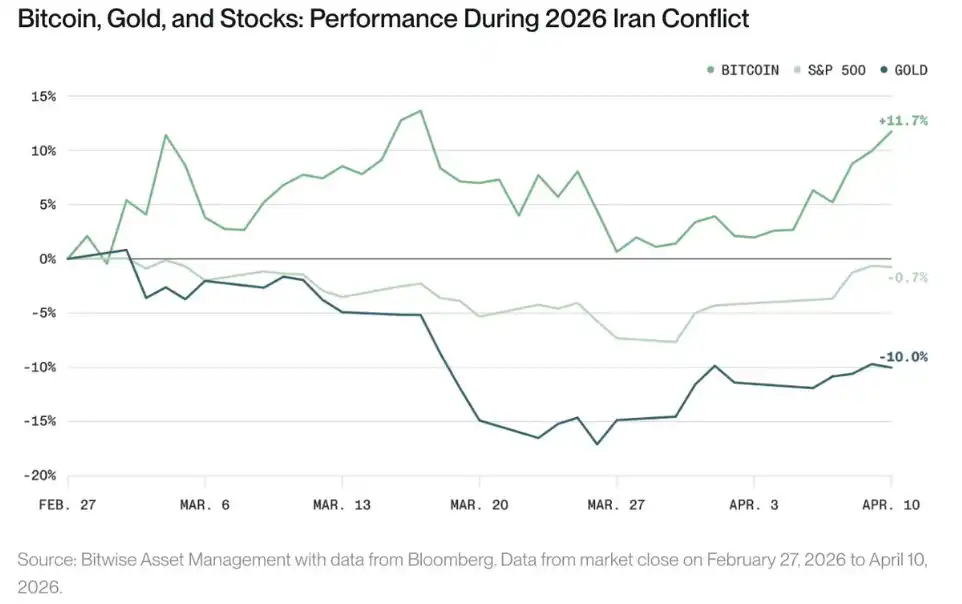
This has surprised many. Bitcoin has long been viewed as a risk asset, and many originally thought it should decline amidst the "risk-off" sentiment triggered by geopolitical conflict. Hence, various explanations started to emerge: some believe that geopolitics has nothing to do with Bitcoin; others pointed out that war often leads to currency over-expansion, which can ultimately benefit Bitcoin in the long term.
Both of these explanations are inaccurate. Bitcoin's strong performance in this crisis originates precisely from the conflict itself. Understanding this is important.
An Investment, Two Bets
Buying Bitcoin essentially involves betting on two things simultaneously.
First, you are betting that Bitcoin will become "digital gold" and compete with physical gold in the $38 trillion "store of value" market. This is currently the primary use case for Bitcoin and is a bet I find very attractive. As I explained earlier, if it captures about 17% of this market over the next decade, Bitcoin's price could potentially reach $1 million.
But when you buy Bitcoin, you are also making a second bet—that someday, perhaps, Bitcoin will operate like a traditional currency.
In the past, I viewed this as an "out-of-the-money call option": a speculative bet on a future that seems unlikely to materialize. After all, for most of Bitcoin’s existence, this possibility appeared extremely remote to most people. Until a few years ago, the global financial system was nearly entirely built on the dollar's framework, and conducting international trade using a volatile, still-nascent "cryptocurrency" sounded more like a fantasy.
The turning point came in 2022 when the U.S. kicked Russia out of the dollar-centric SWIFT system. The French finance minister referred to it as a "financial nuclear bomb," and countries became vigilant. China quickly built a parallel financial system, and other countries followed suit. Russia shifted 99% of its financial activities to these new systems, and other countries began to attempt similarly.
At that time, I thought that the "weaponization" of SWIFT might open space for Bitcoin: if countries gradually become unwilling to rely on the dollar system, then it seems logical for them to eventually turn to a "depoliticized" alternative.
And in the current Iran conflict, we have indeed seen an early (and troubling) manifestation of this trend: Iran stated in an interview with the Financial Times that it would begin charging a "toll fee" of $1 per barrel (about $20 million per day) to all ships passing through the Strait of Hormuz, with payments to be made in Bitcoin.
Clearly, this move has raised significant concerns about sanctions evasion and money laundering. While it may, in some sense, be better than the status quo—Iran has long evaded U.S. sanctions through China's financial system, which is harder to track than cryptocurrency—it also brings new risks.
At the same time, it reveals a reality that transcends the current conflict: in a world where countries are "weaponizing" financial systems, Bitcoin is gradually becoming a depoliticized alternative.
Option Pricing Logic
This is also why I draw a comparison between Bitcoin’s potential as a currency and an "out-of-the-money call option."
The rise in the value of options typically stems from two factors: either an increased probability of hitting the target price or an increase in the volatility of the underlying market.
In this Iran conflict, both factors are occurring simultaneously: first, the probability of Bitcoin being used as a "currency" has increased; second, the uncertainty and volatility of the global monetary system have risen.
This analytical framework can help us understand two important things. First, in future geopolitical conflicts, Bitcoin is likely to continue rising—especially in regions caught between U.S. and Chinese systems. Second, the potential market size for Bitcoin may extend far beyond the $38 trillion gold market.
In the past five years, we have almost exclusively viewed Bitcoin as a "store of value tool." However, if it begins to simultaneously fulfill both "store of value" (like gold) and "payment currency" (like the dollar) roles, then we may need to adjust our long-term expectations for its market potential upwards.
免责声明:本文章仅代表作者个人观点,不代表本平台的立场和观点。本文章仅供信息分享,不构成对任何人的任何投资建议。用户与作者之间的任何争议,与本平台无关。如网页中刊载的文章或图片涉及侵权,请提供相关的权利证明和身份证明发送邮件到support@aicoin.com,本平台相关工作人员将会进行核查。


