Original author: KarenZ, Foresight News
In the power landscape of Web 3, Tether has long played a silent yet wealthy role as a shadow dollar printing machine.
On the evening of April 14, Tether announced the official launch of Tether Wallet, claiming to be "The People's Wallet." The emergence of this product is essentially a "downstream interface" for this stablecoin giant, directly reaching end users.
From asset issuer to user entry point. Previously, Tether was only responsible for "printing money"; now it wants to define how people transfer money and how they hold assets. By directly controlling consumer traffic, Tether is transforming into a closed-loop ecosystem with traffic sovereignty.
This is also a defense of its shadow dollar status. In emerging markets, USDT has already become a de facto substitute for the official currency. However, as Circle continues to strengthen its compliance narrative and squeeze the market, Tether must lock the billions of users abandoned by traditional finance firmly within its official entry by lowering the physical barrier to use.
What is the true core of Tether Wallet?
In the product logic of Web 3, user experience has always been a false proposition. When you ask a user trying to transfer $10 on the streets of Latin America to hand-copy 12 illogical English words and remind him "losing it means bankruptcy," financial inclusion has already died at the starting line.
The core highlight of Tether Wallet lies in its attempt to use a transparent white-box approach to dismantle the three major obstacles of self-custody wallets: addresses, fees, and mnemonic phrases, focusing on "simplicity" and "convenience" while minimizing the experience.
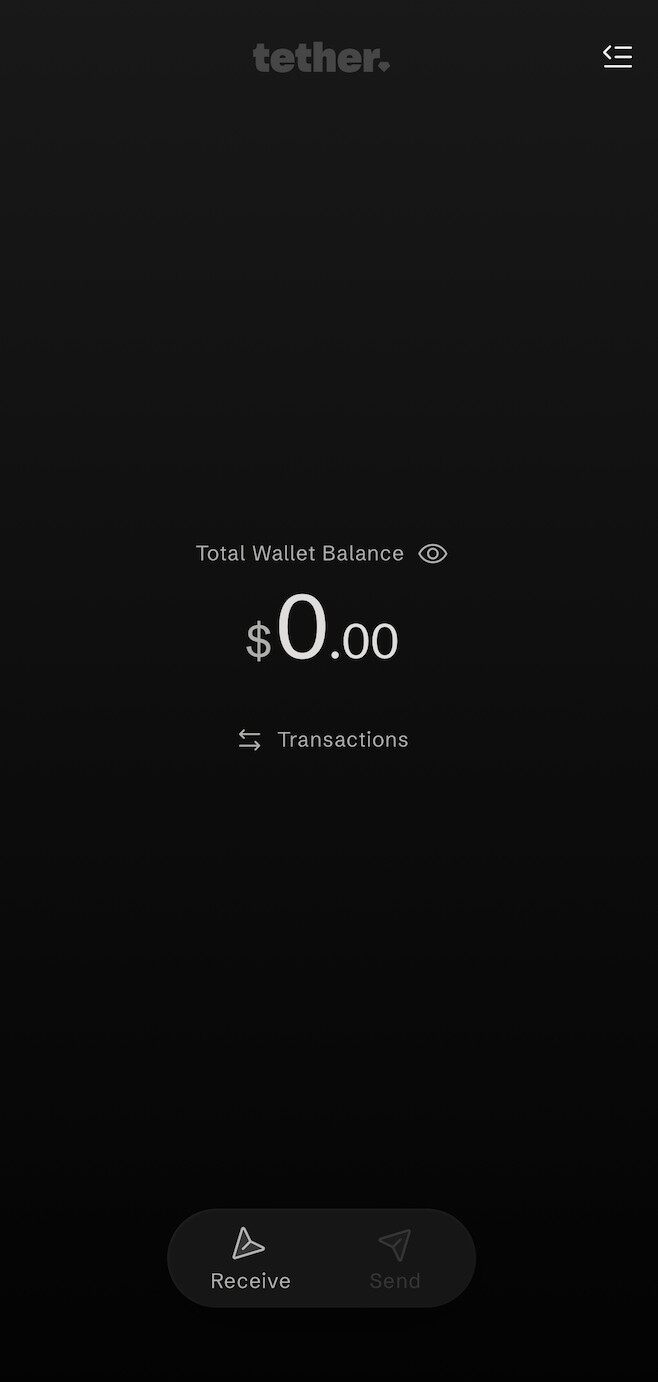
First, identity-based on-chain addresses.
For a long time, hexadecimal long string addresses have been the biggest barrier to widespread adoption. Tether Wallet introduces a payment username system (such as name@tether.me). This means that in cross-border transfer scenarios, USDT sheds the obscure nature of crypto assets and becomes as easy as sending an email or a message.
According to testing, Tether Wallet requires registration using an email address. The current payment usernames must and can only support lowercase letters and numbers, with length limits between 4 and 15 characters.
Second, Gas truly abstracted, fees directly deducted from transferred assets.
Tether Wallet does not charge fees and supports direct deduction of network fees using the transferred assets.
This technology is not innovative, but its native integration by Tether makes it entirely different: it completes the payment experience loop at the protocol level. This "Gas abstraction" means that it has completed the closed-loop payment experience from the underlying protocol level. Users only need to care about how much to transfer, without worrying about the transaction fee.
Third, self-custody design and cloud backup solutions
Tether Wallet adopts a self-custody design, where all transactions are signed and confirmed on the user's own device before being sent to the blockchain. Tether Wallet also offers an encrypted cloud backup solution where wallet data is encrypted and stored on Tether servers, while the key remains in the user's own iCloud/Google Drive. Neither party can unlock it independently; they will only merge together when the user logs into the device. If one wants to restore the wallet on a new device, it can be done simply by logging in with an email.
Of course, users can still choose to back up manually.
Currently, Tether Wallet supports assets and networks including:
· USDT: Ethereum, Polygon, Plasma, Arbitrum
· XAUT: same as above
· USAT: Ethereum
· Bitcoin: on-chain + Lightning Network
It is worth noting that currently, 45% of the circulating USDT supply is on Tron, but Tether Wallet does not currently support Tron.
When stablecoins leap into high-frequency payment assets
When the barrier to payment is lowered to just an email and a username, USDT is no longer just a value anchor in the crypto world; it begins to create a terrifying gravity effect, attempting to consume the entire small-scale cross-border settlements of the real world.
First is the dimensionality reduction attack on traditional cross-border payment intermediaries. Before tether.wallet, laborers in emerging markets who wanted to remit money to their families had to pay high fees and endure settlement periods of up to several days. The logic of Tether Wallet is: since USDT is already the shadow standard currency in these regions, then instant, low-cost transfers achievable through the Lightning Network or other blockchains can be implemented.
Then there is the survival pressure on competing stablecoins. In the past, Circle (USDC) or PayPal (PYUSD) tried to seize the market through compliance and institutional endorsements.
However, Tether realizes that on the retail end, liquidity inertia outweighs everything. When a user is accustomed to smooth transfers using @username in Tether's official wallet, he has no motivation to switch to a payment tool with higher fees and a smaller user base. Tether is transforming its first-mover advantage into an irreversible usage inertia.
The deeper impact is that Tether is redefining financial inclusion. This self-custody wallet gives Southeast Asian farmers and Latin American merchants, who have never had a bank account before, a first-time equal, unilaterally non-shuttable seat in the global financial infrastructure.
Power boundaries and the protocol viability in the AI era
In the documentation for tether.wallet, a term is mentioned twice: Left behind. However, when these groups forgotten by the traditional financial system flock to the new infrastructure built by Tether, a series of unresolved questions about power emerge.
First is the regulatory cold war veiled under self-custody. While Tether emphasizes that users own private keys, the integration of cloud backup features and support for @username systems naturally leaves nodes that can be intervened by regulators.
If regulators require the marking of specific accounts or pressure cloud data, Tether will have to choose between "decentralized credo" and "commercial survival." This will be a key battlefield in the future battles between crypto and sovereignty.
Secondly, AI Agents represent a second growth curve. Paolo Ardoino's statement is highly prescient: this wallet is also designed for AI agents. In a future where everything is interconnected, human biological identity may no longer be the core of financial accounts.
When an AI agent needs to pay for computation resources instantly, a stablecoin wallet that can be dispatched through a simple interface will become the "blood" of machine civilization.
Finally, we must face that ultimate paradox. Tether is a complex entity: it has a centralized core while spreading extremely decentralized tools outward.
This contradiction may well reflect the true state of global financial evolution today. The old order is hard to shake; the new order only grows in the gaps. Tether Wallet does not aim to create a utopia; it merely opens a window on the walls of reality, letting people discover that dollar transfers can be as simple as sending a text message.
A silent yet powerful era of global value transmission, dominated by stablecoin giants, is accelerating towards us. However, the prerequisite for all this is: we must clearly recognize that convenience has never been free. We cannot escape a fundamental question: how to find a truly sustainable balance between the walls of the old order and the wild growth of the new order while pursuing efficiency and inclusiveness?
免责声明:本文章仅代表作者个人观点,不代表本平台的立场和观点。本文章仅供信息分享,不构成对任何人的任何投资建议。用户与作者之间的任何争议,与本平台无关。如网页中刊载的文章或图片涉及侵权,请提供相关的权利证明和身份证明发送邮件到support@aicoin.com,本平台相关工作人员将会进行核查。


