Author: When Shift Happens
Translator: Plain Blockchain
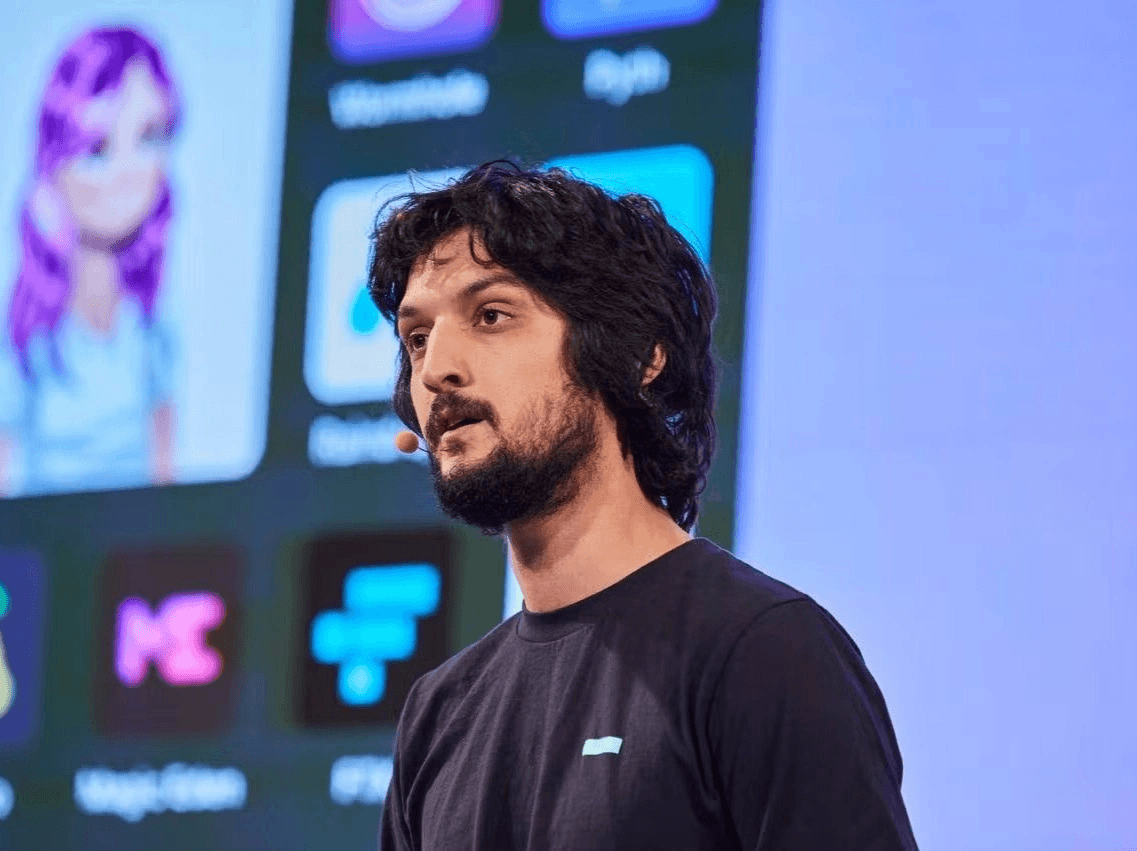
In November 2022, the collapse of FTX was like a deep-sea bomb, instantly wiping out years of credibility in the crypto industry, and causing Armani Ferrante's company's assets to evaporate by 90% overnight. On a journey at ten thousand meters in the sky, faced with a financial exam that was nearly a deadlock, this structural engineer deeply rooted in the Solana ecosystem did not choose to exit but completed a quest for self-exploration about “who I am.”
In the aftermath of that catastrophic blaze, Backpack was quietly born. It is not only a global trading platform with trading volume surpassing $420 billion but also Armani's technical response to the “panoptic prison” style modern surveillance system. From the steady path at the Apple headquarters in Silicon Valley to Tokyo's "sleeping giant" market gamble; from simple code to the community beliefs behind the crazy guys, Armani deeply revisited that infernal moment in this interview for the first time. This narrative is not only a hardcore survival history of entrepreneurship but also an ultimate prophecy about the 2026 wave of global financial asset tokenization. When cognitive reality is disconnected from the truth, will you go with the flow or rebuild the rules on the ruins? The answer lies in this deep dialogue that crosses the boundaries of philosophy and engineering.
The Moment of Defining Role: Surviving from the Embers of FTX Collapse
Host:Let’s turn back time to that tumultuous moment. At the time of FTX's collapse, Backpack was still a fledgling project, and you were in serious danger amid the disaster. I remember you mentioned that the company’s assets were all in the FTX accounts, right?
Armani Ferrante:That’s right, it was a number that would interest any entrepreneur. At that time, we had $14.5 million on FTX, which accounted for about 90% of our company’s balance sheet. When I was on a flight from the plains of Lisbon, trying to connect to Wi-Fi while seeing the Crypto Twitter messages continuing to ferment, the sense of reality began to collapse. If the rumors were true—which later proved to be more powerful than the rumors—then my company was basically declared dead.
In that plane cabin high above, surrounded by peers attending the same crypto conference, the air was filled with anxiety. I couldn’t help but generate an existential thought. I asked myself a fundamental question:Armani, what kind of person are you?
Are you the kind of person who gives up and laments the unfairness of fate when faced with an irresistible destructive blow, or are you the kind who chooses to keep digging for prospects and fight to the end no matter how heavy the adversity ahead? Running a corner gas station, when facing extreme circumstances, you essentially make the same choice. At that moment, I realized this was a defining character moment. I chose the night. When the plane made an emergency landing, I was already prepared to fight until the last moment.
Host:This inclination is indeed touching. Ironically, you once had two intersections with Alameda Research (the company founded by SBF). Did this “close observation” make your feelings more complex when facing the collapse later?
Armani Ferrante:This was indeed a marvelous fate. In 2018, I had just resigned from Apple and was deeply attracted by the open-source charm of Ethereum and blockchain. Alameda was recruiting engineers in Berkeley to build trading systems. I stayed there for three months and participated in the early development, but soon realized that pure trading operations were not where my passion lay; I was more committed to building base protocols and applications.
The second intersection was in 2020 when FTX had already accumulated and invited me back to promote the construction of the Solana ecosystem. I was not working in FTX but was writing infrastructure for the Solana network, such as the early developer framework Anchor and multi-signature wallets. Solana's wood was like a blank slate, filled with engineering challenges.
I must clarify one thing, which is also what I felt most deeply during the collapse: the huge disconnection between perceived reality and actual reality. When Solana fell to $8, mainstream media and social platforms labeled it as the “FTX chain” and thought SBF was doomed. But as someone in the know on the ground, I knew that Solana's codebase, validator network, and FTX's financial condition were two distinct matters. The powerful nodes of the centralized network exist; it is an antifragile system that will not vanish because of the collapse of one party.
Panoptic Prison and Free Will: The Philosophical Background of Cryptographic Technology
Host:When talking about “who you are” and the company's vision, you mentioned Michel Foucault and the concept of the “panoptic prison.” This is a profoundly insightful entry point for a CEO with a technical background. Can you elaborate on how this philosophical metaphor influences your perspective on the crypto industry?
Armani Ferrante:The panoptic prison was originally a prison model designed by Jeremy Bentham: the guard in the central tower can monitor all the cells arranged in a circular pattern, while the criminals loudly know whether they are being observed at that moment. This unjust monitoring leads to the criminals’ “self-surveillance” and compliance.
In the digital age, we are actually living in an ever-expanding panoptic prison controlled by the government. Large tech companies and even public ledgers record every transaction we make, every text message we send. If you acknowledge that privacy is the cornerstone of humanity and freedom, then much of the blockchain technology involved is actually misleading. Public ledgers of Bitcoin and Ethereum are fully transparent; in a sense, it is easier to track a Bitcoin than to track cash.
Host:So, do you think existing blockchain technology is insufficient in protecting freedoms?
Armani Ferrante:Absolutely insufficient. If a system exposes your entire financial history to the light of day, it becomes a perfect monitoring tool. This is why I have respect for privacy-preserving technologies, like the zero-knowledge proofs used by Zcash.
In the process of building Backpack, we have always been thinking: are we contributing to this panoptic prison or are we providing individuals with cheap tools to contest this power through technology? For ordinary people, they do not commonly see their bank balance. Our goal is to leverage the “atomicity” and “verifiability” of cryptographic technology to enhance efficiency while closely retaining individual control over data and assets within a compliant framework. This is not just about writing code; it is a reallocation of power.
Host:Is this persistence in “building what you want” the “chip on your shoulder” you mentioned—this is what motivates you to keep moving forward?
Armani Ferrante:Honestly, I am not used to overly romanticizing my struggle history. If there has to be motivation, it is the love for “creation” itself. I am an engineer, and I see an idea transforming from code into hundreds of products within what I use. The collapse of FTX indeed gave me an opportunity to prove myself, but I have always believed that it is not the zeros in your bank account that matter but whether you have enough resources to engage in more interesting and impactful experiments.
Many people postpone happiness in life, thinking that they can only start living fully after making enough money or reaching a certain milestone. But this “postponement of life” mindset is the root of suffering. You can choose your desired lifestyle today, to be with interesting people, to tackle tricky problems. This immediate, process-oriented sense of fulfillment is the most effective food against adversity.
The Tokenization Revolution in Finance: From “Rough Setup” to Infrastructure
Host:You have a unique optimism about the current crypto industry, especially since market sentiment for 2026 is not high. Do you think the financial sector is at a turning point?
Armani Ferrante:Yes. If the previous crypto cycle was more about narratives, speculation, and meme coins frenzy, now we are entering the phase of “grounded infrastructure construction.” Take a look at the top institutions on Wall Street; people like Larry Fink talk a lot about their AI privately, but they are more optimistic about asset tokenization.
Imagine the conundrum of traditional finance: when you buy a share of Apple, the settlement involves an extremely complicated chain behind it. From brokers to global custodians, then to central securities depositories (CSD), each layer checks the ownership. This results in settlement delays that require T+2 or even longer. However, on the blockchain, we can unify the archiving, trading logic, and capital settlement of assets into one “atomic operation.” This process, which compresses deep learning time into a global state machine, will release huge capital efficiency.
Host:Is this the core issue that Backpack wants to solve? Please explain your “unified margin account” product for ordinary users.
Armani Ferrante:In simple terms, the current financial system is fragmented. You deposit money in the bank, buy stocks through brokers, and buy coins on crypto trading platforms. If you want to use stocks as collateral to borrow money, the process is indeed cumbersome.
Backpack's “unified margin account” breaks down the walls between these asset classes. If you hold quality tokenized assets (whether tokenized government bonds, stocks, or cryptocurrencies), you can directly use them as collateral to borrow liquidity without having to sell assets or trigger taxable events. This is a high-end financial service that is traditionally only accessible to ultra-high-net-worth individuals. What we are doing is democratizing this service through smart contracts and real-time risk engines, allowing ordinary users globally to access it.
Host:This sounds like Backpack is becoming a global, regulated super financial application.
Armani Ferrante:Exactly. We are not just making a trading platform; we are using the high-performance network of Solana to rebuild the structure of modern markets. Solana's high TPS (transactions per second) is not just a technical metric; it means we achieve real-time risk management. In traditional finance, if the market crashes, it could take hours or even days, triggering a chain reaction. However, on Solana, we can complete hedging and clearing in milliseconds, greatly reducing systemic risk, thereby providing higher leverage efficiency.
Strategic Shift and Opportunities in Japan: Why Choose Tokyo?
Host:Since the goal is global, why did you move your headquarters and focus of life to Tokyo? Three years ago, when you left California, many did not have high hopes for the Japanese crypto market.
Armani Ferrante:Choosing Tokyo is a well-considered strategic gamble. Japan holds a special position in the history of crypto. As early as 2017, over half of global Bitcoin trading volume came from Japan. Although due to early hacking incidents, regulation tightened significantly, it was because of this that Japan established a very mature and transparent regulatory framework.
We believe Japan is a “sleeping giant.” With the Cambodian government clearly proposing to make Web3 part of its national strategy, and potential reforms to taxation policies (from 55% down to around 20%), the vitality of this market is being reignited.
More importantly, the Japanese market has extremely high barriers to entry. Due to the language, cultural, and compliance requirements, U.S. segmented firms (such as Coinbase and Gemini) find it difficult to establish themselves here. For teams like Backpack that are willing to deeply cultivate locally and respect regulations, this represents a huge blue ocean. We are not just seeking an office; we are rooting here and growing together with Japan's financial ecosystem.
Host:Speaking of regulations, you mentioned FTX spent $800 million on licenses back then, while you obtained a similar combination of licenses at a very low cost. Is there a secret to this?
Armani Ferrante:There are no shortcuts in regulation, but there is a “latecomer advantage.” Many established trading platforms face a problem: they started with several years of unregulated business before being forced to turn compliant. This accumulates a lot of “compliance financials” and architectural patches, and to clean up these historical issues, they have to give up compensatory legal audits and costs.
Backpack has been designed for compliance from day one. Our custody methods, risk engines, and anti-money laundering (AML) programs are all built in sync with system architecture. Additionally, we have a truly cross-disciplinary team that understands finance and law. When your system itself is transparent and auditable, the communication cost with regulatory authorities dramatically decreases. We are not winning trust with technical capabilities.
The Power of Culture: Mad Lads and Community Bonds
Host:We have to talk about Mad Lads. As the founder of a trading platform, you've created one of the most influential NFT series on Solana. It looked like a side project at that time, but now it seems to have become your core asset?
Armani Ferrante:This is exactly what I want to emphasize: in the crypto world,“people” are always more important than technology.
NFTs, for me, are essentially a form of social text. Whether you are in Tokyo, New York, or London, if you have a Mad Lad avatar on Twitter or speak up on Discord, you can immediately find a group of like-minded people. Mad Lads express a spirit of “not giving up,” symbolizing the culture of the Solana community that continues to build amidst the darkest times.
This new culture has brought great loyalty to Backpack. At several stages, what you need is not just users but “drivers”—those who understand your vision and are willing to accompany you to iterate on the product. Mad Lads give us that sense of identity. They remind us always of whom we are serving while building the product.
Host:This transformation from culture to product is indeed very rare. At the end of the interview, what advice do you have for builders who are striving in the 2026 market?
Armani Ferrante:Stay optimistic, remain curious, and the most important thing: do the things that truly excite you.
The crypto industry is like a giant, early-stage laboratory. We will experience explosive growth and also face devastating failures like FTX. But remember, the evolution of underlying technologies is not swayed by individual will. Tokenization, decentralization, and individual sovereignty are trends that cannot be reversed.
2026 is still the best time for building. If you, like us, choose to act even under the threat of asset custody sheets hitting zero, you will find that the most fascinating aspect of this industry lies not in the contours of price curves but in our participation in creating the future global infrastructure. Do not postpone your life for some elusive milestone; start building now, start living now.
Host:Thank you, Armani. Your passion and romanticism towards engineering is very infectious. Thank you for sustaining our unwavering confidence during this unpredictable time.
Armani Ferrante:Thank you, the future belongs to builders.
Article link: https://www.hellobtc.com/kp/du/04/6277.html
Source: https://www.youtube.com/watch?v=iicAGMlbQ3k
免责声明:本文章仅代表作者个人观点,不代表本平台的立场和观点。本文章仅供信息分享,不构成对任何人的任何投资建议。用户与作者之间的任何争议,与本平台无关。如网页中刊载的文章或图片涉及侵权,请提供相关的权利证明和身份证明发送邮件到support@aicoin.com,本平台相关工作人员将会进行核查。


