Author: Bitrace
In 2026, prediction markets ushered in their "golden era".
With Polymarket dominating the influence in global political events, and Predict.fun deeply integrating into the Binance ecosystem while acquiring the competitor Probable, massive outside capital began to flow into this gray area. Faced with event prize pools reaching hundreds of millions of dollars, traditional regulatory frameworks started to appear inadequate.
When everything can be bet on as a "subject," the legal sword of Damocles hanging over all players and platforms is quietly descending.
Market Landscape: From Political Games to Pricing Everything
In the market landscape of 2026, major platforms carved up global uncertainties through differentiated "event scopes":
Platform | Core Territory | Covered Event Range | 2026 Market Position |
Polymarket | Global/Comprehensive | Political elections, sports and esports, Crypto, geopolitical situations, technology, and pop culture across all fields | The "truth market" with the deepest global liquidity. |
Predict.fun | Asia/BNB Chain | Sports, politics, Crypto, esports, financial economics, and culture across all fields | Deeply bound to Binance wallet, the absolute dominator of Asian traffic. |
Kalshi | United States/Compliant | Economic indicators, political elections, sports events, meteorological disasters, business and technology | CFTC regulated, institutional hedging tool. |
Overtime | Sports/Professional | Purely focused on professional sports events like football, NBA, UFC | On-chain odds system, offering an experience closest to traditional sports betting. |
Limitless | Social/High-frequency | Crypto, sports, finance, politics, with special markets for South Korea and a Chinese prediction area | A social-driven high-frequency betting hub. |
Charts from predictions.paradigm.xyz show that the political sector (Politics $418.5M) occupies a significant portion, with sports events (Sports $340.4M) following closely behind, indicating that many traditional sports betting players are migrating to Web3 platforms. Moreover, the coexistence of Crypto ($70.6M) and segments like finance and culture further confirms the trend of prediction markets where "everything can be priced".
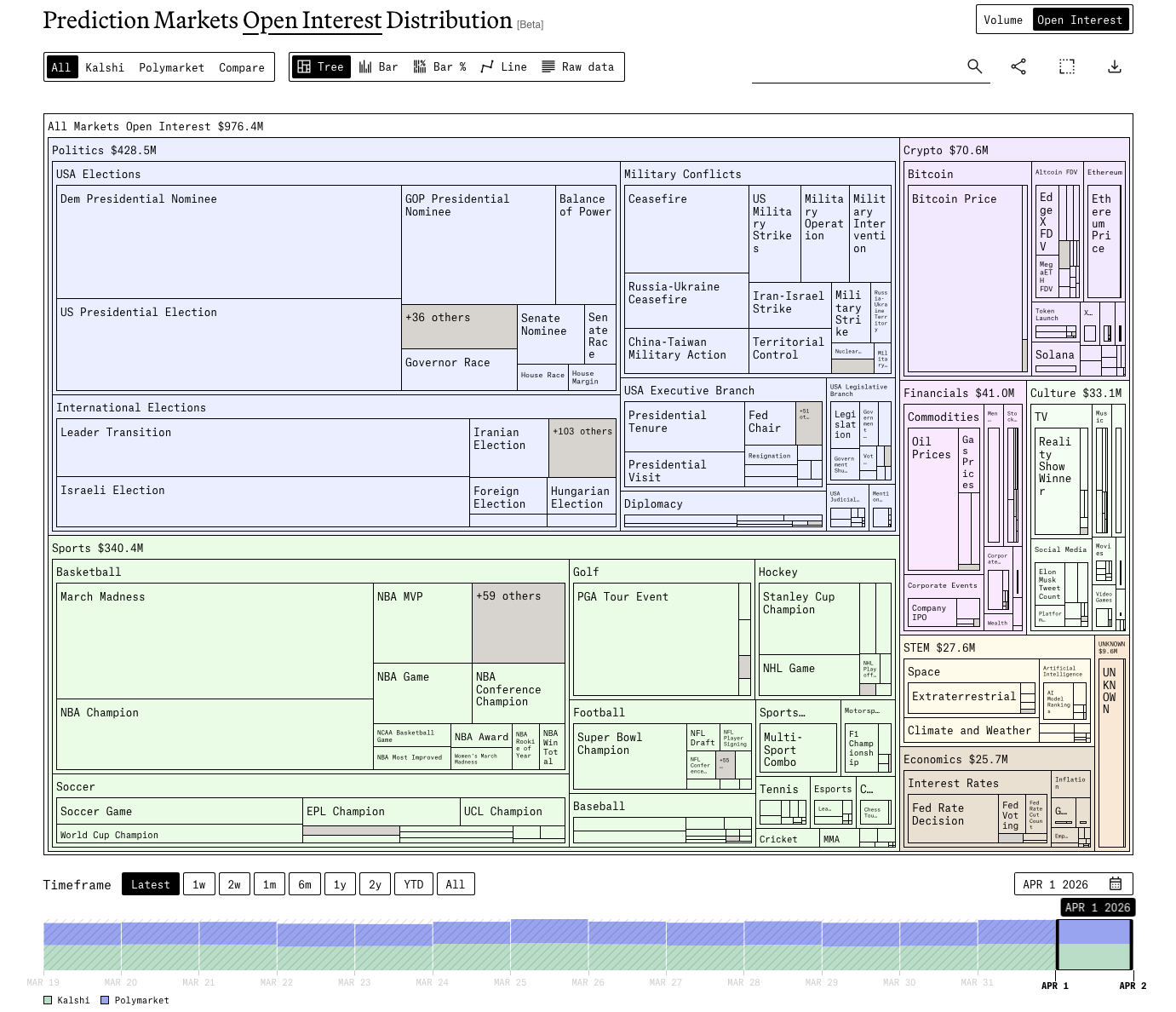
Figure 1 Distribution Map of Unsettled Contracts (Open Interest) in Mainstream Prediction Markets
The size of the charts represents the volume of funds, visually presenting the current preferences of capital in the Web3 prediction markets (Chart source: predictions.paradigm.xyz)
Business Model: Fee Structure and Profit Mechanisms
To understand the commercial essence of prediction markets, one must break down its profit chain. Currently, mainstream matching models are divided into two types.
Order Book Model: Makers provide liquidity, while Takers consume liquidity to achieve instant transactions.
AMM Model (Automated Market Maker): Relies on price feeds from oracle services; the platform profits directly through protocol fees or spreads.
Among these—
Makers are those who provide quotes in the market first. For example, if you believe that "BTC will break $100,000 by the end of the month" with a probability of $0.60, you place a buy order. At this point, the transaction does not happen, and your order "sits" on the order book waiting for someone else to execute it, serving to provide liquidity to the market.
Takers are those who directly accept existing quotes in the market and execute transactions immediately. If you see someone offering $0.60 and you find it appropriate and click buy, you are a Taker. Their role is to consume market liquidity in exchange for the certainty of instant transactions.
Currently, major platforms have generally bid farewell to the "zero fee" era and started generating revenue through dynamic rates or tiered rates.
Polymarket
On March 30, 2026, Polymarket updated its fee system. Makers enjoy a 0% fee and rebate incentives, while Takers adopt a probability-related dynamic fee.
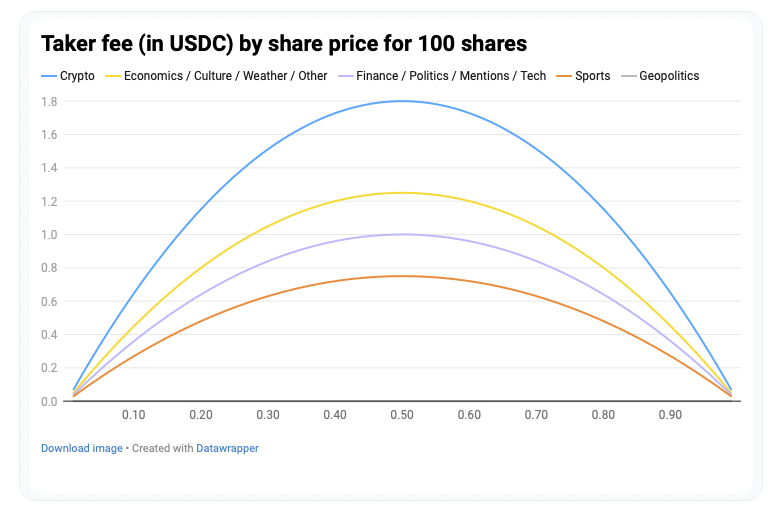
Figure 2 Polymarket Dynamic Taker Fee Curve, with the horizontal axis representing event probability and the vertical axis representing Taker fee rate.
When the event probability approaches 50% (i.e., when the suspense is greatest and competition is fiercest), the fees charged by the platform peak. Conversely, when the outcome is nearly certain (probability close to 0 or 1), the fees approach zero.
Crypto: Peaks at about 1.80% (highest fee when probability is close to 50%).
Finance/Politics/Culture: Peaks at about 1.00%.
Sports: Peaks at about 0.75%.
Geopolitical/Global Affairs: Currently still at 0% fee.
Related link: https://docs.polymarket.com/trading/fees
Predict.fun
As the flagship of the Binance ecosystem, Predict.fun emphasizes capital efficiency. The Maker fee is 0%, and the Taker fee is about 0.018% - 2.00%.
Its uniqueness lies in unifying liquidity through the acquisition of Probable. Its capital settlement earns interest through DeFi protocols (like Venus), and part of the fees is returned in the form of points or airdrops, but the direct transaction costs are highly competitive.
Related link: https://docs.predict.fun/the-basics/predict-fees-and-limits
Kalshi
Kalshi is a compliant platform regulated by the Commodity Futures Trading Commission (CFTC), with fee logic closer to traditional financial derivatives.
Here, standard markets only charge Takers, with the Taker fee standard set at $0.07 - $1.75 per 100 contracts (equivalent to a maximum of about 1.75 cents per contract). Non-standard markets certain specific events (such as U.S. natural gas prices, specific tennis matches, Golden Globe awards, etc.) will initiate bidirectional charging, adding a Maker fee of $0.02 - $0.44 per 100 contracts. A very few specific events (like predicting year-end BTC price ranges) enjoy a 0% fee.
Related link: https://kalshi.com/fee-schedule
Overtime
Pricing Mechanism: Overtime uses the AMM (Automated Market Maker) mechanism rather than an order book; it directly introduces implied probabilities from global betting providers through Chainlink oracles, thus there are no traditional Maker/Taker fees.
Fixed Protocol Fee: Based on oracle-supplied pricing, the AMM will charge a fixed protocol fee of 2% to enrich the platform's fee pool.
Revenue Sharing and Rebates: The platform natively supports revenue sharing. If a transaction is introduced by an integrator (such as MetaMask) or other partners, half of the 2% protocol fee generated will be returned directly to that partner, incentivizing ecological traffic.
Token Discount Privileges: When users use their native token $OVER (instead of USDC or ETH) as collateral for trades, they can enjoy lower hidden charges (Reduced Margin), thus obtaining better odds and higher net payouts.
Related link: https://docs.overtime.io/learn-about-overtime/overtime-amm-and-liquidity-mechanics
Legal Conflicts: Regulation, Crackdown, and Survival
Internationally, the characterization of such platforms has been in intense turmoil. As an industry leader, Polymarket's journey from startup to now has constantly hovered on the edge of the legal definition between "financial instruments and illegal gambling".
Federal-level bans and reconciliations: In 2022, the CFTC charged it with operating an unregistered contract market, imposing a fine of $1.4 million, and ordered it to exit the U.S. market through geoblocking. By the 2024 election, it gained fame by attracting $3.2 billion and was dubbed the "polling terminator". After the election, the FBI raided its CEO's Manhattan apartment for allegedly allowing U.S. users to bypass the ban. To break the deadlock, Polymarket transformed its identity at the federal level in the first half of 2025 by acquiring entities with CFTC licenses (such as QCEX), successfully obtaining the "regulated derivatives" shield and permission to return to the U.S. market. To completely isolate compliance risks and meet global traffic demands, Polymarket has officially split into the regulated polymarket.us and the encrypted native experience of polymarket international version.
2026 State-level Crackdown:Despite federal recognition, state courts in Tennessee, Nevada, and others still view it as "unlicensed sports betting" and issued bans. In March, 11 states issued a cease and desist order. At this point, the prediction market in the United States faces severe legal fragmentation—federal agencies regard it as "financial derivative contracts" that need regulation, while local state governments and betting committees deem its essence as "illegal online gambling".
France's comprehensive ban threat: At the end of 2024, after a French whale user made tens of millions of dollars predicting the U.S. election, the French National Gaming Authority (ANJ) swiftly intervened. ANJ determined that Polymarket's betting behavior fully complied with the definition of "illegal gambling" in French law, and began preparing to prohibit access for French users through domain blocking and other means.
Insider trading ignites new regulations:On the eve of the capture of Maduro in early 2026, an address utilized non-public information to earn $400,000 on the platform. This scandal directly birthed the "2026 Financial Prediction Markets Public Integrity Act".
Core Controversy: Qualitative Risk under Hong Kong Law
Returning to Asia, based on relevant regulations in Hong Kong, the nature of these platforms is extremely sensitive. According to the "Gambling Ordinance," all gambling activities are illegal unless they fall under the following circumstances:
Obtained explicit approval: Approved by the government under the "Betting Duty Ordinance" (Cap 108), namely regulated horse racing, football betting, and lottery (operated by the Hong Kong Jockey Club HKJC);
Obtained licensing approval: Licensed by officials appointed by the Home Affairs and Youth Affairs Bureau (like mahjong houses);
Legally exempted: Exempt under section 3 of the ordinance (mainly social-type gambling).
The sports events, entertainment gossip, short-term fluctuations, and other businesses of prediction markets are just a thin line away from "offshore betting" in the current perspective of Hong Kong law.
When prediction markets provide football predictions, their format has already constituted significant competition with the Jockey Club's "Foot Intelligence". Since they have not obtained approval under Cap 108 or government licensing, they can easily be categorized as illegal gambling under Hong Kong law.
With a clear premise of suspected illegal online gambling, the operating entities of relevant platforms also involve certain criminal risks:
Platform operator: Providing services without blocking Hong Kong IP is suspected of "operating an illegal gambling venue".
Promoter: KOL distributing commission-based invitation links, easily violating the "promoting illegal gambling" crime.
Funding side: Directly depositing funds through Web3 wallets to participate in illegal sectors, facing penetrating regulatory risks.
Recognizing Legal Red Lines
It is undeniable that prediction markets utilize decentralized technology to solve the "black box operations" of traditional casinos. When predictions and DeFi yield interests, combined with AMM revenue sharing, they indeed exhibit high financial efficiency.
However, platform operators still need to pay close attention to the laws and regulations of various countries or regions during their operations, to avoid legal innovations breaching legal red lines, becoming illegal gambling.
Compliance and Risk Warning: The content of this article serves only as an objective analysis of the industry, and does not constitute any investment advice, betting guidance, nor encourage any trading behavior that circumvents local laws and regulations. Certain areas (such as Mainland China, Hong Kong Special Administrative Region, etc.) have strict legal restrictions on online gambling and virtual asset derivatives. Readers are advised to comply with local laws and regulations and refrain from participating in illegal gambling.
Appendix: Reference Links
免责声明:本文章仅代表作者个人观点,不代表本平台的立场和观点。本文章仅供信息分享,不构成对任何人的任何投资建议。用户与作者之间的任何争议,与本平台无关。如网页中刊载的文章或图片涉及侵权,请提供相关的权利证明和身份证明发送邮件到support@aicoin.com,本平台相关工作人员将会进行核查。


