Author: Deep Tide TechFlow
As long as you take action, there will be substantial results.
This was the response from Aster CEO Leonard Leung when the community became curious about the frequently appearing "🥷- Ninja" image in social media materials, explaining that true strength does not need noisy proof.
To some extent, this statement could also depict Aster's authentic portrayal over the past year.
Under the near-monopoly pressure from Hyperliquid, in September 2025, Aster surprised everyone as a dark horse during its TGE, becoming a noteworthy newcomer in the Perp DEX track.
Coinciding with Aster's one-year anniversary and the arrival of two major milestones for Aster Chain, we conducted an in-depth conversation with Leonard.
Regarding the "Ninja Spirit," Leonard sees it as an extreme form of execution:
"Ninja Spirit" is one of Aster team's guiding principles; we pursue continuous delivery rather than over-promising, establishing trust through results.
This restraint and determination ran throughout the entire conversation. When discussing Aster's achievements over the past year, Leonard gave a direct judgment:
Aster cut in at the right time into the right track, Perp DEX is a market with clear vertical value.
When asked about effective growth strategies post-TGE, Leonard remained clear-headed:
Airdrops are a double-edged sword. The only important measurement for effectively using airdrops is how much of the traffic attracted by incentives eventually converts into real users, generating sustained revenue and retention. Aster has a clear goal, hoping users come for the airdrop but stay for the product.
When discussing the launch of Aster Chain, Leonard emphasized that this move did not stem from "the necessity to upgrade," but rather was a proactive strategic choice:
Aster has viewed privacy as a core value since its inception. Through Aster Chain, Aster can natively embed privacy capabilities at the infrastructure level, ensuring both stability and high responsiveness, which will significantly promote institutions' substantial adoption of decentralized trading.
This issue allows us to follow Leonard Leung's narrative to understand Aster's main achievements over the past year, while exploring Aster Chain's layout details. We look into Aster's larger future under the new competitive landscape of DEX in 2026.
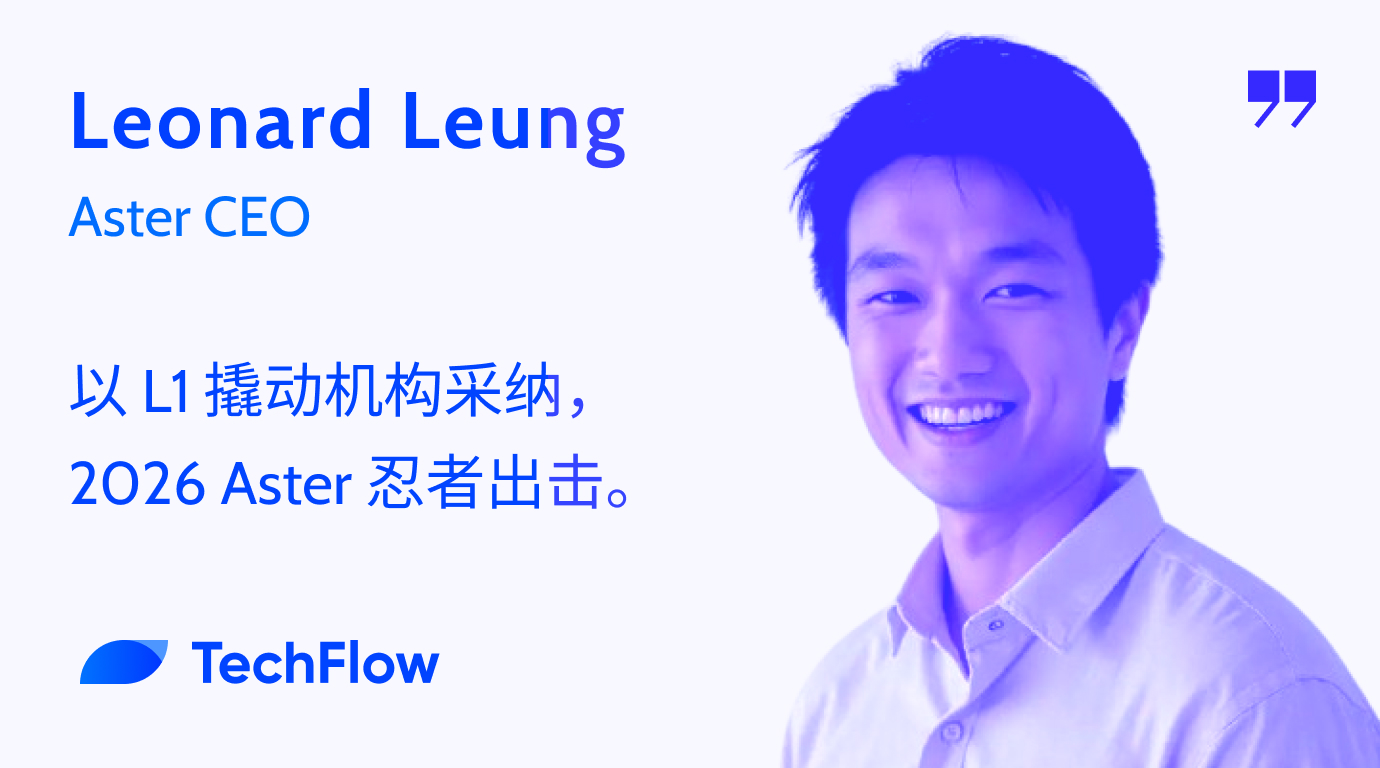
Aster's One-Year Anniversary: Choosing the Right Track and Achieving Success
Deep Tide TechFlow: Thank you for your time. Aster has experienced rapid growth this past year. Before we officially start, could you please introduce your role at Aster and what you are mainly responsible for?
Leonard Leung:
Hello everyone, I am Leonard Leung, the CEO of Aster. On the occasion of Aster's one-year anniversary, I am glad to have the opportunity to share Aster's journey and our thoughts on future development.
Deep Tide TechFlow: The past year has been remarkable for Aster in the DEX track. During this anniversary celebration, which is the best time to "show the report card," what challenge in the past year felt the "most difficult" yet was also the "most rewarding" for you?
Leonard Leung:
When we initially pushed for brand rebranding, the market was almost monopolized by Hyperliquid. At that time, almost no one thought that anyone could shake this pattern. Especially before the Aster TGE, for a long time, the market generally believed it was nearly impossible to achieve.
Before the Aster TGE, to my knowledge, the external expectations for Aster's FDV (fully diluted valuation) were not high. But ultimately, we achieved a valuation far exceeding market expectations, which greatly prompted the market to re-evaluate the space and value of the Perp DEX track.
In fact, we once postponed the Aster TGE plan because we believed the product still had room for further optimization before the official launch. But later, we decided to prioritize "execution speed" over merely "pursuing perfection." Looking back now, it was the right decision.
Deep Tide TechFlow: In the process of facing challenges, what moment made you feel that Aster had truly built its core competitive edge?
Leonard Leung:
I think this moment occurred in the second half of 2025.
Entering the second half of 2025, Aster platform's 24-hour trading volume continued to climb, breaking 1 billion dollars in June and growing to 11 billion dollars by September. This speed of growth let us genuinely feel that the project was entering a phase of accelerated development.
Of course, what left a deeper impression on more people was the performance during the September Aster TGE, when the platform achieved key results such as a 24-hour trading volume exceeding 345 million dollars, an increase of wallet addresses reaching 330,000, and a platform TVL exceeding 1 billion dollars, further solidifying Aster's position in the DEX market.
As the project continuously refreshed trading volume records, we increasingly realized that Aster cut in at the right time into the right track, Perp DEX is a market with clear vertical value.
And when we launched the genuinely "optional privacy" feature on the L1 mainnet, this judgment became even stronger: we believe Aster Chain is a unique product form that has yet to appear in the current market, and it is also an important prerequisite for promoting the substantial application of on-chain trading.
Under the Privacy Barrier: Aster's Continuous Delivery "Ninja Spirit"
Deep Tide TechFlow: Behind the achievements are the team's decisions and execution. In Aster's social media, we can easily grasp the distinctive stylistic symbol of "🥷- Ninja," so we would like to ask you to share what kind of team temperament and working style Aster wishes to convey through the "🥷- Ninja." Does this "🥷- Ninja Spirit" also influence your decision-making style and team management approach?
Leonard Leung:
We chose "Ninja" as the stylistic symbol for Aster's social media, and the core is not about the sense of mystery but about extreme action.
Ninjas often possess great power but are not loud; instead, they continuously exert influence in a humble and restrained manner. For Aster, this spirit corresponds to speaking less and doing more, prioritizing execution, and building trust through results.
Specifically regarding Aster's team style, I usually break down this spirit into three levels:
Being low-key and efficient. We do not pursue frequent exposure under the spotlight but instead focus on silently accumulating and executing the most precise strikes. Internally, this means high-frequency and precise coordination within the team, while externally, we always maintain restraint. It's like ninjas never announce loudly before taking action, but strive for precise strikes with every move.
Continuous delivery rather than over-promising. Compared to exaggerated promotion, we prefer "directly delivering results." We do not make promises lightly, but as long as we act, there will definitely be substantial output, because before making commitments, I ensure that the team has the capability to deliver, rather than trading visions for short-term attention.
Execution-first, let results speak. In Aster's values, execution outweighs volume; we hope all the team's energy is focused on realizing the blueprint rather than chiseling words or managing personal brands.
It can be said that, to a large extent, the "Ninja Spirit" is not just a brand symbol but is Aster team's authentic code of conduct.
Deep Tide TechFlow: There are already many DEX in the crypto space, yet Aster has still achieved success. From your perspective, what do you think is the unique value that Aster provides to users, which cannot be replaced?
Leonard Leung:
If I had to summarize Aster's most irreplaceable value, I believe it boils down to two core points: Privacy and trading experience.
Aster has viewed privacy as a core value since its establishment and is willing to make necessary trade-offs and sacrifices for it. This persistence in privacy constitutes our real moat, allowing Aster to have long-term survival in the fiercely competitive DEX track.
The launch of Aster Chain is precisely to confront the long-standing trading pain points in the traditional DeFi market. Previously, position sniping incidents frequently occurred on Hyperliquid, deeply exposing the structural risks posed by excessive transparency in on-chain trading. Aster's answer is to find a true balance between on-chain fund transparency and trading privacy. This not only provides DEX users with a safer option but also creates realistic conditions for CEX whales to migrate large positions onto the chain.
Deep Tide TechFlow: In your opinion, what is the truly unreplicable technical barrier in the current DEX competition?
Leonard Leung:
The competition among DEX is essentially a prolonged battle for liquidity. Technological solutions are already the basic threshold for entry today; users should not feel any difference between centralized and decentralized architectures when trading. This is Aster's core pursuit from a technological perspective.
Essence of Growth: Coming for Airdrop, Staying for Product
Deep Tide TechFlow: "Growth" is also an unavoidable topic. What was the peak of Aster's growth in the past year? What factors drove it, and do you think the growth strategies from then are still effective today? In facing the topic of "growth," what other trump cards does Aster have for the future?
Leonard Leung:
The peak of growth occurred during the TGE period in September 2025.
This peak was driven not by a single factor but by the interlocking results of multiple variables: precise product positioning, well-thought-out token economic design, clear and credible development roadmap, coupled with widespread support and dissemination from community users and industry opinion leaders, all contributed to this explosive growth phase.
The real turning point in growth occurred when the liquidity and product experience of Perp DEX reached a level that could compete with CEX. The market has been searching for more transparent CEX alternatives, and this is fundamentally the reason why Perp DEX took off.
Moreover, trust is crucial and hard-won in the DeFi field. The endorsement from BNB Chain and CZ completed our critical cold start (Bootstrap), while a series of tangible initiatives that the team has long cultivated and continuously built also laid a solid foundation for building trust. With trust as the cornerstone, acquiring and converting users became genuinely possible.
Of course, for DEX during this period, airdrop incentives have become a standard. However, airdrops are a double-edged sword:
They can bring explosive user growth, but at the same time, they may attract a group of speculators who have no real demand for the product itself.
But without airdrops, at least in the initial stage, you might not even get the competition ticket.
Therefore, I believe that how to effectively use airdrops hinges on balancing the ratio of real users to "farmers" and properly managing market expectations. Any project choosing to implement airdrops must plan ahead and have the capability to absorb the TGE impact, as data and revenue usually face a sharp decline as farmers shift.
I always believe that the only truly important measurement is not the pretty surface numbers during the airdrop incentive period, but rather how much traffic attracted by incentives can ultimately be converted into real users, generating sustained revenue and retention.
Thus, our growth goals have always been clear: coming for airdrop, staying for product.
Aster Chain Will Strongly Promote Substantial Adoption by Institutions
Deep Tide TechFlow: On this one-year anniversary, another important milestone for Aster is the arrival of Aster Chain. In your view, with L1 already abundant, why must Aster create its own L1?
Leonard Leung:
The core motivation behind choosing to create Aster Chain is to build an environment specifically designed for perpetual contract trading.
We know that institutional-level trading has higher confidentiality requirements. For large traders, strategy exposure, front-running, and position sniping directly affect their genuine trading willingness. By creating a self-built L1, Aster can natively embed privacy capabilities at the infrastructure level, thereby better protecting trading behavior and ensuring that large trading strategies are not maliciously manipulated.
In addition, we want to provide an experience comparable to centralized exchanges, where responsiveness and stability are both crucial. Most general-purpose L2 or generic public chains struggle to balance both simultaneously. Aster Chain's block time is set at 50ms and supports over 100,000 TPS, which is very important for high-frequency trading and high-leverage derivatives scenarios.
Moreover, having our own L1 means we can deeply customize everything from the "consensus mechanism" to the "execution layer." This comprehensive control over the underlying technology stack allows us to focus our attention genuinely on trading optimization, continuously building a high-performance derivatives platform.
L1 can also serve as the underlying support for overall liquidity, which not only helps increase asset diversity but also reduces reliance on a single stablecoin, thus constructing a more robust and scalable decentralized financial ecosystem.
From this perspective, only by building L1 can Aster truly break through the limitations of existing general-purpose public chains and fundamentally solve the critical issues of speed, privacy, and costs that traders care about most.
Deep Tide TechFlow: What qualitative leaps will the official launch of Aster Chain bring to the Aster ecosystem and the entire DEX track?
Leonard Leung:
I believe that Aster Chain will strongly promote substantial adoption of decentralized trading by institutions.
The lack of privacy guarantees has always been a core barrier to institutional funds entering on-chain trading on a large scale. Now that Aster provides a truly usable privacy trading solution, institutions will at least begin attempting to shift part of their trading onto the chain. The reasoning for this is ample:
On one hand, institutions hope to achieve diversification in asset allocation; on the other hand, increasingly more institutions believe that the future of trading ultimately belongs to DEX, and they have simply been waiting for a mature enough solution.
And now, Aster Chain is that solution.
Lastly, another key point to note is that through the coordination of Aster Chain and Aster Code, developers and financial institutions can quickly deploy customized on-chain derivative trading solutions, meaning Aster is not just a trading platform but also an open infrastructure that fully empowers partners to build efficient, private, and competitive trading interfaces on Aster Chain, jointly expanding the boundaries of the entire ecosystem.
Deep Tide TechFlow: Does the launch of Aster Chain at this time mean that Aster has reached a stage where it must upgrade its underlying capabilities?
Leonard Leung:
Continuous product upgrades have always been our ongoing effort, but the timing for launching Aster Chain does not stem from any "necessity to upgrade" pressure; it is a proactive strategic choice.
In simple terms, we saw the real pain points existing in the market, judged the direction, set the development schedule, and then executed.
When you clearly know what users need and what existing infrastructure cannot provide, and then you build according to the plan, it is a very natural choice.
Deep Tide TechFlow: For ordinary users, what will be the most intuitive changes in their daily trading experience with the arrival of Aster Chain? During the important window period of Aster Chain's official launch, what participation opportunities and early benefits are available for ordinary users?
Leonard Leung:
For ordinary users, the most intuitive change is reflected in the product interface. Now, users can start using a series of new features such as Account Privacy switch, blockchain explorer, Viewer Pass, and instantly experience the flexibility and security brought by "optional" privacy trading, all without sacrificing trading speed, while also enjoying the convenience of zero gas fees.
Furthermore, thanks to our strategic cooperation with WLFI, the platform will expand support for USD1 contract trading pairs, giving users more diverse asset options, further enriching trading scenarios.
Regarding early participation benefits, the first we have launched is the Staking Program, aimed at providing exclusive incentives for early participants. Users can choose different validation nodes and staking durations to stake $ASTER and earn rewards. Users interested in detailed rules and participation methods can visit the official Gitbook for further information.
Deep Tide TechFlow: As a last question, if we jump to March 2027 for Aster's second anniversary: What key achievements do you hope Aster will attain? And after another year of hard work, what kind of entity do you hope Aster becomes in the hearts of users?
Leonard Leung:
Looking ahead to the next 12 months, what I most look forward to seeing is the privacy feature truly driving substantial adoption of decentralized trading by institutions, and I believe my expectations can be well realized.
In the hearts of users, I hope Aster becomes not just a useful trading platform but also an infrastructure that can be trusted for the long term, capable of accommodating real funds and trading strategies.
免责声明:本文章仅代表作者个人观点,不代表本平台的立场和观点。本文章仅供信息分享,不构成对任何人的任何投资建议。用户与作者之间的任何争议,与本平台无关。如网页中刊载的文章或图片涉及侵权,请提供相关的权利证明和身份证明发送邮件到support@aicoin.com,本平台相关工作人员将会进行核查。


