
Original text: Zeneca
Translation: Big Pliers | PANews Lobster
The number of existing tokens is between 37 million and 120 million, the exact number does not matter. What matters is that over 99.99% of the tokens have actually failed.
According to different sources, the current number of cryptocurrency tokens exists between 37 million and 120 million. The specific number depends on the statistical methods and data sources, but getting entangled in details at this scale is not meaningful. No matter how you look at it, this is an astronomical figure.
In the past year, I have mentioned several times the need to concentrate holdings in a few assets. Today, I want to share some data and research that support this view and strategy.
Let’s get straight to the point.
How many tokens are there?
The answer depends on your data source and statistical methods, and different platforms count differently:
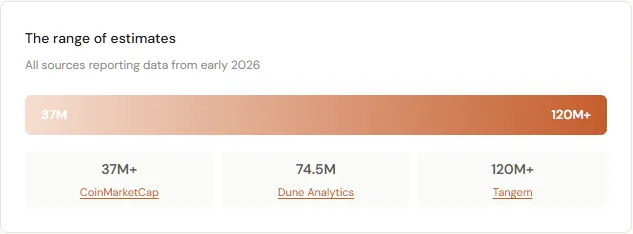
CoinMarketCap: Cross-chain index token count reports over 37 million
Dune Analytics: Tracks unique tokens on major chains, approximately 74.5 million
Tangem: Citing January 2026 on-chain data, over 120 million on major networks
The differences stem from the definition of "token": Do you count all deployed smart contracts? Do you only count those that have had at least one transaction? Or do you only count those that are still actively trading? Each filtering condition will yield different numbers.
However, all sources are highly consistent on three points:
The growth rate is astonishing
Most tokens are dead or near death
Real value is concentrated in a very small number of tokens
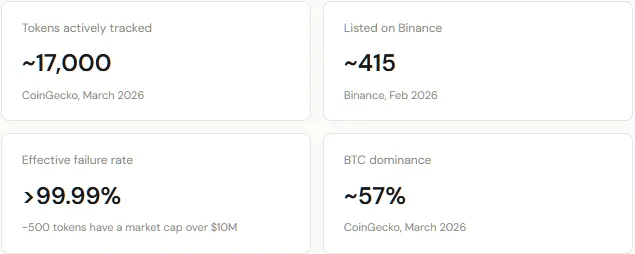
Failure rate close to 99.99%
There is an informal statistic circulating — 53.2% of cryptocurrency tokens have failed, from a study released by CoinGecko in January 2026. This study is decent, but I see a few flaws:
It only counts about 20 million tokens that entered GeckoTerminal and have transaction records, excluding a large number of tokens that perished before they even started after being created
It defines "no activity" as failure; however, in my view, extremely low activity coupled with a 99% price drop is also a failure
As previously mentioned, the actual number of created tokens far exceeds this, and the failure rate is also far higher.
Memento Research tracked 118 token generation events (TGE) in 2025. These are typically projects backed by venture capital, with teams and roadmaps, that went through formal TGE processes (rather than randomly issued meme coins), among which 84.7% of tokens currently trade below their issuance valuation — and I still find this figure low.
The median token has dropped 71%. The worst-performing projects issued at fully diluted valuations (FDV) amounting to hundreds of millions or even billions and then dropped 85%-93%. If the projects with the most abundant resources in the crypto market lose 85% of buyers' investments, what do you think the fate of the other 74.5 million tokens will be?
Let me tell you: among the 74.5 million tokens tracked by Dune Analytics, about 500 have a market cap over 10 million dollars, accounting for 0.0007%.
Cryptocurrency failure is not limited to a single category; it is a total collapse across the board. As I mentioned before: a good starting point is to assume that each token is heading towards zero, and then look for extremely rare exceptions.
Meme coins failure: 99.67% of Pump.fu tokens have never "graduated" (i.e., reached a market cap of 90,000 dollars)
ICO failure: 80% of 2017 ICOs were scams, and by 2020 almost 90% of surviving tokens fell below their issuance price
TGE failure: See the aforementioned Memento Research data
Airdrop failure: Most airdropped tokens are sold off within hours of distribution and never recover
VC project failure: High FDV, low circulation issuance methods have become a hallmark disaster of 2025
Creator token failure: Celebrity tokens from politicians to influencers typically drop over 90% within days
AI agent token failure: The AI narrative from 2024-2025 spawned hundreds of tokens, the vast majority dropping more than 80% from their peaks
Game token failure: The Play-to-Earn craze of 2021-2022 created dozens of tokens, most of which are now worth less than a penny
L1 failure: Do you remember when Fantom was at 3 dollars? Did Luna reach 100 dollars?
L2 failure: Most L2 tokens perform worse than ETH, while ETH itself underperforms BTC
Secret issuance failure, fair launch failure, governance token failure, utility token failure
This pattern runs through every category, every issuance mechanism, every narrative, and every market cycle. Almost all tokens tend towards zero. Exceptions are extremely rare: Bitcoin, Ethereum, Solana, Hyperliquid, BNB, and a very small number of other projects.
This is the reality of this damn market.
Why are there so many coins?
In short: creating tokens has never been so easy and cheap.
Pump.fun went live on Solana in January 2024, allowing anyone to create a token in 60 seconds—no programming required, with costs almost zero. Just choose a name, upload an image, click create, and you're done. You now have a cryptocurrency.
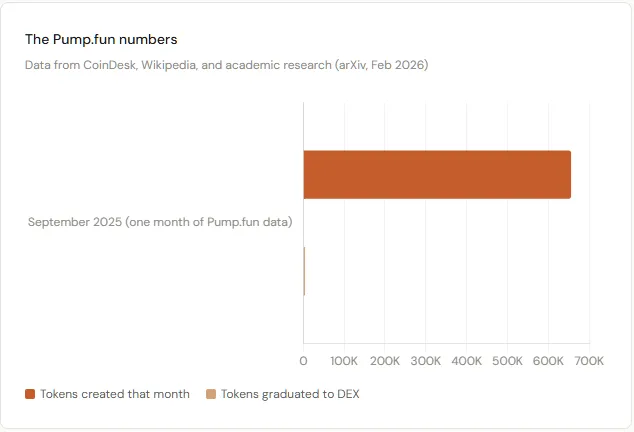
A research paper published in February 2026 analyzed a month of data from Pump.fun: In September 2025, 243,123 different wallet addresses created 655,770 tokens, of which only 4,338 "graduated" to decentralized exchanges, with a graduation rate of 0.63%.
By mid-2025, Pump.fun deployed over 80% of Solana tokens, while Solana accounted for about 64-70% of the total number of tokens created on all chains throughout history.
In other words, one platform, deployed on one blockchain, has generated the majority of the total number of tokens created in the cryptocurrency market. Among those, 99.37% of tokens declared failure before reaching a market cap of 90,000 dollars.
Where is the money?
This is the most important part of your investment portfolio.
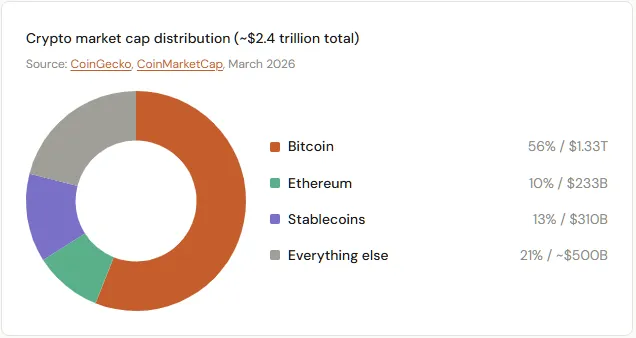
Bitcoin accounts for about 56 cents of every dollar in the cryptocurrency market. Adding Ethereum and stablecoins increases this to 79%. The top 10 tokens together account for about 90% of the total market cap. The remaining approximately 230 billion dollars is dispersed across tens of millions of other tokens.
The average data of tokens outside the top 100 is shocking: even if the 230 billion dollars were evenly distributed across about 17,000 tracked tokens, the average market cap would only be about 13 million dollars. And this average is heavily inflated by a few hundred mid-cap tokens; the median is much lower, much lower. The market cap of millions of tokens is actually zero.
Survival Funnel
One picture is worth a thousand words; it basically summarizes the entire content of this letter:
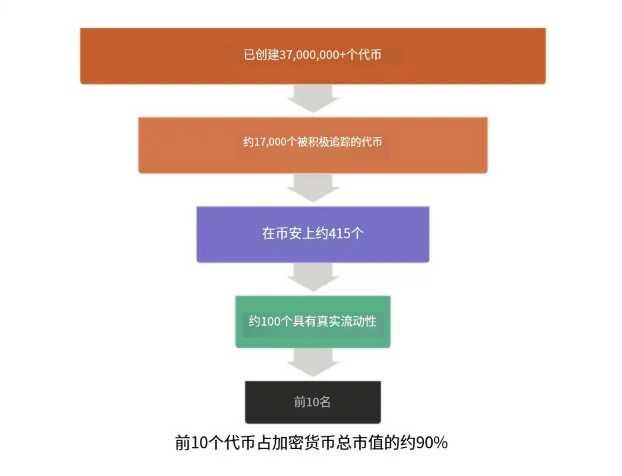
[Survival Funnel Diagram]
As time goes on, this differentiation will only become more extreme.
Actual Insights
The market follows a power law distribution
The top ten tokens hold over 90% of the total cryptocurrency market value. Holding Bitcoin and Ethereum means you hold the most important assets by market cap weight. This pattern has persisted for years.
Token creation ≠ value creation
Tens of millions of tokens exist, but the vast majority are created for the purpose of profiting the creators, not benefiting the buyers.
The haystack is getting bigger, but the needles are not increasing
Finding legitimate projects with real utility becomes increasingly difficult every month. The signal-to-noise ratio is worse than ever. More tokens do not equate to more opportunities; on the contrary—it means more noise and harder to grasp opportunities.
Survivorship bias is everywhere
You only hear about that meme coin that soared 1000 times, but you haven’t heard about the ones that went to zero among the 655,000 tokens issued in the same month. Success stories fill the feed on X (Twitter), while failures go silent.
Liquidity is the real filter
CoinGecko tracks about 17,000 tokens; Binance lists 415. The gap between "existing" and "having substantial liquidity" is vast.
Final Thoughts
The number of existing tokens is between 37 million and 120 million; the exact number does not matter. What matters is the distribution pattern.
Over 99.99% of tokens have actually failed.
Of all the created tokens, about 500 have a market cap over 10 million dollars. 99.37% of Pump.fun tokens failed to "graduate." 85% of TGE projects issued in 2025 trade below their initial price.
Data from all sources are highly consistent.
I write this not to scare you away from the crypto market, but to help you understand that this background can make you wiser in allocating capital and attention. Opportunities in the crypto market still exist, but they are found in a few assets and protocols, not in those millions of tokens created to extract wealth from careless buyers.
What I have been saying is that for almost everyone, the best strategy is to dollar-cost average (DCA) into Bitcoin, maybe adding a very small number of other tokens, and then wait.
There are indeed stages where altcoins will outperform greatly, but the vast majority will lose money in the process of searching for needles in a haystack, making it better to stick to mainstream assets.
I hope this data can support this position and perhaps help some reader realize that treasure hunting is not suited for them.
One last point: Even if you do want to look for those gems, this data should at least reinforce the understanding that typically you should only use a smaller proportion of your portfolio to do this, while keeping the majority (over 80%) in assets like BTC, ETH, SOL, HYPE, and if you're a bit bolder like me, you could also add ZEC and TAO.
免责声明:本文章仅代表作者个人观点,不代表本平台的立场和观点。本文章仅供信息分享,不构成对任何人的任何投资建议。用户与作者之间的任何争议,与本平台无关。如网页中刊载的文章或图片涉及侵权,请提供相关的权利证明和身份证明发送邮件到support@aicoin.com,本平台相关工作人员将会进行核查。


