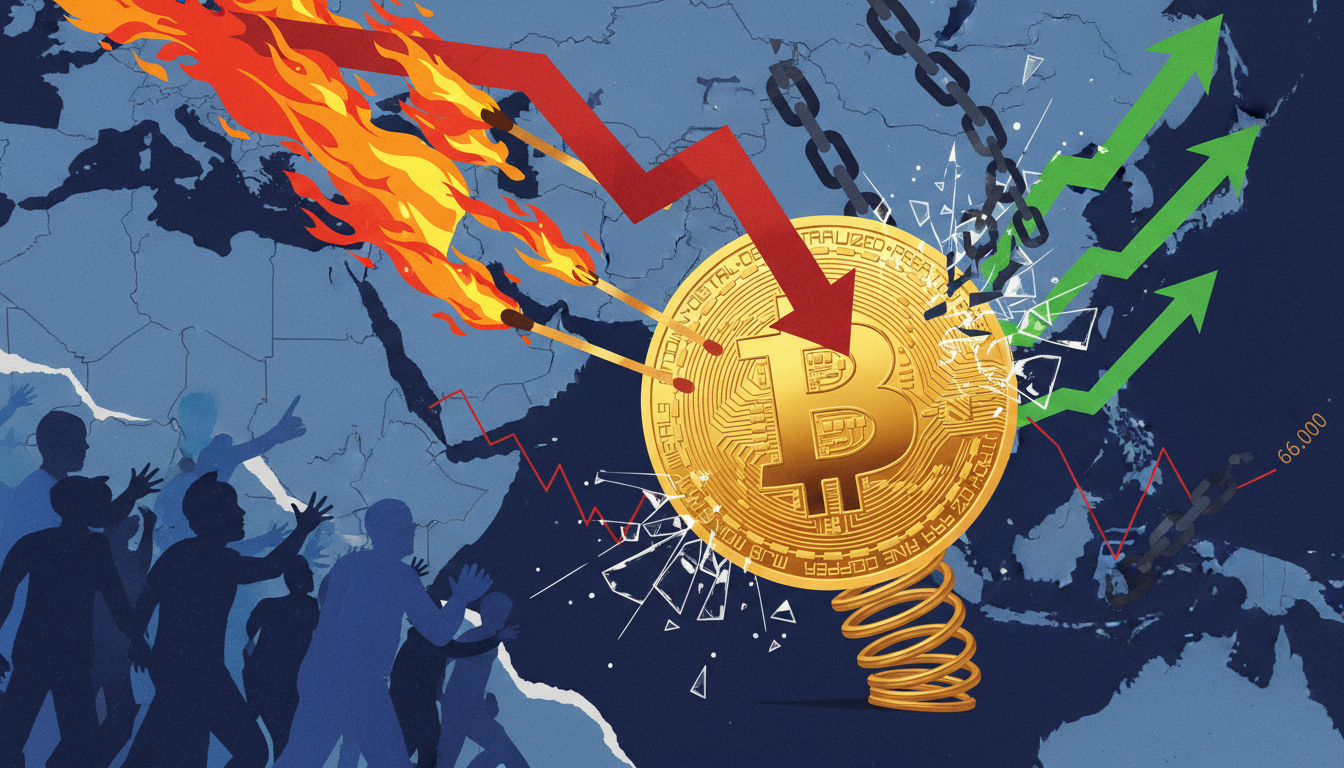
This week in East 8 Time, Coinbase launched a prediction market regarding U.S. college basketball event March Madness, igniting a debate about whether it represents "financial institutions or casinos." Since the launch of the prediction market feature in January in collaboration with Kalshi, Coinbase has continuously promoted this new business to users through App notifications, and the frequent pushes around the outcomes of the games became the trigger. Some users believe that this practice leads a platform that claims to be "compliant and institutional" to slide toward being a "disguised prediction market casino," directly conflicting with its established identity as a financial institution. In response to the criticism, CEO Brian Armstrong attributed the issue to a "system bug," claiming that there was a misconfiguration in the notifications and publicly apologized, but this incident has brought an old problem back to the forefront: how should the platform balance new product promotion and long-term trust when the credibility threshold in the crypto industry has not yet stabilized.
From financial platform to gambling table? Notifications like betting invitations
The controversy surrounding the March Madness event stems from the repeated prediction market notifications popping up on users' phones. Several users reported that the Coinbase client frequently pushed related prediction opportunities concerning game wins, losses, and point spreads in a short period, using an obviously marketing tone to guide users to "participate in predictions" and "seize the opportunity," creating a rhythm and visual atmosphere similar to gambling applications. For many users who are used to only buying and storing coins on Coinbase, these notifications suddenly broke their established impression of the platform as "more financial and custodial."
On social media, the discomfort quickly festered. Some users publicly stated that these notifications "looked like gambling inducements" and questioned whether Coinbase was using the emotional atmosphere of sports events to conduct emotionally-driven marketing to ordinary users who were not actively seeking such products. In the comments section, descriptions such as "turning from a brokerage into a casino" and "like a sports betting app constantly pestering users" proliferated, and the sentiment quickly evolved from initial complaints to questioning the platform's values and compliance boundaries.
A more concrete form of "voting with one's feet" also appeared. Some users mentioned on social platforms that they chose to cancel their Coinbase One subscription due to dissatisfaction with the wave of prediction market notifications, expressing distrust through their actions. There were also voices claiming that these notifications reached ordinary users who had never used the prediction market function, further seen as radical placements "forced upon those who do not need it." However, whether the notifications included all users who had never engaged with prediction markets is still classified as unverified information, with public channels not providing quantifiable and verifiable data support.
The financial institution image clashes with the prediction market casino
In the public discussion, a frequently cited assessment is: Coinbase is being pulled between a financial institution and a "prediction market casino". On one hand, it is listed on the U.S. capital markets and for many years has continually reinforced its positioning as "compliant, prudent, and institutional-friendly"; on the other hand, the prediction market launched in conjunction with Kalshi, as well as the high-frequency push around sporting events, has made many see a side of it more akin to a gambling platform. This dual identity exacerbates the sense of tearing in brand image.
This sensitivity is not just an emotional escalation in an isolated context but is compounded by the fragile trust foundation across the entire crypto industry. After experiencing multiple rounds of exchange crashes, project liquidations, and regulatory accountability, user expectations of "top platforms" increasingly focus on keywords like security, predictability, and not being malicious. Because of this, when a leading platform increases its business in a highly sensitive area, even a mere mistake in notification strategy can easily be magnified as a signal of "value shift."
From a product attribute perspective, the differences in risk perception between prediction markets and traditional brokerage services also directly fueled this controversy. Users view buying coins, custody, and fiat deposits and withdrawals more as investment or asset management behaviors, with psychological expectations of their volatility; meanwhile, predictions related to sports events or elections inherently carry a strong entertainment and betting quality, naturally aligning closer to the semantics of "gambling." When these two different risk perceptions are forced into the same notification channel, the sense of conflict is evident. Thus, expectations of the platform's role also become misaligned: some users wish it to be a custodial and trading infrastructure akin to banks or brokerages, rather than a venue that constantly reminds them to "come and play a game."
Armstrong's apology and the boundaries of the "Bug explanation"
After the controversy quickly escalated, CEO Brian Armstrong stepped forward to provide an official explanation. He attributed the unusually dense and inaccurate distribution of notifications related to March Madness to a "system bug" and a configuration error, stating that the push logic did not respect user preferences and layered settings as anticipated, and apologized to users for this. From the wording, this is a fairly typical response of "technical issue + poor experience," hoping to weaken external interpretations of a value shift through technical reasons.
However, among users, the persuasiveness of the "Bug explanation" has not been consistent. Some users accepted the explanation of "system configuration error" and viewed the incident as a product operation failure; others questioned that attributing the problem to a bug seemed more like a relatively harmless excuse for "excessive marketing"—the true motivation might lie in a strong desire for new product exposure and conversion, with the bug merely being the last straw that broke the camel's back on user experience. Especially when the pushed content had clear "betting" implications, users would naturally lean towards interpreting it from the perspective of "commercial impulse" rather than "pure technical accident."
In his response, Armstrong also promised to improve user preference settings and push controls, including more finely respecting users' subscription willingness for different product lines, reducing disturbances to uninterested users, and algorithmically limiting high-controversy products from entering the default push range. This reflects a long-term, unavoidable proposition within the platform: the product growth team needs to use data to validate new features and strive for KPIs, while the brand and compliance dimensions must uphold the long-term trust of that "invisible K-line." As promotional pressures steadily increase, the game of "one more push, one more conversion" versus "one less disturbance, one more trust" will inevitably frequently appear in decision-making meetings.
The gray imagination in the tug of regulatory oversight over U.S. prediction markets
In a broader context, this incident is compounded by the macro uncertainty that the regulation of U.S. prediction markets has not yet solidified. Public information indicates that there are state-level lawsuits and federal jurisdiction disputes regarding prediction market regulations in the U.S., but many related details and specific jurisdictions remain in unverified status, making it difficult to form a clear, unified regulatory framework. This institutional ambiguity makes prediction markets inherently viewed as "high sensitivity tracks."
In such an environment, Coinbase's choice to collaborate with Kalshi and introduce prediction markets into its own system is itself under close scrutiny along the compliance edge. Even if the partner has made significant preliminary work on compliance licenses and product structure, the market will still raise the question from a "regulatory expectation" perspective: if regulations tighten in the future, will the platform be forced to adjust or even take down relevant services? When platforms strengthen the presence of prediction markets with high-frequency pushes while regulations are not yet fully clarified, it can easily be interpreted externally as an aggressive move to "seize the betting lane during a regulatory window."
For the public, the combination of regulatory ambiguity and the entertainment betting attributes of product forms can further amplify the perception of "covert gambling." If future regulatory winds turn cold, such as a federal or state level clearly tightening the boundaries on prediction-type products, mainstream platforms like Coinbase may have to forcibly retreat in product strategy or even face the awkward scenario of "from aggressive expansion to hasty exit." The shadow of this prospect also grants the incident, which seems to revolve solely around notifications, a deeper space for policy and compliance imagination.
How crypto platforms can promote new products without "disturbing to death"
From the product and operations perspective, this controversy serves as a complete negative case study, reminding the entire industry to re-examine the genuine impact of notification frequency, targeting strategies, and default subscription mechanisms on user experience. For features like prediction markets which are highly sensitive and not essential, continuing to apply the push logic used for regular trading or market information can easily trigger a strong aversion to "being marketed" in a short time, especially when the content is inconsistent with the user's self-positioning; this aversion can be further magnified into doubt about the platform's values.
The restraint boundaries in advertising and notifications in traditional finance and internet platforms provide some comparable references. Large brokerages and banks, while also promoting profitable products like wealth management and credit cards, often avoid using overly emotional and betting-type language under compliance rules and internal risk controls; internet giants, known for algorithmic push, have also been compelled to add features like "do not disturb mode" and "one-click close specific category notifications" due to privacy regulations and public pressure, responding to users' fatigue and aversion to information interference.
For crypto platforms, layered user preference management and explicit consent mechanisms may be essential options for reducing friction. For example, placing high-sensitivity products like prediction markets and leveraged derivatives into a separate notification level and only pushing them after users explicitly check their interest; for users who have never used relevant functions, adopting a default silent "whitelist activation" rather than a flood-style approach. Meanwhile, in notification text and frequency, minimizing "betting-style" incitement while strengthening risk warnings and neutral information expression, allowing users to feel they are making informed choices, rather than being driven by emotion.
In an industry where trust is scarce and black swan events are frequent, the pace of product iteration must ultimately yield to long-term credibility assets. A few conversion curves on short-term KPIs are far less valuable than the moment when the platform is instinctively trusted by users at critical times. How to draw the line between "growth hacking" and "restraint" will become a public topic that all leading crypto platforms cannot bypass.
A small bug reflecting Coinbase's trust proposition
Looking back at the entire event, from the superficial push controversy to the deeper brand positioning, product strategy, and regulatory expectations, this interlude attributed by officials to a "small bug" concentrated on exposing the multiple pulls within Coinbase. On one side is the serious role of a compliant, publicly listed financial institution that has custody of assets, and on the other side is the high-yield, highly controversial new prediction track. Between growth anxiety and brand restraint, any imbalance in rhythm can be amplified into evidence of "position wavering" in the age of social media.
It is certain that prediction markets will remain a highly focused sensitive segment in the foreseeable future. Whether it is the regulatory power disputes between state and federal levels, or the continued public skepticism about "covert gambling," all indicate that every product trial and marketing action in this track must be treated as a compliance and brand risk event, rather than a mere business A/B test.
For Coinbase and other mainstream crypto platforms, this controversy may accelerate the formation of a clearer industry consensus: in the next round of innovation cycles, "trust first" must be written before product experiments and commercial layouts. New features can be slower to launch, and pushes can be less aggressive, but ensuring not to overdraw user trust at critical nodes is the true underlying asset for weathering bull and bear markets.
Join our community, let's discuss and get stronger together!
Official Telegram community: https://t.me/aicoincn
AiCoin Chinese Twitter: https://x.com/AiCoinzh
OKX benefit group: https://aicoin.com/link/chat?cid=l61eM4owQ
Binance benefit group: https://aicoin.com/link/chat?cid=ynr7d1P6Z
免责声明:本文章仅代表作者个人观点,不代表本平台的立场和观点。本文章仅供信息分享,不构成对任何人的任何投资建议。用户与作者之间的任何争议,与本平台无关。如网页中刊载的文章或图片涉及侵权,请提供相关的权利证明和身份证明发送邮件到support@aicoin.com,本平台相关工作人员将会进行核查。