"Weekly Editor's Pick" is a "functional" column of Odaily Planet Daily. On the basis of covering a large amount of real-time information every week, Planet Daily also publishes many high-quality in-depth analysis articles, but they may be hidden within the information flow and hot news, passing you by unnoticed.
Therefore, our editorial department will select some high-quality articles worth spending time on, reading, and collecting from the content published in the past 7 days every Saturday, providing you, who are in the cryptocurrency world, with new insights from perspectives such as data analysis, industry judgment, and opinion output.
Now, let's read together:

Macroeconomic Situation
Why are oil prices still above $100 after 400 million barrels were dumped?
After the United States and Israel launched a joint strike on Iran, Iran threatened to attack tankers passing through the Strait of Hormuz, paralyzing the world's most important oil transportation chokepoint. Currently, the actual traffic in the strait is less than 10% of pre-war levels. Crude oil prices have soared.
On March 11, the International Energy Agency (IEA) announced the release of strategic oil reserves, which is the largest one-time release of strategic oil reserves by its 32 member countries in its 50-year history. However, since the daily release of 400 million barrels only covers 17% of the shortfall, the effect is not ideal. If all 400 million barrels were dumped into the market at once, it would only last less than 4 days.
What determines the response of oil prices is not how many barrels have been released, but whether the source of the supply interruption has been eliminated. The release of reserves is essentially not about "supplying oil," but about "buying time," using limited ammunition to gain negotiation windows and the flexibility to rearrange alternative routes. If time is bought but the source of interruption is not resolved, oil prices will rise regardless. The current mathematical reality clearly shows that the rate of replenishment is significantly lagging behind the rate of depletion.
Jiang Xueqin: A hot Beijing high school teacher who predicted America's defeat in advance (paired with Jiang Xueqin's latest interview)
The U.S. military is essentially a "muscle display" system from the Cold War era, expensive, pursuing technological deterrence rather than the resilience of enduring attritional warfare. This mismatch presents itself as a ludicrous asymmetry in reality.
The modern global economy is built on one premise: Energy is cheap and readily available. And now this premise is collapsing.
Jiang Xueqin believes the Iran war will be highly similar to the Ukraine war: dragging on and turning into an attritional war. The U.S. cannot withdraw because once it does, the only regional power able to fill the security vacuum is Iran. About one-fifth of the world's oil passes through the Strait of Hormuz daily; if Gulf countries turn to Iran, the petrodollar system will collapse.
The current U.S. economy is essentially a Ponzi scheme, relying on foreign countries constantly buying dollars to maintain its operations.
Three weeks into the U.S.-Iran war, who is making money and who is paying the bills?
The Iran war changed the discount on Ural crude oil. The economic wall built by three years of Western sanctions has been partially dismantled by three weeks of the Iran war.
Losses at the supply end and revenues at the benefiting end will ultimately transmit to the consumer end. American consumers are the most direct bearers of this burden. This round of oil price increases has just swallowed the tax refunds that American families received.
In three weeks of the Iran war, the world lost 11 million barrels of oil daily, Russia earned nearly $800 million more in 15 days, and the oil costs for American consumers increased by one-third. After the sanction exemptions expire on April 11, this transmission chain will continue to extend.
Don't just focus on oil prices; the bond market is the real barometer
As the war enters a stalemate, a more systematic variable began to surface: financial conditions are tightening. What is truly driving the current market is no longer the war itself, but the disorder in the bond market.
In the past month, the yield on 10-year U.S. Treasury bonds has risen sharply, directly reshaping interest rate expectations from "rate cut paths" to "rate hikes before further discussion," and forming pressure on stock markets, commodities, and even policy space. In this process, the continuous weakening of the labor market and the renewed rise in inflation expectations compound the Federal Reserve's dilemma.
The bond market is not only reflecting risks but also determining the boundaries of risk.
Did the war win or lose? Trump: We won
Trump, the king of rhetoric, uses market manipulation techniques, with the underlying goal—making stock market prosperity the best "meal replacement" for economic prosperity to solidify his voter base.
Investment and Entrepreneurship
Will Balancer's "all-in" decision to abandon token issuance and eliminate veBAL bring new life?
On November 3, 2025, an incident that resulted in losses exceeding $120 million largely shattered the growth illusion of Balancer, a long-standing DeFi protocol.
The entire system appears to be a continuously operating "printing press," but in reality, it has two sides "leaking water": on one hand, transaction fees are lost layer by layer; on the other hand, the BAL token releases about 3.78 million tokens annually, creating a continuous sell pressure of approximately $580,000 at current prices.
On March 23, Balancer's core team simultaneously released two important governance proposals: a comprehensive reform of the BAL token economics and a restructuring of its operational framework. The core logic of these two documents can be summarized in one sentence: abandon the growth model driven by token releases and shift to sustainable operations driven by revenue.
Also recommended: Odaily Interview with Bitwise: BTC may reach $95,000 by the end of the year, SIREN, a carefully designed leverage harvesting, Bittensor (TAO) Bearish Logic: A Revenue Desert Under the Myth of Computing Power.
Web3 & AI
The ERC-8183 protocol is an on-chain standard for the decentralized AI agent economy; its essence is not a payment protocol in the traditional sense, but a specification for a business infrastructure surrounding the full lifecycle of "task-delivery-settlement."
ERC-8183 centers around the core primitive "Job," defining a tripartite collaboration model composed of the client, provider, and evaluator, and implements a complete state machine process for task publishing, fund custody, result submission, and result adjudication (open, fund, submit, complete/reject/expire) through smart contracts.
Within this framework, payment is no longer a singular action but rather a programmatic process strongly bound by task conditions, delivery verification, and evaluation mechanisms, thus enabling trustless on-chain business execution. Application scenarios include automated supply chains, marketing automation, decentralized computing power markets, fully automated AI software outsourcing centers, etc.
Skill scanning is nearly futile in the face of hacker attacks. Static detection rules are easily bypassed, AI audits have inherent detection blind spots, and the audit process itself has underlying design flaws.
AI Agents cannot eliminate SaaS
Since AI can now write code, find vulnerabilities, and even dynamically generate tools, the cost of writing code is approaching zero. Once an agent can produce various customized tools for enterprises anytime and anywhere, the software companies that charge monthly subscriptions will naturally lose their hard-earned moats. Thus, from CrowdStrike to IBM, from Salesforce to ServiceNow, regardless of how shiny their financial reports are, they are experiencing severe sell-offs.
At the same time, countless AI entrepreneurs are waving business plans towards VCs, claiming they want to "be the intermediary layer of the Agent era" and "start businesses for Agents."
They are all betting on one thing: creating tools is the sexiest business of this era. But in reality, software has never sold just code.
The most critical aspects are actually these three things: the solidified business processes, the years of accumulated customer data, and the resulting high switching costs.
Scarcity has shifted from "the ability to create tools" to "having irreplaceable business context data." AI is the engine, while exclusive data is the fuel, as well as the sediment of time and an unreplicable history. Code becomes worthless, and data starts generating rental income. The true winners are those who hold data assets that Agents cannot circumvent.
Don't focus on the Agent's hands; cut off the Agent's neck.
Also recommended: Token Naming War: Who is battling for the "minting rights" of the AI era?.
Predictive Markets
4 Heavy Truths and Cost Traps Behind Polymarket LP Market-Making Incentives
The original author analyzes Polymarket's new eating fee mechanism, market-making incentive plans, liquidity incentives, and sponsored LP incentives.
Polymarket does not need volume-boosting bots; it needs real value-providing LPs. Systematically earning market-making incentives requires capital, risk management, and continuous presence, which greatly weakens the advantages of the "profiteers," instead benefiting true market participants.
Arbitrage traders and Polymarket/Kalshi bot player securezer0 believe that LPs are another form of "paying to lose money." Rather than quenching thirst with poison, it is better to cut to the root: strike at the vampires rather than harvesting from users. Specific measures are: only charge a fixed fee of 1% on profits; build native liquidity pools using POLY tokens; charge for expanded products instead of core products.
Dismantling Polymarket's leaderboard of 40 addresses, only three ways to profit exist
The first type: sports market, directional, bet right and hold until the end;
The second type: crypto sector, structural, not relying on predictions to make money, but on market-making;
The third type: cognitive, betting a small amount but making a judgment on every bet.
Understanding which game you are playing is more important than optimizing any parameters.
2% of users contribute 90% of trading volume: the true portrait of Polymarket
The vast majority of trading volume on Polymarket is contributed by a small group of algorithmic trading and high-frequency trading individuals; the massive low-frequency retail traders have almost no overlap with these professional traders. Recognizing the differences between these two groups directly determines platform fee design, product priority planning, and market category strategic layout.
Master Polymarket, these 7 tools are enough (complete tutorial included)
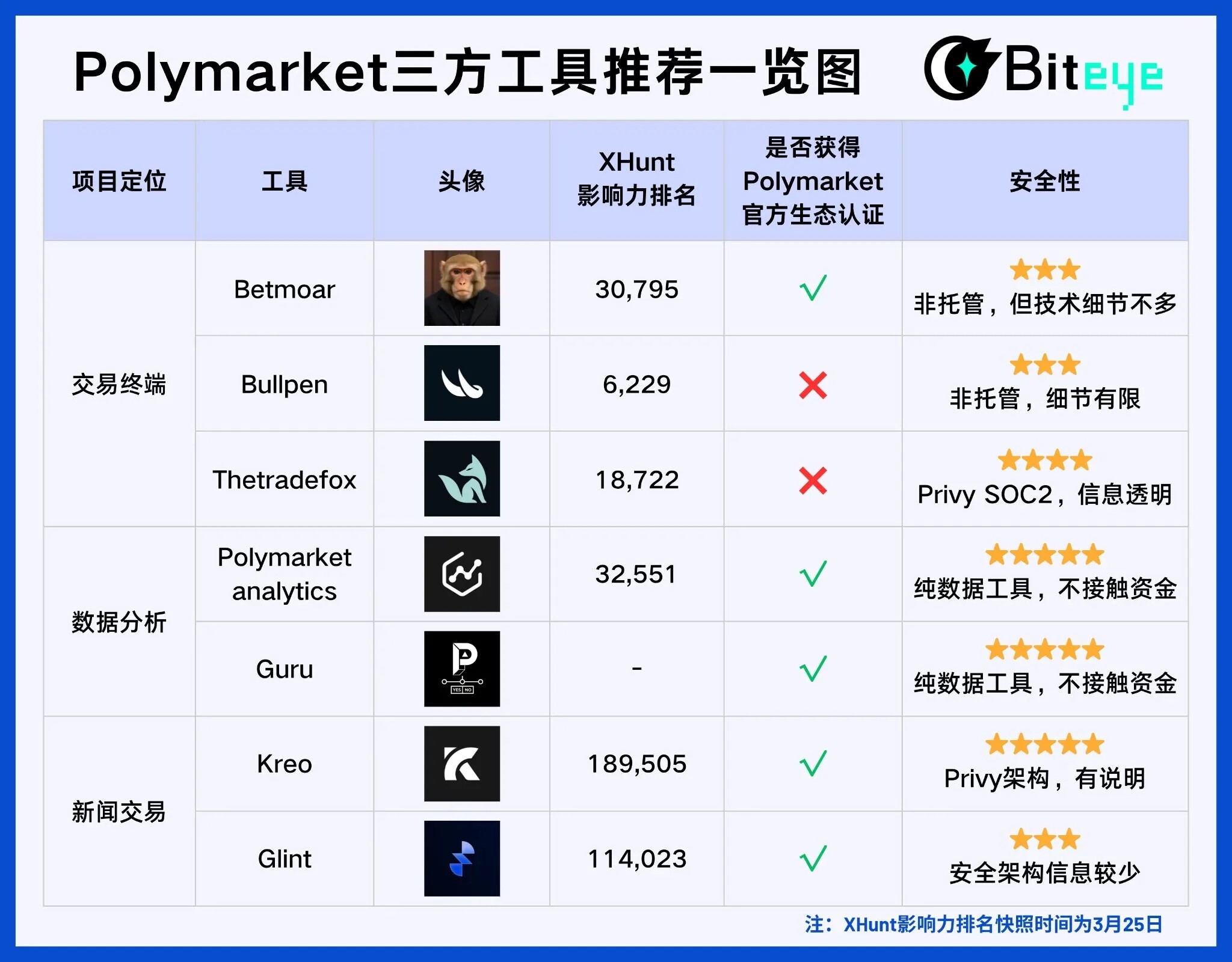
Also recommended: Interpreting Polymarket's significant update last night: fee expansion, self-regulation, added incentives, Kalshi and Polymarket joint investment in a new fund, a major step towards "ecologizing" the predictive market.
Policies and Stablecoins
The CLARITY Act rewrites the death ledger of DeFi: Circle gains, DeFi tokens bleed
The latest CLARITY proposal effectively ends the narrative of stablecoins as savings products; stablecoins are strictly defined as payment tools rather than interest-generating assets, which will be unfavorable to most DeFi. The assets most susceptible to impact are DeFi tokens and governance tokens linked to fee income, such as UNI, SUSHI, DYDX, 1INCH, and CAKE DEX tokens.
Meanwhile, Maker's structure has enabled it to benefit from this transformation. Other beneficiaries include compliance infrastructure providers like Circle, exchanges, and custodians (BitGo).
10x expects a fundamental target price of $120 over the next 12 months. If USDC growth accelerates again and profit margins significantly improve, it is expected to rise to $150; however, if growth stagnates and the current economic situation persists, there is a risk of a drop to $80.
Also recommended: Tether signs with four major auditing firms, Circle's compliance moat collapses, stock price plummets by 20%.
Airdrop Opportunities and Interaction Guide
Interaction tutorial | Startale Group, which raised $63 million, has launched points activity
Ethereum and Scaling
Ethereum Foundation's statement: L1 and L2, from division to symbiosis
Weekly Hot Topics Recap
In the past week, Iran proposed five ceasefire demands to the U.S., Israel fears Trump will compromise to declare victory; Iran stated it will not allow Trump to decide when the war ends;
Additionally, in terms of policy and macro markets, U.S. legislators will introduce a bipartisan bill to ban the sports sector of predictive markets; the UK plans to suspend political donations in cryptocurrency, with the Prime Minister stating a need to prevent illegal funding risks;
In terms of opinions and voices, analysis shows: Bitcoin is under pressure alongside the S&P and Nasdaq, and the Iran war has intensified market risk aversion; BIT: the Bitcoin options market has shifted to defense, with a significant increase in demand for downside protection; Bloomberg: Tether has suspended its $20 billion financing plan; Bernstein: Circle's stock price correction may have been overdone, and the market misreads the impact of stablecoin regulations;
In terms of institutions, large companies, and leading projects, the New York Stock Exchange is collaborating with Securitize to develop a tokenized securities platform, supporting 24/7 trading; Tether collaborates with one of the Big Four accounting firms to advance its first comprehensive audit; Strategy launches a total of $42 billion equity issuance plan; Interactive Brokers launches a cryptocurrency investment portfolio transfer feature, supporting outsourced wallets for digital asset transfers; Binance releases a risk reminder for market makers and a guideline for project parties and users (interpretation); Backpack launches a token claim and staking interface; Balancer's co-founder announces the closure of Balancer Labs, with the protocol transitioning to DAO and foundation structure for continued operation; Odaily Skills is launched for free, featuring a structured output of curated information to save tokens;
In terms of data, on March 23, the year-to-date rise of spot gold has returned to zero, falling over 4% in a day; on March 25, Circle's stock price once dropped by 18%, as the U.S. Clarity Act draft aims to restrict stablecoin rewards;
On the security front, Resolv Labs confirmed experiencing a vulnerability attack and has suspended all protocol functions... well, it's been an eventful week once again.
Attached is the portal to the Weekly Editor's Picks.
See you next time~
免责声明:本文章仅代表作者个人观点,不代表本平台的立场和观点。本文章仅供信息分享,不构成对任何人的任何投资建议。用户与作者之间的任何争议,与本平台无关。如网页中刊载的文章或图片涉及侵权,请提供相关的权利证明和身份证明发送邮件到support@aicoin.com,本平台相关工作人员将会进行核查。


