Text | Sleepy.md
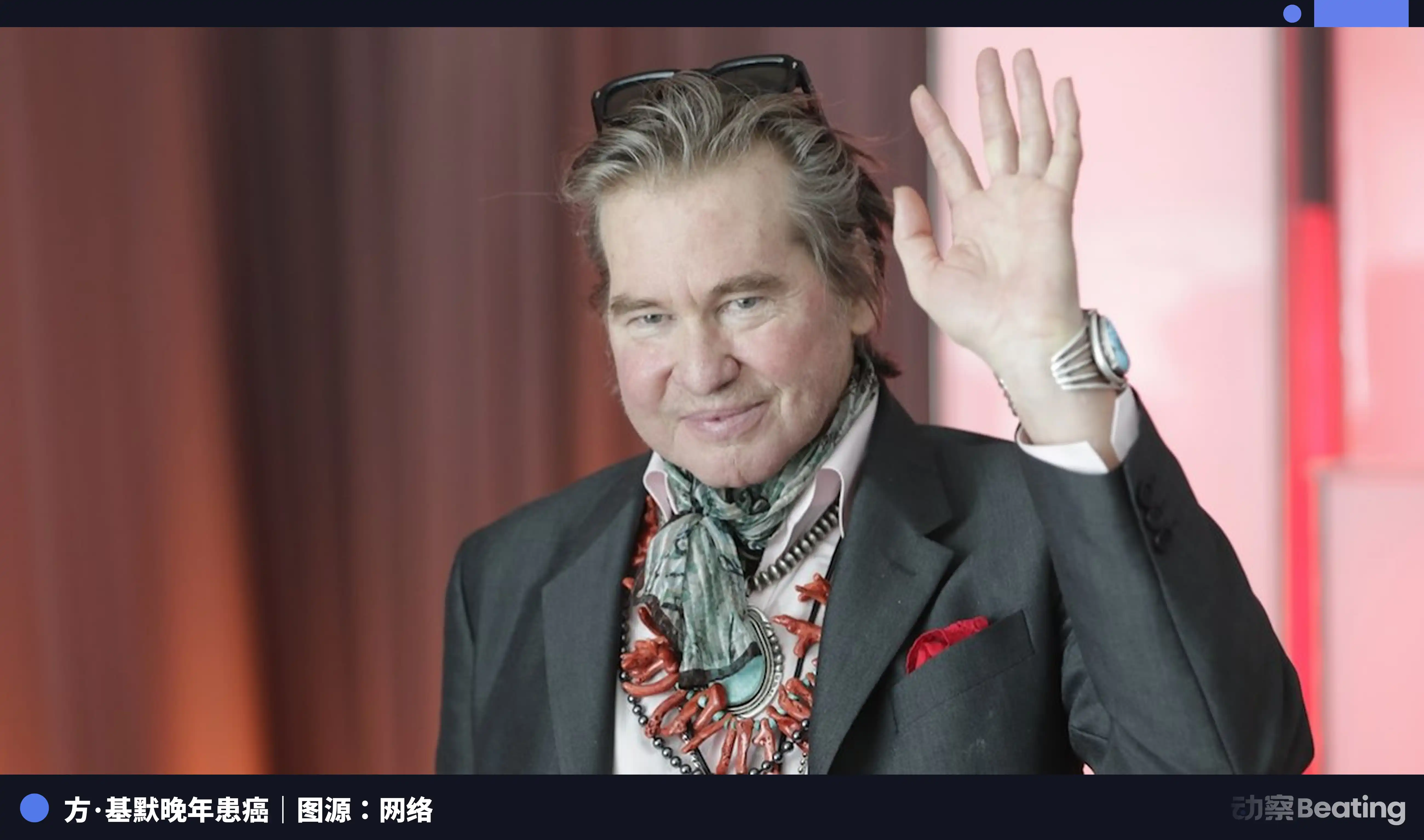
In 2025, Val Kilmer passed away at the age of 65 due to complications from throat cancer. The once spirited Iceman in "Top Gun," the cool and charming Bruce Wayne in "The Forever Batman," suffered greatly from cancer in his later years.
He was a devout Christian Scientist who rejected modern medicine, attempting to heal his illness through prayer. This ultimately cost him his voice and his life.
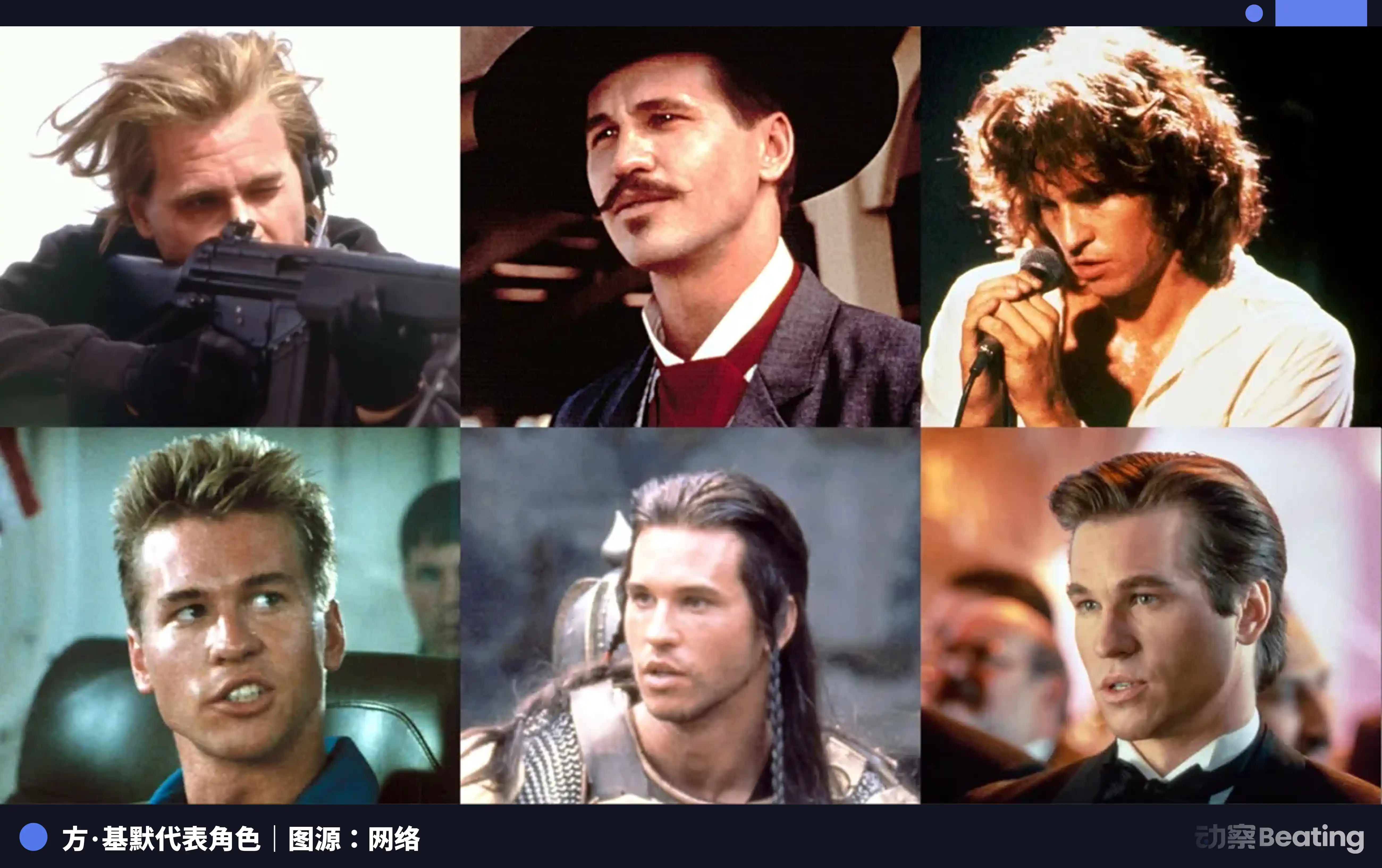
However, less than a year after his death, he was "resurrected" in a movie about Native American spirituality titled "Deep as the Grave." This marks the first time in cinema history that generative AI technology has allowed a deceased actor to deliver an entirely new performance.
A soul that was previously averse to modern technology, and even attempted to combat pathology with theology, has now been transformed into a digital specimen by the most extreme modern technology.
We once believed that death was the only fair thing. But now it seems that while poor people turn to dust without anyone caring, rich people continue to work for capitalists even after death.
Cyber Séance
The story of "Deep as the Grave" is set in Canyon de Chelly, Arizona, a sacred land belonging to the Navajo tribe.
Val Kilmer plays a Catholic priest and Native American spiritualist in the film, following two archaeologists in the canyon as they attempt to find the resting place of ancient souls. The film's underlying theme is reverence, a quest inquiring about the lost civilizations on this red land.

But reality is particularly ironic. In the traditional culture of the Navajo, death is an extremely dangerous taboo. They believe that when a person dies, they leave behind an evil aura known as "Chindi," which departs the body with the last breath, carrying away all imbalance and malevolent thoughts.
The Navajo people have a deep respect for death. They go to great lengths to avoid discussing the deceased, never directly naming the dead, and are particularly averse to touching their belongings. In their view, forcibly disturbing the peace of the dead will invite tremendous misfortune.
Yet, "Deep as the Grave," a film parading under the banner of "respecting Native history," has audaciously chosen the most offensive way possible, using AI to force Val Kilmer back to the living.
To fill in the scenes he could not complete due to illness, engineers in Silicon Valley collected his archival footage, audio clips, and even the raspy breath he had towards the end of his throat cancer, throwing these digital remnants into an algorithm. Ultimately, in a cold server room, they calculated the priest in the film exploring the fate of souls in the canyon.
Does Hollywood not realize this is an offense to Navajo culture? Of course, they do. But they simply do not care; they care more about financial reports and valuations.
How much can a deceased actor earn for the living capitalists?
Posthumous Economics
To answer this question, we need to understand the newest business model that Hollywood has developed.
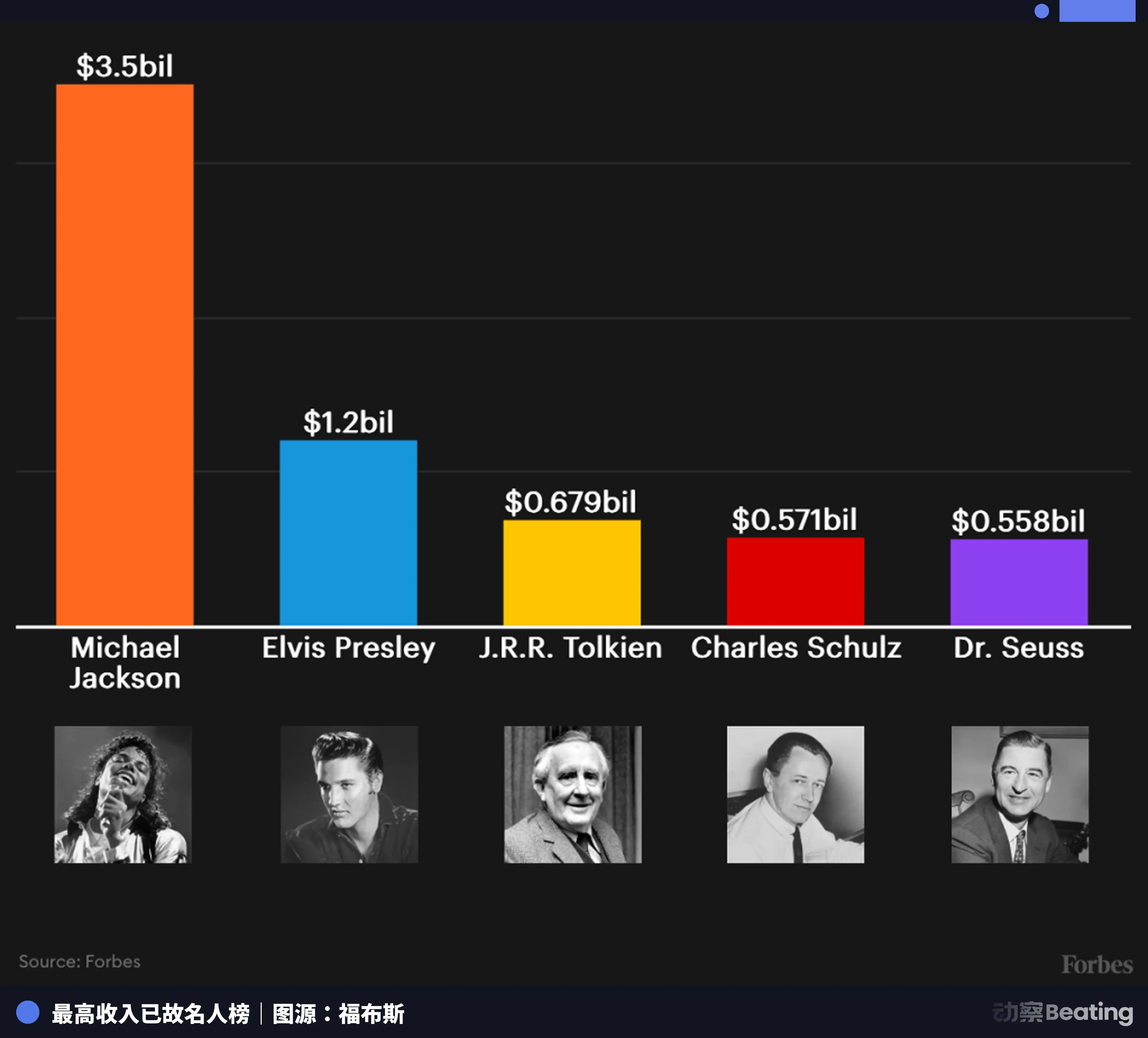
According to Forbes' "Highest Earning Dead Celebrities" list, stars like Michael Jackson still generate hundreds of millions in revenue annually after their deaths. However, in the past, this "posthumous economics" relied on copyright licensing, such as selling recordings, merchandise, and holding tribute concerts. In that sense, estate companies were merely collecting rent, benefitting from the stock that stars accumulated during their lives.
But the arrival of AI has completely changed this business model.
According to an in-depth analysis by Hollywood industry media "The Ankler," California has recently expanded its posthumous personality rights legislation, explicitly including AI-generated digital replicas. This means that estate companies are no longer selling "past works," but rather the "posthumous labor time" of stars.
The commercialization of posthumous IP has officially moved from copyright licensing to an era of production extraction.
For production studios, this is a perfect commercial loop. In traditional filmmaking, actors are the most uncontrollable variables; they age, gain weight, clash with the production team over pay, and scandals in their personal lives can lead to films being pulled. They can even unite to form unions and initiate long strikes lasting up to six months.
But actors resurrected by AI will not. Capitalists have finally found the perfect employee.
The digital Val Kilmer will never age, he doesn't need a mobile home, doesn't need breaks, has no temper, won't join unions, and will always obey. If you ask him to play a priest, he will play a priest; if you ask him to recite a sad line, his algorithmically computed digital face will squeeze out the most precise tear.
Marx predicted in "Capital" that capital would extract every drop of sweat from workers, but he probably never imagined that in Hollywood in 2026, even the surplus value of the dead could be drained.
Who is Selling Val Kilmer?
In this digital séance, Val Kilmer's daughter played a crucial role.
Faced with external controversy, she publicly stated her full support for the producers using AI to resurrect her father. Her reasoning was: "My father was a deeply spiritual person who always looked at emerging technologies with an optimistic attitude, believing they were tools to expand artistic possibilities."
Indeed, before his role in "Top Gun: Maverick," Val Kilmer, needing to say goodbye to an old friend, compromised by allowing AI technology to reshape his lost voice. His daughter used this as a reason, claiming her father was optimistic about technology. This effectively cloaked the production company in a legal and moral facade.
However, the family and capitalists have swapped concepts: a living person who actively borrows digital prosthetics to complete an artistic swan song is not equivalent to someone willing to completely sever their soul and body after death, becoming a mere puppet of electronic strings. The compromise made during life was to defend dignity, but the resurrection after death is a total deprivation.
In 2023, the American Actors Guild launched a 118-day strike to resist AI substitution. The agreement ultimately reached included clauses that any AI resurrection of deceased actors must receive explicit authorization from the estate management (usually family members) and adequately compensate them.
The union thought it built a solid fortress with its strike, but reality proved this merely left a backdoor for capital. Now capital doesn't even need to defeat unions; it just needs to dazzle family members with money.
While Val Kilmer may have indeed had an optimistic view of technology during his life, this does not mean he would want to entrust his face and voice to a character that never read a script or participated in a single second of filming after death. In an era without digital wills, the dead have become the most silent lambs waiting for slaughter.
The capitalists and family have completed their plunder, but as the paying audience, can we indeed see the "performance" we want on screen?
Electronic Pre-Made Dishes in the Uncanny Valley
It turns out that the audience does not want to watch it at all.
A deep report from "Wired" points out that today's audience has a strong aversion to AI-generated entertainment content. No matter how studios brag about technological breakthroughs, all the audience sees are dead fish eyes, distorted micro-expressions, and a creepy plasticity.
This aversion is not born out of moral fastidiousness but is instead a visceral response to the uncanny valley effect. When a non-human entity closely resembles humans in appearance and movement but is not fully human, it elicits strong disgust and nausea in viewers.
German philosopher Walter Benjamin proposed a famous concept in "The Work of Art in the Age of Mechanical Reproduction": "Aura." He believed that true works of art possess a unique presence that is irreplaceable, which is the essence of "aura."
The AI-generated Val Kilmer, precisely, has had all his aura siphoned away.
He has no weight of flesh, no suffocating breath, no uncontrollable impromptu performance. Every expression of his is merely an average value computed by algorithms from past data. The resurrection of Val Kilmer is not a technological miracle; it is an electronic pre-made dish forced onto the audience by a Hollywood independent production studio that has run out of budget.
If AI has drained the essence of performance, then what is the true and moving performance?
The Iceman's Tears, Incomplete Truth
To answer this question, we only need to turn back the clock four years.
In 2022, Val Kilmer genuinely portrayed the Iceman in "Top Gun: Maverick." By then, he had undergone a tracheostomy due to throat cancer, completely lost his voice, and his body had become extremely frail.
The director did not use CGI to make him appear young again or conceal his illness. In the film, the Iceman also suffers from throat cancer and can only communicate with Tom Cruise by typing on a computer keyboard.
In that scene, the Iceman typed a line: "It's time to let go."
Tom Cruise looked at the screen, his eyes misty, and he cried on the spot.
Then, the Iceman struggled to emit a hoarse and extremely faint sigh.
At that moment, all the audience was moved.
Because that was the true flesh enduring pain, that was two old friends entwined for thirty years, carrying out a dignified farewell with their incomplete bodies. That kind of incomplete beauty shadowed by death, that human vulnerability and dignity displayed in the face of illness, is something no top-tier graphics card can render.
And in 2026's "Deep as the Grave," AI reshaped Val Kilmer's youthful visage, granting him a perfect voice. He is no longer in pain, no longer needs tubes, and he gains eternal life in the digital world.
In the real world, where his decayed body has perished, and the eternally polished replica in the digital realm, do we really love that authentically suffering person, or do we love that perfect digital reflection? When the audience weeps at a code-generated sad micro-expression, what exactly are we feeling?
Ultimately, we can only empathize with real pain; we cannot fall in love with a flawless string of data. The authenticity of imperfection will always carry more weight than the false allure of perfection.
A Labor Contract Without a Period
Val Kilmer suffered greatly from illness during his life. He lost his voice for rejecting medical treatment and could only eat through tubes due to his tracheostomy. In the final years of his life, his body became a prison.
He deserved to find peace in death.
But in today's Hollywood, death is no longer the end of labor but the beginning of a new contract without a period. His image, his voice, and all his performance data from his life have been packaged into an asset bundle named "Val Kilmer," continuing to earn box office revenue for others on screen.
As the wave of AI sweeps in, when we look at those resurrected stars, we are actually looking at our future selves. When our data, habits, voices, and images can all be perfectly replicated by algorithms, even before death, the presence of our flesh has become less significant.
Technology once promised to liberate humans from heavy labor, but the reality is that it has turned humans themselves into infinitely replicable production materials. In life, it strips away your uniqueness; in death, it even confiscates your right to rest.
The Navajo are right. Let the dead rest, do not disturb their souls. Because when you gaze into the abyss, the abyss not only holds the departed spirits but also the greedy eyes of the capitalists.
免责声明:本文章仅代表作者个人观点,不代表本平台的立场和观点。本文章仅供信息分享,不构成对任何人的任何投资建议。用户与作者之间的任何争议,与本平台无关。如网页中刊载的文章或图片涉及侵权,请提供相关的权利证明和身份证明发送邮件到support@aicoin.com,本平台相关工作人员将会进行核查。


