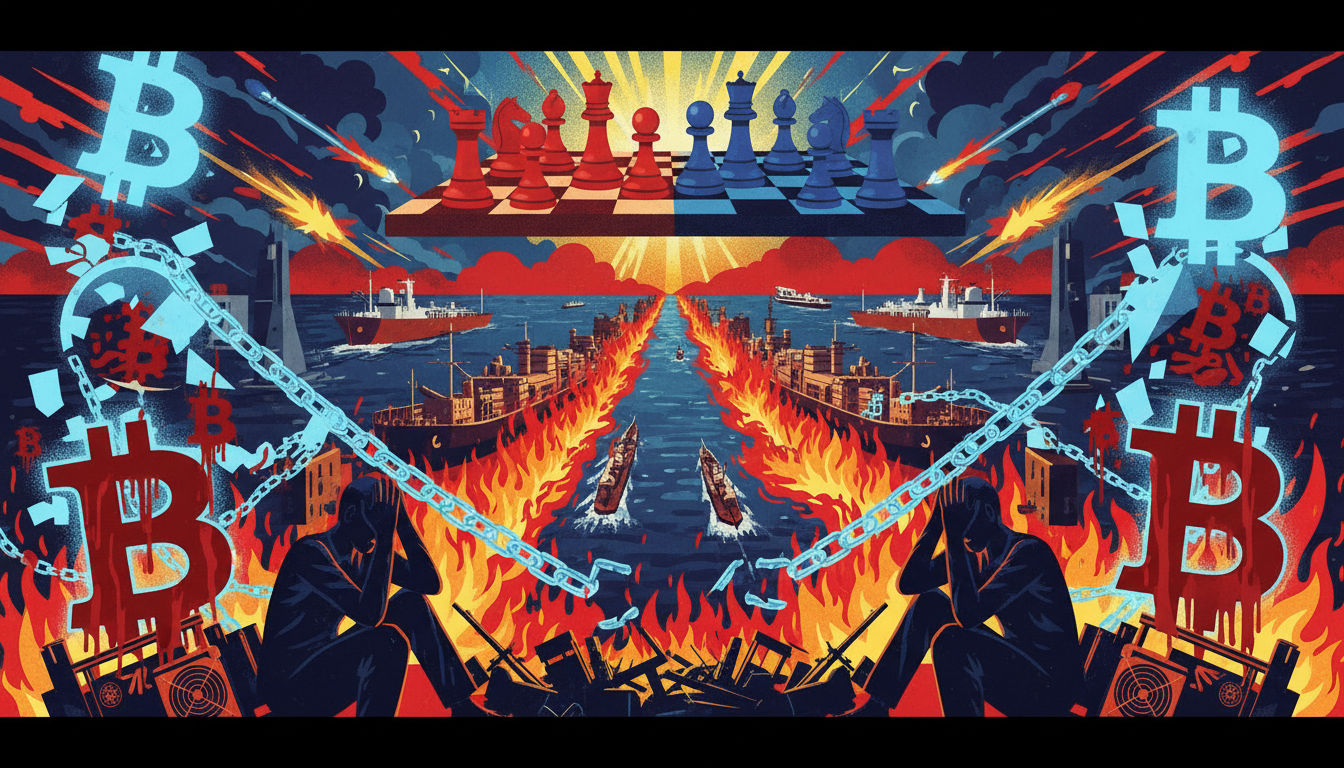
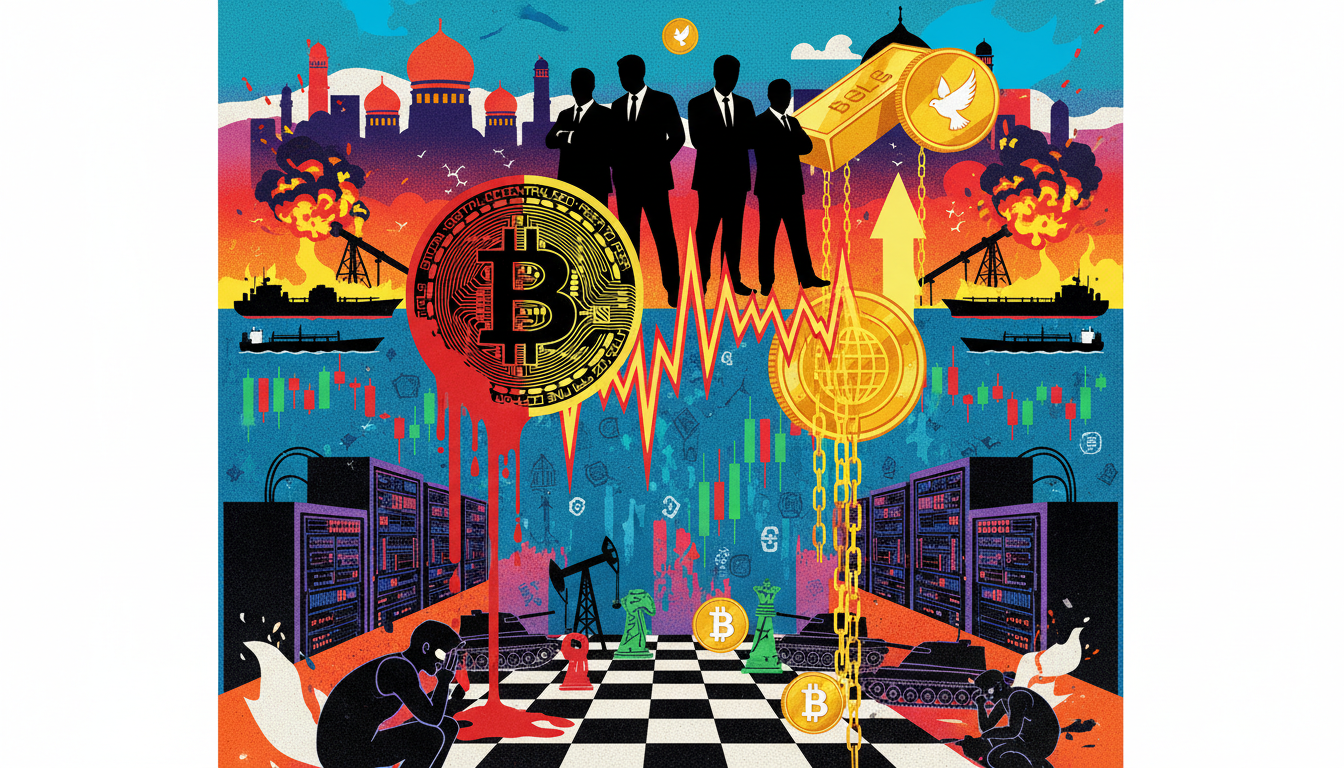
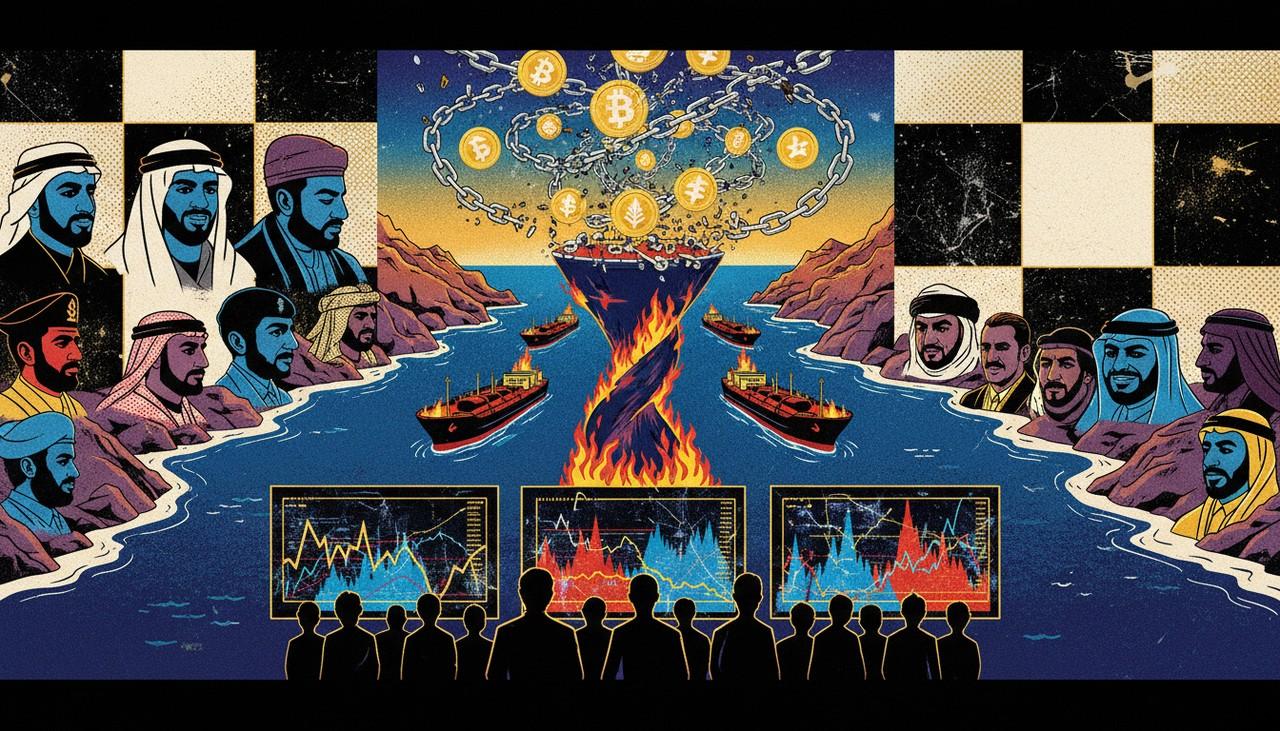
On March 22, 2026, local time in the East Eight Time Zone, as the lines of geography and energy intertwined in the Middle East, Bitcoin and the entire cryptocurrency market were once again dragged into a wartime narrative. Israeli Prime Minister Netanyahu announced that day targeted strikes would be implemented against the current Iranian regime and the Islamic Revolutionary Guard Corps, with aims directly at the leadership of the Guard Corps, as well as its infrastructure and economic assets. Meanwhile, Iran signaled that if the conflict escalated, Middle Eastern energy facilities could be viewed as "legitimate targets for attack," and expectations of disruptions in oil and gas supply subsequently intensified. For the market, this not only implies potential drastic fluctuations in international oil prices and regional electricity prices but also indicates instability in Bitcoin mining computing power and electricity costs, which will amplify the short-term volatility of crypto assets on an emotional level. On one hand, there is a resurgence of the "geopolitical safe-haven asset" narrative, while on the other hand, the pressure of rising electricity prices and mining costs forces investors to reassess the risk premium of every coin in their possession against a backdrop of inflation and the shadow of war.
Missiles Targeting Oil Wells: How High Will Mining Costs Rise?
Netanyahu's statement is not a symbolic warning; rather, it specifically calls for targeted strikes on the current Iranian regime and the Islamic Revolutionary Guard Corps, covering the leadership of the Guard Corps, key infrastructures, and related economic assets. From publicly available information, this scope includes not only military and security facilities but may also extend to critical assets supporting Iran's finances and regional influence, such as energy and finance, intended to weaken Iran's projection capability and funding sources in the Middle East. In this context, the risk of military conflict has expanded from the battlefield itself to the regional economy and energy system.
More shockingly is the response from Iranian Parliament Speaker Ghalibaf – "Middle Eastern energy facilities will become legitimate targets." This statement directly touches the nerves of the global market. The Middle East holds a critical share of the global oil and gas supply; once oil fields, pipelines, ports, or related infrastructure are attacked, even a localized and brief disturbance is sufficient to trigger rapid increases in expected oil prices in the futures market. Historical experience shows that similar conflicts typically first reflect risk premiums in long-term prices and then gradually transmit to retail energy prices and industrial electricity costs in various countries.
For Bitcoin mining, rising oil and natural gas prices translate into higher electricity prices through thermal power costs, which, in turn, affect the distribution of computing power and miner profits. Although global computing power is not concentrated in the Middle East, Middle Eastern oil prices are one of the critical anchors for global energy pricing. Rising electricity costs will compress the profit margins of marginal miners, especially for small and medium-sized mines that are already near the breakeven line. As electricity prices rise, miners will see their cash costs for mining the same number of Bitcoins increase, forcing some high-cost mining rigs to shut down, potentially leading to a restructuring of the computing power distribution between regions; the increase in shutdown rates will become the first reaction of the mining sector to geopolitical conflicts.
This creates a subtle contradiction with the market's renewed hype around "Bitcoin as a geopolitical safe-haven asset." On one hand, during times of escalating warfare and rising perceived risks of fiat currency, Bitcoin is often packaged as a store of value unrestricted by sovereign borders, emotionally pushing prices and demand upward; on the other hand, rising mining costs mean that fundamental production prices will increase, and if coin prices do not recover in sync or even decline, miners will be squeezed from both sides, increasing the potential for selling pressure. This tension between "the warming of the safe-haven narrative and the pressure on costs" is an underlying variable that cannot be ignored in current market pricing.
Safe Haven or Sell-off: The Dual Emotion of the Crypto Market
From past experiences, whenever geopolitical conflicts suddenly escalate, mainstream assets like Bitcoin and Ethereum tend to exhibit soaring volatility in the short term, rather than a straightforward "linear rise in safe-haven." In the initial stages of conflict, tightening expectations of dollar liquidity intertwine with panic sentiments, pushing some funds towards cash or traditional safe-haven tools, which suppresses the prices of crypto assets; as events evolve, if the conflict is interpreted as long-term and systemic risk on the rise, another portion of funds will view Bitcoin as a hedge against sovereign and inflation risks, bringing about a second phase of passive or active inflows. Historical performance increasingly shows a "first sell then rise," two-phase model of heightened volatility, rather than a simple linear relationship.
The current escalation of tensions between Israel and Iran is likely to generate this "polarized" emotional path in exchange and on-chain data. On one end are actions to reduce positions and deleverage on exchange spot and derivatives markets: leveraged longs are forced to close positions, with some prudent funds choosing to lower risk exposure, leading to a temporary decline in exchange transaction activity while the amount of liquidations grows; on the other end, funds betting on the safe-haven narrative are pouring in, with spot buying stepping in at critical support levels and increased demand for call protection and put hedging in the options market, pushing implied volatility upwards. On-chain, the number of active addresses and large transfers may show structural divergence—large funds frequent exits and entries, while retail addresses tend towards caution and observation.
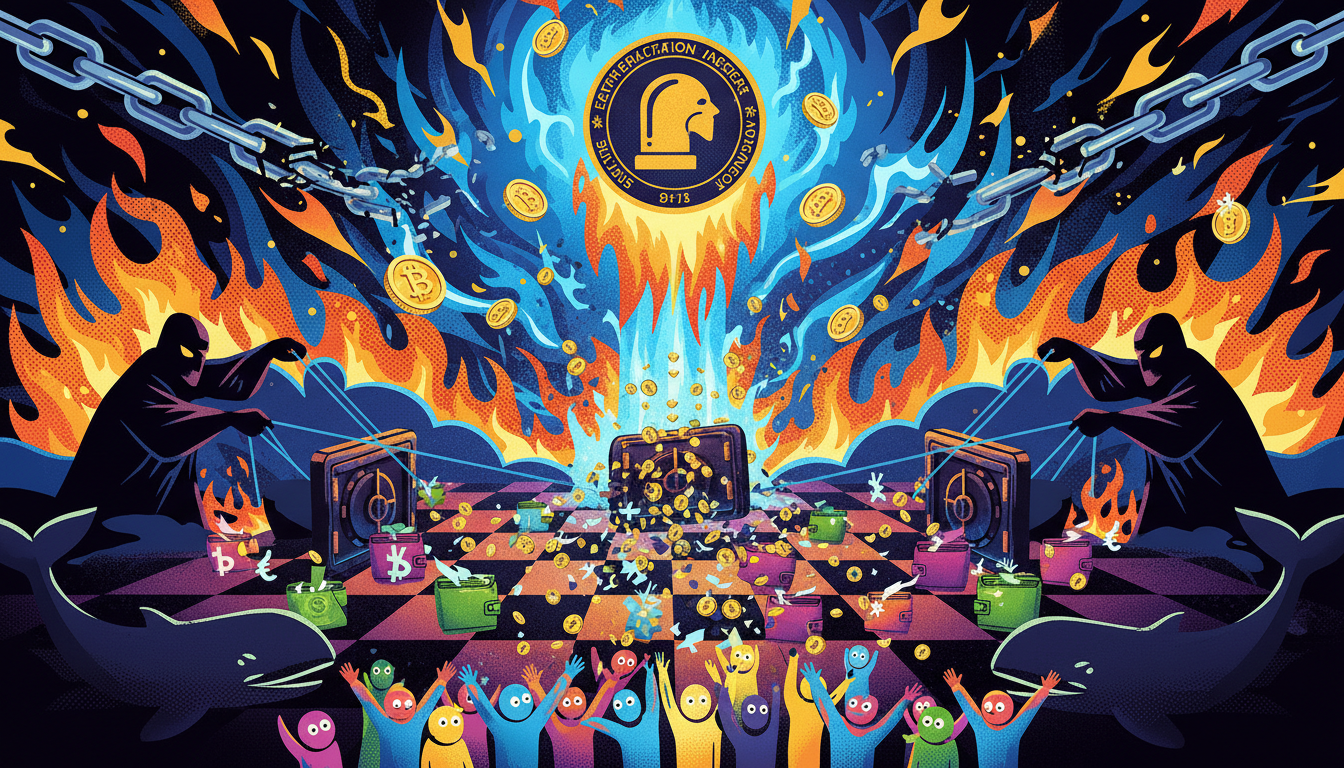
The research brief mentions that recently, a whale bought 8,662 ETH in a single transaction, estimated at around 18.05 million USD at the time (single source). Amid widespread concerns and selling sentiments, such large-scale buying on dips underscores the time perspective misalignment between large holders and retail investors: the former add quality assets during magnified uncertainty, betting on the return of medium to long-term risk premiums; the latter may exit the market in a panic due to sudden price drops and dual shocks from geopolitical news. During a phase dominated by geopolitical conflicts, this misalignment is often amplified—each update on battle conditions may become a trigger for retail emotional response, yet simultaneously provides liquidity-rich institutions and whales with better entry discounts.
It is worth noting that there is a significant gap in publicly available information regarding military operations. The brief clearly states that the specific timetable for Israeli strikes and Iran's counter-strategy has not been disclosed, and any undisclosed military details should not be speculated upon. In such an environment of "severe information asymmetry," market pricing is more of a reaction to expectations and fears, rather than a calm valuation based on exact facts. This means that both panic premiums and uncertainty discounts exist simultaneously, amplifying the range of fluctuations, making prices more susceptible to excessive deviation from the fundamentals, and elongating the time required for emotional recovery.
From Oil Prices to Computing Power: Cost Migration Under Geopolitical Conflict
To understand the impact of the Middle East conflict on the global computing power landscape, one must first distinguish the differences in geographical and energy structural layers. The Middle East plays a vital role in the supply of global oil and natural gas, but the main concentration of Bitcoin computing power is distributed in regions with diverse electricity structures or those that rely predominantly on hydropower and wind/solar energy, such as North America, Central Asia, and Northern Europe. Therefore, missiles will not directly target the majority of mining sites globally, but fluctuations in oil and gas prices will have an indirect impact via power generation costs and electricity price policies, particularly affecting those mining projects that rely on thermal power and are linked to fuel prices.
Once oil and natural gas prices continue to rise due to regional tensions, thermal power-dominated mining sites and high-energy-consuming AI computing centers will be under cost pressure. For mining sites, possible coping strategies include: periodically shutting down when electricity prices exceed the breakeven point to preserve hardware lifespan and cash flow; moving some facilities to regions with higher proportions of hydropower, nuclear power, and renewable energy, with relatively friendly regulations, to secure long-term low-cost electricity; or choosing to sell mining rigs, Bitcoin, or equity assets under increasing pressure to recover cash and navigate through high volatility periods. For AI computing centers, the marginal expansion of high-energy businesses may slow down, and capital may lean toward solutions with higher energy efficiency and computing power.
The rise in costs will also translate into potential selling pressure in the spot market through the cash flow pressure on miners. Against a backdrop of intensifying price fluctuations, the continuous rise in electricity and maintenance costs will force more miners to liquidate the Bitcoins they mine to cover operational expenses and debts, which could amplify selling pressure during price declines, creating a typical "reflexive" impact on the spot market: price declines—miner selling pressure increases—prices come under further pressure. If the market's safe-haven sentiment fails to support coin prices at higher levels in the short term, this chain may become a key force affecting the mid-term supply rhythm.
Thus, an unavoidable question arises: if the current conflict evolves into a medium- to long-term geopolitical confrontation and continues to weigh down energy prices, will the investment landscape for mining and AI computing move more rapidly towards regions with predictable energy costs and more stable policy environments within the next couple of years? This not only pertains to the traditional notion of "computing power migration," but also implies that capital may favor jurisdictions with stable electricity structures and clear compliance frameworks, viewing today's conflicts as catalysts for accelerating geographical restructuring in the industry.
From the OpenClaw Guide to USR Decoupling: The Hidden Line of Security and Trust
Also on March 22, the Chinese National Internet Emergency Center and the Cyberspace Security Association jointly released the "OpenClaw Safe Usage Practice Guide," outlining boundaries for the use of AI and cybersecurity tools. The guide emphasizes that ordinary users should use these tools in a segregated environment to avoid directly deploying them in production systems or main environments containing sensitive data, with the core assertion being that physical and logical isolation reduces the risks of data leakage and malicious utilization. In an increasingly tense global security climate, where digital infrastructure is viewed as a "soft target," such official guidelines target not only traditional enterprises but also represent a clear signal to the cryptocurrency sector, including exchanges and wallet service providers.
The penetration of AI and security tools in the crypto field has already begun: on one hand, exchanges and institutions enhance their risk monitoring, anti-money laundering, and compliance review capabilities through AI, improving the efficiency of identifying abnormal transactions and potential attacks; on the other hand, more powerful automation and models also mean that once misconfigured or with insufficient isolation measures, attackers can leverage AI to amplify their attack efficiency, exposing user data and private key management to new attack fronts. The official emphasis on "usage in isolated environments" reflects a sober recognition of this dual-edged attribute—the stronger the tool, the more significant the systemic consequences if misused or compromised.
The vulnerabilities in technology and security are especially evident in the serious decoupling event of USR prices. According to the brief, the current price of USR is only 0.053 USDT, with a decline of 93.72%, nearly a zero-trust situation. Such events often stem not only from singular technical flaws or contractual loopholes but from an accumulation of technical risks and credit risks: once the market begins to doubt the risk control abilities or collateral mechanisms of the project party, even if the underlying code is not immediately compromised, users will "vote with their feet," driving prices into deeply discounted territories and causing a stampede. The decoupling itself is a pricing event, but it also reflects a collapse of trust in the entire protocol architecture and governance system.
If we place the Middle Eastern geopolitical conflict, national-level security guidelines, and USR decoupling within the same picture, a less conspicuous yet deadlier mainline emerges: as systemic uncertainty heats up, the most vulnerable links are often not short-term price fluctuations but the trust at the infrastructure level. Warfare prompts a reevaluation of sovereign and currency risks, while official guidelines remind people that the attack surface in the digital world is expanding, and the decoupling events expose the intrinsic instability of crypto protocols themselves. For ordinary users, what ultimately determines whether they continue to stay in this market is their confidence in the underlying infrastructure—including regulation, technology, security, and governance—rather than the length of a specific candlestick.
Unlocking Waves and Exchange Turmoil: The Paranoid Moment of Liquidity
In an already tense emotional backdrop, liquidity events that typically belong to daily rhythms are also amplified into potential "black swans." The brief indicates that on March 25, the Humanity token (H) will unlock 105 million tokens, accounting for 4.19% of the circulating supply, estimated at about 10.2 million USD at current prices (single source). In terms of absolute scale, this is a medium-level unlocking, but during a phase of geopolitical conflict and frequent credit events, any new supply is easily interpreted by the market as a selling pressure signal. Especially for small to mid-cap tokens, a 4% increase in new chips, if concentrated in a short-term release to the secondary market, may be magnified in sentiment as a story of "the project party or early investors eager to cash out."
The actual impact of unlocking depends on multiple variables: token allocation structure, the behavior constraints of beneficiaries after locking and unlocking, the communication transparency of the project party, etc. In the current stacked environment of uncertainty, the pricing of high-volatility small and mid-cap tokens will become more stringent, increasing the expected return threshold and demanding higher "risk compensation," while also making it easier for investors to vote with their feet—unlocks lacking clear use plans or lock-up arrangements are often directly seen as short-term reduction risks. For projects, how to manage expectations before and after unlocking, disclose usage, and even proactively engage in buybacks or liquidity management becomes more crucial than ever.
At the same time, on March 22, OKX Star issued a clarification announcement stating that the large outflows of funds detected by the platform were for planned wallet maintenance, and that the maintenance plan had been publicly disclosed in advance (source: A). In outcome, this was a technical operation, but at such a highly sensitive moment, large on-chain transfers can easily be amplified and interpreted by social media as a "security incident" or "user run," with the speed of public opinion dissemination far exceeding that of official announcements. Even if it ultimately proves to be just routine maintenance, the impact on the confidence of some users has already occurred, sounding alarm bells for the platform's communication and expectation management capabilities.
During a cycle of escalating conflicts, asset decoupling, and frequent technical attacks, any event involving liquidity—be it token unlocking, exchange wallet migrations, or large on-chain fund movements—is more likely to be "overinterpreted" by the market. The importance of rationally reading announcements and cross-verifying on-chain data is magnified once again: investors need to learn to distinguish technical operations from substantive risks, while project parties and platforms need to understand that in this environment, any delays and ambiguities in information disclosure may be automatically filled in by the market with the worst expectations.
The Shadow of War Lingers: The Storm Coordinates of the Crypto World
Returning to the current round of tensions in the Middle East, a relatively clear transmission chain can be observed: the expectations of targeted strikes by Israel on the Iranian regime and the Islamic Revolutionary Guard Corps, combined with Iran's statement that "Middle Eastern energy facilities will become legitimate targets," elevate the uncertainty around oil and gas supply to the forefront; subsequently, there are expectations of rising international oil prices, potential increases in electricity costs, and compression of Bitcoin mining computing power and miner profit margins. At the market level, this intertwines with the narrative of "Bitcoin as a geopolitical safe-haven asset," raising attention and willingness for allocation in crypto assets on one hand, while on the other hand exacerbating price fluctuations through the cost and selling pressure chain, forming a mid-term structural impact that cannot be ignored.
Another main thread running through the text is the repricing of "security and trust." From the national-level "OpenClaw Safe Usage Practice Guide," to the trust vulnerabilities exposed by USR decoupling, and the brief public relations storm triggered by OKX Star’s fund maintenance, the transparency of infrastructure and compliance is emerging as a key variable determining whether funds "flee or flow back." In the dual context of warfare and technical risks, users are becoming increasingly concerned about the institutional and technical structures underpinning their assets, and this structural preference will reshape the allocation logic of funds among different platforms and assets in the coming months, and even years.
In the coming weeks, several key observation points are worth continuous tracking: first, whether the military situation experiences substantial escalation, including but not limited to actual strikes on energy facilities, which will directly affect the trends of oil, gas, and electricity prices; second, whether there are marginal changes in the global distribution of computing power and miner behavior, such as declines in computing power in specific regions, increased shutdown rates of miners, or collective actions by miners to either increase or reduce holdings; third, whether unlocking events, such as those related to Humanity, and subsequent exchange fund dynamics will introduce new disturbances to market confidence, especially in small and mid-cap tokens and highly leveraged products, potentially leading to sudden liquidity contractions or abnormal spikes in volatility.
In such a phase of heightened informational uncertainty and rapid narrative shifts, investors need to actively reduce the probability of being swept up by emotions. Specifically, this means controlling leverage and position concentration to avoid over-betting on a single narrative (whether "geopolitical safe-haven" or "technological revolution"); differentiating so-called "structural safe-haven assets" from high-risk narrative coins—the former may provide certain hedging value in the long run, while the latter is more susceptible to becoming the first victims during tightening liquidity conditions; and maintaining prudence regarding any news involving security, unlocking, and fund migration, prioritizing verification of official announcements and on-chain data rather than being driven by secondary opinions and rumors. Under the shadow of war, the risks and opportunities in the crypto world are equally magnified, and the ability to navigate this round of volatility depends on who can maintain a calm judgment regarding security, costs, and trust amidst the noise.
Join our community, let’s discuss and become stronger together!
Official Telegram community: https://t.me/aicoincn
AiCoin Chinese Twitter: https://x.com/AiCoinzh
OKX Welfare Group: https://aicoin.com/link/chat?cid=l61eM4owQ
Binance Welfare Group: https://aicoin.com/link/chat?cid=ynr7d1P6Z
免责声明:本文章仅代表作者个人观点,不代表本平台的立场和观点。本文章仅供信息分享,不构成对任何人的任何投资建议。用户与作者之间的任何争议,与本平台无关。如网页中刊载的文章或图片涉及侵权,请提供相关的权利证明和身份证明发送邮件到support@aicoin.com,本平台相关工作人员将会进行核查。