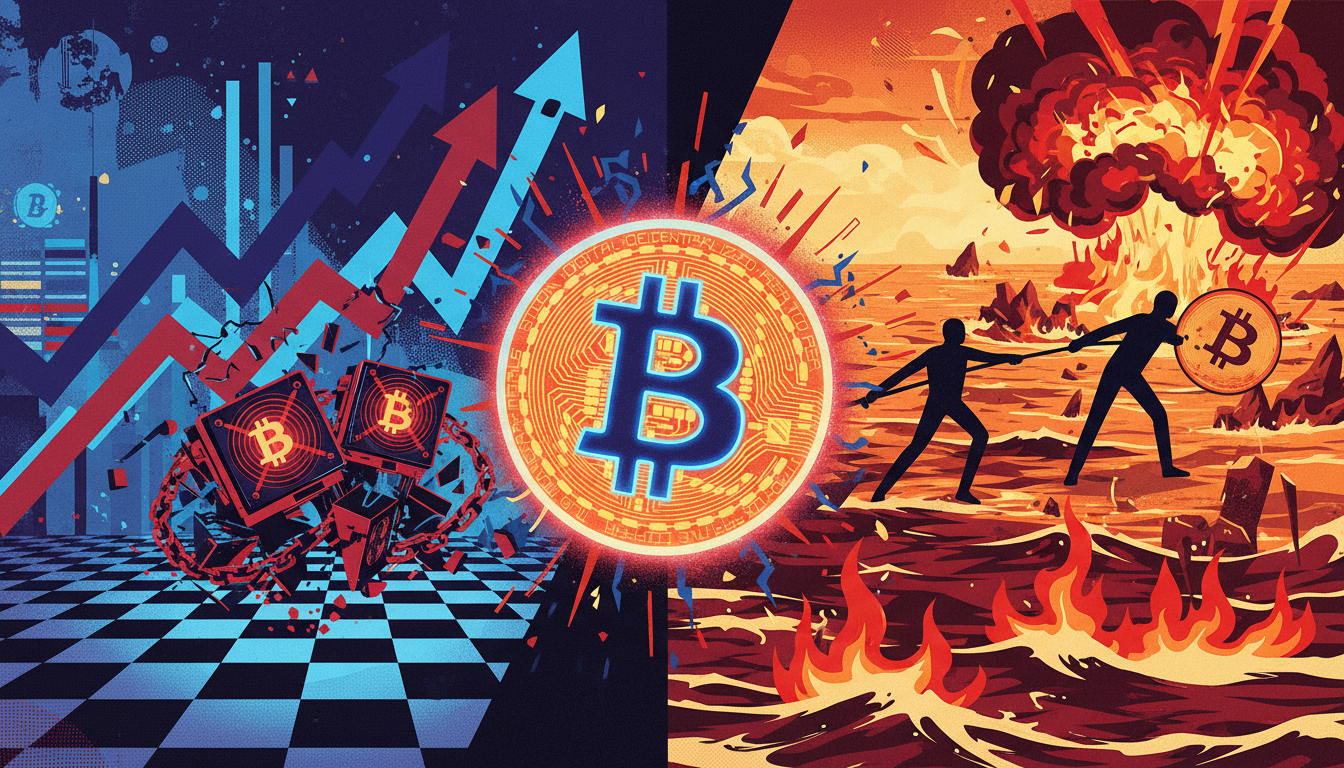
In March, under the East Eight Time Zone, the Federal Reserve maintained the federal funds rate in the range of 3.50%-3.75% during its regular meeting, while the situation in the Middle East became tense again: the confrontation between the Iranian Islamic Revolutionary Guard Corps and the Israel Defense Forces escalated, as the U.S. military responded with missile interception and additional deployments, creating a high-pressure situation in the Persian Gulf and surrounding areas. Within this timeframe, the cryptocurrency market is being pulled by two main lines simultaneously: one is the Bitcoin mining difficulty being significantly reduced by 7.76% to 133.79T (according to a single source, this is the largest decrease since the end of 2025), reflecting hidden changes in hash power and miner behavior; the other is that the Strait of Hormuz, which accounts for 20%-30% of global oil transportation, is being approached by missiles and warships, leading to rapidly rising expectations of oil price shocks. The core contradiction is forming: geopolitical risks are rising, pushing up safe-haven and inflation expectations; yet the cryptocurrency market remains constrained by high interest rates, tightening liquidity, and regulatory shadows. The main judgment of this article is that under the entanglement of war in the Middle East and macro high interest rates, crypto assets will be in a state of short-term risk aversion-driven momentum, but still suppressed by macro hard constraints in the medium to long term.
Missiles and warships approach the energy artery
From a timeline perspective, this round of tension continues the trajectory of the long-standing standoff between Iran and Israel. The Iranian Islamic Revolutionary Guard Corps showcases regional influence through missiles and drones, while the Israel Defense Forces respond with airstrikes and air defense interception; the U.S. has strengthened its presence in the Persian Gulf and surrounding waters and proposed to deploy three additional warships and approximately 2,500 Marines. It is important to emphasize that the scale and pace of this reinforcement have low confidence in public information, suitable only as a background reference, and should not be used to infer specific tactics or timelines as hard intelligence.
In this chain of conflict, the Strait of Hormuz is the most sensitive node. This narrow waterway connecting the Persian Gulf and the Gulf of Oman carries 20%-30% of the world's seaborne oil and a large amount of liquefied natural gas. Any risk of blockade, rerouting of vessels, or soaring insurance costs under military tension would be viewed by the market as a systemic threat to global energy supply. Even if attack actions do not directly target tankers or ports, the expectation of "once an incident occurs, it could affect energy corridors" is enough to push up risk premiums.
The transmission pathway of the energy corridor under threat is very direct: first, there is an increase in risk premiums for oil prices and shipping costs, followed by upward adjustments in cost expectations for refineries and end-user enterprises, and ultimately transmitted through inflation expectations, compressed corporate profits, and changes in consumer capacity to the pricing of global risk assets. The stock market, credit bonds, and foreign exchange markets would quickly reassess the risk exposures of high-energy-consuming industries and economies highly reliant on imported energy. For cryptocurrency assets, being sensitive to liquidity and risk appetite, once oil prices are pushed up due to tensions in Hormuz, funds will be forced to reallocate among energy stocks, commodities, and crypto assets.
What happens when oil prices rise to $180
The research brief presents a widely discussed scenario: if the geopolitical conflict amplifies the impact on energy corridors and international oil prices surge to $180 per barrel under extreme pressure, in this assumption, the corresponding price for Bitcoin in a scenario analysis model is approximately $51,000. This is not a prediction of oil prices or cryptocurrency prices but rather a "range that cryptocurrency assets may correspond to if oil prices reach this point based on historical correlations and funding behavior assumptions", used to help investors understand how macro shocks transmit to the crypto market.
If oil prices soar from the existing range to $180 per barrel, the primary transmission is the renewed rise in inflation expectations, leading the market to question prior optimism regarding inflation peaking and a return to monetary easing; at the same time, high energy costs compress corporate profits, putting pressure on stock market valuations. The secondary transmission lies in the rearrangement of risk aversion and risk preferences: on one hand, traditional safe-haven assets like gold benefit in a "high inflation + high uncertainty" environment; on the other hand, the stock market and high-risk assets known for growth and high beta are seeing fund allocations reduced.
With Hormuz accounting for 20%-30% of global oil transport, the market tends to not wait for actual blockades or attacks on tankers to act, but instead prices in advance based on news of military actions, force deployments, and diplomatic signals. In terms of asset selection, energy stocks, gold, and cryptocurrency assets become the most direct triangle:
● For traditional funds, energy stocks are seen as beneficiaries of rising oil prices, while gold is the standard tool for hedging geopolitical and monetary risks;
● For some crypto investors, Bitcoin is regarded as an asset akin to "digital gold," which, when traditional safe havens are congested, may serve as a complementary hedge and speculative target to be increased.
It must be emphasized repeatedly that $180 and $51,000 are merely points in scenario analysis, not definitive predictions. The research brief clearly prohibits the fabrication of new predictive models or numbers on this basis, and any attempt to "fit" oil prices and cryptocurrency prices with more complex functional relationships constitutes a subjective construction detached from factual foundations, posing significant risks.
Significant drop in mining difficulty and migration of hash power
Almost simultaneously with the geopolitical conflict, significant changes occurred in the Bitcoin network during the recent adjustment: the mining difficulty decreased by 7.76% to 133.79T, which according to the brief, is the largest single decrease since the end of 2025. It is important to note that this data currently relies on a single source; although its credibility is relatively high, it still requires room for adjustment when conducting more refined quantitative deductions. Nevertheless, the directional signal is already quite evident—the overall network's effective hash power has undergone a significant change.
In the Bitcoin mechanism, a significant reduction in difficulty usually corresponds to two scenarios: first, some miners shut down or exit, possibly due to rising electricity prices or profit compression from price corrections, or interruptions due to geopolitical issues; second, migration or redistribution of hash power, with some regions seeing hash power offline or migrating away, and there not being enough new machines to take their place in other regions. Currently, the Middle East is viewed as a potential cluster for hash power, primarily supported by relatively cheap energy and the open attitude of some countries towards data centers and energy development.
As the Middle East moves into a high-pressure state, these hash power clusters face risks that go beyond just electricity prices and regulation, but tangible "physical security" and infrastructure continuity. Should conflicts spill over to oil and gas facilities, power networks, or critical ports, even without direct targeting of mining sites, secondary impacts like fluctuations in electricity supply, changes in fuel costs, and logistics disruptions could force local miners to shut down en masse or accelerate migration. The 7.76% reduction in difficulty provides a window for the market to observe—whether hash power is quietly withdrawing from high-risk areas towards more stable jurisdictions and energy structures.
From the price perspective, miner behavior is included in the pricing framework on three levels: first, the halving cycle has compressed miner income, and the difficulty reduction relieves some pressure in the short term, but also reflects the fragility of operational hash power; second, the relationship between coin prices and miner selling pressure will be reassessed amid fluctuations in hash power—shutdowns and migrations may reduce short-term sell-offs, but if hash power concentrates in fewer regions long-term, it could raise security concerns; third, the geographical distribution of hash power itself is viewed as a crucial dimension of Bitcoin's decentralized security, and changes in hash power in high-risk areas like the Middle East directly impact market assessments of the network's risk resilience, thereby affecting valuation discounts or premiums.
Clashes in narratives of safe-haven amid high-interest shadows
All these geopolitical and on-chain signals ultimately return to a larger constraint framework: the high-interest rate era. In March, under the East Eight Time Zone, the Federal Reserve's meeting decided to keep the target federal funds rate range at 3.50%-3.75%, sending a clear signal to the market—that even with some decline in inflation, the monetary environment is still a considerable distance from "re-easing." HSBC further pointed out that the Federal Reserve may maintain interest rates unchanged in 2026-2027, and if this view becomes mainstream, it will exert continuous pressure on global liquidity and risk appetite.
Under this interest rate anchoring, the short-term safe-haven buying driven by geopolitical conflict collides with the structural tendency for funds to prefer cash and government bonds in a high-interest environment. On one hand, the escalation of tensions in the Middle East, threats to Hormuz, and scenarios of rising oil prices all push the market's demand for inflation and safe-havens higher; on the other hand, when cash and short-term bonds can provide stable returns close to 3.50%-3.75% in risk-free yield levels, institutional funds' appetite for allocations to highly volatile assets like crypto will be significantly weakened.
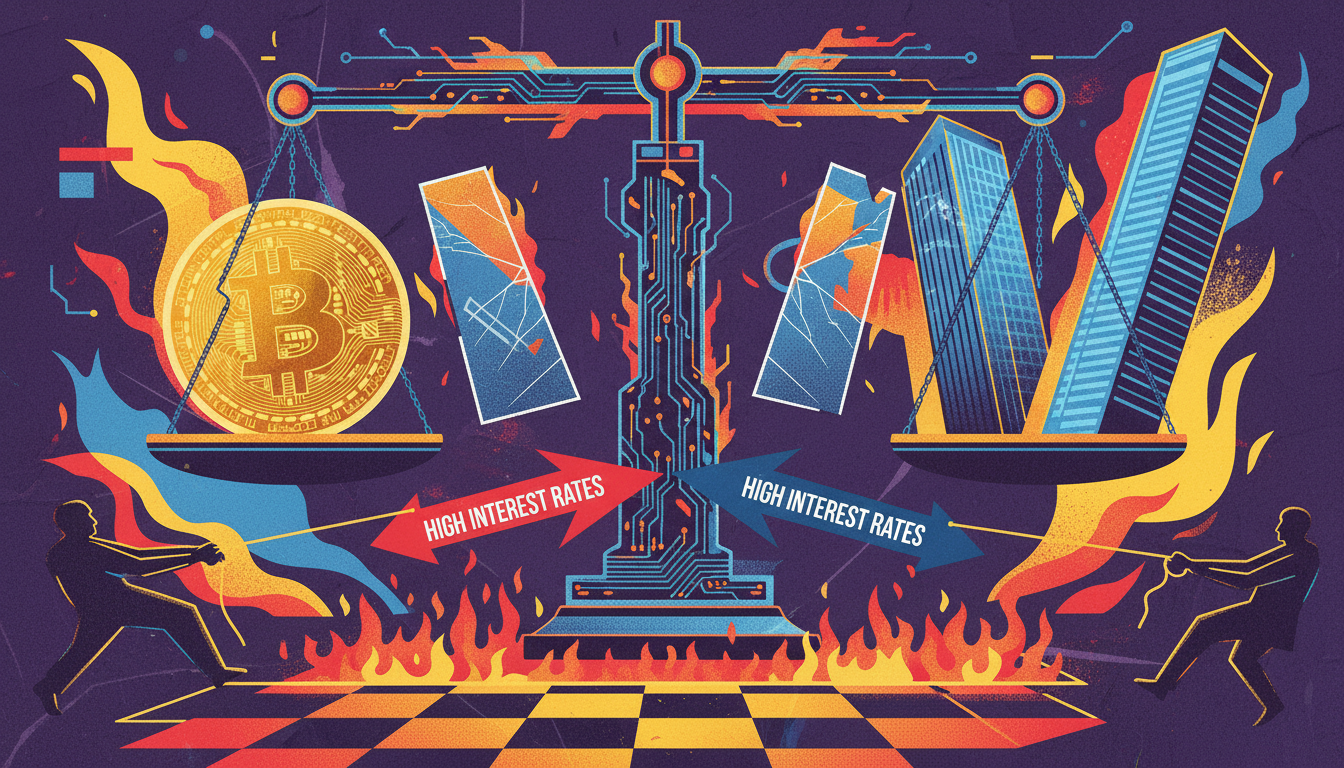
Investor behavior among gold, crude oil, and cryptocurrency assets presents a seesaw pattern:
● Gold continues to attract traditional safe-haven interest under the "high uncertainty + doubts about monetary credit" combination, with hedge funds and central banks inclined to increase their holdings;
● Crude oil and energy stocks are both sources of inflation and direct carriers of geopolitical premiums; the closer the conflict approaches the supply side, the more aggressive the bullish and hedging operations in this sector become;
● Cryptocurrency assets find themselves caught between two opposing forces: on one side is the "digital gold" narrative and distrust of sovereign currencies, while on the other side is high interest rates and regulatory pressures imposing strict limits on allocations by compliant institutions.
Therefore, even during the window period when conflicts in the Middle East amplify safe-haven sentiment, it is not surprising for Bitcoin and mainstream crypto assets to experience a short-term rise, but this rise is more like a local maneuver under the ceiling of high interest rates rather than the beginning of a new liquidity-driven bull market.
War won't cease, and markets won't halt
Another cruel reality of the situation in the Middle East is — the timetable is highly uncertain. Israeli Defense Minister Katz publicly stated that actions will not stop until wartime objectives are achieved, meaning any expectation of "short-term ceasefire" lacks a solid anchoring point. For the market, this long-term tug-of-war conflict equates to a permanent tail risk label on oil and gas supply, shipping routes, and regional infrastructure.
In this context, local oil and gas facilities, power networks, and potential hash power clusters will need to be re-incorporated into risk models: even if attacks do not directly target these assets, as long as there is the possibility of collateral damage or spillover, insurance costs, financing costs, and capital expenditure decisions will trend conservative. For mining sites and data centers operating in the Middle East, risks extend beyond the safety of the machines to include the continuity of cross-border capital flows, equipment imports, and operational teams.
For traders, the narrative constantly switches between geopolitical news and macro data, which is the core mechanism amplifying the current volatility. A single headline involving missiles or drones could ignite surges in oil prices and gold within hours; subsequently, a rate decision or inflation data might shift focus back to the Federal Reserve's path and economic resilience; the rolling amplification of fragmented information on social media further accelerates the rhythms of emotional ups and downs. Prices thus exhibit high-frequency jumps and overshooting characteristics rather than a smooth single-direction trend.
In an environment where combat details are missing and assessments of battlefield outcomes are highly uncertain, the market is also more inclined to amplify emotion and rumor risks. The research brief has clearly stated that there is currently a lack of critical data such as the specific frequency of Iranian missile attacks, the exact timing of U.S. reinforcements, and evaluations of Israeli airstrike outcomes; any trading decision based on alleged "exclusive battle reports" is essentially leveraging on opaque and unverifiable intelligence. Once news reverses or is disproven, the risk of rapid price retracements and chain liquidations will instantly magnify.
Placing bets in the cracks of geopolitics and liquidity
In summary, we can see three main lines shaping the current market: First, the risks in the Strait of Hormuz and Middle Eastern energy corridors, influencing global asset pricing through oil prices and inflation expectations; second, the 7.76% significant reduction in mining difficulty and potential migration of hash power, prompting the market to reassess the economic viability and geographic distribution safety of the Bitcoin network; third, interest rates maintained in the high range of 3.50%-3.75% amid intertwined safe-haven demand, resulting in short-term risk aversion buy-ins driven by geopolitical conflicts while forming long-term pressure on overall liquidity and risk appetite.
In this structurally constraining environment, cryptocurrency assets may indeed benefit from safe-haven narratives in the short to medium term: as the pressures of oil prices, uncertainties from war, and doubts about fiat currency credit accumulate, Bitcoin's appeal as a "systemic external asset" will periodically increase. However, from a longer cycle perspective, high funding costs, intensified regulatory scrutiny, and constraints on institutional allocation remain hard constraints that dictate this wave of risk aversion is more akin to structural volatility than a reversal of underlying logic.
For investors attempting to find their position in this game, it might be more important to continuously track three key indicators rather than fixate on the price at a single moment:
● The situation in Hormuz—monitor actual shipping conditions, insurance rates, and the oil price curve, rather than scattershot details of skirmishes;
● Mining difficulty and hash power distribution—observe whether hash power is changing regions under the drives of geopolitical risks and energy costs, in conjunction with the 7.76% reduction in difficulty;
● The Federal Reserve's path and interest rate expectations—using the 3.50%-3.75% range as an anchor, understand how "longer high-interest rates" suppress the valuation ceilings of risk assets.
In an environment of high information asymmetry and rapid developments in conflict, the most dangerous positions are often not the risk exposures themselves, but the impulses to leverage bets based on unverified military details. Whether a single battle report, so-called "exclusive intelligence," or unvalidated price correlation models, none should serve as reasons for amplifying leverage. Cautiously observing in the cracks of geopolitics and liquidity, rather than hurriedly placing bets, may be the most realistic demand on participants at this stage.
Join our community, let's discuss and become stronger together!
Official Telegram group: https://t.me/aicoincn
AiCoin Chinese Twitter: https://x.com/AiCoinzh
OKX benefits group: https://aicoin.com/link/chat?cid=l61eM4owQ
Binance benefits group: https://aicoin.com/link/chat?cid=ynr7d1P6Z
免责声明:本文章仅代表作者个人观点,不代表本平台的立场和观点。本文章仅供信息分享,不构成对任何人的任何投资建议。用户与作者之间的任何争议,与本平台无关。如网页中刊载的文章或图片涉及侵权,请提供相关的权利证明和身份证明发送邮件到support@aicoin.com,本平台相关工作人员将会进行核查。