From March 20 to 21, 2023, Eastern Eight Time, the confrontation between the US, Iran, and Israel in the Middle East accelerated sharply: The US military announced the deployment of three warships and approximately 2,500 Marines to the region, while Iran, under the backdrop of a month-long conflict, conducted the 71st wave of strikes under “Real Commitment 4”, targeting Israel and US military bases. Meanwhile, the management of transit through the Strait of Hormuz has been noticeably "tightened" — the Iranian Navy is not simply blocking, but instead is guiding an Indian oil tanker through Hormuz, showcasing a form of asymmetric energy corridor management to the outside world: it is no longer merely about gunfire obstruction, but about reshaping the navigational order through differentiated arrangements of "who is allowed passage, and who is obstructed."
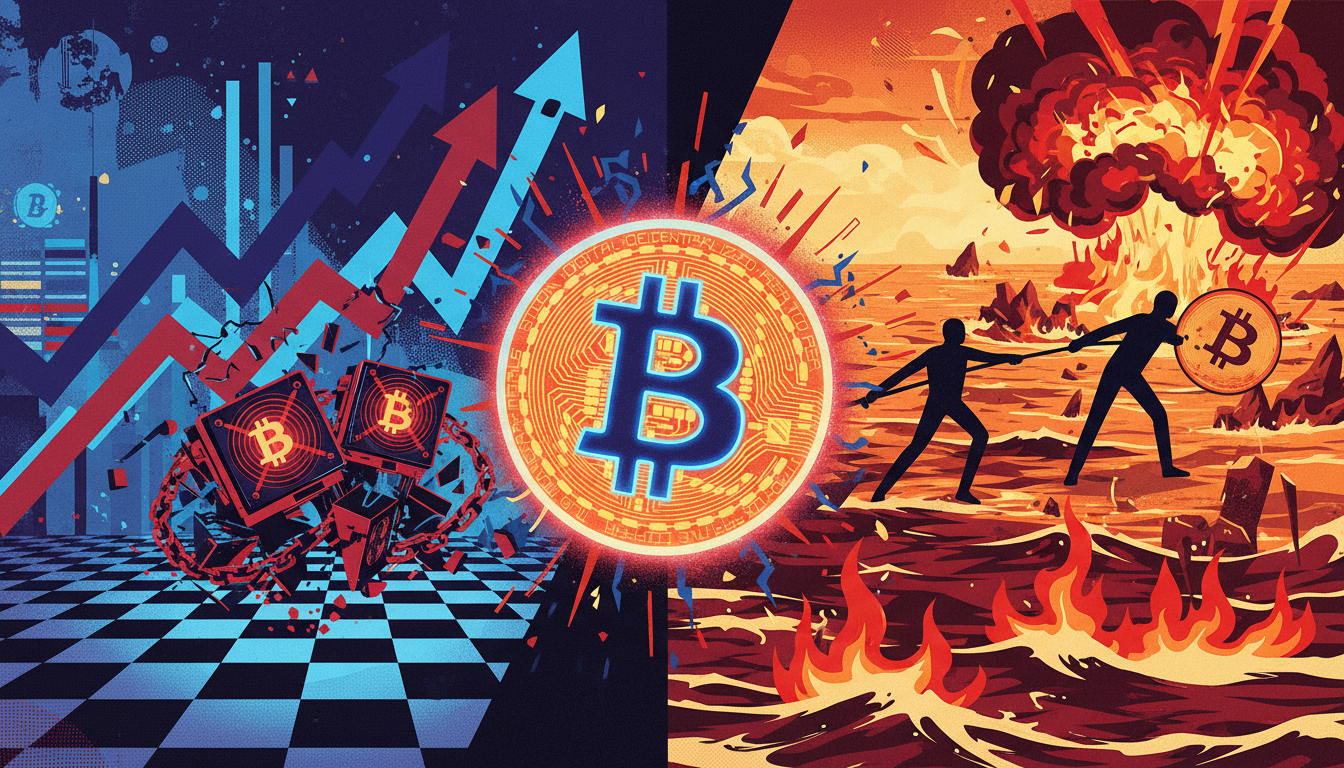
In this context, a key question arises: As local geopolitical conflicts deepen and energy inflation expectations are reignited, why is global capital not flowing solely into traditional safe-haven assets but is partially moving into cryptocurrencies like Bitcoin as a supplementary risk hedge? The risk premium from Hormuz is spreading along with oil prices, freight rates, and insurance costs, gradually penetrating broader financial asset allocations, while Bitcoin and some public chain assets are passively drawn into this redistribution of the "safe-haven narrative."
The Hormuz corridor is being monitored, and energy risks begin to spill into finance
As of late March, the Iran War has been ongoing for about four weeks. The Strait of Hormuz is already regarded as the "throat" of the global energy system: a large volume of crude oil and liquefied natural gas (LNG) transportation must traverse this narrow waterway, and any military friction or transit restrictions often results in market pricing magnifying the sensitivity by several times. Because of this, every naval maneuver, missile launch, and tanker incident rapidly amplifies into a shadow of "systemic risk" in the futures, spot, and freight markets.
In this round of escalation, Iran presses on Israel and US military bases through the 71st wave of strikes under "Real Commitment 4," continuing the path of direct military attack; on the other hand, it signals an upgrade from hard conflict to "differentiated passage management" by guiding Indian tankers through Hormuz. The key of this model lies not in blocking all flows, but rather in determining: on the global energy corridor, who can be prioritized for protection and who will be placed on an invisible "strangulation" list.
For countries like India, which heavily rely on energy imports from the Middle East, the background of this "guided navigation" carries significant political meaning: it indicates that they are not a primary target in the current game, and it reminds them to balance more finely between major powers in future diplomatic and energy procurement strategies. For other major importing countries and energy giants, the market will reassess its supply security accordingly — distance, alternative shipping routes, additional reserves, and hedging costs are all re-entering models. The risk premium from Hormuz is then gradually spilling from futures prices, freight, and insurance rates into broader financial asset allocations, becoming an invisible variable driving the reconfiguration of capital weights between stocks, bonds, commodities, and even cryptocurrency.
Military confrontation between the US, Iran, and Israel escalates, with traditional safe haven roles redistributed between the dollar and Bitcoin
From March 20 to 21, the US military announced the increase of three warships and approximately 2,500 Marines to the Middle East to strengthen military support for Israel and key shipping lanes; Iran, meanwhile, continues its 71st wave of airstrikes against Israeli targets and US military bases under the framework of "Real Commitment 4." The military escalation between the two sides significantly raises the risk of misjudgment and local escalation, but the publicly available information remains in a state of "action exists, details unclear," forcing the market to attempt pricing amidst limited facts and high uncertainty.
Unlike previous geopolitical crises where gold stood out as a safe-haven asset, a recurring market sentiment in the current Middle East tension is that: “The dollar siphoning effect is partially replacing the safe-haven function of traditional precious metals.” During the early stages of rising risks, capital often flows back into US Treasury bonds, short-term bond funds, and money market instruments rather than uniformly chasing gold. This path of "first returning to dollar assets, then discussing other hedges" reflects the overwhelming advantages of the dollar system in global liquidity and credit.
Historically, in several Middle East crises related to oil price shocks, the correlation between US Treasury yields, the dollar index, and gold prices has often been quite tight: the triangle relationship of a strong dollar, soaring oil prices, and benefiting gold is relatively clear. However, in the current environment, due to substantial internal discrepancies in inflation and interest rate expectations in the US, the feedback rhythm of Treasury yields and the dollar index to shocks becomes more complex, and gold no longer enjoys a "non-replaceable" single-narrative safe haven space. This, in turn, objectively leaves room for emerging assets like Bitcoin: when traditional safe haven tools engage in competition, digital assets can serve as a "supplementary hedging layer," attracting some funds into the defense structure.
However, it must be noted that the current phase is still a process where military and financial games intertwine. Every deviation in missile landing points and misjudgment of fleet movements might trigger sharp repricing of oil prices and related asset prices within a short time. The safe-haven narrative of Bitcoin therefore resembles a layer of "tail risk insurance" above traditional financial buffer zones, rather than serving as a central anchor replacing gold or US Treasury bonds.
ETF continues to see slight inflows, Bitcoin's safe-haven role is still auditioning
In the same week that geopolitical tensions escalated, the US Bitcoin spot ETF recorded a net inflow of approximately $93.1 million (single source). This is not a "tsunami-level" influx of capital, but it provides a signal on an important dimension: as the risks from Hormuz continue to amplify and military actions unfold in succession, funds have not collectively withdrawn from Bitcoin-related products, but rather opted for gentle accumulation. This contrasts with the conventional narrative that "geopolitical danger = full return to dollars or gold."
Combining the earlier observations of the “dollar siphoning effect,” some institutions seem to be constructing a “dual defense line of dollar assets + Bitcoin”: the former corresponds to liquidity and systemic risks, while the latter is seen as an "option" to hedge against sovereign and inflation risks in extreme tail scenarios. In other words, Bitcoin is not regarded as the only safe haven anchor, but as an additional layer that may explode in value under specific circumstances. The slight net inflows into ETFs reflect this slow expansion of "option positions."
At the juncture of accumulating Hormuz risks, traditional institutions still prefer to use compliant ETF channels for Bitcoin allocation, instead of large-scale direct on-chain investments or high-leverage derivatives. On one hand, this continues the approach of compliance and risk control — ETF products can be incorporated into existing investment research and compliance processes, facilitating unified management with other asset classes; on the other hand, it also reflects that mainstream funds still view Bitcoin as an "alternative asset that needs stringent encapsulation," rather than a basic position that can be flexibly adjusted daily.
It should be emphasized that the net inflow into ETFs does not present a simple linear relationship with Bitcoin's price performance. A single-week inflow of $93.1 million cannot be inflated to a long-term trend turning point, nor generalized as evidence of "large-scale capital entering for hedging." For investors, mechanically extrapolating high-frequency capital data as medium-to-long-term logic is one of the cognitive traps most easily fallen into amidst rising macro uncertainty.
From tankers to on-chain addresses, funds are probing migration between physical and digital channels
The imagery of Indian tankers being “guided to navigate” in the Strait of Hormuz by the Iranian Navy essentially presents a scenario of “guided liquidity”: physical oil tankers are assigned new paths and priorities within the coordinate system of geopolitical games. On the same timeline, on-chain funds are being guided in another set of coordinates, traversing different public chains and asset forms, tentatively constructing a “de-geopoliticized” capital flow corridor.
One side signal is that, the number of small addresses on the XRP Ledger has reached approximately 5.66 million (single source). This increase in data, coinciding with a rise in macro uncertainty, is easily associated with broader retail participation and increased expectations for cross-border payments and small settlements. An increase in small addresses does not necessarily equate to a leap in actual payment scales, but narratively, it provides an observable metric for “more individuals reserving a digital channel for cross-border value transfer.”
Meanwhile, the call from Robinhood CEO urging to “allow the issuance of stablecoin earnings” has sparked discussions at the US retail end. For the platform, this is about striving for a new type of revenue product; for users, it represents a quest to transfer part of their "dollar earnings" onto the blockchain; for regulators, it poses a significant challenge to existing financial boundaries and product classifications. The core of the three-way game revolves around whether dollar credit and yield can be more widely embedded into the chain asset system.
As physical energy channels become increasingly sensitive due to repeated geopolitical pressures, whether cross-border capital will be more inclined to seek “de-geopoliticized” digital channels is still in an early verification stage. From the guidance of tankers to the increase of on-chain addresses, the two cannot yet be said to have a direct causal relationship, but they form differing reflections of the same era's proposition: in a physical world where channels are more vulnerable and subject to high-frequency games, can the digital world’s value channels bear more expectations regarding security and accessibility?
The competition between energy inflation and crypto returns, who can better retain risk-averse capital
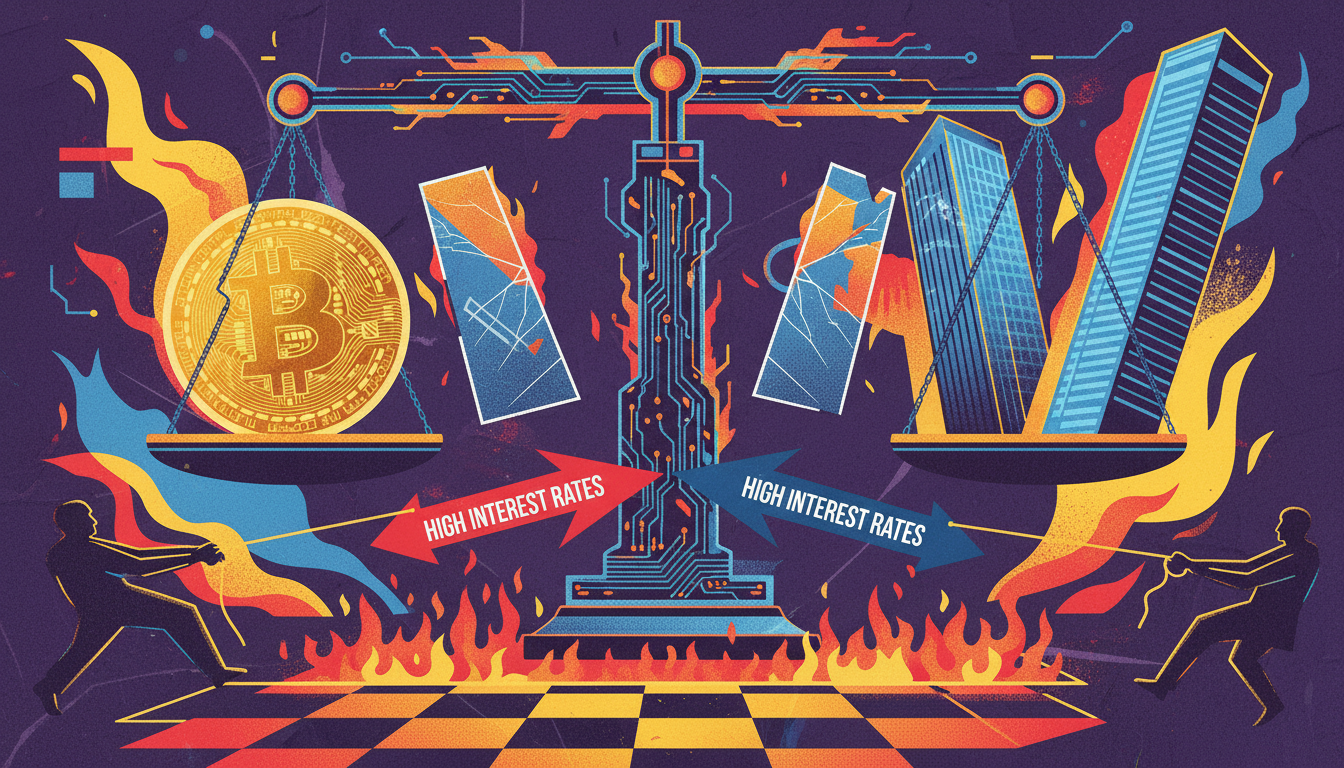
As the risk premium from Hormuz continues to accumulate, if oil prices and freight remain high for an extended timeframe, the actual yield from traditional financial products will be invisibly compressed. For funds pursuing stable yields, nominal interest rates are continually being "eaten" by inflation and various costs, inevitably driving them to seek higher returns or more flexible yield carriers. This pressure applies to both bond and money market instruments, as well as banks' wealth management, insurance, and pensions as long-term capital allocations.
In this context, Robinhood's desire to offer users returns linked to on-chain assets (such as stablecoin earnings) is not just a single platform's business decision, but rather a systemic game among the platform, users, and regulators around whether "dollar earnings can be widely put on-chain." The platform aims to gain profit and user stickiness through new products, users wish to lock in more attractive yields amid high inflation and uncertainty, while regulators need to weigh systemic risks, prevent securitization circumvention, and maintain the stability of monetary policy transmission.
Before the US regulatory framework has fully provided clear boundaries, various crypto earnings products, and interest arrangements linked to dollar assets can only probe repeatedly at the "compliance edge": on one hand, they need to meet hedging and yield demands; on the other hand, they must endeavor to avoid being directly classified as unregistered securities or part of the shadow banking system. The uncertainty brought by this gray area makes any long-term interest commitments around crypto earnings naturally carry high risk premiums.
Moreover, coupled with the overlay of geopolitical risks and policy uncertainty, investors, when facing the "high-yield" narrative, need to actively dismantle the true sources and risk structures behind it. The situation in Hormuz may help explain why some funds are willing to spend extra costs for hedging, but that does not mean all on-chain products labeled with "yield + hedge" can fulfill commitments in extreme scenarios. Recognizing the gap between the narrative and tangible cash flows becomes one of the key abilities to protect principal in this cycle.
Conflicts won't end immediately, Bitcoin can only play the role of "contingent hedge" on the margins
In summary, one clear main thread emerges: The Strait of Hormuz is being impacted by gunfire strikes and "differentiated passage management", affecting the energy risk premium that spills into the broader asset markets. From crude and LNG futures to freight and insurance, and then to stocks, bonds, and digital assets, the pricing of global assets is being rewritten by the uncertainties of this "throat corridor." Bitcoin and some public chain assets are not actively involved but are passively included in the new round of safe-haven narrative options.
The week’s net inflow of approximately $93.1 million into the US Bitcoin spot ETF, combined with the growth of approximately 5.66 million small addresses on the XRP Ledger, shows the two ends of funds examining tentative allocations: one end is adding a layer of "hedge option" for Bitcoin through compliant ETFs, while the other end involves more small participants reserving potential cross-border value channels on-chain. However, in terms of truly becoming a “mainstream safe-haven asset,” Bitcoin and the entire crypto market still have a considerable distance to cover — whether liquidity depth, volatility levels, or regulatory and accounting treatment standards, they do not yet possess a foundation to be directly compared to gold or US Treasury bonds.
Looking ahead, at least three main lines are worth continuous tracking: first, the actual transit conditions in the Strait of Hormuz and oil price movements will directly determine the height and duration of energy inflation expectations; second, the progress of US-Iran-Israel conflicts on military and diplomatic levels will influence the market's subjective probability assessments of miscalculation risks and further escalation; third, the policy orientation of the US towards crypto earnings products and the overall compliance framework will dictate whether Bitcoin and on-chain earnings products can secure a more stable position within mainstream capital portfolios.
In a context of highly fragmented information and easily magnified emotions, maintaining sensitivity to data sources and unverified information is particularly important. Whether it’s institutions making aggressive price predictions or rumors of the situation on social media, they should not be treated as established facts directly embedded in trading decisions. Before the complex chains of Hormuz, energy, and crypto assets become clearer, controlling leverage and retaining sufficient liquidity may be more valuable than pursuing any single narrative.
Join our community to discuss together and grow stronger!
Official Telegram community: https://t.me/aicoincn
AiCoin Chinese Twitter: https://x.com/AiCoinzh
OKX Welfare Group: https://aicoin.com/link/chat?cid=l61eM4owQ
Binance Welfare Group: https://aicoin.com/link/chat?cid=ynr7d1P6Z
免责声明:本文章仅代表作者个人观点,不代表本平台的立场和观点。本文章仅供信息分享,不构成对任何人的任何投资建议。用户与作者之间的任何争议,与本平台无关。如网页中刊载的文章或图片涉及侵权,请提供相关的权利证明和身份证明发送邮件到support@aicoin.com,本平台相关工作人员将会进行核查。