TL;DR
Upgrade Background: The competition among public chains has shifted to "real financial capacity competition," demanding faster, more stable, cheaper, and more predictable solutions.
Ethereum Mainline: Through the Glamsterdam and Hegotá upgrades, Ethereum aims to reshape L1's capability boundaries, transitioning from being "the safest settlement layer" to a "higher performance financial foundation."
Solana Mainline: Through the Alpenglow and Firedancer upgrades, Solana is addressing its shortcomings, helping it transition from "the fastest transaction chain" to "a more reliable global settlement candidate layer."
Route Comparison: Ethereum proves that "the most stable system can also be sufficiently fast," while Solana demonstrates that "the fastest system can also be sufficiently stable."
Conclusion and Outlook: 2026 is not the endgame, but an open qualification round where success depends on the ultimate direction of stablecoins, RWA, and on-chain capital.
The current competition among public chains is no longer about "whose story is bigger or whose community is more vibrant," but "who can maintain stability in the face of real financial traffic." As institutional funds begin to regard on-chain as a new settlement track, and as stablecoins, RWA, and high-frequency trading applications truly require 24/7 operation, the market's demands on the underlying infrastructure have distilled into a few simple keywords: faster, more stable, cheaper, and more predictable. This is also why 2026 will be a key year for the face-off between Ethereum and Solana—the former needs to prove that it can handle high-frequency, large-scale financial activities, not just be "the safest asset layer," while the latter needs to demonstrate that it can support global-level financial flow, not just be a high-performance testing ground or “meme hotspot.”
1. Upgrade Background of the Two Major Public Chains in 2026
1. Ethereum Upgrade Background: Transition from "the Safest Settlement Layer" to "High-Performance Financial Foundation"
In 2025, Ethereum completed two mainnet upgrades: Pectra launched in May and Fusaka went live in December. The official clearly defined 2025 as the year with the most output in terms of protocol layer. More importantly, these upgrades were not just about stacking functions but gradually formed a clearer rhythm in the upgrade process: more frequent forks, smaller iterative deliveries, and continuous advancement around scalability, account abstraction, and data availability. In other words, Ethereum is no longer content to "outsource complex demands to L2" but is attempting to enhance L1's capacity to handle pressure. In 2026, the Glamsterdam in the first half of the year and the subsequent Hegotá will be like two successive "system-level surgeries": the former focuses on L1's expansion capability and block production mechanism optimization, while the latter continues to push for more radical underlying transformations.
The goal of Glamsterdam is to separate the pressures of "block packing" and "block execution," allowing validators to outsource block construction more securely and pave the way for parallel execution and higher gas limits. By the time of Hegotá, the keywords discussed within the developer community have further extended to shorter slots, censorship resistance, native account abstraction, and post-quantum security, touching on deeper topics. This can be simply understood as Ethereum is upgrading from a "robust but slightly clumsy" global settlement host to a still conservative but significantly more powerful financial operating system. It resembles a heavy-duty truck, previously prioritizing not to tip over; by 2026, it aims to prove that it can not only avoid tipping but also run faster even when fully loaded.
2. Solana Upgrade Background: Transition from "the Fastest Transaction Chain" to "Global Financial Settlement Layer"
On the other hand, Solana's story is entirely different. In 2024, it regained market attention thanks to the memecoin frenzy and the explosive growth of pump.fun; entering 2025, after experiencing a drop in ecological heat, on-chain activity and prices underwent considerable fluctuations. However, the truly noteworthy change was not in price but in the infrastructure layer: Solana achieved its first full year of uninterrupted operation, maintaining a stable slot time of about 400 milliseconds during the Agave 3.0 advancement; by the end of 2025, Firedancer had covered about 22% of the total staking, significantly reducing single-client risk. This change is significant—because the most frequent criticism of Solana in the past was not that it lacked speed, but "though fast, it easily encounters problems when congested." The performance in 2025 made the market start to seriously consider: it might indeed have an opportunity to transition from a high-performance public chain to a high-reliability financial infrastructure.
The upgrade of Solana in 2025 was essentially a stress test before the major overhaul in 2026. Anza officially proposed Alpenglow in 2025, even calling it "the biggest change in Solana core protocol history"; this new consensus design aims for lower latency, stronger security, and higher efficiency. One of Alpenglow's goals is to push the network's median finality below 150 milliseconds. Meanwhile, Firedancer is more than just a "second client"; it represents Solana's ambition to escape dependency on a single implementation while enhancing both network performance and client diversity. Coupled with continuous optimization of Agave, the adjustment of computational units, improvements in the network layer, and the fine-tuning of market microstructure, Solana began increasingly defining itself in the second half of 2025 as the infrastructure for the internet financial market, rather than merely a high-throughput platform suitable for issuing, trading, and conducting on-chain experiments.
Therefore, the real highlight of 2026 is not "whether Ethereum will become more like Solana," nor "whether Solana will completely replace Ethereum," but rather that the two routes are rarely converging towards the same direction. Ethereum aims to address performance, execution efficiency, and user experience shortcomings, so it deserves the next phase of on-chain financial scale; Solana, meanwhile, is working to improve its stability, client dispersion, and institutional credibility, trying to convince the market that it is suitable not only for traffic bursts but also for asset retention. Both paths ultimately point to the same question: the future foundation for carrying internet finance, should it resemble a cautiously evolving global computer for settlement, or a real-time financial engine designed for speed that compensates for reliability?
2. Ethereum's 2026 Upgrade Mainline Task: Reshaping L1 Capability Boundaries
In recent years, Ethereum's division of labor logic has been very clear: L1 is responsible for security, settlement, and decentralization; L2 is responsible for scalability, low fees, and high-frequency interaction. However, as on-chain begins to carry more stablecoin settlements, RWA, trade matching, and cross-chain settlement demands, L1 must not only be a settlement hub but must also become a sufficiently fast, smooth, and predictable financial artery. This is why the Ethereum upgrade in 2026 feels no longer just about "fixing the roads for L2," but rather about directly reshaping L1's capability boundaries itself. In the protocol priority update released by the Ethereum Foundation in February 2026, the next main line is succinctly summarized as: parallel execution, higher gas limits, protocol-built PBS, continued expansion of blobs, and advancements in censorship resistance, native account abstraction, and post-quantum security. Glamsterdam is explicitly positioned as the next major network upgrade in the first half of 2026, with Hegotá planned to follow in the second half.
1. Glamsterdam: Making the Main Network No Longer "Slow by Half"
The key to Glamsterdam lies not in speed, but in its attempt to solve two fundamental problems that have long plagued Ethereum L1: firstly, the mainnet's throughput and complex transaction carrying capacity are not strong enough, and secondly, the block production and transaction ordering mechanisms still face significant MEV and centralization pressures.
Higher Gas Limit: Between the two upgrades in 2025, the Ethereum community has gradually raised the mainnet gas limit from 30 million to 60 million, the most significant increase since 2021. The direction of Glamsterdam is to continue pushing upwards from the existing 60 million, potentially becoming a " TPS public chain."
Achieving Parallel Execution: What really adds weight to Glamsterdam is its binding with parallel execution. The goal of parallel execution is to allow non-conflicting transactions to be processed more efficiently simultaneously, extracting higher actual throughput from the same block space. For end-users, this will likely mean: during congestion, it is less likely for fees to suddenly skyrocket, and complex interactions are easier to be packaged smoothly, resulting in less stuttering and waiting in on-chain application experiences.
2.ePBS: Institutionalizing Transaction Ordering
Another truly "structural transformation" of Glamsterdam is enshrined proposer-builder separation, referred to as ePBS or enshrined PBS. This is not a simple efficiency optimization but a fundamental reorganization of the block production process. To put it simply, the previous system was more akin to "one person is responsible for receiving orders, queuing, packaging, and serving it up"; whereas ePBS aims to break this process down into clearer divisions of labor: proposers are responsible for block production capabilities and consensus layer responsibilities, while builders focus on organizing transactions more efficiently and constructing execution loads.
This does not mean that "MEV will be eliminated." The significance of ePBS lies in attempting to transition this matter from being primarily "gray, temporary, off-chain negotiations" to a stage that is "more open, more stable, and protocol-perceptible." This is particularly crucial for institutions and large applications—because what they truly fear is not the existence of arbitrage in the market, but rather the ambiguity in transaction ordering rules, poor execution predictability, and substantial latent risks of centralization under extreme conditions.
3.Hegotá: Making Ethereum Lighter and More User-Friendly
If the keywords for Glamsterdam are "speeding up" and "reorganization," then Hegotá represents Ethereum's "lightweight and usability project" for the second half of the year, with upgrade main directions focusing on: state slimming, censorship resistance, native account abstraction, and long-term node sustainability transformation. Two key terminologies here are: statelessness and account abstraction.
Statelessness: The goal is to validate new blocks without storing large amounts of historical and status data, significantly reducing the operating costs of running nodes, thereby making the entire network easier to remain decentralized—because lighter nodes with lower hardware thresholds are less likely to evolve into a situation where only a few large infrastructure service providers can steadily operate full nodes. Additionally, Verkle is an important technical path for achieving state proof compression and promoting lightweight node implementation, which is seen as a key piece of Ethereum's state slimming puzzle in the long term.
Account Abstraction: The goal is to natively support smart contract wallets without relying on complex intermediary layers. In a more mature account abstraction system, wallets will no longer just act as "safety deposit boxes for mnemonic seeds," but will increasingly resemble true internet financial accounts: they can set more flexible permissions, allow applications to cover gas fees, and support multi-signatures, social recovery, and batch operations. This will determine whether a significant number of ordinary users and institutional users are willing to keep real funds on-chain long-term.
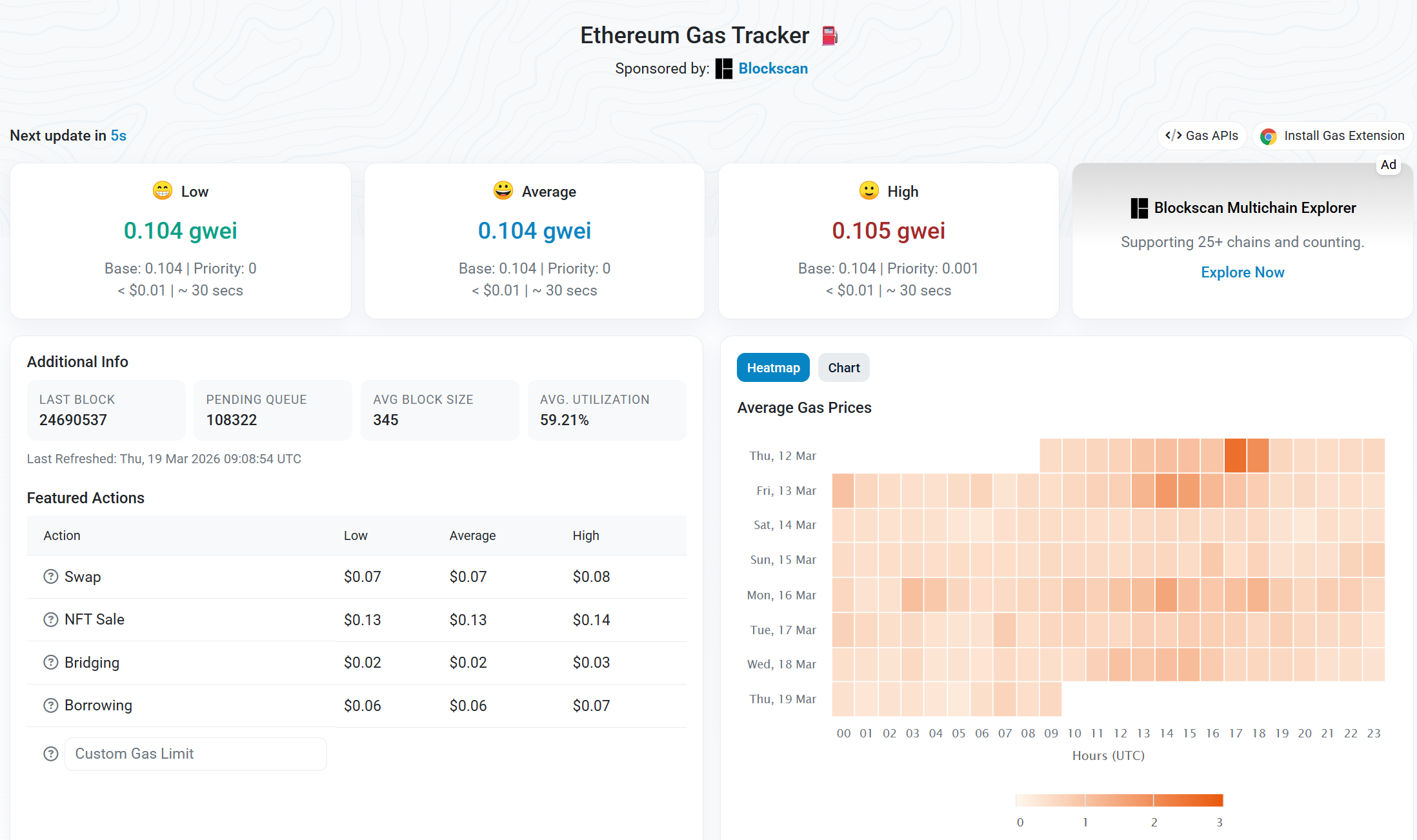
When looking at Glamsterdam and Hegotá together, it becomes clear that Ethereum's mainline in 2026 is not about a single functional point but rather a clear strategic shift: L1 is no longer just "a secure foundation," but is extending towards stronger execution capabilities, lower coordination costs, and better account experiences while maintaining its safety core. Currently, Ethereum's gas prices are at extremely low levels: Etherscan snapshots from March 19 show that low-tier gas prices drop as low as 0.1 gwei, with fluctuations around 0.1–0.3 gwei at multiple points. This indicates that after Dencun, Pectra, Fusaka, and L2 absorb traffic, the Ethereum mainnet is no longer in the past environment of "normalized high fees."
Source: https://etherscan.io/gastracker
However, "cheap" in itself is not the end goal. The truly important thing is that when gas prices have already significantly fallen, the progress of L1's capacity ceiling must continue. This means that Ethereum's competitiveness in the future will not only lie in being "the safest" but will increasingly manifest as: maintaining the foundation of safety and decentralization, while the mainnet itself can also bear more real financial activities instead of forever leaving performance issues to be dealt with by peripheral layers.
3. Solana's 2026 Upgrade Mainline Task: A Gamble from "Fast Chain" to "Global Settlement Layer"
Solana was once seen as a representation of high performance but unreliability due to the 2022 FTX collapse and multiple outages that led it into a trough. However, in 2024, applications like pump.fun brought the thresholds for issuing coins and trading down drastically, driving the on-chain activity of Solana to explode rapidly. Despite SOL prices significantly retracting from historical highs between 2025 and 2026, the performance of Solana's infrastructure has actually been stronger. Solana aims to handle not just memes, bots, and retail high-frequency trading, but is further entering more serious financial scenarios such as payments, settlements, asset issuance, and on-chain capital markets.
1. Alpenglow: Major Overhaul of Consensus Mechanism
Alpenglow is Solana's most core protocol-level upgrade in 2026. Anza officials have stated that it is the biggest change in Solana's core protocol history, aiming to compress the network's finality to a median of approximately 150ms, ideally approaching 100ms. Its significance is mainly reflected in three points:
Rewriting Consensus Logic: Replacing key parts in the existing TowerBFT/PoH combination with a new mechanism to reduce confirmation latency.
Enhancing Reliability: Simplified consensus and clearer verification and propagation paths pave the way for higher throughput.
Building a Real-Time Financial Network: If finality can truly be compressed to 100–150ms, the transaction confirmation experience in Solana will be closer to that of a real-time system on the internet, rather than just a traditional blockchain.
2. Firedancer: Client Diversity Enhancement
If Alpenglow addresses how to achieve faster confirmation at the consensus layer, then Firedancer resolves the reconstruction of client diversity. Solana's officials have clearly stated at Breakpoint 2025 that after Firedancer goes live on the mainnet, Solana will officially bid farewell to the "single-client network" phase and enter a true era of client diversity. This means that even if a specific client encounters a bug in the future, it will not expose the entire network to the same risks. Currently, the Firedancer route has entered the mainnet combat stage, with Frankendancer already handling actual traffic on the mainnet, while full Firedancer is still gradually rolling out. The importance of Firedancer can be summarized in three points:
Reducing Single Client Risks: In the past, the Solana network heavily relied on the Agave system client, which concentrated software implementation, making it prone to systemic vulnerabilities. The arrival of Firedancer essentially adds "a second engine" to Solana.
Enhancing Network Resilience: With multiple clients coexisting, one type of bug will no longer necessarily spread to become a network-wide failure, which is crucial for high-frequency financial chains.
Increasing Institutional Credibility: For scenes involving payments, stablecoins, RWA, matching, and settlements, what truly matters is not peak TPS in the laboratory, but rather that "the system does not malfunction due to failures in the same software stack." Firedancer brings Solana closer to a foundational infrastructure that can be trusted by serious financial flows.
In summary, Alpenglow determines how fast Solana can be, whereas Firedancer determines whether Solana can survive long-term with that speed. Only if both hold true can Solana qualify to upgrade from "the most capable fast chain" to "a candidate for the global financial settlement layer."
4. Ethereum vs. Solana Route Comparison Analysis
Ethereum and Solana represent two completely different underlying philosophies: the former attempts to separate governance of security, scalability, and user experience through modular stratification; the latter hopes to complete execution, transaction, and settlement as much as possible within the same layer using single-chain high performance. They are not merely different solutions to the same problem but rather are addressing two distinct questions: should internet finance resemble a global settlement network, or a real-time financial operation system?
1. Route Divergence: Modular Financial Network vs. Monolithic Real-Time System
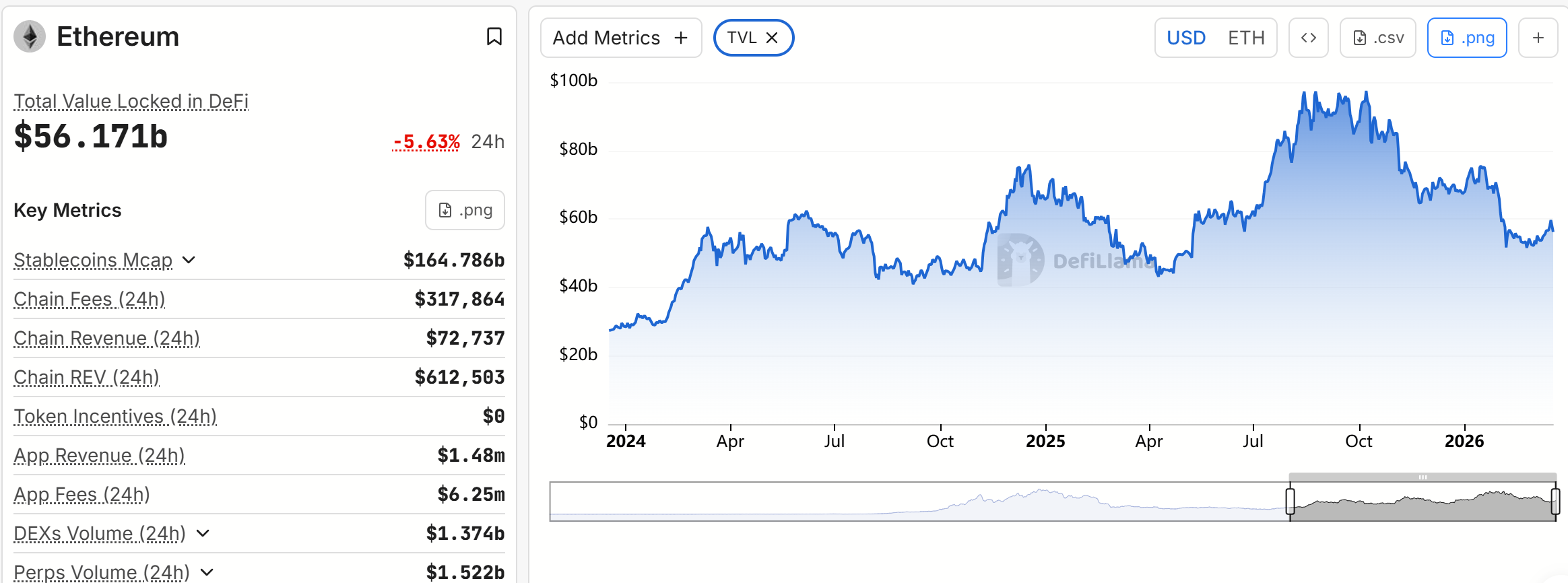
Ethereum's logic has always leaned toward the "institutional school." It believes that the most important aspect of the underlying layer is not extreme speed, but credibility, stability, verifiability, and composability. Thus, it defines L1 as the global settlement layer and security anchor, transferring most high-frequency activities to L2. According to data from DefiLlama, as of March 19, 2026, Ethereum's main chain DeFi TVL is approximately $56.17 billion, and stablecoin scale is around $164.78 billion; meanwhile, according to L2BEAT, the total value guaranteed by Ethereum's second layer is approximately $32.53 billion, with Arbitrum One accounting for approximately $16.32 billion, and Base for approximately $11.03 billion. This indicates that Ethereum is no longer simply in a single-chain competition but is a multi-layer financial network centered on the mainnet with L2 as its extension.
Source: https://defillama.com/chains
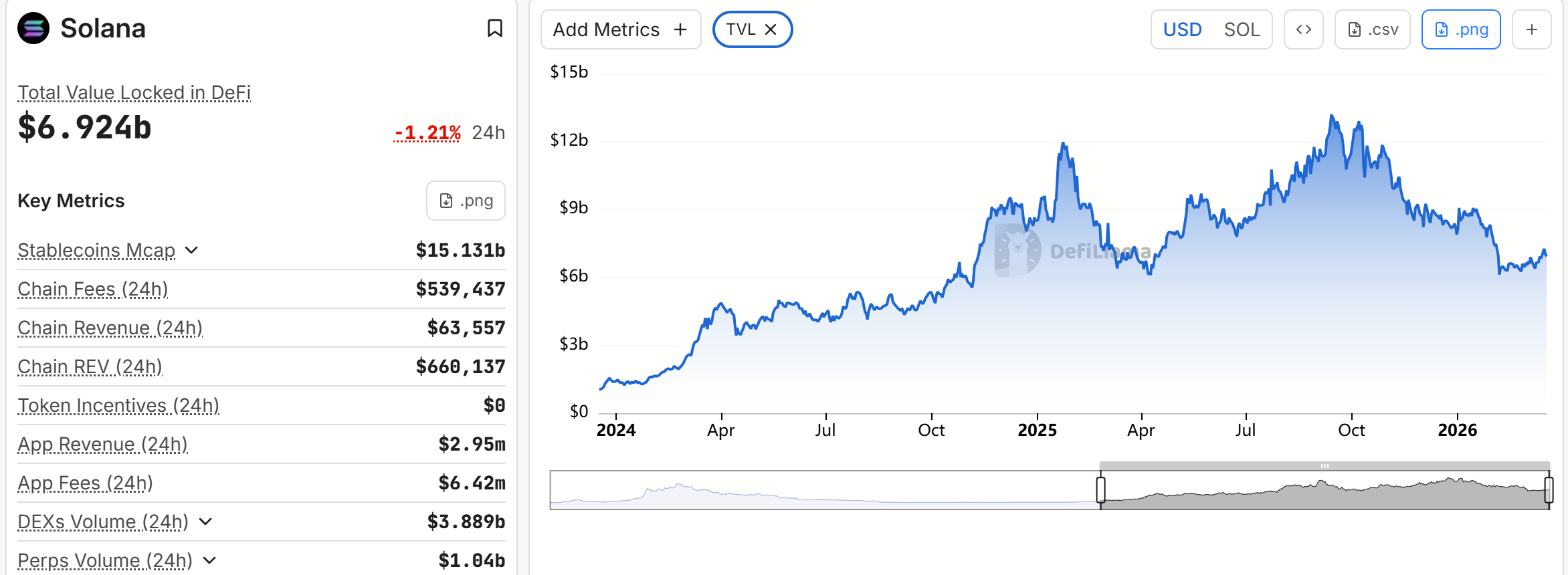
Solana represents another approach: minimizing the fragmentation of transactions, settlements, and liquidity across multiple layers and instead enhancing performance, speeding up confirmations, and lowering fees directly on a single chain. As of March 19, 2026, Solana's on-chain DeFi TVL is approximately $6.92 billion, and stablecoin scale is around $15.13 billion, significantly lower than Ethereum; however, its 24-hour DEX trading volume reached $3.89 billion, far surpassing Ethereum's main chain volume of about $1.37 billion during the same period. This implies that Solana's advantage lies not in the depth of asset retention but in transaction activity and single-layer turnover efficiency.
Source: https://defillama.com/chain/Solana
In other words, Ethereum functions more like "the foundational legal and settlement architecture of a global financial network," while Solana resembles "a real-time execution engine for high-frequency financial activities." It is not about who is more advanced or falling behind; rather, their service focus is different.
2. Who is More Suitable for Institutional Funds and RWA?
What institutions care about most is not just the level of fees but also the stability of rules, security of funds, depth of asset retention, and compatibility with custodial, auditing, compliance, and settlement infrastructure. Currently, the Ethereum main chain still possesses the industry's deepest stablecoin pool, the most complete DeFi protocol layer, and the most mature institutional collaboration environment; in terms of stablecoin scale, Ethereum’s stablecoin supply exceeds $164 billion, roughly ten times that of Solana. More importantly, Ethereum's 2026 upgrade direction essentially addresses the shortcomings that Solana could readily exploit in the past: L1 is no longer content with merely being "the safest," but through parallel execution, higher gas limits, ePBS, and ongoing account abstraction advancements, aims to enable the mainnet to also possess stronger actual financial carrying capacities.
However, from the perspective of "transaction efficiency" and "payment-style settlement," Solana's attractiveness rises quickly. In 2025, Solana completed its first full year of operation without outages, maintaining a stable slot time of approximately 400 ms; by the end of the year, the Firedancer route client covered about 22% of total staking. This indicates that Solana is transitioning from "high-performance but fragile" to "high-performance and gradually dependable," which is precisely the foundation that payment, settlement, market-making, and high-frequency asset issuance scenarios value most.
Therefore, in the context of institutions and RWA, a more accurate judgment is not about "who wins, who loses," but rather: Ethereum resembles an asset retention layer while Solana is more like an asset turnover layer. The former is suitable for large assets to stay long-term, while the latter is more suited for high-frequency funds to flow efficiently.
3. Who is More Suitable for Ordinary Users and Consumer-Level Applications?
From the perspective of ordinary users, the answer clearly leans towards Solana. Most users care about three issues: speed of transfer, cost of fees, and the complexity of operations. On these dimensions, Solana's product experience is naturally closer to Web2—a single chain to complete transactions, with very fast confirmation speeds and almost negligible costs, providing a very direct user perception. Solana remains highly attractive in consumer-level transactions, meme traffic, and bot-driven activities.
The issue with Ethereum precisely lies in its "overly mature and too complex" nature. The main chain, L2, cross-chain bridges, different Rollups, different gas tokens, and different wallet abstraction paths, while reasonably designed from a systems perspective, often result in experiences that are too fragmented for ordinary users. The upgrades in account abstraction and L1 performance in 2026 are indeed improving these issues, but at least for now, Solana still resembles a consumer financial product that can be used immediately upon opening, while Ethereum resembles a powerful but higher entry hurdle financial operating system.
Therefore, if the goal is to attract a broad range of internet users, Solana obviously has a natural advantage; if the goal is to serve high-value funds and complex financial protocols initially, Ethereum still possesses greater institutional depth.
In summary, Ethereum's strength lies in "retaining funds." The deep moat today consists of the main chain's stablecoin scale, DeFi TVL, L2 total value guaranteed, and historical institutional credibility. Solana's strength lies in "driving flow." High DEX transaction volumes, near-real-time confirmations, low fees, and an increasing diversity of clients make it resemble the next-generation on-chain trading and payment network. The former represents financial credibility, while the latter indicates financial efficiency.
5. Outlook and Conclusion
The competition between Ethereum and Solana essentially aims to approach the same goal: to become the most core and irreplaceable layer in the future on-chain financial world.
Ethereum has chosen a more robust and institutional path. It still insists that security, decentralization, and trusted settlements are the most important aspects of the underlying network, but the change in 2026 is that it is no longer content to be merely "the safest settlement layer." Whether through Glamsterdam's advancements in parallel execution, higher gas limits, and ePBS, or through the subsequent lightweight nature and account abstraction direction represented by Hegotá, it indicates that Ethereum is working to prove one thing: the most stable system can also become more efficient; the heaviest foundations can evolve into stronger financial arteries.
Solana bets on single-chain high performance, near-real-time confirmation, and ultra-low interaction costs, believing that large-scale on-chain finance in the future need not rely on complex multi-layer divisions, and can be directly supported by a sufficiently fast, smooth, and stable main chain. Alpenglow's rewrite on consensus and Firedancer's enhancement of client diversity both point to the same goal: the fastest systems must not only be fast but also prove themselves stable and reliable enough to support genuinely serious global financial activities.
Looking ahead, the next round of decisive variables shaping the landscape may not merely be shifts between bull and bear markets, but rather specific migrations: whether stablecoins will continue to expand as a global payment and settlement network, whether RWA will genuinely form large-scale on-chain asset pools, whether on-chain capital markets can support more complex, higher frequency, and more institutional trading demands, and whether ordinary users are willing to genuinely stay long-term at the wallet, payment, and application levels.
In conclusion, 2026 is not a final battle but rather an open qualification round: Ethereum is striving to prove that the most stable system can also be sufficiently fast; Solana is working to prove that the fastest system can also be sufficiently stable. Both are crossing their past boundaries and approaching a higher level of competition. The real answers will be reflected in the true direction of the next round of migrations of stablecoins, RWA, and global on-chain capital markets.
About Us
Hotcoin Research, as the core research and investment institution of Hotcoin Exchange, is dedicated to turning professional analysis into your practical weapon. Through "Weekly Insights" and "In-depth Research Reports," we analyze market trends; leveraging our exclusive column “Hot Asset Selection” (AI+Expert dual selection), we identify potential assets and lower trial-and-error costs. Weekly, our researchers also engage with you via live sessions, interpreting hot topics and predicting trends. We believe that with warm companionship and professional guidance, we can help more investors navigate cycles and seize opportunities in Web3.
Risk Warning
The cryptocurrency market is highly volatile, and investing in it involves risks. We strongly recommend investors to make investment decisions based on a full understanding of these risks and within a strict risk management framework to ensure the safety of their funds.
Website: https://www.hotcoin.com/zh_CN/learn/index/
免责声明:本文章仅代表作者个人观点,不代表本平台的立场和观点。本文章仅供信息分享,不构成对任何人的任何投资建议。用户与作者之间的任何争议,与本平台无关。如网页中刊载的文章或图片涉及侵权,请提供相关的权利证明和身份证明发送邮件到support@aicoin.com,本平台相关工作人员将会进行核查。