Author: Nancy, PANews
From less than 100 million dollars of initial experiment to exceeding 4 billion dollars in scale, tokenized stocks have completed the leap from concept validation to mainstream penetration in just over a year.
Behind the market's exponential growth, there are not only crypto-native players entering the fray, but also traditional financial giants venturing into the "deep waters" with core assets.
SEC Officially Allows, Nasdaq Approved to Pilot Tokenized Stocks
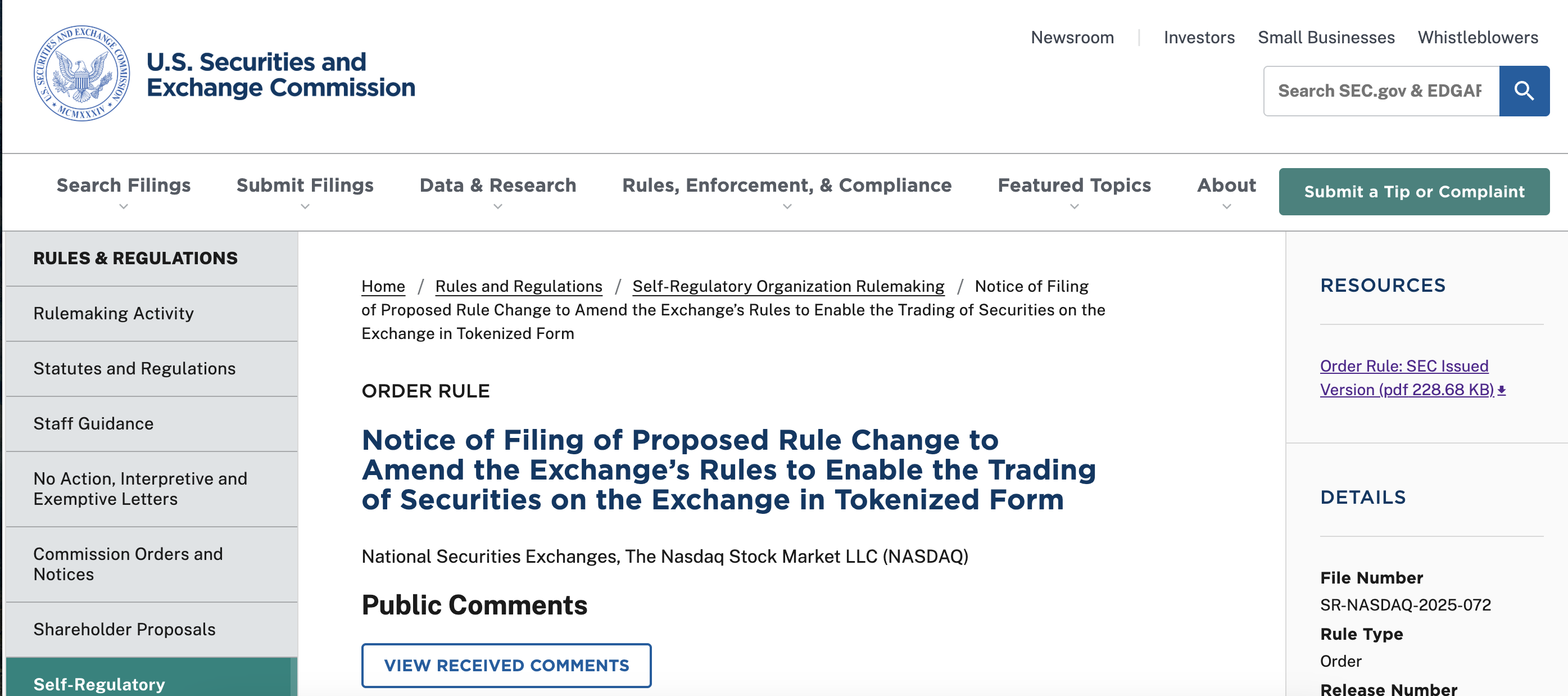
After half a year of multiple revisions and public consultations, the SEC officially approved Nasdaq's proposed rule change on March 18, allowing securities to be traded in tokenized form on its exchange. This means that mainstream U.S. stock exchanges have officially launched a pilot for trading tokenized securities.
The executing party for this pilot of tokenized trading is DTC (Depository Trust Company), a subsidiary of DTCC (Depository Trust & Clearing Corporation). The SEC has approved DTC to provide custodial asset tokenization services, allowing it to offer tokenization services for three years on pre-approved blockchains for participants and their clients, covering high liquidity assets, including the Russell 1000 index, ETFs tracking major indices, and U.S. Treasury securities.
SEC documents emphasize that tokenized securities are not new products and will be fully incorporated into the existing securities regulatory framework, retaining all rights associated with traditional securities, such as equity ownership, dividend rights, and voting rights. Meanwhile, the trading system, market structure, fee structure, and regulatory oversight remain unchanged, with the only difference being the settlement method. In other words, the original institutional logic of the exchange remains unchanged, but the underlying settlement chain introduces blockchain technology as an alternative pathway.
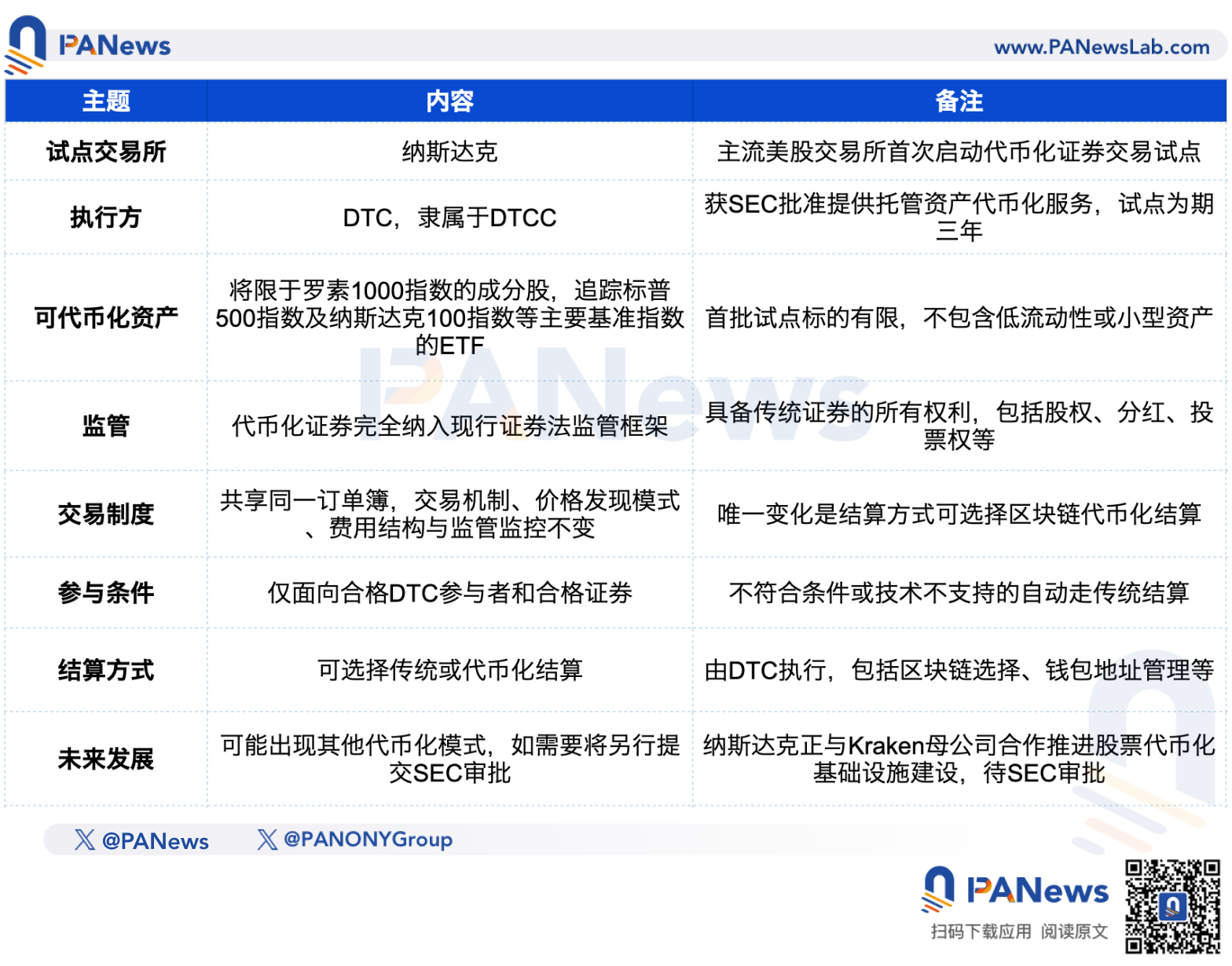
According to the Nasdaq plan, the pilot trading of tokenized stocks is only available to qualified DTC participants and eligible securities, allowing them to choose to trade in traditional or tokenized form. Transactions that qualify and choose tokenized settlement will be executed by DTC (such as selecting blockchain, wallet address, etc.). If participants are not qualified, assets do not meet the criteria, or technology does not support, then settlement will occur automatically by traditional means.
Tokenized stocks and traditional orders will share the same order book, maintaining consistency in queue priority, trade matching mechanism, and price discovery model. Traders can choose "whether to enable tokenized settlement" when placing orders, thus avoiding issues of liquidity fragmentation and trade fragmentation.
However, the first batch of pilot subjects is limited, mainly including constituents of the Russell 1000 index and ETFs tracking major benchmark indices such as the S&P 500 and Nasdaq 100. From the selection logic, these are all high liquidity, high market capitalization, and mature regulatory structure asset classes, rather than small or low liquidity assets.
Nevertheless, Nasdaq has also made it clear that the tokenized trading based on the DTC pilot is not the only model. Various tokenization methods may exist or emerge in the market, and if other models are adopted in the future, they will be submitted to the SEC for approval separately.
In fact, besides focusing on the trading and settlement layer of tokenization in this pilot, Nasdaq is also promoting plans aimed at issuers.
Recently, Nasdaq announced a partnership with Kraken's parent company Payward to jointly develop plans for offering tokenized stocks and exchange-traded products (ETPs) on its exchange. The two parties plan to build a conversion system called "Stock Conversion Gateway," allowing tokenized stocks to flow freely between regulated traditional stock markets and unlicensed blockchain networks, using the same CUSIP code to ensure interchangeability, with settlement still completed through DTCC. This plan awaits final approval from the SEC and is expected to go live in the first half of 2027.
With Nasdaq taking the lead, the pool of tokenized stocks is rapidly expanding. In addition, traditional financial giant NYSE is also following closely, revealing that it is developing a tokenized trading platform, and its parent company ICE recently announced an investment in OKX to accelerate related layouts.
S&P 500 First on Chain, Hyperliquid Secures Official Authorization
Almost simultaneously, another tokenization experiment is taking place in the on-chain market.
S&P Dow Jones Indices recently announced that it has authorized Trade XYZ to launch the first and only officially authorized perpetual derivative contract for the S&P 500 on Hyperliquid.
This product is aimed at qualified non-U.S. investors and supports on-chain leveraged long and short trading, directly using institutional-grade S&P DJI index data. S&P stated that this move extends the liquidity ecosystem of the S&P 500 onto the chain, achieving 24-hour round-the-clock trading, supplementing existing futures, options, ETFs, and other on- and off-exchange products.
As one of the world's most important stock indices, the S&P 500 tracks the 500 largest and most representative companies listed on major U.S. exchanges, with related derivatives (futures, options, ETFs, etc.) trading volume exceeding 1 trillion dollars daily. It is not only a "barometer" of the U.S. economy but also a core tool for global investors to allocate dollar assets and participate in U.S. growth.
This "on-chain" event means that this nearly 70-year-old index has achieved all-day trading for the first time. Additionally, unlike the Nasdaq approach, the S&P 500 index appearing in the on-chain perpetual market directly skips the traditional exchange system and is viewed as an important step in the chain migration of global assets.
In fact, S&P Global has been accelerating its crypto strategy in recent years, including launching crypto indices, releasing DeFi indices, rating stablecoins and tokenized government bond funds, launching crypto ecosystem indices, and cooperating with blockchain projects to promote tokenized funds.
Trade XYZ is the largest RWA perpetual market on Hyperliquid, with contracts for traditional assets such as crude oil attracting attention from Wall Street funds. Since October 2025, the market's trading volume has exceeded 100 billion dollars, with an annual trading scale of over 600 billion dollars. For Hyperliquid, the introduction of the S&P 500 not only brings liquidity expansion but, more importantly, gains brand endorsement, which may attract more TradFi products onto the chain in the future.
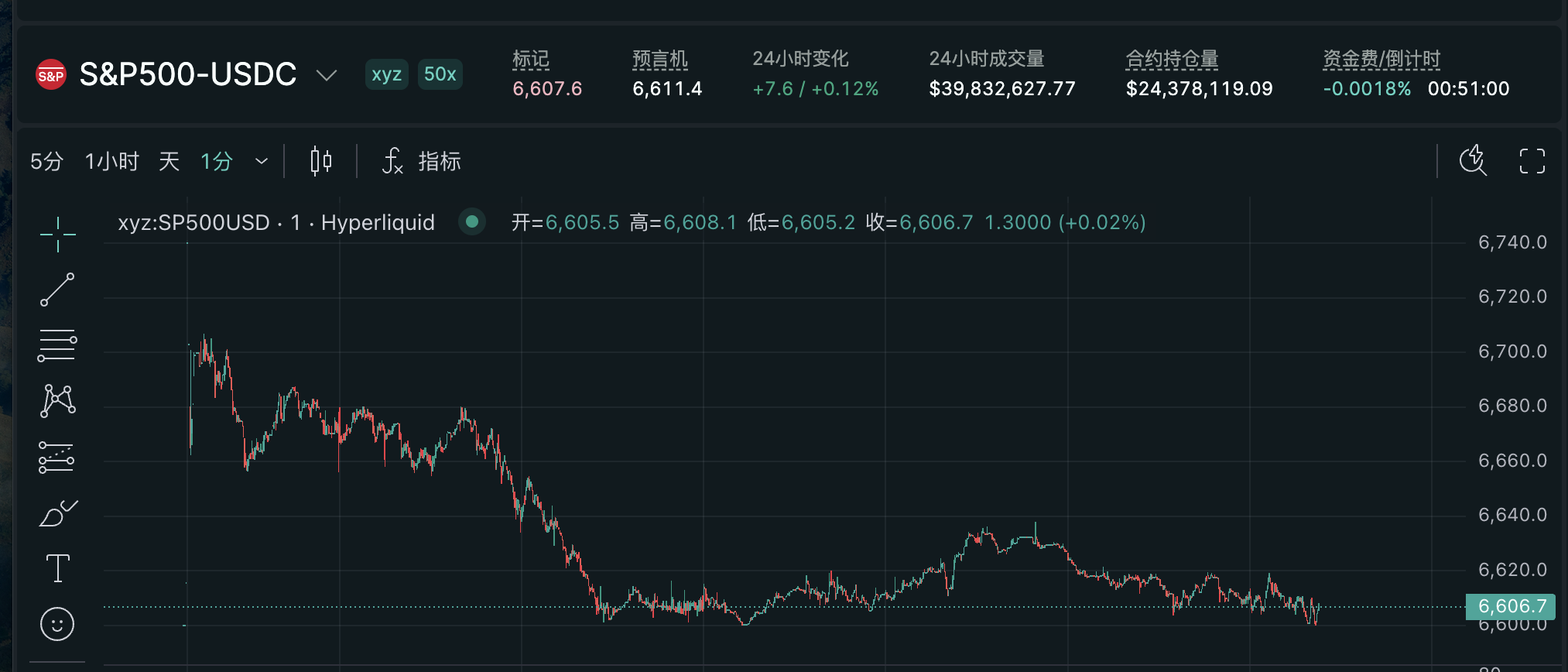
Currently, Trade.xyz has deployed the S&P 500/USDC trading pair on the Hyperliquid platform through the HIP-3 protocol, supporting leverage of up to 50 times. As of publication, the cumulative trading volume of this asset has exceeded 39 million dollars, with open interest rapidly climbing to 24 million dollars.
From Nasdaq to Hyperliquid, tokenization is advancing along two routes. One is centered on traditional finance, introducing blockchain into existing markets and reconstructing the clearing and settlement processes; the other directly reconstructs the trading system on-chain, mapping traditional assets as crypto derivatives that can be traded around the clock.
However, one clear trend is that global financial assets are accelerating their migration to the chain.
免责声明:本文章仅代表作者个人观点,不代表本平台的立场和观点。本文章仅供信息分享,不构成对任何人的任何投资建议。用户与作者之间的任何争议,与本平台无关。如网页中刊载的文章或图片涉及侵权,请提供相关的权利证明和身份证明发送邮件到support@aicoin.com,本平台相关工作人员将会进行核查。


