At the beginning of this year, the sentiment in the global financial markets was actually quite warm.
Although the Federal Reserve itself appeared very reserved during its last meeting at the end of last year, hinting that it might only symbolically cut rates once over the year, Wall Street clearly has its own assessment system. Established institutions like Goldman Sachs, Morgan Stanley, and Bank of America almost unanimously provided more "positive" answers: at least two rate cuts, with rates falling from the high range of 3.5%-3.75% to just over 3%. Citigroup and some Chinese brokerages were even more aggressive in their assessments, betting on three cuts.
The consensus among analysts, aside from economic data reasons, also stems from political reasons: the midterm elections in the U.S. in November.
For those in power, votes are life, and to get votes, the economy needs to heat up. And interest rates are the most direct thermostat, but monetary policy takes time to see results after being implemented. If the Trump administration wants to see results by November, the Federal Reserve must complete significant rate cuts before October.
Thus, predictions from major institutions at the time were all placing the rate cuts in the first half of the year: Goldman Sachs favored March and June, while Nomura Securities focused on June and September.
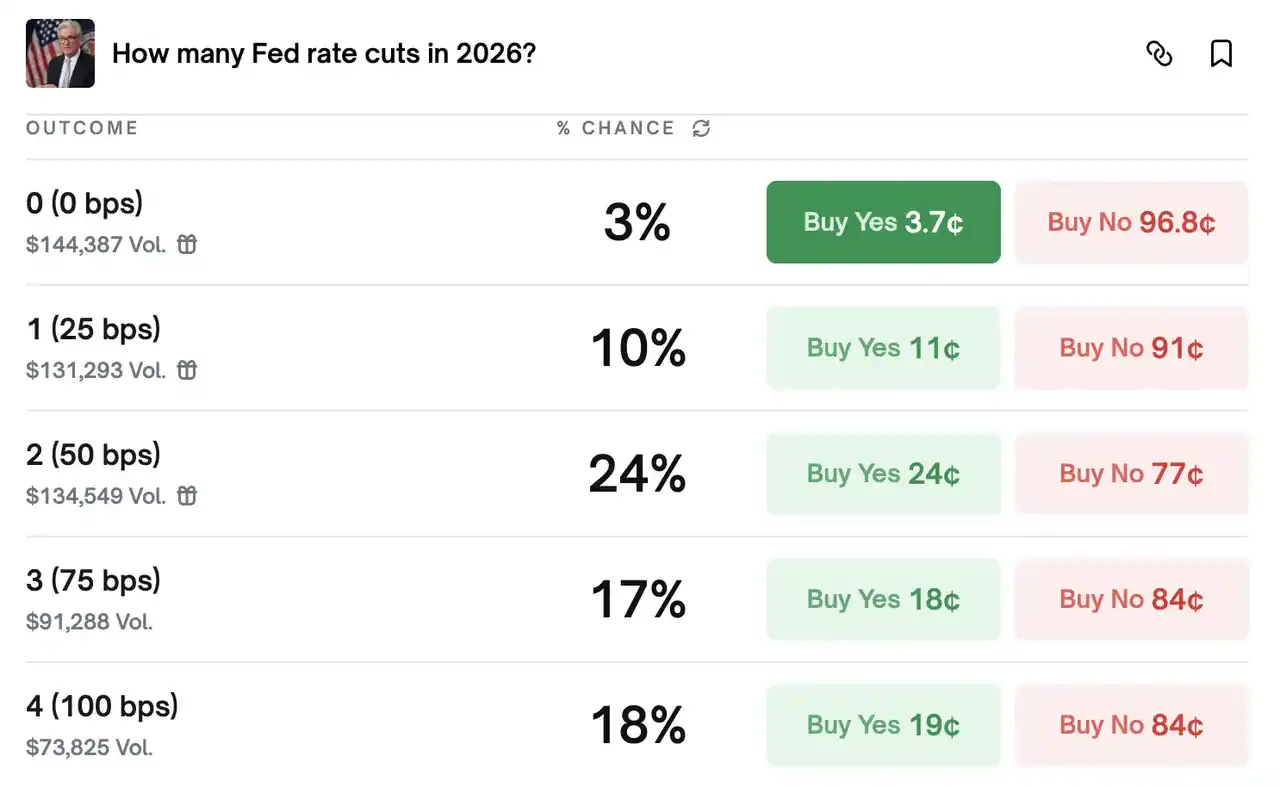
At the beginning of this year, polymarket predicted that the most probable number of rate cuts for 2026 was 2 times
Everyone felt that a "blessing" of liquidity was just around the corner.
Traders Begin to Bet on Rate Hikes
However, Trump has never been someone who plays by the rules, and he initiated a war in mid-March.
In mid-March, the situation in the Middle East suddenly escalated. The tensions in the Strait of Hormuz quickly transmitted to the energy market, with oil prices skyrocketing nearly 50% in just two weeks, with some varieties crossing the $100 mark temporarily. This surge in energy prices directly compressed the Fed's space for rate cuts.
The CPI data from February had already shown that inflation was still above the 2% target, and now with the added strain of rising oil prices, the Fed had to appear tougher.
The expectation of a "100% rate cut" was shaken, and even a very small number of discussions about "returning to rate hikes" emerged.
What everyone originally thought would be a rate-cutting announcement at today's meeting has now turned into a "hawkish pause." According to the latest data, the market is almost 100% certain that the Fed will stand pat this time.
Even more restless is the Chicago Mercantile Exchange's observation tool showing a 1.1% probability of rate hike bets. Although this percentage is small, it sends a dangerous signal: the inflation monster may be back.
Analysts' attitudes have also shifted accordingly.
Goldman Sachs’ chief economist Jan Hatzius revised the prediction report on March 12, directly pushing back the rate cut expectation from June to September, now expecting only two rate cuts this year.
Moreover, JPMorgan was very frank: current rates may not have suppressed the economy at all, and if inflation continues to rebound, the Fed's next move may very well be a rate hike: "The assertion that rates are restrictive is becoming difficult to maintain. If the labor market doesn't weaken, the Fed will maintain high rates for a long time."
Even more radical voices are coming from strategists at EY-Parthenon and Carson Group. EY-Parthenon analyst Gregory Daco believes there may not be any rate cuts this year. While Carson Group analyst Sonu Varghese pointed out that due to the surge in oil prices caused by the conflict with Iran, the Fed may not only refrain from cutting rates but might even discuss rate hikes later this year.
The latest forward-looking analysis from Caixin and Wall Street Journal pointed out that due to rising expectations of terminal interest rates, the yield on 2-year U.S. Treasuries has exceeded 3.75%, which is usually a precursor to market expectations of tightening policy. Thus, some traders believe that the likelihood of a rate hike before the end of the year has risen from 0% to around 35%.
Tonight, at 2 AM Beijing time on Thursday, the Fed will unveil the final interest rate decision, whether to raise, cut, or maintain rates.
Then at 2:30 AM, Powell will hold a press conference to talk about monetary policy, inflation path, and economic prospects.
It is worth mentioning that the Fed is in a delicate political window: Powell's term will end on May 15. This is his second to last time hosting a press conference in his capacity as Fed chairman, and the market is currently in a policy vacuum waiting period. He himself is under significant political pressure, as Trump has repeatedly criticized Powell publicly and called for an emergency meeting to significantly cut rates. This external pressure conflicts with the internal anti-inflation logic, increasing policy uncertainty.
Aside from the Fed, global central bank expectations show similar sentiments.
This week, 21 central banks covering two-thirds of the global economy will announce their latest interest rate decisions. Given that this is the first "Super Central Bank Week" after the outbreak of conflict in the Middle East, global markets are closely monitoring whether global central bank decisions will be affected by developments in the Middle East.
The Reserve Bank of Australia just raised rates again by 0.25 percentage points yesterday; it was the first among the eight major central bank rate decisions this week and the first central bank tightening monetary policy among developed economies this year.
Additionally, the European Central Bank (ECB) is expected to keep rates unchanged at the March 19 meeting, with policymakers warning that global trade policies and geopolitical risks limit future rate cut prospects. The Bank of England (BoE) is also expected to hold rates steady this Thursday, even though there are a few voices internally supporting rate cuts, the current focus remains on stability.
How Much Longer Will Oil Prices Rise?
If we deconstruct all the variables, we would find an almost unavoidable core: oil prices.
If oil prices remain unbounded, the space for rate cuts will be compressed; only when oil prices fall can monetary policy have room to maneuver.
Thus the question becomes more direct: how much longer will oil prices continue to rise?
From recent information released by the U.S. government, the answer seems not as pessimistic as the market imagines.
On March 8, U.S. Energy Secretary Chris Wright provided an accurate timeline in an interview: he believes that the current surge in oil prices is merely a temporary fear premium that will improve within "a few weeks at worst, rather than months."
This aligns with what White House Press Secretary Karoline Leavitt stated a few days prior, saying "the rise in oil prices will only last another 2-3 weeks,"
Coincidentally, Trump's statement on March 10 was even more explicit. He said actions against Iran were moving much faster than expected, even stating, "I believe this war is very close to completion." On the same day, the Energy Secretary's social media account had a "post-deletion controversy."
What is most intriguing is the adjustment of diplomatic pace.
Trump was originally scheduled to visit China in early April, but he suddenly announced a one-month delay. The official excuse was "the war keeps him busy" and "the war requires him to stay in Washington," but when looking at this one-month delay alongside the Energy Secretary's "2-3 week recovery period," the one-month postponement effectively covers the "2-3 week recovery period" plus the initial post-war handling time.
Thus we boldly speculate that the Trump administration's script may be: to essentially finish large-scale military operations by the end of March; within the following 2-3 weeks, along with the release of strategic oil reserves, forcibly pushing oil prices back below $80; by the time of his visit in May, the situation in the Middle East will be settled, the inflation threat will be lifted, and he can present himself as a "victor," not only demanding significant rate cuts from the Fed but also holding absolute leverage in "U.S.-China" trade negotiations.
The optimism at the beginning of the year was based on the assumption of "controllable inflation + proactive policies"; however, the sudden change in the Middle Eastern situation has shaken one of its most critical foundations—energy prices.
Once oil prices lose their anchor, inflation loses its anchor as well; when inflation loses its anchor, the path for interest rates also becomes unclear.
In the coming period, the global asset prices will be determined by those distant places, by the still-active oil tanker routes, and by the yet-to-be-resolved sounds of gunfire.
免责声明:本文章仅代表作者个人观点,不代表本平台的立场和观点。本文章仅供信息分享,不构成对任何人的任何投资建议。用户与作者之间的任何争议,与本平台无关。如网页中刊载的文章或图片涉及侵权,请提供相关的权利证明和身份证明发送邮件到support@aicoin.com,本平台相关工作人员将会进行核查。