Author: When Shift Happens
Translation: Baihua Blockchain
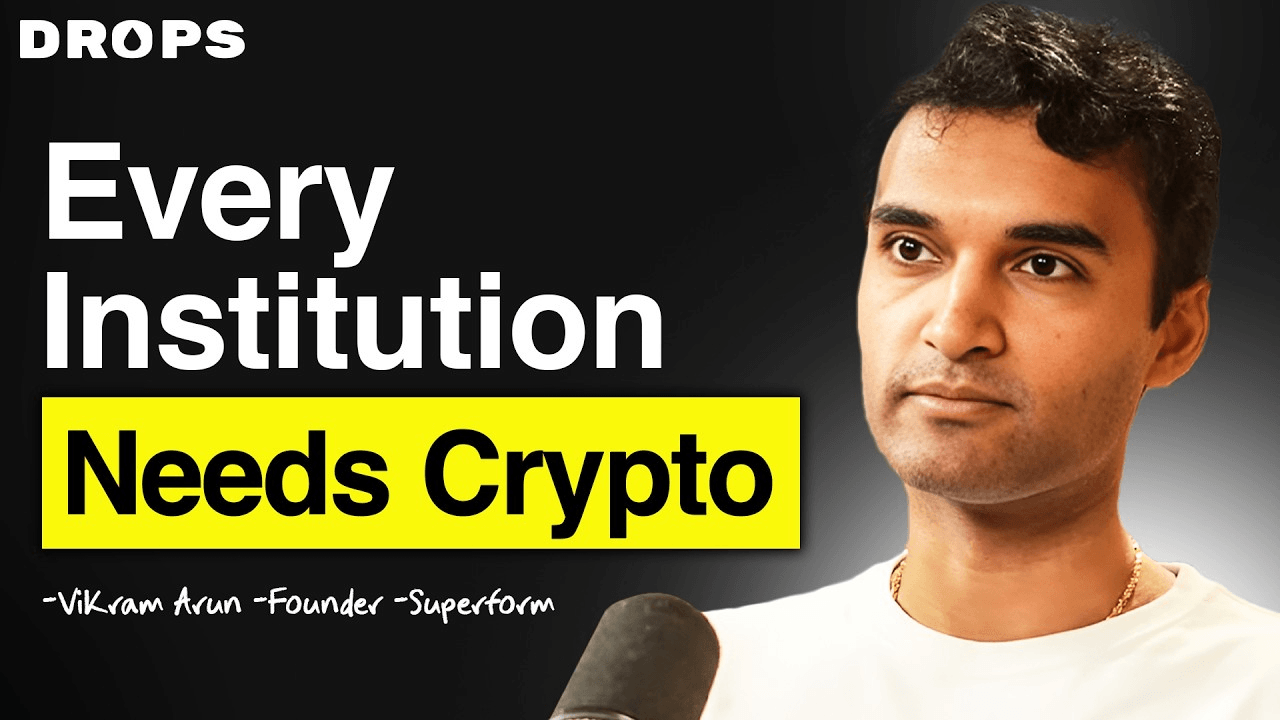
Have you ever experienced a bank account being frozen without warning, border restrictions draining your resources layer by layer, or watched in astonishment as greed accumulates without any alerts? Amid the ruins of traditional finance and the early collapse of crypto black boxes (like FTX), a silent revolution around "financial sovereignty" is erupting.
This issue's fund interview features former core member of top crypto fund Block Tower, Vikram, co-founder of Superform. He was a professional trader managing billions, but chose to "wash his hands" at the peak, vowing to dismantle the walls of centralized finance himself. From the candid departure of a player, to how USDC generates a transparent 6% invoice yield, to how "self-custody" makes your money truly yours—this is not just a deep industry dialogue, but a survival guide for preserving wealth in a crisis era. If you are also satisfied with the labor of the existing financial system, this article will reveal what future banks will look like.
1. Superform's Mission: Building a "Real" On-chain Bank
Host: Vikram, you have worked at top crypto fund Block Tower and are now co-founder of Superform. If you had to explain what Superform is to your mom in one sentence, how would you say it?
Vikram:We are building a brand new, better banking system.
For a long time, the traditional banking system has systematically occupied our funds but hardly gave back to users, letting us down. Later, FinTech companies attempted to solve this problem, realizing that the user experience (UX) of banks is terrible, but they also lock users' funds. Essentially, FinTech is just a pretty fortress built on crumbling infrastructure.
I left the fund to stop trading because I want to see retail investors win. In the crypto world, it should be transparent and verifiable. Celsius or FTX's black box operations caused huge disasters, while our returns come from the real demand for crypto assets of the underlying protocols. The core point is:Self-Custody. The returns people saw before were real, but they never truly had the custody of their assets during access. Self-custody solves this trust custody issue.
Host:Welcome to the Drops series podcast. We focus on uncovering founders who have not yet entered the mainstream but have potential. Vikram, there have been significant changes in the crypto market this week; how do you feel? Did you sleep well?
Vikram:To be honest, I haven't slept much. I woke up in the middle of the night looking out the window, thinking, "This week is the perfect time for this interview." All the pain points people complained about over the past week are the issues we are committed to solving.
2. The Shift for Traders: Why Professionals No Longer "Trade Coins"?
Host:I spoke with another founder today who said he has been trading like a beast lately. In this exciting time of market volatility, will you still participate in trading?
Vikram:I haven't touched the secondary market in four years. Since leaving the fund, I have not traded again. It has been the best decision for my mental health.
Host:That's quite a rhythmic choice. As a former professional player, why completely distance yourself from the competition?
Vikram:Four years ago, trading was everything in my life. I experienced the bull and bear cycles in the fund and eventually discovered a harsh truth: most people simply cannot make money in this game. Most who enter the crypto space are speculating—buying hot coins, buying NFTs.
The only value of these speculative activities lies in generating "attention," and attention breeds DeFi. While now there are protocols capable of generating real income, those so-called trading protocols mostly aren't designed for users to make money. You’re playing with the casino, betting against the house. So I decided to build a yield platform; it’s one of the few things in the crypto world you can do that won’t lose money.
Host:Mobility should be good for funds; you rely on it for survival. Why do you think most funds are underperforming now?
Vikram:Nothing new under the sun. Most crypto funds from the last cycle were essentially just "going long." They are venture funds tasked with helping investors obtain crypto encryption exposure. When the market drops, they can get stuck. Although more complex strategies have emerged now, last week we still witnessed many "deaths." Many people always overexpose, and this greed has never changed.
3. Vision: Transforming Speculation into Financial Sovereignty
Host:Since trading is hard to make money, what drives you now?
Vikram:I came in because I believe in the possibility of owning a fully consuming, permissionless market, which isn’t possible in traditional finance. In traditional finance, you give money to banks, they earn 7% and only give you 1%. But in the crypto world, when you access the same products, you can own the entire software layer, you have ownership.
However, the investment targets we were looking for in the past were all speculative activities. The biggest applications during the cycle are actually just trading and prediction markets. I want to build a protocol that turns this speculative energy into something real. We need to build the underlying stack for the future of finance, moving everything from banking to FinTech on-chain. This doesn't require KYC; it's the only path to financial freedom.
Host:A saying was popular in Silicon Valley a few years ago: use FinTech for the front end, blockchain for the hardware. Do you mean that we need to redo the front end along with the core infrastructure?
Vikram:The existing FinTech sector can integrate blockchain, but they integrate it on top of the already crumbling old systems. They take the cool things we build that should be free and decentralized, and charge on top of each layer. They hand over control to them, and it becomes "funds, their links," not yours. If you want to focus on decentralization and non-custodial ideas, you must build a complete underlying stack from the ground up.
4. Days at Block Tower: The "Moat" of Crypto Funds
Host:Let’s talk about your background. What did you specifically do at Block Tower?
Vikram:I entered the field in 2016 and managed DeFi portfolios at Block Tower. When DeFi exploded in 2020, our largest strategy was arbitrage between centralized exchanges (CEX) and decentralized exchanges (DEX).
At that time, our moat was our underlying understanding of DeFi protocols and our actual building capabilities. We built trading facilities on all chains. A lot of capital poured in, filled with idealism. My co-founders and I realized that the decision layer back then did not support large-scale fund management. This gap in understanding prompted us to start our protocol, even superform.
Host:People often think making money in the crypto market is easy, and some even quit their jobs to trade full-time. Where do you think this "illusion" comes from?
Vikram:Because the barrier to entry is low, anyone can start. And in the early days, there wasn't such a thing as "institutional advantage." I could beat those big funds that only buy Bitcoin and Ethereum by looking for obscure altcoins on CoinGecko's fifth page with friends. That illusion of "fair competition" felt perfect. But in the end, you realize managing the backend and mid-platform and the actual risks are extremely difficult.
Host:What was the craziest position you held?
Vikram:In 2021, we traded a meme coin called Samoyed on Solana. That was a frenzied time; we bought on Raydium for two weeks. That trade was typical—it relied on "culture" at the time, whereas now it relies on "value." Back then, as long as you could make money, there were no rules against touching junk coins.
Host:So today, can ordinary retail investors still make money from trading?
Vikram:It becomes increasingly difficult. As a former professional trader, my advice is:Stop.The current market has a clear structural information disadvantage, and institutions have the upper hand. Stock selection trading is mediocre in the long run, and in an unregulated crypto market without investor protection, you are betting against people with information advantages.
All my current funds are parked in several DeFi protocols like Morpho, Superform, Euler, etc. I no longer engage in secondary market trading. Sometimes, doing nothing is the best strategy.
5. Sales, Risks, and "Web 2.5" Users
Host:You once said, "Everything is sales," and that includes in-depth DeFi analysis. What do you mean by that?
Vikram:Why hasn't DeFi become popular yet? Because we haven’t done a good job in sales and education. Many people think that putting money in banks is safer, but in reality, a well-designed, low-risk DeFi protocol can far exceed the security of a traditional bank that might collapse or lock your funds. We need to build trust in on-chain systems through showcase and education.
Host:You left a high-paying job at Block Tower in 2021 to start your own business. What was your mental state at the time?
Vikram:That was the hardest decision of my life, with great opportunity costs. But at 25, I felt that if I didn’t step into the arena to build my own thing, I’d be sidelined for life. It turns out that the emotional rollercoaster builders endure is ten times harder than that of investors. Investors can do one thing, while builders must excel in ten different areas.
Host:Superform initially was a yield marketplace, but you realized you missed the market.
Vikram:Yes. We thought that crypto natives would love us. But later we found that crypto natives only wanted higher yields. Our products—simple, secure, and easy to use—are actually meant for those "Web 2.5" users.
Host:Who are "Web 2.5" users?
Vikram:Those who have been hurt by FinTech. They have had their funds locked on Venmo or Robinhood because the platform decided to shut down the market and they couldn't trade. They have heard about the benefits of crypto but lack the ability to operate complex protocols independently. They are in between Web2 and Web3, and this is the crowd we aim to reach through a mobile-first application.
6. Politics, De-banking, and the Social Function of Crypto
Host:Why is it essential to create this product now?
Vikram:If we don’t take action now, FinTech companies will take over these consuming permissionless technologies and package them as tools that expand user control.
Host:Is this distinction really obvious from the user perspective?
Vikram:For an average user in the U.S. or Europe, it may feel insignificant. But for those who have been disenfranchised, it is the only lifeline. For instance, political groups, emerging industries, and even individuals like Trump have experienced "de-banking" during campaigns. You never know when you might be blacklisted by a bank due to saying the wrong thing or conducting sensitive transactions.
I resonate with that. In 2019, I was de-banked by Revolut because I transferred 7,000 USD to buy Bitcoin, and now it's all gone. My accounts at data companies in Hong Kong and Singapore were recently locked without even telling us the reason.
Vikram:That’s why trust is critical. These systems shouldn’t require you to trust; the essence of crypto is "trustless." Now we conduct a lot of our business using stable payment coins because we no longer trust bank accounts.
7. Breaking Down Yields: Why Does USDC Provide 6% APY?
Host:This is a core question. My uncle lost all his money on Celsius and FTX. If you now tell him USDC has nearly a 6% yield, he would likely think it's another scam. How do you explain that this 6% isn't "too good to be true"?
Vikram:This is a question the whole industry must answer. Celsius made mistakes by wrapping a centralized black box in DeFi.
Our yields come from the real financing demand for crypto assets of the underlying protocols. For example, when someone wants to leverage their assets long, they have to pay interest to borrow USDC. This 6% is the real cost generated by market trading activity.
The critical difference is: at Superform, where every dollar of yours is, in which protocol it generates yield, is transparently traceable on-chain. We don’t hold your assets; you have self-custody. Self-custody was the only solution for FTX.
8. Branding, Mascots, and Simplifying Products
Host:You have a little pig mascot named Piggy, positioned as "the Pudgy Penguins of the DeFi world." Most DeFi founders only care about APIs; why do you think a cute little pig can win?
Vikram:In the DeFi space, we’ve tried almost every hard-core method to attract users, but we haven’t tried becoming "fun."
We can talk about security and transparency but can only attract a crowd. If we want to bring in the next billion users, we need community and culture. The little pig represents a traditional piggy bank, making finance less intimidating. Superform recently announced the acquisition of the pig brand to use it as a cultural symbol to reach the public.
Host:In your app, you directly label various derivative asset experiences as "USD" or "BTC." While this alleviates some concerns, could it mislead users?
Vikram:That’s a balancing point. Many new users are scared away by terms like "token wrapped on some chain." Our goal is not to create barriers at first. Of course, at the execution layer of trades, we will provide in-depth disclosures and risk warnings. We strive to find a middle ground between "not scaring users" and "maintaining transparency."
9. Outlook for 2030: Will DeFi Become Invisible?
Host:Assuming it's now 2030, Superform has entered a revolution in the DeFi space with millions of users. What must be done in the next five years to achieve this goal?
Vikram:First, self-custody must be normalized. Users should be able to use products securely without remembering 24 seed phrases. Secondly, we need to build the same safety nets as traditional finance—insurance, downside protection, and layered products.
While banks are bailed out by the government, we aim to create the same level of protection in DeFi through technology. We intend to prove that decentralized finance is not only freer but can also match or even exceed traditional versions in security.
Host:Finally, what do you want listeners to remember?
Vikram:The future is bright.
People are being harmed by existing institutions, and crypto is the only systemic solution. This is not only about technology; it's a social movement about "taking back control of one's life." If you are unhappy about someone being able to take your assets at will, please join in. Take back the conversation now; that's what it’s about.
Host:Thank youVikram. Thank you for being so pragmatic and recognizing that we need to make this space understandable for our parents and cousins. If we don’t simplify everything, we will never reach the places we want to go.
Article link: https://www.hellobtc.com/kp/du/03/6250.html
Source: https://www.youtube.com/watch?v=jE-SRxUJei0
免责声明:本文章仅代表作者个人观点,不代表本平台的立场和观点。本文章仅供信息分享,不构成对任何人的任何投资建议。用户与作者之间的任何争议,与本平台无关。如网页中刊载的文章或图片涉及侵权,请提供相关的权利证明和身份证明发送邮件到support@aicoin.com,本平台相关工作人员将会进行核查。


