Original Title: President Trump's CONFLICT Playbook, An Investor's Step-by-Step Guide
Original Author: @KobeissiLetter
Translation: Peggy, BlockBeats
Editor's Note: In the escalating situation in Iran and market volatility, what investors are most prone to is emotional interpretation of the news itself. However, from a longer time scale, the multiple trade conflicts, geopolitical frictions, and policy games surrounding the Trump administration often exhibit a similar trajectory: first establishing pressure through public rhetoric and deterrence, then gradually escalating actions, and ultimately returning to the negotiating table after risks and stakes have sufficiently accumulated.
This article attempts to outline the decision-making patterns of the Trump administration over the past year from the structure of "Conflict - Escalation - Pricing - Negotiation", breaking it down into an observable market rhythm. For the financial markets, the key lies not just in the event itself, but in how the market prices for the worst-case scenarios and how it quickly reverses when uncertainty fades.
Within this framework, oil prices, stock market fluctuations, and the flow of safe-haven assets often reflect not only risk but also become part of political gamesmanship. Understanding this logic may help clarify the market mechanisms behind the news in a highly uncertain environment.
The following is the original text:
The Iran war is escalating. Over the past 12 months, we have systematically analyzed all geopolitical conflicts involving President Trump. What will happen next? Below is a clear guide explaining the potential situations that may arise in the future, and what these changes mean for investors and financial markets.
Before we begin, please bookmark this article—it will become an important reference for your market trends in the upcoming 2 to 4 weeks.
On January 17, 2026, we published the first "Playbook," titled "Tariff Playbook." At that time, President Trump was increasing tariff pressure on the EU while pushing his strategic plan to acquire Greenland. It turned out that this article almost precisely predicted the outcome of Trump's latest round of tariff battles. So, how did we accomplish this?
Since President Trump took office on January 20, 2025, we have spent hundreds of hours systematically analyzing geopolitical and trade war news related to Trump. Through this research, we identified a very clear pattern: when Trump attempts to achieve a certain economic or military goal, he often employs a similar negotiation and pressure approach towards both allies and adversaries in the U.S.
In 2025 and early 2026, we consistently identified this pattern as an important component of our investment strategy. Today, we think it is an appropriate time to share this method with the X platform and the wider public. We hope this can help everyone find a reference framework amid market volatility.
Step One: All Conflicts Start Similar
First, we need to review how the Iran war began.
This conflict did not truly start with the first strike on Iran on February 28—it actually sowed its seeds two months prior.
In the weeks leading up to the outbreak of war, President Trump made multiple posts indicating: "A massive Armada is heading to Iran," constantly urging Iran to "make a deal."
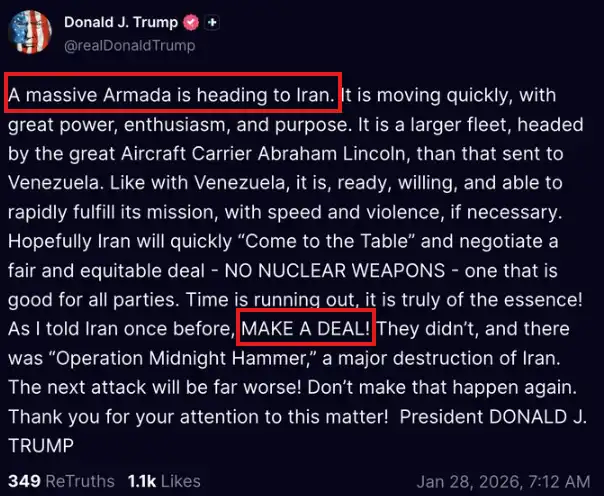
President Trump—Truth Social (January 28, 2026)
The Iran war is the largest conflict President Trump has engaged in during his second term. However, if you look back at the situation from the past 6 to 8 weeks, you’ll find that the strategy Trump employed is almost entirely consistent with the trade wars he initiated, and even with his approach to capturing Venezuelan President Maduro.
Why is that?
Of course, from the perspective of actual military actions, the two are not entirely the same. But at the fundamental level of negotiation and pressure strategies, they follow the same historical pattern.
For example, consider the following post from November 29, 2025: Trump announced, "We are fully closing the airspace over Venezuela and its surrounding areas." It is important to note that this announcement was made over a month before the U.S. ultimately captured President Maduro. In other words, before any real action occurred, Trump had already released strong pressure and deterrence through a series of public statements and military signals.
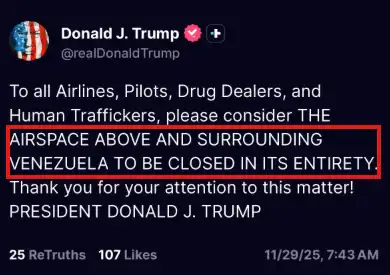
President Trump—Truth Social (November 29, 2025)
Next, let’s look at another post President Trump made on Truth Social. In fact, between January 1 and January 18, we saw multiple similar posts from Trump.
In these posts, Trump stated, "It is time to acquire Greenland," continuously pressuring and threatening Denmark. Just a few days later, President Trump imposed widespread tariffs on the EU.
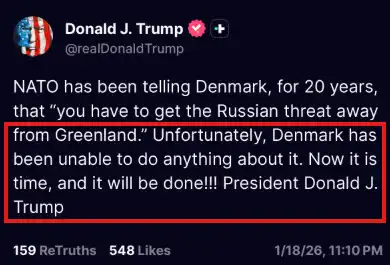
President Trump—Truth Social (January 18, 2026)
Clearly, Trump's "War Playbook's" first step is to exert strong verbal pressure on the target through public statements to compel the other party to "make a deal."
Step Two: Strategic Posture and Actual Deployment
The second step typically manifests as visible strategic preparations: before fully launching actions, reinforcing deterrence and credibility through military or policy moves.
In the case of Iran, this step includes: military redeployment; public coordination with allies; and the so-called "Armada" sent by Trump to the Middle East.
A similar pattern appeared in the Venezuela incident. At that time, the U.S. first announced the closure of airspace and regional military deployments, while the actual actions against President Maduro occurred later.
In trade wars, this path is equally clear: often starting with investigations, administrative reviews, and public notices, followed by actual tariff measures.
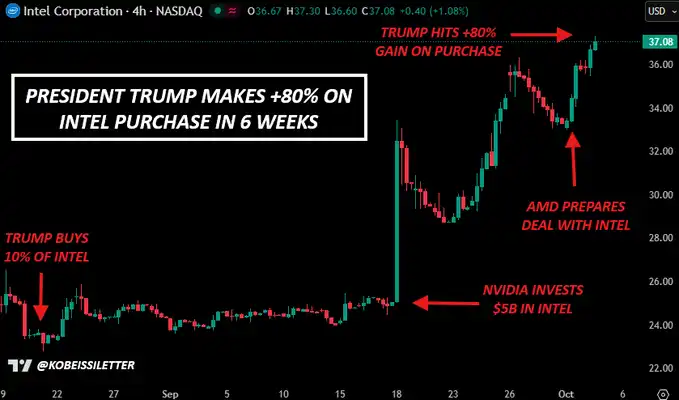
For example, look at a news item from August 11, 2025. At that time, President Trump met with Intel CEO Lip-Bu Tan. Just a few days before, Trump had posted on Truth Social that Tan had "serious conflicts of interest and should resign immediately, with no other options."
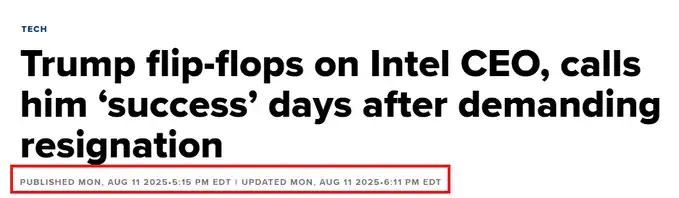
A few days later, the Trump administration announced it had reached an "agreement" with Intel to acquire 10% of the company's shares. As shown below, this investment gained over 80% in less than two months.
Again, it emphasizes that President Trump's goal is almost always to reach a "deal."
In some cases, conflicts may end in this second stage. After the initial threats and pressure lay the groundwork, both parties may reach an agreement through negotiations, resolving the situation in this stage.
If not resolved, it will enter the third step.
Step Three: "Strikes" on Friday Nights
When the initial pressure exerted by Trump fails, he often escalates actions further, turning to military force or economic warfare.
A very stable tactical feature in Trump's escalation model is the timing of choices. Many major announcements, key strikes, or sudden policy changes often occur on Friday evenings—when the U.S. stock market is closed, and liquidity in the futures market has not yet fully formed.
Why choose this timing? Because Trump is highly sensitive to severe fluctuations in financial markets.
Here are some important actions that occurred on Friday nights or Saturday mornings:
U.S.-Israeli joint air strikes on Iranian nuclear facilities—June 21
U.S. military strikes on Caribbean drug vessels—September 1
Threats of imposing 100% tariffs on China—October 10
Closure of Venezuelan airspace—November 29
Nigerian military actions—December 25
U.S. airstrikes in Iran—February 28
In fact, since 2025, multiple geopolitical or policy actions have taken place after Friday's market close, and this timing choice is considered a deliberately arranged strategy.
If significant geopolitical events erupt during trading hours, the market’s price discovery mechanism often quickly goes awry: market liquidity immediately declines, quantitative trading algorithms amplify volatility, and intra-day sharp fluctuations can trigger panic chain reactions.
In contrast, announcing actions on Friday night allows for a buffer period.
Investors, institutions, and governments can utilize the entire weekend: digest information, assess risks, consult advisors, and explore various scenarios.
By the time the market reopens, all parties have a more thorough judgment of the situation.
For the Iran situation, the critical moment was February 28. Typically, on the Sunday of the same week (before the futures market opens), Trump often releases signals of "possible agreements" to ease market expectations.
But this time, it evidently did not occur, and the situation entered the fourth step.
Step Four: Risk Premium Spread Across Various Assets
After the shock events of the third step, at 6 PM on Sunday (Eastern Time) when the futures market opens, asset prices generally exhibit severe fluctuations.
However, the market often remains skeptical of whether the conflict will persist long-term.
The reason is simple: everyone knows that Trump ultimately hopes to reach a deal. Therefore, the initial sharp fluctuations seen in the stock, commodity, and bond markets often partially retrace before Monday's stock market opens.
For example, let’s look at the market performance on March 2 (the day before we wrote this article): the movements of crude oil prices and the S&P 500 index reflected this typical market reaction pattern.
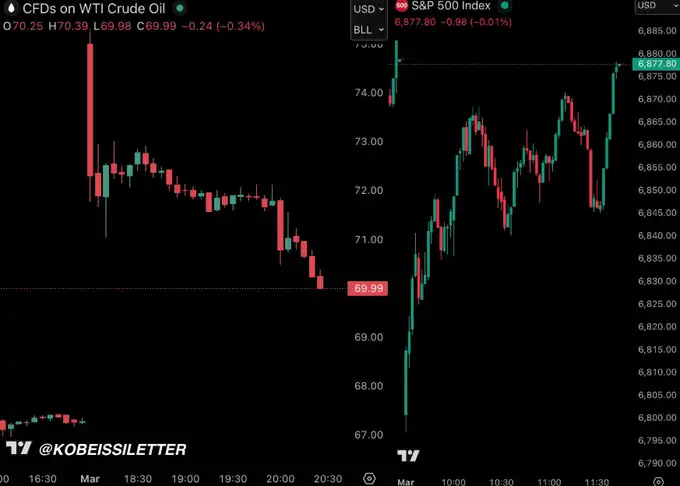
S&P 500 and WTI Crude Oil—March 2, 2026
WTI crude oil prices at one point retraced about 70% of their gain, while the S&P 500 index even briefly turned positive yesterday. However, today, this trend has reversed again—oil prices hit new highs, while the stock market refreshed its phase low.
The reason for this change is that President Trump understands: the market also knows he generally prefers to "make deals." Therefore, although the market once bet that this conflict would end soon, the reality is often that the conflict continues to escalate.
Now, the situation has entered the fifth step.
Step Five: Trump Hints Conflict May "Last Long"
When investors expect Trump to "take a step back" and quickly buy the dip, the market is often caught off guard by sudden changes. As news headlines worsen, many will believe Trump will soon begin to ease pressure on the target. However, the actual situation is often quite the opposite.
As shown in the statement from March 2, Trump now states, "The war can go on forever," and claims the U.S. has "unlimited mid- to high-end weapons."
It is noteworthy that the word "forever" is placed in quotes. This is actually a tactical phrase: the message Trump conveys is—he does not wish for the war to persist indefinitely, but if necessary, the U.S. is fully capable of doing so.
This is also a negotiation strategy.
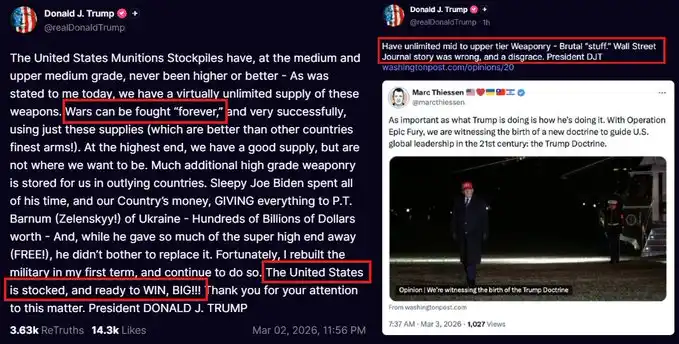
President Trump—March 2 & March 3, 2026
Since the outbreak of the conflict between the U.S.-Israel and Iran, even before the war truly began, our judgment has been that President Trump would not benefit from a long-term war. Even with recent statements about "forever war," we maintain this viewpoint.
Why? Because the three most important policy goals of the Trump administration currently include: becoming a "peace president"; lowering inflation; and reducing U.S. gasoline prices to $2 per gallon.
Engaging in a long-term war with Iran would run contrary to these core policy goals. Especially in a critical midterm election year, any short-term outbreak and continuation of conflict will significantly impact these agendas.
Step Six: Market Begins Pricing for Long-Term Conflict
As of March 3, our sixth step in this "Playbook" seems to have begun to manifest.
Consider the following market performances:
Brent crude oil prices rose above $85 per barrel for the first time in nearly two years;
Previous gains in the U.S. stock market have fully retracted, and new weekly lows have been set;
Market risk aversion sentiment is rapidly rising, with funds accelerating withdrawal from risk assets.
That day, the Dow Jones index fell by about 1100 points.
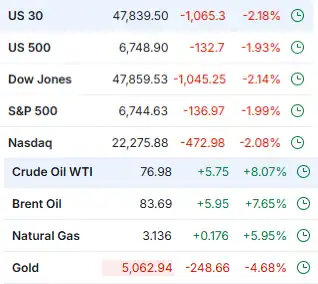
U.S. Markets and Commodities—March 3, 2026
At this phase, the market no longer assumes this is just a transient, symbolic military conflict.
Rising oil prices above $85 per barrel reflect not just a brief weekend friction, but pricing related to supply chain risks, rising tanker insurance costs, and the potential partial closure of the Strait of Hormuz.
Meanwhile, the U.S. stock market dropping to new weekly lows is not just an immediate reaction to any news headline, but a reassessment of duration risk regarding the ongoing conflict.
This is precisely the psychological turning point that Trump's strategy aims to create.
When the first drop occurs, investors often choose to buy the dip because they believe a deal will be reached soon. During the second drop, investors will still buy in, believing the escalation is only temporary. It is only at the third drop that the market’s position structure will begin to undergo real adjustments.
The so-called "Smart Money" often can continuously identify when market sentiment is excessively leaning in one direction, especially as retail participation rises.
In 2025, our investment strategy was largely based on this: how to anticipate the next market turning point by recognizing Trump’s historical patterns in economic conflicts.
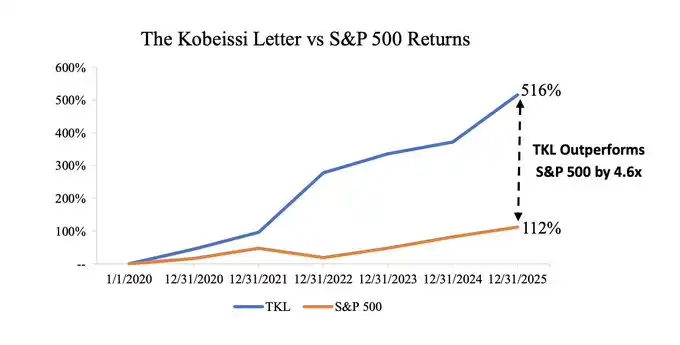
As shown, since 2020, our investment strategy returns have approached five times that of the S&P 500 index. Just in 2025, our trading strategy targeting the S&P 500 achieved a return of 21.8%, significantly outperforming the index itself. The reason lies in our ability to identify key changes in market sentiment and trends in advance.
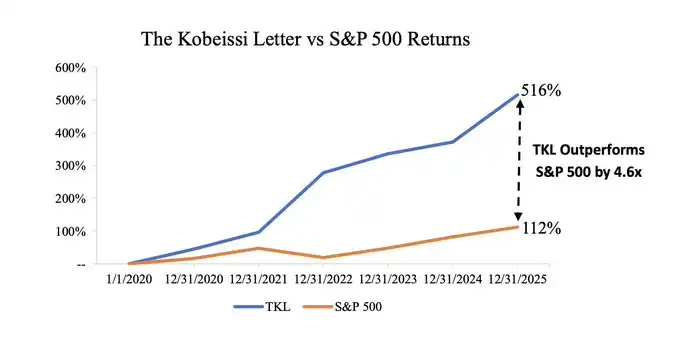
Kobeissi Letter Strategy Performance (2020–2025)
This brings us to Step Seven.
Step Seven: "Conditional De-escalation Signals" Emerge
Before explaining this step, it is important to note: the time span between step six and step seven carries significant uncertainty. For example, in the trade war at the beginning of 2025, this phase lasted several months before tariff "pauses" emerged on April 9. This turning point was largely driven by the rapid surge in U.S. Treasury yields, as shown below.
Typically, there will always be some triggering factor that prompts Trump to choose to throttle back or calm the situation. This factor may be:
One side of the conflict actively proposing to "make a deal";
or significant changes or pressure signals in the financial markets.
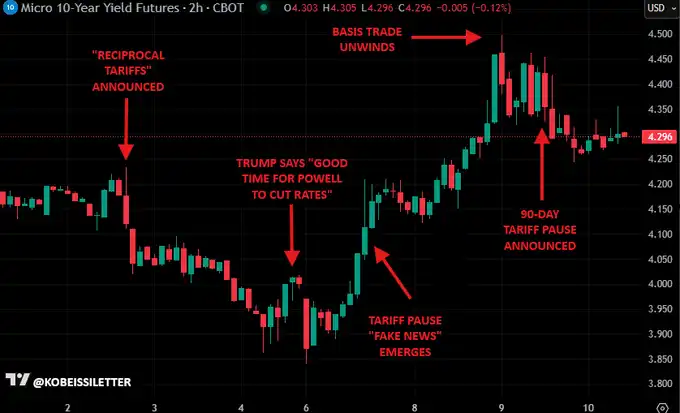
10-Year U.S. Treasury Yield—April 9 Tariff "Pause"
When the risk premiums in the stock, commodity, and fixed-income markets significantly expand, Trump often begins to release some carefully designed de-escalation signals. It is important to note that these statements do not usually imply a real concession.
In the context of the Iran war, there may be two pivot points: either a change in the Iranian government, or a significant event that has a structural impact on the U.S. and global economy.
At this stage, official language will gradually shift toward conditional paths for resolution. Statements will begin to emphasize: negotiations are possible if certain conditions are met; simultaneously, expressions such as "talks", "consultations", or "framework agreements" will gradually enter the narrative. The core purpose of this phase is to test both the opponent's and financial markets' reactions without giving up strategic initiative.
Recent examples include:
In October 2025, Trump reached a tariff agreement with China;
In January 2026, an agreement related to Greenland was reached with the EU;
On February 9, 2026, a trade agreement was made with India.
These agreements almost universally follow a similar path: threats → action taken subsequently → further escalation → finally, gradual de-escalation of the situation.
Step Eight: Feedback Loop Between Markets and Politics
One often overlooked factor in this strategy is that financial markets itself gradually become part of the negotiation environment. Trump has repeatedly shown that he is highly aware of stock market performance, energy prices, and inflation expectations, viewing these factors as part of a broader political narrative.
If the conflict lasts too long and leads to a significant rise in oil prices, it will directly impact his repeatedly emphasized three core policy goals: to shape himself as a leader committed to peace; to lower inflationary pressures; and to reduce gasoline prices.
Rising energy costs will quickly transmit to consumer sentiment and inflation data, which in turn will have significant effects on the political landscape during the midterm election cycle.
According to estimates from JP Morgan, if the Strait of Hormuz is closed, oil prices could rise to $120–130 per barrel. This would imply that the U.S. CPI inflation rate could climb to about 5%.
And the last time the U.S. experienced 5% inflation was in March 2023, when the Federal Reserve was in an aggressive rate-hike cycle.
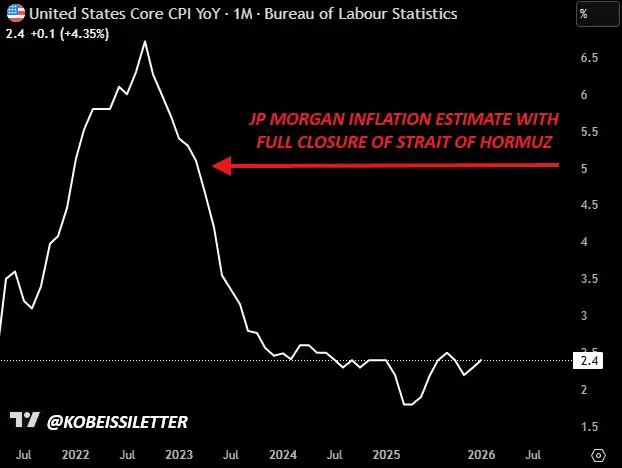
In the current environment, several key indicators are worth close attention: Brent crude oil prices consistently above $90 per barrel will significantly exacerbate market concerns about inflation; a stock market drop of 5% or more will clearly alter investor sentiment; an increase in gasoline prices exceeding 10% will severely impact consumer confidence.
Once these thresholds are reached or approached, the probability of news about negotiations emerging in the market will sharply rise.
Important Note: This is precisely the time when "smart money" begins to position for buying—because at this moment, retail sentiment often collapses completely.
Step Nine: Achieving Agreements and Shaping Narratives
In the context of the Iran war, the ninth step is somewhat conditional.
If the Iranian government collapses, the U.S. and Israel are likely to declare mission accomplished, military objectives achieved. In this case, this "Tariff Playbook-style" strategy will conclude before the ninth step occurs.
If none of the above situations occur, it enters the next phase: within this framework, almost all significant confrontations ultimately conclude with negotiated results, which are shaped as strategic victories. The specific agreement structure may vary by circumstance, but the narrative logic tends to remain consistent: "maximum pressure" compels the other party to make concessions.
In past trade conflicts, agreements reached are often portrayed as proof of economic advantages brought by the escalation strategy (for example, trade agreements with China, the EU, India, Vietnam, and Japan).
In corporate-level confrontations, it usually starts with public pressure, followed by achieving equity investments or structural adjustments (like the agreements related to Intel and rare earth elements).
And in geopolitical conflicts, ceasefire agreements or framework arrangements are interpreted as: forcing the opponent to compromise through a hardline stance (for example, several conflicts Trump ended in 2025).
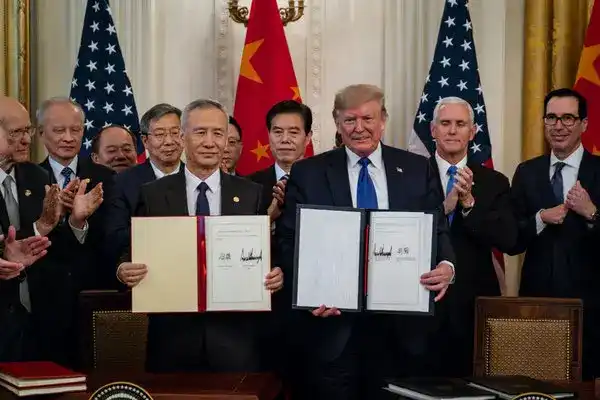
If the Iran conflict develops along existing patterns, a genuine resolution will often only emerge after sufficient stakes and pressure are demonstrated.
This type of resolution may include: ceasefire agreements linked to concessions on nuclear issues; regional security arrangements with implementation mechanisms; or sanction adjustment proposals contingent on compliance conditions.
The specific structure of the agreements is not the most crucial; what truly matters is the timing of the agreement and how the narrative is framed.
Step Ten: Intense Asset Repricing and Political "Victory Narratives"
The final phase of Trump's conflict strategy does not end with the announcement of an agreement. The true endpoint is the market's reaction to the agreement and the ensuing political narrative.
Historically, once a clear resolution framework appears, financial markets often do not adjust slowly, but undergo rapid and intense repricing. The primary reason is related to changes in market position structure.
When negotiations truly become credible, investors have typically adopted a highly defensive configuration: energy asset allocations increase noticeably; exposure to stock risks is significantly reduced; and due to high uncertainty, market volatility remains elevated.
When this uncertainty suddenly dissipates, these positions get quickly liquidated, triggering sharp price reversals.
Similar situations have been witnessed in April 2025, August 2025, October 2025, and January 2026, as illustrated below.
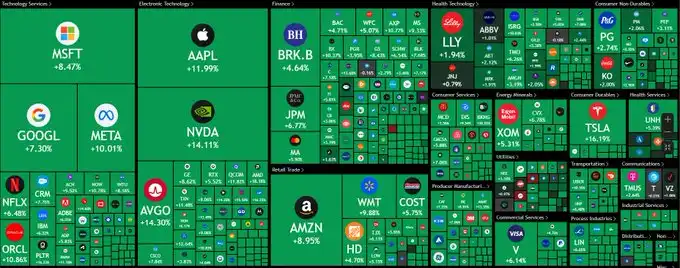
In past trade wars, once a tariff pause is announced or a type of framework agreement is reached, the stock market tends to rise rapidly, even if those deeper structural issues remain unresolved. Similarly, during periods of escalating geopolitical conflict, once the market confirms that shipping channels will reopen and conflicts will not further escalate regionally, oil prices typically fall back rapidly.
This type of price reevaluation tends to come very sharply because it is not a sudden improvement in fundamentals driving market changes, but rather the rapid decline of risk premiums. The market's uptrend is not because everything becomes perfect, but because the likelihood of the worst-case scenario is significantly reduced.
Again, emphasizing that even just temporarily allowing the market to price for the "worst-case scenario" is a very important part of Trump's negotiation strategy.
We still hold the judgment: if in the coming days or weeks the U.S.-Israel military actions against Iran do not lead to the collapse of the Iranian government, negotiations will ultimately return to the table.
Trump does not wish for a "forever war," as such a situation contradicts any of his economic goals.
What Could Happen in the Next 2–4 Weeks
Currently, the situation seems to be transitioning between the peak of escalated rhetoric and the beginning of releasing conditional de-escalation signals. Compared to when the initial airstrikes occurred, the market has now begun to price for a more prolonged conflict.
Oil prices have broken upwards, previous stability rebounds in the stock market have vanished, and defensive capital inflow is evidently accelerating.
Historically, this is often a phase where pessimistic sentiment begins to firmly establish itself in market positions. But at the same time, the probability of negotiations being reached quietly rises beneath the surface, and "smart money" often begins to look for trading opportunities at this stage.
This is reflected in the current price movements of silver and gold. Both metals have shown significant declines, with silver dropping about 20% within 24 hours, even as the market is overall re-pricing for risk premiums.
This clearly indicates that the market is witnessing large-scale withdrawal and waiting behavior, with holding cash increasingly seen as the most straightforward hedging choice by many investors.
And the "smart money" is often observing these capital flows.
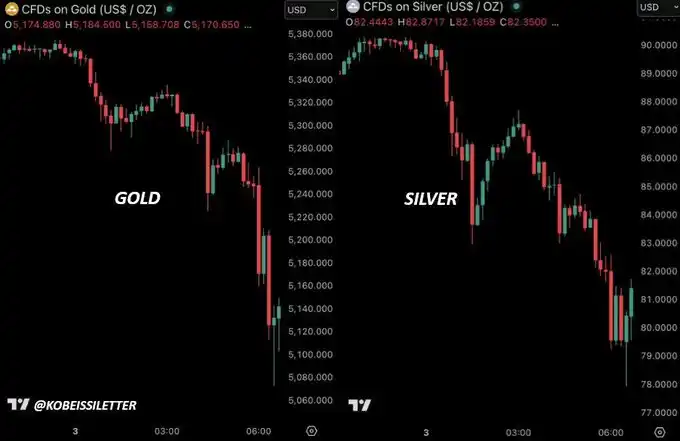
Gold and Silver—March 3, 2026
Final Point: Do Not Forget the True Objective
In the coming weeks, there are roughly three main scenarios.
The first scenario is: a brief escalation of conflict drives oil prices further up and stock markets continue to decline, followed by a sudden shift in rhetoric announcing negotiation talks. In this case, due to prior overly defensive positions in the market, once negotiation signals emerge, asset prices may rapidly reverse.
The second scenario is: the conflict progresses in a controlled yet persistent manner. Oil prices remain high but do not experience drastic spikes; the stock market fluctuates at high volatility, waiting for the situation to further clarify. In this case, solutions may not emerge until later in the month, following continued pressure.
The third scenario is: a significant escalation of regional conflict, for example, substantial disruptions to shipping routes or more countries becoming directly involved in the conflict. In this case, oil prices could reach three-digit levels and compel a deeper revaluation of global risk assets. Considering historical experiences and the current critical midterm election year, we believe that the probability of this outcome is relatively low but not impossible.
Ultimately, do not forget a fact: in nearly 13 months since Trump took office, almost every significant conflict involving him has ended with an agreement.
Trump is essentially a dealmaker skilled in negotiation and trading. If you can identify and follow this pattern, you often benefit from it.
About Our Strategy
In the current turbulent market environment, those who can remain objective and strictly adhere to a systematic approach are encountering one of the most attractive trading environments in recent years.
It is this objective and systematic investment approach that has allowed our strategy to consistently outperform the market benchmark. As shown, since 2020, our investment strategy's cumulative return has approached five times that of the S&P 500 index.
免责声明:本文章仅代表作者个人观点,不代表本平台的立场和观点。本文章仅供信息分享,不构成对任何人的任何投资建议。用户与作者之间的任何争议,与本平台无关。如网页中刊载的文章或图片涉及侵权,请提供相关的权利证明和身份证明发送邮件到support@aicoin.com,本平台相关工作人员将会进行核查。


