Author: Zen, PANews
The world spotlight is on Iran and the Persian Gulf. When the outside world talks about Iran, it often revolves around military and regime risks, energy and shipping shocks. The immediate reports from mainstream media focus on military actions, oil and gas facilities, the Strait of Hormuz, and the sharp fluctuations in financial markets.
However, beneath these grand narratives, if we zoom in on the ordinary people in cities like Tehran, Mashhad, and Ahvaz, we will find that, during times of heightened tension, protecting life and assets is the most important issue.
After the US and Israel launched attacks, the asset outflow from Iran's largest cryptocurrency exchange Nobitex surged, increasing by about 700% in just a few minutes. A report from Chainalysis also confirmed that the hourly trading volume of cryptocurrencies in Iran rose sharply within hours following the attack.
In the four days leading up to March 2, over ten million dollars' worth of cryptocurrency has accelerated outflow from Iran. The funds of the Iranian people are finding a safer path through cryptocurrency.
Iran's Economy under Dollar "Dominance"
For Iran, any escalation of the situation in the Middle East quickly transmits to the fragile nerves of exchange rates and the financial system, while cryptocurrency has unexpectedly become an important medium.
In recent years, Iran's economy has become increasingly trapped in a cycle of external sanctions, internal imbalances, and currency depreciation. The continuous weakening of the national currency, the rial, has become not just a change in price, but a source of nationwide social panic.
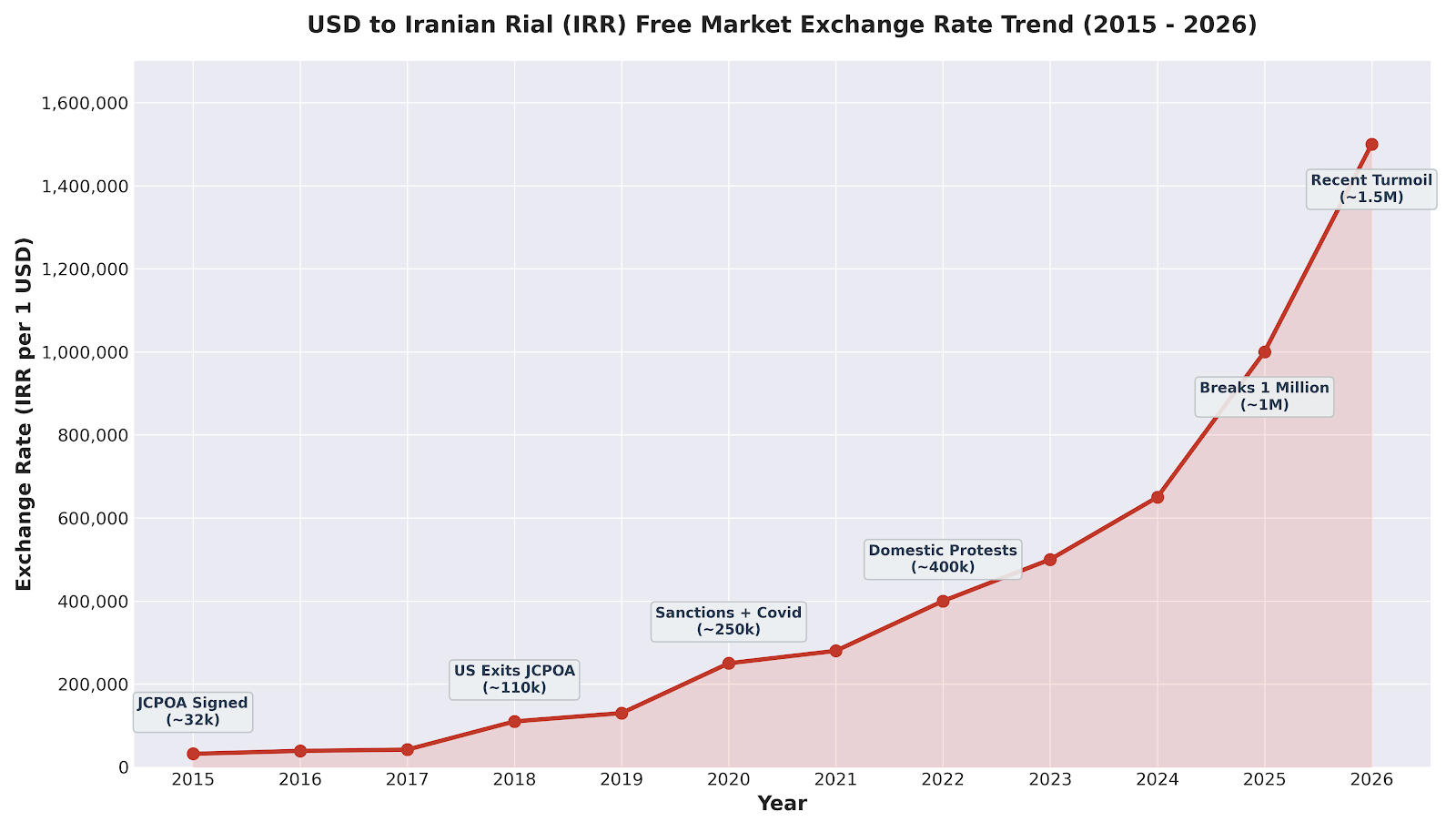
After the nuclear agreement (JCPOA) was reached in 2015, the market once hoped for an easing of sanctions: at that time, the free market exchange rate was about 32,000 rials to 1 US dollar. However, after the US withdrew from the JCPOA in 2018 and announced a phased re-imposition of sanctions, the rial quickly entered the "hundred thousand rial era," and thereafter, the long-term sanctions combined with inflation, tight foreign exchange supply, and geopolitical conflicts caused it to fall below one million rials last year. At the beginning of this year, amid widespread protests, it hit a historical low of 1.5 million rials.
In a global financial structure centered around the dollar, Iran, which is sanctioned and "choked," has to face a situation of dollar dominance and continuous depreciation of the rial.
The dollar, as the "hub currency" of global foreign exchange trading, is able to facilitate imports, debt, insurance, shipping, critical component procurement, and other cross-border transactions in a stable and low-friction manner. Even if Iran's printing press roars, issuing more rials domestically cannot replace this critical capacity.
In many commodity and supply chain pricing systems, the dollar remains the natural pricing anchor; in a sanctioned environment, it becomes more difficult for Iran to obtain dollar settlement services through normal banking channels, making the entry of hard currency scarce and expensive.
Therefore, many people anticipate quickly converting their rials into more reliable assets—such as US dollar cash, gold, and cryptocurrencies dominated by stablecoins like Bitcoin and USDT.
As an Islamic country, financial activities must also comply with the regulations of Islamic law (Sharia). Islamic teachings forbid all forms of usury (Riba) and gambling (Gharar), while cryptocurrency trading carries volatility and speculative nature.
However, Iran's former Supreme Leader Khamenei has held a relatively open stance towards cryptocurrency and called for keeping Islamic law up to date. Khamenei's comments essentially reflect a pragmatic compromise in the face of an economic crisis.
From Government to Society, Iran Needs Cryptocurrency
Due to long-term sanctions and high inflation, both the Iranian government and the populace are seeking alternative sources of hard currency in their own ways. This is why cryptocurrencies, represented by Bitcoin and US dollar stablecoins, have gradually shifted from being "speculative goods" to an almost indispensable value tool in Iran. It serves both as a financial safety valve for citizens and a "cyberbank" for the state apparatus to evade sanctions.
The Iranian government's attitude toward cryptocurrency can be described as "mixed feelings, utilizing and suppressing in tandem."
At the national level, when cryptocurrency activities can provide alternative channels for import settlement, foreign exchange acquisition, or fund transfers, regulators tolerate or even embrace them within certain limits, as seen in the earlier opening of domestic Bitcoin mining. Cryptocurrencies are also important tools in Iran's government and military's "shadow financial network," used to transfer funds and evade regulation.
According to TRM Labs, the company has identified over 5,000 addresses marked as associated with the Islamic Revolutionary Guard Corps (IRGC) and estimates that since 2023, the organization has transferred cryptocurrencies worth 3 billion dollars. The UK blockchain research firm Elliptic stated that the Central Bank of Iran obtained at least 507 million dollars worth of stablecoin USDT in 2025.
However, when cryptocurrency is viewed as accelerating the depreciation of the rial, strengthening the expectation of capital flight, or forming an unregulated informal financial network, the Iranian government quickly shifts to tighten controls.
In early 2025, the Central Bank of Iran (CBI) "suddenly stopped all rial payment channels for cryptocurrency exchanges," resulting in over 10 million crypto users being unable to purchase Bitcoin and other digital assets with rials; reports pointed out that one of its main objectives was to prevent further depreciation of the rial and to avoid the rapid exchange of the currency for foreign currency or stablecoins through exchanges.
This method of cutting off the entry point of fiat currency essentially uses administrative measures to sever the most convenient channel for the public to convert rials into value. However, it does not mean that Iranian society no longer needs cryptocurrency; instead, it will push demand into even grayer and more decentralized paths, including over-the-counter trading, alternative payment accounts, or more covert on-chain transfers.
When the state repeatedly employs this governance approach during a currency crisis, the preference of ordinary people for "off-system assets" will also be further strengthened. Every sudden restriction serves as a reminder that financial rules may change at any moment, and assets are not entirely under individual control.
At the citizen level, the demand for cryptocurrency is mainly driven by three forces: value preservation, transferability, and speculation. According to TRM Labs, 95% of the capital flows related to Iran come from retail investors. Iran's largest cryptocurrency exchange, Nobitex, disclosed that it has 11 million customers, most of whose trading activities are from retail and small investors. The exchange stated, "For many users, cryptocurrency mainly serves as a store of value in response to the continued depreciation of the local currency."
More fantastically, in mid-2024, Telegram "Tap-to-Earn" crypto games such as "Hamster Kombat" and "Notcoin" caused nationwide excitement in Iran. On Tehran's subways and streets, countless Iranians frantically tapped their phone screens, hoping to combat soaring prices through free "crypto airdrops." Reports indicated that nearly a quarter of Iran's population participated in such games at that time. When the national currency loses credibility, even the hope of clicking screens to obtain negligible virtual coins becomes a glimmer of light in the darkness.
Thus, in Iran, we can see a paradox: authorities are worried that cryptocurrency will accelerate the depreciation of the rial and weaken capital controls, so they will cut off rial payment channels at critical moments; on the other hand, within the long-term structure of sanctions and foreign exchange scarcity, cryptocurrencies continuously prove their usability. For ordinary Iranians, this usability is immensely important, becoming an emergency exit in times of crisis.
The Silent Battle for Electricity and Growing "Black Miners"
Unlike the direct confrontation with firearms at the frontlines, Iran has been engaged in a silent conflict over electrical resources for years.
In a country like Iran, which is "deficient in social resources," electricity is no longer merely a necessity of life; it has been redefined as a strategic resource that can be arbitraged. But the cost of this arbitrage is ultimately borne by ordinary residents, leading to severe electricity shortages.
Although Iran is a typical energy-rich country, it has long been trapped in a cycle of electricity shortages and rolling blackouts. The main reasons include insufficient infrastructure investment, aging power generation and transmission systems, and price subsidies leading to excessively rapid demand growth.
The Iranian power company Tavanir stated in a public report in the summer of 2025 that cryptocurrency mining consumes nearly 2000 MW of electricity, equivalent to the output of two Bushehr nuclear power plants. More critically, mining accounts for about 5% of total electricity consumption but may constitute 15%-20% of the electricity shortfall at that time.
Tavanir noted that during an internet outage related to a conflict with Israel, national electricity consumption decreased by about 2400 MW; Tavanir partially attributed this to a large number of illegal mining machines going offline and claimed that 900,000 illegal devices were involved, indirectly confirming the scale of underground mining.
The CEO of Tehran Province's electricity distribution company also stated that Iran has become the world's fourth-largest cryptocurrency mining center, with over 95% of active mining machines operating without a license, indicating a high degree of illegality and being a "paradise for illegal miners." This statement shifts the blame from the government to ordinary Iranian citizens.
In recent years, Iranian authorities have been cracking down on illegal mining, but instead, it has only increased. This indicates that so-called illegal mining has transformed from a fringe phenomenon into a structural industry, backed not only by electricity price arbitrage but possibly also by gray protections, law enforcement rent-seeking, and complex local interest networks, stamped with deep-seated privileges.
Religious sites and industrial zones controlled by the military even enjoy benefits of free mining.
“Ordinary citizens and even private enterprises cannot obtain the power needed to run and cool such a large number of mining machines.”Workers in the cryptocurrency mining industry believe thatonly industrial-scale production activities can cause such huge electricity consumption.
According to various media outlets and investigative agencies, the privileged class in Iran dominates this electricity feast. Religious places like mosques legally enjoy extremely cheap or even free electricity supply, causing many mosques to turn into roaring "underground mines."
Meanwhile, heavily industrial parks controlled by the military and certain confidential facilities exempt from blackout indicators also often conceal oversized mining operations. While the privileged classes exploit free "state electricity" to accumulate Bitcoin, ordinary residents burdened with high inflation find it a luxury to maintain electricity for fans during summer nights.
Ultimately, Iran's electricity crisis and illegal mining are not simple public order issues; they represent an electricity struggle centered on subsidized resources, currency depreciation, and survival pressure. The pain of power outages will continue to linger in ordinary households during summer nights.
Currently, under the endless geopolitical conflicts and political uncertainties, the economic future of Iran is once again cast in shadow.
免责声明:本文章仅代表作者个人观点,不代表本平台的立场和观点。本文章仅供信息分享,不构成对任何人的任何投资建议。用户与作者之间的任何争议,与本平台无关。如网页中刊载的文章或图片涉及侵权,请提供相关的权利证明和身份证明发送邮件到support@aicoin.com,本平台相关工作人员将会进行核查。


