Original author: Cosmo Jiang
Translated by: Ken, Chaincatcher
AI agents are becoming economic participants. But what kind of financial infrastructure do they need to transact without human intervention?
The viral rise of OpenClaw (originally Clawdbot) marks a generational leap in autonomy. When these AI agents start to interact with each other—sometimes even negotiating and trading—the future of agents shifts from science fiction to operable reality.
OpenClaw is just one step in a rapidly advancing process. Trillions of dollars are being invested in building an AI-powered world. It is expected that by 2026, spending by the largest cloud service providers in the AI space in the U.S. will exceed $650 billion, which is about ten times the inflation-adjusted cost of the Apollo program.
Initially simple chatbots are evolving into agentified, fully autonomous systems. These AI agents will not only generate content but will also become economic participants; they are capable of reasoning, acting, trading, coordinating, and debating—all without real-time human supervision.
Some forecasts suggest that by 2030, AI agents could facilitate $3 trillion to $5 trillion in global consumer business transactions. Even if only 10% of these transactions occur between agents, this implies a flow of hundreds of billions of dollars in machine-native settlement funds each year.
This naturally raises a question: what kind of financial and coordination infrastructure is suitable for the native business of AI agents?
Today's commercial systems are built for humans, involving personal identity verification, bank intermediation, legal contracts, settlement cycles, and human oversight. Autonomous software cannot walk into a bank branch, sign paper documents, or wait days to complete ACH (Automated Clearing House) settlements. What agents need is infrastructure that is inherently programmable, always on, globally accessible, permissionless, and machine-verifiable.
Blockchain can meet these constraints, and we have already seen this dynamic emerging.
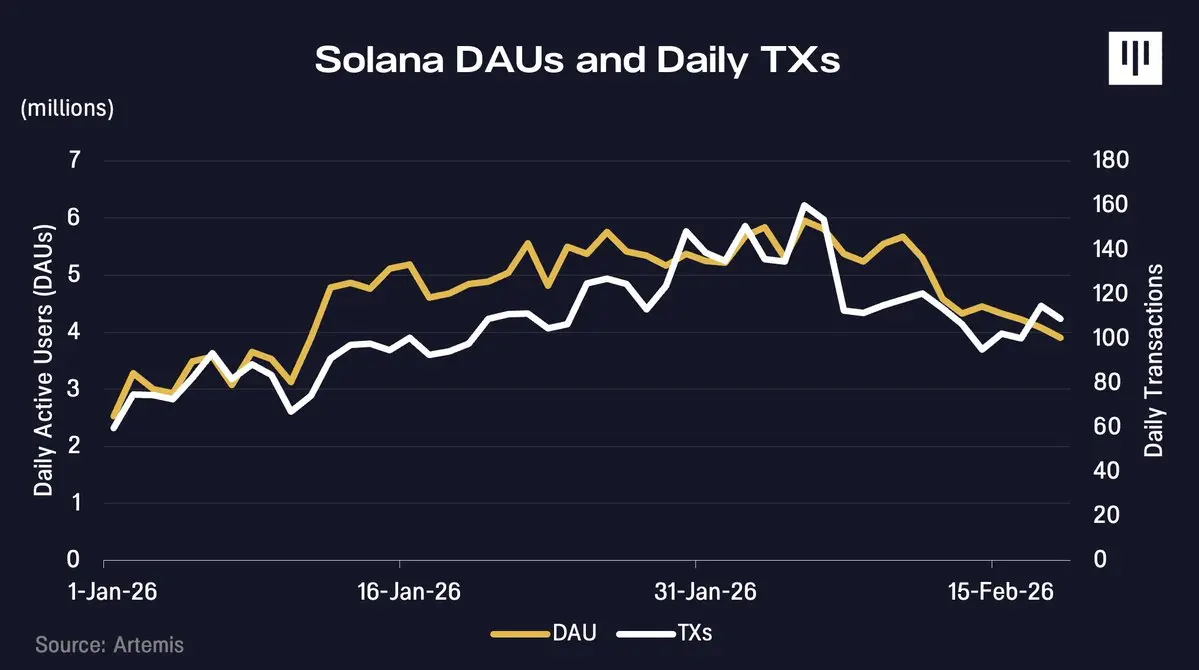
In line with the rapid rise of OpenClaw in January, Solana's transaction volume and active address counts have also begun to rise. Evidence from the social network Moltbook, where the AI agents reside, indicates that they may have driven this growth.
The x402 payment protocol developed by Coinbase allows agents to pay for digital resources in real-time without needing accounts or complex identity verification. Its usage has steadily grown since launch.
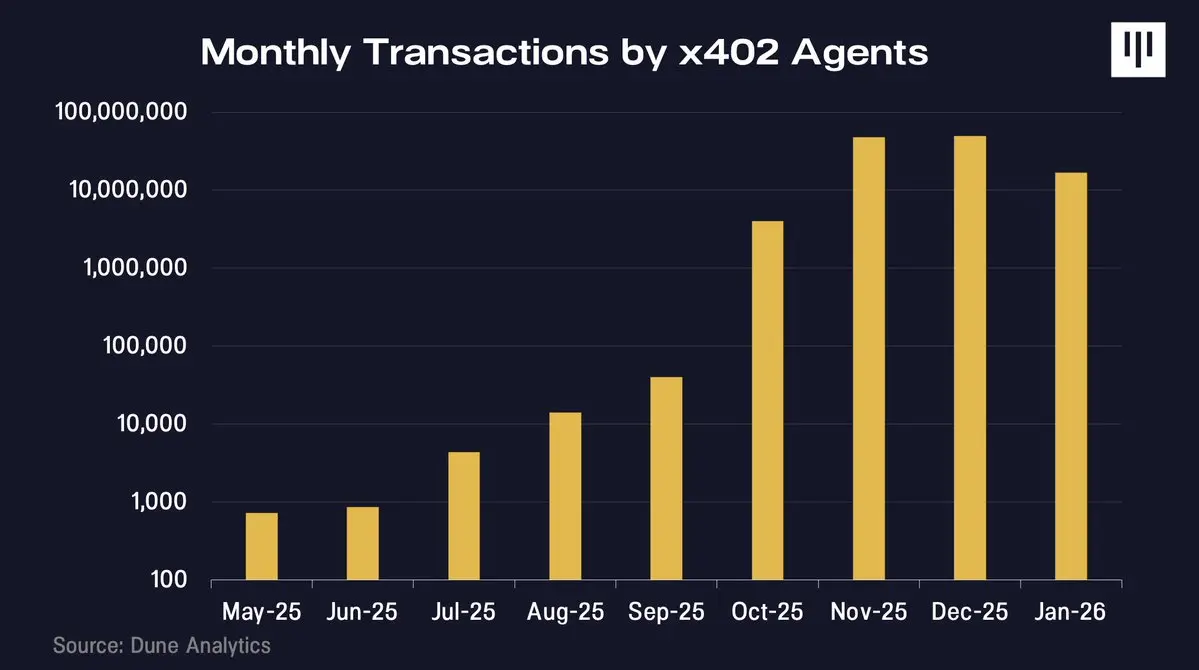
Still in its early stages, existing examples are more directional than definitive. However, if investors are excited about AI innovations, it would be a mistake to overlook “why blockchain tracks may become the cornerstone for unlocking fully autonomous agents.”
Levels of Autonomy
Many would rightly point out that today's AI agents do not need blockchain. This is true, but it is somewhat short-sighted.
McKinsey has outlined six levels of automation that AI-driven businesses can reach, from basic assistance (Level 0) to fully autonomous inter-agent commerce (Level 5). Levels 0-4 can operate within existing financial tracks since human identities still underpin the transactions. Human users have already verified their identities on ChatGPT, Amazon, or Perplexity and linked them to credit cards. The agents merely act as proxies, inheriting that human's identity, payment credentials, and legal status.
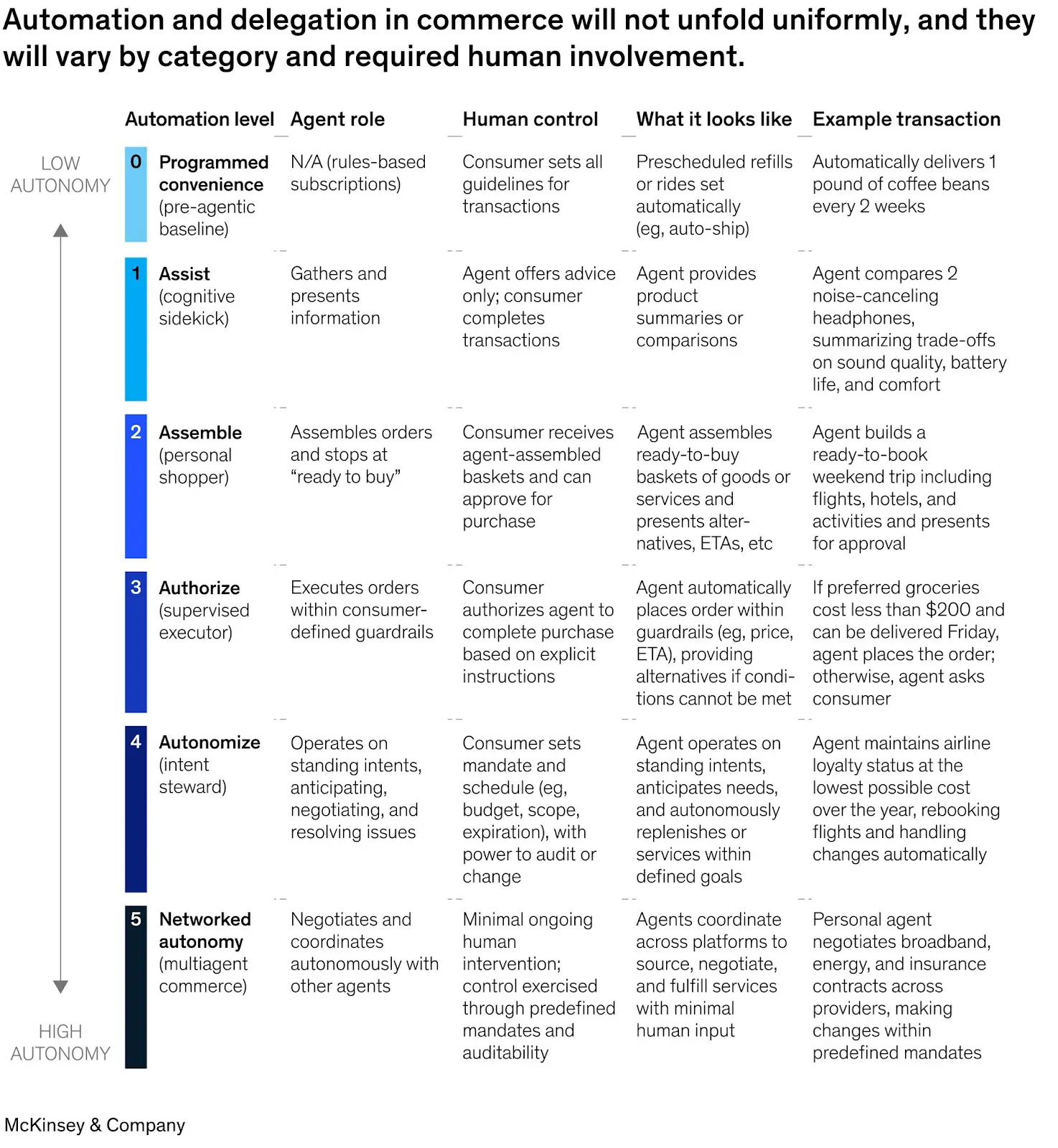
The infrastructure for this model—shared payment tokens, fraud detection systems—already exists and is functioning well through Visa or Stripe.
At Level 5, blockchain tracks become essential: at this point, agents trade directly with other agents without human instruction; there are no human identities to inherit; payments must be programmatic, conditional, and settled in milliseconds; and the agents' reputation must be portable across different platforms.
As long as humans remain involved and responsible, traditional tracks are sufficient. However, once agents become economically independent participants, the constraints will fundamentally change.
Agent Finance
To understand where value will aggregate and why blockchain is important, we must envision the final logical form of AI agents. Some agents will be created by companies or individuals. Others will be generated by the agents themselves, forming increasingly autonomous systems that can reason, allocate capital, and transact without real-time human supervision.
Without human-specified channels (e.g., going to the bank, using Stripe, or establishing a blockchain wallet), agents will rationally choose tracks that maximize speed, reliability, and global coverage while minimizing friction and dependency. When the alternative is opening a bank account and waiting for ACH settlements during limited banking hours, agents will naturally choose permissionless, 24/7 blockchain tracks.
We see three structural constraints that will drive agents toward blockchain tracks.
Identity and Access
Before agents can transact, counterparts must know who or what they are dealing with.
Traditional identity systems are designed for humans, relying on government IDs, physical signatures, and legal personality. Autonomous AI agents do not possess any of these.
Tying agents to human bank accounts immediately raises questions: how to conduct anti-money laundering (AML) checks on software? Who is the liable entity? How to independently authorize multiple agents? How to isolate misconduct while avoiding freezing entire accounts?
In simple cases, agents can inherit their owner's credentials (e.g., ChatGPT Checkout). But this model will collapse once scaled widely. Agents need self-verifiable identities, not borrowed human identities.
Blockchain-based identity verification allows agents to prove their authorization without disclosing sensitive information. You can think of it as a digital credential that anyone, anywhere can verify instantly without having to call a lawyer or check a database.
Emerging standards such as Ethereum's ERC-8004 propose on-chain registries where agents can establish verifiable credentials and accumulate transaction history and reputation over time. An agent with thousands of undisputed transaction records is fundamentally different from a brand new agent, and this reputation is portable across different platforms.
Trust is a prerequisite for business. In an economy driven by agents, the core question will shift from “intercepting bots” to “identifying which bots are trustworthy.”
Programmable Money and Micropayments
Traditional payment tracks are designed for transactions at human scale. Credit card fee structures make micropayments below one cent economically unviable. Fraud detection systems also flag high-frequency machine actions as suspicious.
Business activities among agents operate at fundamentally different scales. An agent writing code may make thousands of API calls within a single workflow. Another might compare pricing across hundreds of data providers. Payments must occur in milliseconds, with amounts often just fractions of a cent.
On-chain transactions can be divided into extremely small units, with very low settlement costs. More importantly, they are programmable. Payments can be attached with conditions: payment only when data is valid, funds released upon task completion, or real-time streaming payments when services are consumed. Agents can mathematically prove their solvency without needing to pre-fund their accounts, greatly increasing capital efficiency.
Blockchain empowers a financial infrastructure matching the operating method of agents: autonomous, high-frequency, conditional, and capital efficient.
Deterministic Execution
Traditional business builds trust on intermediaries. Banks guarantee settlements. Payment processors manage chargebacks. Courts adjudicate disputes. Contracts ultimately rely on human legal systems.
As billions of low-value transactions occur across different jurisdictions, this framework bears immense stress. Non-human participants may not share jurisdictions, legal remedies, or enforceable contracts. Cross-border enforcement is often slow, costly, and fraught with uncertainty.
Blockchain enforces compliance directly coded into smart contracts, thus reducing reliance on centralized systems or legal remedies. Settlement is deterministic and not subject to subjective interpretation. The rules are transparent and verifiable in advance. This is what blockchain geeks refer to as "trustless execution."
For autonomously operating agents at scale, minimizing reliance on centralized intermediaries can reduce friction and increase predictability. Lower friction also expands the boundaries of feasible economic activity. Agent commerce enabled by blockchain tracks is expected to accelerate global GDP growth.
This is Just the Beginning
The question is not whether agent commerce will arrive, but on what kind of infrastructure it will operate.
As AI agents become autonomous economic participants, the number of participants in the global economy will grow exponentially. Agents will require digital-native financial tracks capable of handling programmatic settlements, vast micropayments, permissionless coordination, and technologies that minimize trust in identity. These principles are at the core of blockchain design.
We believe that the rapid uptake of AI agents represents a strong long-term structural tailwind driving blockchain activity. Preliminary evidence indicates this is happening, and we believe it constitutes a value creation opportunity underestimated by most investors.
免责声明:本文章仅代表作者个人观点,不代表本平台的立场和观点。本文章仅供信息分享,不构成对任何人的任何投资建议。用户与作者之间的任何争议,与本平台无关。如网页中刊载的文章或图片涉及侵权,请提供相关的权利证明和身份证明发送邮件到support@aicoin.com,本平台相关工作人员将会进行核查。


