Original Author: ChandlerZ, Foresight News
The rising star player in the prediction market track, Opinion, is about to welcome its TGE moment, but this long-awaited token issuance brings not celebration, but a lot of user anger and loss reports.
According to its announced OPN tokenomics, the first quarter airdrop accounts for only 3% of the total token supply, which is vastly different from market expectations; the pre-market price of Opinion points plummeted from a high of $45/point to $6/point; bloggers such as @daidaibtc openly stated that they burned $200,000 for points accumulation and ultimately received only 2,000 OPN, equivalent to about $1,000.
This is one of the most controversial TGEs since the beginning of 2026.
Pre-market price briefly rises over 30%, but airdrop users are crying
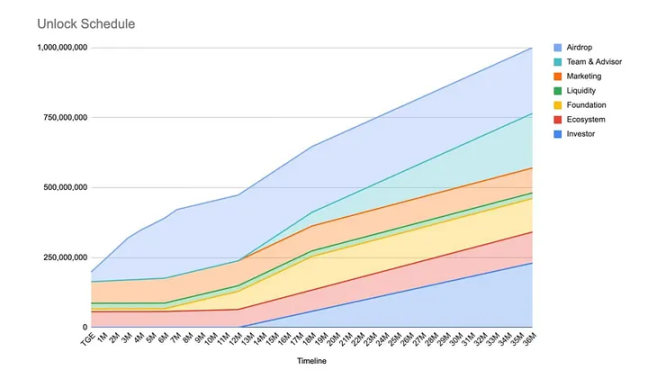
On the evening of March 2, the Opinion Foundation officially announced the tokenomics and roadmap for its native token OPN. The total supply of OPN is 1 billion tokens, with an initial circulation of 198.5 million tokens to be deployed on Ethereum and BNB Chain. In terms of token distribution, the airdrop accounts for 23.5% (235 million tokens), with TGE releasing 3.5%, and the rest vesting over 7 months; investor allocation is 23% (230 million tokens), and the team and advisors account for 19.5% (195 million tokens), both of which have a 12-month lock-up period and a 24-month linear release period.
The foundation accounts for 12% (120 million tokens), with TGE releasing 1%; the ecosystem and incentives account for 11.1% (111 million tokens), with TGE releasing 5.65% (including 3.5% of locked airdrop rewards and 2.15% of retrospective incentives); marketing accounts for 8.9% (89 million tokens), with TGE releasing 7.7%; liquidity and market making accounts for 2% (20 million tokens), with TGE releasing 2%.
After Opinion announced the airdrop query website, the Binance pre-market price briefly rose over 30%, breaking through $0.57.
Some bloggers noted that before the tokenomics was announced, the OPN point secondary market had once quoted $45/point. With the official disclosure that the first quarter airdrop only released 3% of the total token supply, the pre-market price quickly dived to $6/point, with a cumulative drop of over 85%.
Strangely, the price movement itself was in stark contrast to the experience of airdrop users. Due to the extremely low initial circulation, the pre-market price of OPN briefly surged. The logic of low circulation and high control temporarily worked in price terms, but point holders had already been washed out in the pre-market crash. According to feedback from several well-known studios, the cost of points ranged between $5 to $20/point, with the post-TGE airdrop value conversion resulting in almost no one achieving positive returns.
Bloggers such as "带带带比特" openly shared their loss details, having invested $200,000 in point accumulation, ultimately receiving 2,000 OPN, which, based on the current price, is about $1,000. "200,000 bucks for 2,000 coins. Yes, you didn't read it wrong." This statement quickly went viral in the Chinese crypto community.
Polymarket data indicates that the betting probability for "OPN surpassed 500 million FDV one day after launch" is 64%, and market expectations are not considered pessimistic. However, airdrop users' anger is primarily due to the allocation logic itself.
"带带带比特" stated, "Of course I accept getting rekt after trying to farm. Who says farming will definitely make money? Willing to gamble and accept the outcome. My point of frustration is the betrayal. You can learn from Lighter and simply not distribute points. If you don't distribute points, do you think anyone will help you with data? But you distributed points, telling everyone to come help me, use the community, and then at TGE tell you, 'the points I distributed to you to play with no longer count', does that make sense?"
The project team actively called on users to contribute data and generate buzz using the point mechanism, but unilaterally reset the implicit contract at the time of fulfillment. Losses are currently a norm, but the "use-and-discard" operational logic has touched the community's bottom line regarding fundamental trust relationships.
Notable capital bets, founders with Wall Street backgrounds in Hong Kong
Opinion (Opinion Labs) is a chain-based prediction market protocol. Unlike mainstream platforms like Polymarket and Kalshi with binary settlement mechanisms, Opinion focuses on a continuous prediction market model where users can buy and sell, adjust positions at any time during the evolution of topics without waiting for event settlement. The market price continuously reflects changes in collective expectations. The platform uses a CLOB (Central Limit Order Book) structure, while also introducing an AI-assisted market creation feature, allowing any user to initiate structured prediction markets covering a range from macro-financial events to esports, entertainment, and region-specific political content in the Asia-Pacific region.
Regarding the founding team, Opinion CEO Forrest Liu graduated from Columbia University and previously worked as a corporate financing consultant at China Merchants Bank International Capital (CMB International Capital), with a background in traditional financial institutions. The co-founder team also includes former members of JPMorgan. The project aims to fill the gap in the Asia-Pacific content market for Western platforms (Polymarket, Kalshi) and is currently one of the few on-chain protocols in the prediction market track focused on Asian users as the core audience.
Opinion has completed two rounds of financing, totaling over $25 million. In March 2024, Yzi Labs announced the selection of 13 early projects for the 7th season MVB accelerator program, including Opinion. In March 2025, Opinion announced the completion of a $5 million seed round financing led by Yzi Labs, with other investors including angel investment community Echo, Animoca Ventures, Manifold Trading, Amber Group, among others.
The endorsement from YZi Labs means that Opinion directly gained access to Binance ecosystem channel resources and subsequently launched on Binance Launchpool and Binance Wallet Booster program as scheduled. Zhao Changpeng tweeted in October 2025, stating, "Yzi Labs is only one of the few investors in the prediction market Opinion but will do its best to help increase strategic value."
In February 2026, Opinion announced the completion of $20 million Pre-Series A financing, co-led by Hack VC and Jump Crypto, with participation from Primitive Ventures, Decasonic, and Continue Fund.
Another side of high growth, OI/Vol anomalies and data questioned
However, the narrative of Opinion's rapid pace has never escaped a question: Is the trading volume real?
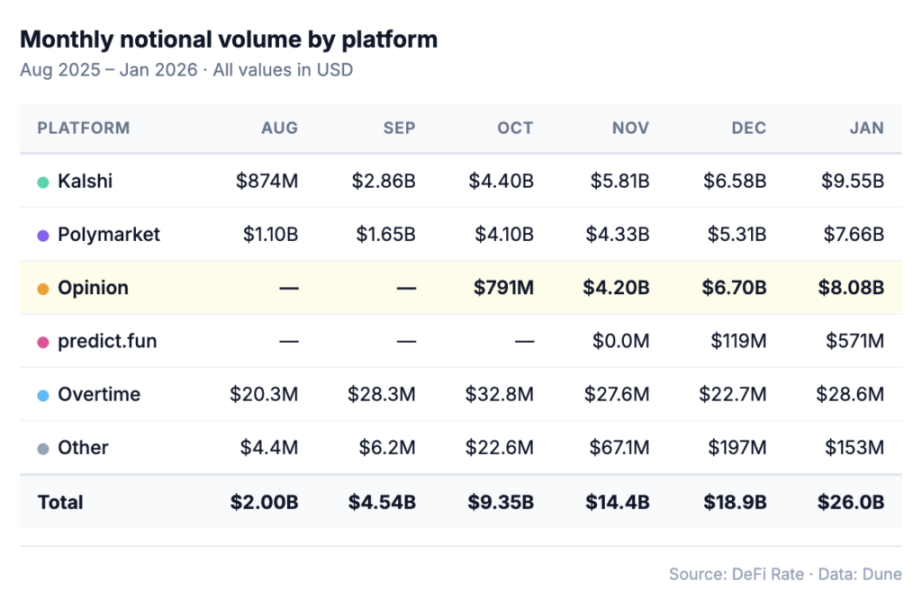
According to a report from DeFi Data, Kalshi's monthly trading volume increased from $874 million in August to $9.55 billion in January, a staggering increase of 11 times, primarily driven by sports events. Polymarket's trading volume also grew from $1.1 billion to $7.66 billion, an increase of 7 times, with a more diversified business composition covering sports, cryptocurrency, and politics.
Opinion launched on October 23 and achieved $791 million in revenue in its first month (less than a month), reached $4.2 billion in November, and further reached $6.7 billion in December, surpassing Kalshi and Polymarket's revenue for that month.
Though trading volume is a key indicator, the actual number of transactions reflects a different situation. In January 2026, Opinion had a trading volume of $8.08 billion, completing 3.2 million transactions, with an average transaction amount of about $2,525. In the same month, Kalshi's trading volume was $9.55 billion, with 54.5 million transactions (averaging $175 per transaction). Polymarket's trading volume was $7.66 billion, with 52 million transactions (averaging $147 per transaction).
Opinion held up 31% of the total industry trading volume with less than 3% of the total industry transaction count. The average transaction amount of $2,525 is 17 times that of Polymarket and 14 times that of Kalshi.
This disparity is nearly impossible to occur under organic user behavior. The report further highlighted two additional anomalies: first, Opinion's active user count experienced a dramatic fluctuation of up to 6 times within weeks, while platforms with organic growth usually see a stable user base; secondly, as the platform scales up, Opinion's per capita trading volume has neither decreased but rather continued to rise. This is contrary to the pattern of almost all normal growing platforms.
The root of the problem points heavily to Opinion's point incentive design (PTS). PTS distributes a fixed 100,000 points weekly, proportionally distributed among all users based on contribution, where the core calculation weight of "contribution" includes three aspects: transaction volume, holding duration, and the closeness of orders to the market midpoint price. Among them, transaction volume directly influences scoring, with larger single transactions carrying higher point weight.
The conclusion from DeFi Rate is that these trading volumes did occur on-chain, but structural incentives created a data form that significantly deviates from organic demand. Opinion's data may not necessarily be false, but it likely records point-driven financial behaviors rather than real predictive market demand.
With the TGE implementation, point incentives declare an end. The fuel driving that $8 billion monthly trading volume has already extinguished, and whether this portion of funds will remain on the platform will directly determine the true foundational user base of Opinion.
Two uncertainties
Opinion appears at an excellent node in the track, where user education for prediction markets is largely complete, regulatory attitudes are becoming clearer, and the potential market size in the Asia-Pacific region is vast. However, the choice to complete the TGE with a tokenomics structure that triggered widespread community backlash during a market downturn will undoubtedly increase the friction cost for user retention in the post-airdrop era.
Opinion currently faces two uncertainties to be answered: after removing point incentives, how much of the $8 billion monthly trading volume remains; and how many of those early users who were "rekt" will choose to stay, and how many have already permanently left. The answers to these two questions will jointly determine how much real value support OPN has before the impending token unlock wave.
免责声明:本文章仅代表作者个人观点,不代表本平台的立场和观点。本文章仅供信息分享,不构成对任何人的任何投资建议。用户与作者之间的任何争议,与本平台无关。如网页中刊载的文章或图片涉及侵权,请提供相关的权利证明和身份证明发送邮件到support@aicoin.com,本平台相关工作人员将会进行核查。