Author: Arthur Hayes
Translation: Shenchao TechFlow
Shenchao's Guide: The core argument of Hayes' article is simple: After every U.S.-led war in the Middle East, from the Gulf War in 1990 to the War on Terror in 2001, the Federal Reserve has chosen to cut interest rates. He believes that the Iran War in 2026 will replay the same historical logic, and that will be the time to increase Bitcoin holdings. Clear in viewpoint and logical in reasoning, one may not necessarily agree after reading, but it deserves serious consideration.
The full text is as follows:
(All views in this article are personal opinions of the author and do not constitute investment decision-making basis, nor do they constitute suggestions or opinions for participating in investment transactions.)
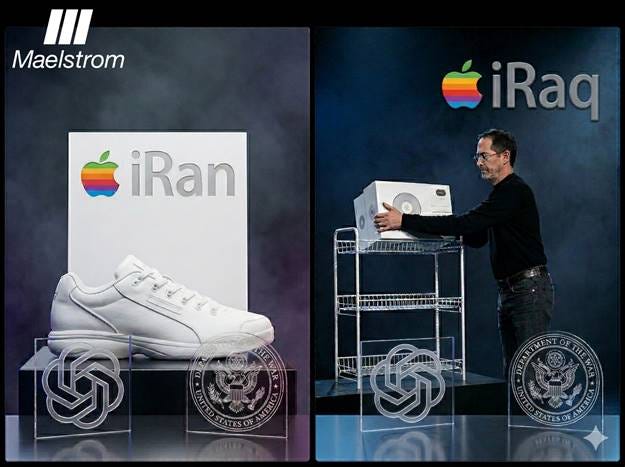
At the behest of America’s most peace-loving president Donald J. Trump, the U.S. Department of War and OpenAI jointly launched an offensive Agent AI weapon—a deadly new Apple iOS. Once uploaded to a nation's network infrastructure, this operating system will initiate a regime change. Regime changes are usually accompanied by indiscriminate bombings of military and civilian infrastructure, resulting in massive casualties, costing at least hundreds of billions and at most trillions of dollars. After eliminating resistance forces, the new political elite fostered by the U.S. can then siphon money from U.S. taxpayers and local residents into personal wealth accounts at JPMorgan Chase. Public dissatisfaction with this pro-U.S. Vichy-style regime in the Middle East continues to accumulate, ultimately fostering a reactionary, often oppressive and bloodthirsty local political structure violently. The sales cycle is thus complete, and OpenAI can begin marketing the next version. Are you already looking forward to the IPO priced at infinity P/E by OpenAI?
Since my consciousness awakened in 1985, leaving marks on the quantum continuum, America's reign over Middle Eastern oil-producing countries—and the geopolitical corridors of oil and gas pipelines—has never ceased. Come and admire this exquisite chart created by Perplexity's new Computer model:
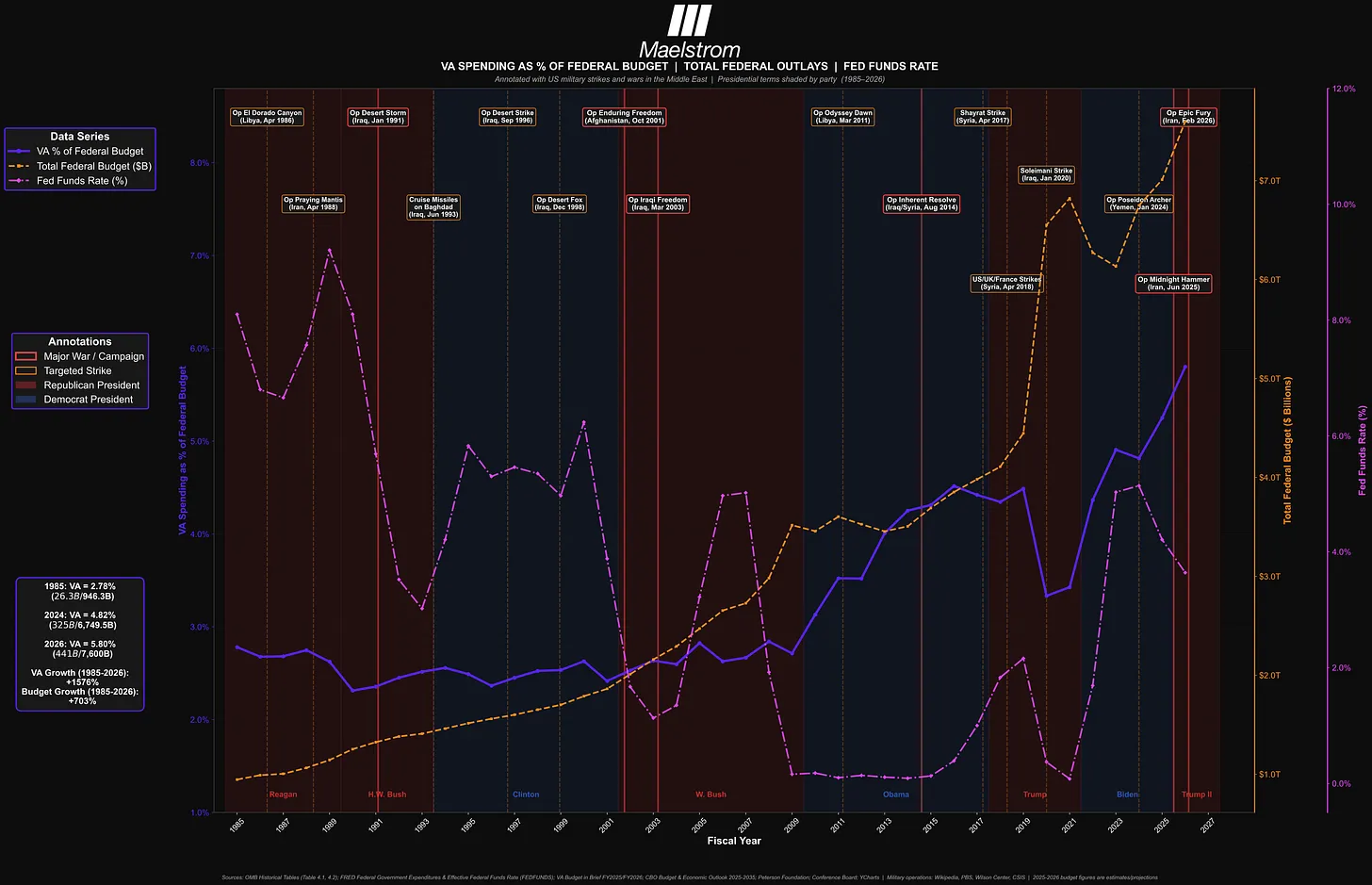
From a macro perspective, the chart shows the humanitarian cost of war: the share of federal budget spending on Veterans Affairs (VA), the total nominal scale of federal spending, and the effective federal funds rate. The chart marks instances of U.S. missile strikes or full-scale wars against Middle Eastern countries, provided for illustration and not as a comprehensive list. As shown, the cost growth for caring for soldiers is double the growth rate of the federal budget. And most importantly for this article: every time the American regime proactively initiates a war in the Middle East, the Federal Reserve immediately lowers the cost of funds. Despite every U.S. president during my lifetime attempting to deceive the public, saying that those video game wars in the Middle East broadcast on evening television do not cause suffering for American soldiers, the data clearly shows: this obsession with military adventures in the Middle East is destroying the lives of Americans at a very high cost.
My lottery of ovaries enabled me to be born in this land defined by fictional curved lines known as America. Throughout my forty years of existence, every red team Republican and blue team Democrat president has launched missiles or initiated full-scale wars against some country in the Middle East. It’s as if once you become president, senior bureaucrats take you into a super-secret room, clamp your testicles in a vice, and force you to swear: at least one Middle Eastern country will feel the heat of democracy during your term… or else!
Whether or not you believe the current popular explanations or conspiracy theories about why America bombed some country, at least in my lifetime, the chart clearly indicates: every U.S. president since 1985 has used force against one or more Middle Eastern countries. Therefore, when President Trump boasts about the obvious assassination of Iran's Supreme Leader Khamenei and endorses the popular revolution to overthrow this theocratic state, we investors must ponder: What will happen to our investment portfolios when Trump embarks on the rite of passage taken by successive predecessors?
Given that I am just a crypto bro infected with toxic masculinity and simple-mindedness, I use a very simple heuristic rule to judge Bitcoin’s rise and fall: the longer Trump remains engaged in this extremely costly endeavor of nation-building in Iran, the higher the likelihood that the Federal Reserve will lower the cost of funds and increase the money supply to support the latest round of American interventionism in the Middle East.
To validate my hypothesis, let’s examine the history of the Federal Reserve's actions following each major Middle Eastern war from 1985 to the present.
1990 Gulf War—Father (President George H.W. Bush)
In the first meeting after the outbreak of the war, the Federal Reserve kept interest rates unchanged but hinted that if the war dragged on, it might need to ease monetary policy.
The following is a direct quote from the FOMC statement, retrieved for me by Perplexity.
August 21, 1990:
"The increase in uncertainty brought about by events in the Middle East and the subsequent adverse economic outlook has greatly complicated the formulation of effective monetary policy."
"Many committee members believe that developments seem likely to lead in a direction that will necessitate a policy easing at some point to combat the economy's weakening trend that had already emerged prior to the rise in oil prices."
Subsequently, the Federal Reserve lowered interest rates in its meetings in November and December 1990, delicately referring to the war as a confounding factor affecting decision-making. The war ended in March 1991.
"Business and consumer confidence has fallen sharply, and may not only reflect the evolution of the situation in the Middle East, but perhaps also uncertainty over developments in the region and their impact on oil prices."
The Federal Reserve eased monetary policy under inflationary pressures triggered by surging oil prices.
2001 Global War on Terror (GWOT)—Son (President George W. Bush)
The GWOT was immediately initiated after the collapse of the Twin Towers in New York. Iraq and Afghanistan were almost immediately interrogated by cruise missile courts. The Federal Reserve unhesitatingly accelerated interest rate cuts to help restore economic confidence.
In an emergency meeting following the attacks, the master himself, Chairman Alan Greenspan, announced:
"Clearly, the events of last week have at least created a substantial amount of fear and uncertainty, putting significant downward pressure on asset prices and increasing the likelihood of asset price deflation, the effects of which are evident on the economy. Therefore, I propose to lower the target for the federal funds rate by 50 basis points."
Essentially, if a recession of confidence in the American economy leads to falling asset prices, the Federal Reserve must act immediately. The antidote, as always: cheaper and more abundant money.
Another statement from the Federal Reserve is equally noteworthy, indicating that when needed, the Fed will fulfill its role in helping the government finance the war machine.
November 6, 2001—FOMC statement:
"While a necessary reallocation of resources for safety may suppress productivity gains for a period of time, the long-term outlook for productivity growth and the economy remains optimistic."
2009 Troop Surge—The Holy Spirit (President Barack Obama)
The unfortunate civilians in Iraq, Syria, and Afghanistan may have thought that a Nobel Peace Prize-winning president would not rain down hellfire on their countries. But they were grievously mistaken; false hopes can indeed cost lives. Although Obama did not initiate any major new wars in the Middle East, he did implement a troop surge in what he considered a just war in Afghanistan.
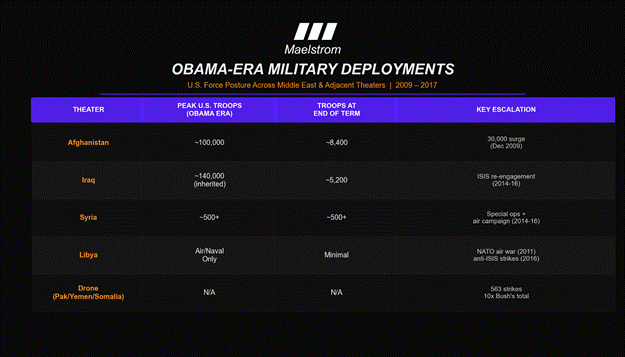
Given that the Federal Reserve had already lowered rates to zero at the end of 2008 and started printing money through quantitative easing, in the face of Obama's troop surge, they had no operational space left. Money was free, and supply was unlimited. The American war machine and its contractors feasted.
2026 Iran—The Messiah (President Donald Trump)
Fate played a trick, and after surviving an assassination attempt during the 2024 presidential campaign, Trump almost resurrected from the dead. As Kanye said, Jesus walks. I can talk about Kanye now because he has capitulated, right…?
Trump's presidential term, as well as his red team Republican members' chances of re-election in November, will depend on the rise and fall of financial asset markets and the fluctuations in oil prices. Given that since the fall of the Iranian king in 1979, regime change in Iran has been a spring dream for elite political figures in both parties, the Federal Reserve has the political cover to significantly ease monetary policy. Failing to fulfill the duty of providing cheaper and more abundant funding to transform Iran into a U.S. vassal state would be unpatriotic.
Trading Strategy
Sitting here today, we do not know how long Trump will maintain his interest in spending billions or even trillions of dollars to reshape Iranian politics according to his preferences, nor do we know how much geopolitical and financial market pain he can politically endure before retreating. The prudent approach is to wait and see. The time to fully invest in Bitcoin and high-quality altcoins like $HYPE is immediately after the Federal Reserve cuts interest rates and/or prints money to support the government's Iranian objectives.
Take care, everyone.
免责声明:本文章仅代表作者个人观点,不代表本平台的立场和观点。本文章仅供信息分享,不构成对任何人的任何投资建议。用户与作者之间的任何争议,与本平台无关。如网页中刊载的文章或图片涉及侵权,请提供相关的权利证明和身份证明发送邮件到support@aicoin.com,本平台相关工作人员将会进行核查。


