Author: Ba Jiuling, Wu Xiaobo Channel
As an oil tanker attempting to pass through the Strait of Hormuz was hit and sank, the military hostilities between the U.S. and Israel against Iran began nearly 48 hours ago, and what people feared most happened.
On Saturday, the fifth day of resuming work after the Spring Festival, the U.S. and Israel launched another military attack on Iran. Although people had anticipated this, it still caused a massive shock psychologically and in the market.
The U.S. Pentagon's Central Command released a situation report on Sunday stating that U.S. forces attacked more than 1,000 targets within Iran over the weekend. According to earlier reports by the BBC, around 40 Iranian officials, including Iran's Supreme Leader Khamenei, were killed.
Previously, Trump declared that the U.S. aims to defend the American people by eliminating the imminent threat from the Iranian regime and achieving regime change in Iran.
However, the situation is still deteriorating.
For the global economy, first, the crucial "energy lifeline" has been completely severed—at 1:30 AM Beijing time on March 1, the Islamic Revolutionary Guard of Iran announced the closure of the Strait of Hormuz and expressed a hardline stance by attacking passing ships.
Following the announcement and the sinking of the oil tanker, at least three liquefied natural gas transport ships traveling to and from Qatar have suspended their voyages to avoid the Strait of Hormuz, halting one-third of the world's maritime oil and one-fifth of liquefied natural gas transportation.
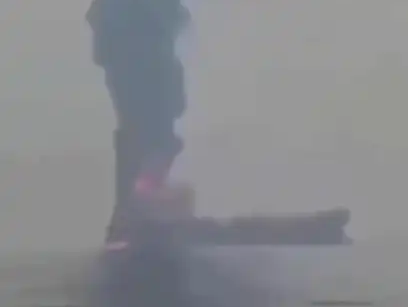
An oil tanker attempting to pass through the Strait of Hormuz was hit
Image Source: CCTV News
Secondly, the duration of the war has changed from four days to four weeks.
Previously, Israeli government officials stated that Israel was preparing for a "four-day intensive and powerful joint strike." Now, the Israeli Prime Minister has announced that the intensity of attacks on Iran will be further increased in the coming days.
And at 12 AM on March 2 Beijing time, U.S. President Trump stated: Iran is a large country, and we expect military actions against Iran to potentially last four weeks.
This means that the impact time facing global assets is also extended, and the situation becomes even more confusing.
For everyone in front of their phone screens, while caring about the development of the situation, the most pressing concern is naturally how their "wallets" will withstand the variables of the coming week or even month.
Today's article will discuss this from four aspects.

International Oil Prices: Heading Towards $100?
From a geographical perspective, the Strait of Hormuz is just 33 kilometers at its narrowest point, a typical "funnel" choke point, making it naturally easy to defend but hard to attack, very susceptible to blockades.
The Persian Gulf beyond the strait hosts the seven major oil and gas exporting countries: Saudi Arabia, Iran, Iraq, Kuwait, the UAE, Qatar, and Bahrain.
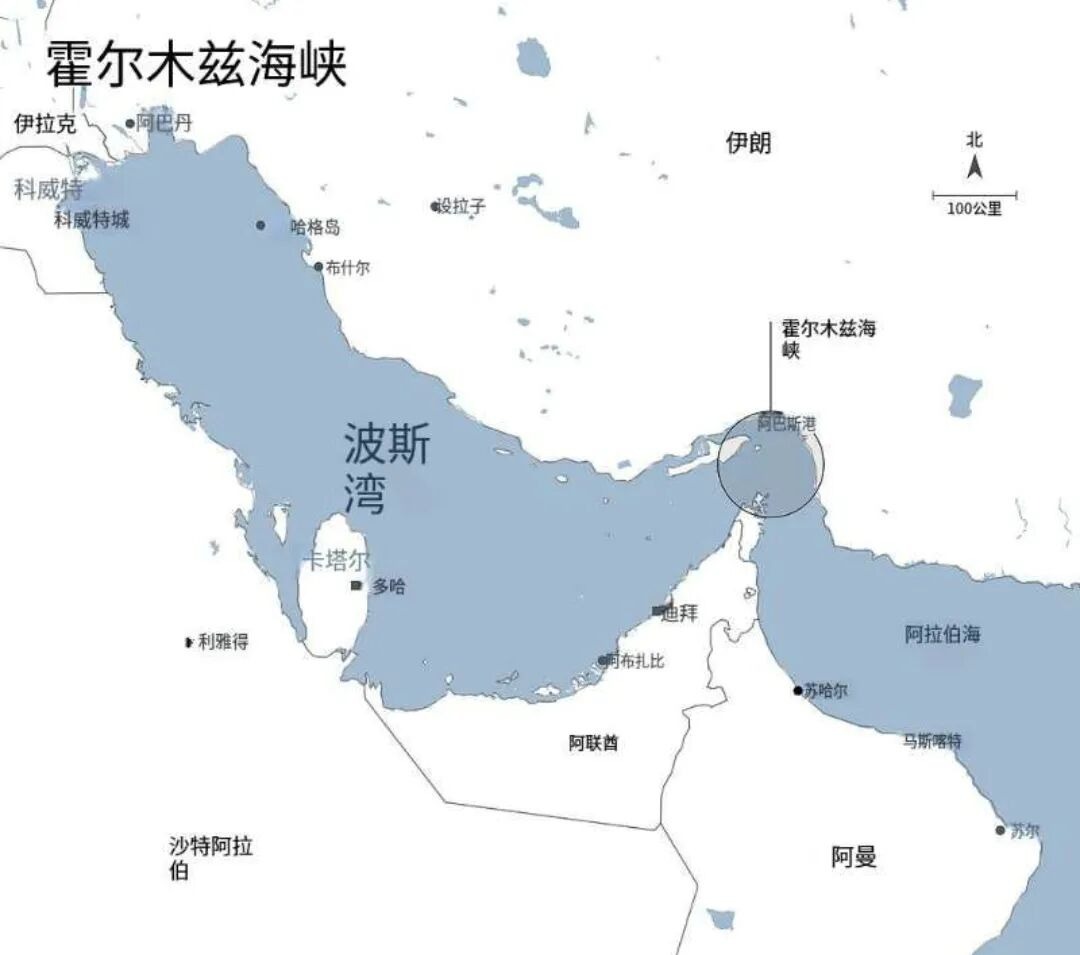
Geographical position of the Strait of Hormuz
After Iran's closure of the Strait of Hormuz, the global energy market shifted from a state of "supply-demand balance" directly into an extreme state of "structural shortage," rapidly transmitting through all links of the energy industry chain, with Asian countries particularly affected.
Data from energy consulting firm Kpler shows that by 2025, over 14 million barrels of oil will pass through the Strait of Hormuz daily, accounting for one-third of the world's total maritime crude oil exports. About three-quarters of this oil goes to China, India, Japan, and South Korea. As the world's second-largest economy, China's imports of crude oil from the Strait of Hormuz account for half of its crude oil imports.
Historically, geopolitical conflicts have always been the core driving force behind skyrocketing oil prices, especially in the powder keg that is the Middle East.
In 1973, during the Middle East War, oil prices surged over 300%; in 1990, during the Gulf War, prices rose by 199% within two months; in 2019, when Saudi oil facilities were attacked, Brent crude oil surged by 20% in one day; in June 2025, when Israel struck Iranian targets, Brent crude rose by over 12% on that day, with domestic oil and gas-related futures also soaring.
Various institutions and analysts have previously made predictions about how this situation will impact oil price movements.
Bloomberg Economics estimates that if Iran truly shuts down this critical shipping lane, oil prices could soar above $100 per barrel;
Muyu Xu, a senior oil analyst at Kpler Ltd., estimated that even a one-day blockade of the Strait of Hormuz by Iran could lead to oil prices soaring to $120 to $150 per barrel;
Goldman Sachs and JPMorgan expect that in the most extreme "doomsday scenario," if the Strait of Hormuz is blocked for 2-4 weeks, international oil prices will rise to $150-200, triggering a global energy crisis and stagflation or even recession in major economies.

On March 1, in Sri Lanka, people queue at gas stations
In reality, it seems that the predictions of analysts are just a step away.
On the morning of March 2, as the market opened, international oil prices soared by $8, with Brent crude reaching a high of $82.37 per barrel, and WTI crude rising to $80.82 per barrel.
In the early hours of March 2, the Iranian Islamic Revolutionary Guard stated in a communique that they hit three U.S. and UK oil tankers in the Persian Gulf and the Strait of Hormuz with missiles.
German shipping giant Hapag-Lloyd announced a war risk surcharge for cargo traveling to and from the Bay Area, Arabian Gulf, and Persian Gulf.
The Iranian Islamic Revolutionary Guard also warned that if Iran's oil and gas facilities were attacked, all oil and gas facilities in the Middle East would be destroyed in response, representing an "energy threat" comparable to that of a nuclear bomb.
In anticipation of the impending surge in oil prices, the Organization of the Petroleum Exporting Countries (OPEC) announced on March 1 that eight major oil-producing countries decided to increase daily production by 206,000 barrels in April.
Gold: Entering a Critical Window
Prior to the outbreak of war, the market had anticipated the deterioration of the situation in Iran, the most notable characteristic being the rise of safe-haven assets. Last Friday, London gold rose by 1.77%, closing at $5,276, while London silver jumped by 6.15%.
As the sounds of explosions from Iran continued to emerge, Tim Waterer, chief market analyst at KCM Trade, told Reuters: "Demand for gold at Monday's open may be higher than usual, and gold is expected to once again become the preferred safe-haven asset."
And indeed, on Monday morning after the market opened, spot gold rose to $5,374 per ounce, up 1.8%, while spot silver was priced at $96 per ounce, up 2.6%.
The future price of gold largely depends on the intensity and scope of the war.
Kaiyuan Securities, after referencing similar events in March 2003 and June 2025, believes that after military actions commence, the short-term benefits for gold may diminish, with prices spiking and then retreating. However, from a medium- to long-term perspective, gold prices have shown more noticeable increases afterwards.
Yang Delong, chief economist at Qianhai Kaiyuan Fund, stated: The large-scale military actions by the United States against Iran have significantly boosted market risk-aversion, driving up the prices of gold, silver, and other precious metals remarkably; if the situation further deteriorates, the price fluctuations of crude oil, gold, and silver, along with the adjustment pressure on global stock markets, will increase significantly.
Wang Weimang, investment manager at the asset management department of Zhonghui Futures, believes that the next 24-48 hours will be a crucial window for determining the height of gold prices. He previously presented two possible directions:
◎ Direction 1: If Iran retaliates with limited and precise strikes, targeting only Israel or U.S. military bases without blocking shipping lanes, gold will maintain a high fluctuation, with investors oscillating between risk aversion and market digestion of expectations.
◎ Direction 2: If the conflict spreads to regions like Lebanon or the Red Sea, with shipping obstructed leading to further contraction of energy supply, gold will receive dual drives from risk aversion and inflation, starting a significant upward trend.
Based on his judgment, since Iran has announced the closure of the Strait of Hormuz, gold will become the "ultimate safe haven" for global funds, with prices likely to challenge historical highs.
Some of Trump's statements are also fueling the trend of gold. He stated: "Iran has just declared that they will launch unprecedentedly aggressive attacks today; they better not do that, because if they do, we will respond with unprecedented strength."
A-shares: Short-term Impact
Next, we will discuss the A-share market, which is of most concern to us. After the conflict broke out over the weekend, some netizens humorously remarked, "The U.S. military's missiles have hit my account precisely."
In a weekend filled with worries, how will this Middle East conflict affect capital markets?
First, let's look at the performance of foreign markets in chronological order.
On March 1, when the Saudi Arabian stock market was still open, it fell sharply by 4% in the morning, and by the closing time, the Saudi TASI index had dropped 2.18%, hitting a near one-month low. Egypt's main stock index fell 5.44% in the morning, and the Kuwait Stock Exchange announced the suspension of trading.
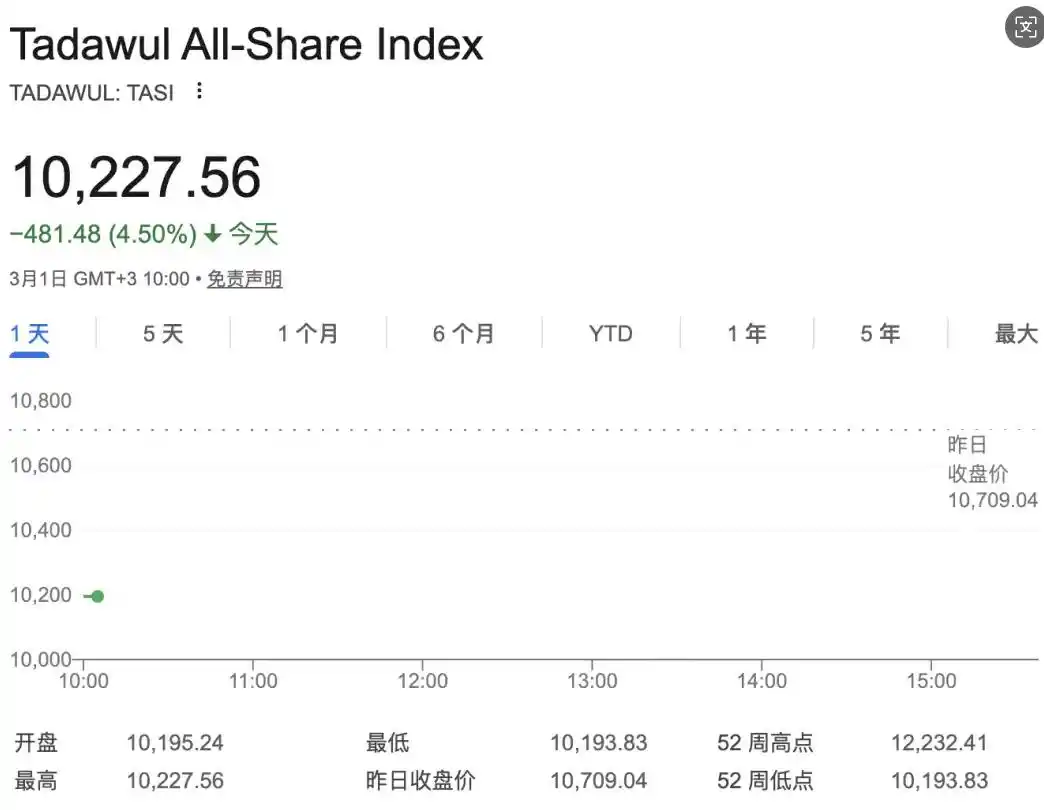
Saudi Arabian stock market index (TASI) sharply declines
In the early morning of March 2, the futures market saw U.S. stock index futures open lower, with Nasdaq and Dow futures each down over 1%, and S&P 500 futures fell over 0.9%.
At 8 AM Beijing time on March 2, the Nikkei 225 index opened down 879.56 points, a decrease of 1.49%.
Currently, the performance of overseas markets looks poor.
Fu Yifu, a special researcher at Suzhong Bank, believes that this military action will most likely show characteristics of "short-term shock, mid-term differentiation, and long-term limitations" on the A-shares.
◎ In the short term, the volatility of A-shares will primarily be driven by funding adjustments following the emotional shock. Among them, four major sectors: oil and gas extraction and oil service equipment, gold and precious metals, national defense and military industry, and coal and coal chemical industries may see opportunities for growth.
◎ Mid-term movements will depend on the duration and scale of the conflict, which is the key variable in determining the degree of differentiation of A-shares. This mirrors the trends seen in gold.
Jia Yang, fund manager at Guangdong Zhongxing (Beijing) Private Fund Management Co., believes that this local geopolitical conflict between the U.S. and Iran may bring short-term emotional volatility to the overall A-share market, but the impact will be relatively limited. In the short term, geopolitical conflicts will likely lead to rallies in sectors like non-ferrous metals and oil commodities.
Chief strategy analyst at Zhongtai Securities pointed out that this incident will further reinforce the asset allocation logic of “global geopolitical upheaval + technology and manufacturing expansion” established since last year. Among them, gold, nonferrous metals, power equipment, rare earths, and military industry sectors will directly benefit; the AI technology sector may present a "short squeeze followed by long accumulation" pattern.
Xinda Securities believes that the development of geopolitical conflicts in the Middle East may continue to reinforce inflation narratives based on energy security, bringing structural opportunities to sectors like gold and oil and gas. Meanwhile, they maintain a long-term optimistic outlook on investment opportunities based on PPI recovery.
Luo Zhiheng, chief economist at Guangdong Kaihui Securities, believes that capital market trends still need to "prioritize our own interests," as external geopolitical changes will affect investor risk appetites and listed companies' operations, but internal factors are fundamental and long-term; external factors are merely short-term and phase-specific.
Overall, institutional opinions suggest that the current situation has limited impact on China's capital markets, and short-term adjustments may actually present layout opportunities.
It is worth mentioning that the Hong Kong stock market has already prepared preventive measures in advance.
Paul Chan, the Financial Secretary of the Hong Kong Special Administrative Region, stated: "Due to the influence of the Middle East conflict, financial market volatility has increased, and capital flows may accelerate. Local funds may seek a 'safe haven' and flow into Hong Kong. The Special Administrative Region Government is prepared and will carefully manage financial risks, with adequate contingency plans."
AI: Military Concept?
Unlike previous Middle East wars, this round of conflict may become a hidden benefit for the AI industry.
According to The Wall Street Journal, the U.S. Air Force Central Command has long used AI tools from Anthropic in the Middle East to perform tasks such as intelligence assessments, target identification, and battlefield scenario simulations; even when Trump issued a ban, this tool was still deployed in the recent strikes against Iran.
With media hype, the narrative that "AI has deeply integrated into the U.S. military operations system" gradually formed over the weekend.

The Trump administration put Anthropic on the blacklist
Media reports indicate that the application of AI in modern warfare mainly focuses on two aspects:
◎ One is intelligence collection and analysis. For example, the U.S. military's Central Command can quickly process thousands of hours of intercepted communications in Persian, internal messages of the Iranian Islamic Revolutionary Guard, satellite and ground intelligence using Claude, accurately identifying vulnerabilities in Iran's command chain.
◎ The second is practical applications on the battlefield. In the recent airstrikes against Iran, the U.S. military used low-cost, approximately $35,000 kamikaze drones named LUCAS for the first time in actual combat. This drone is highly scalable and equipped with autonomous AI flight control and swarm coordination capabilities.
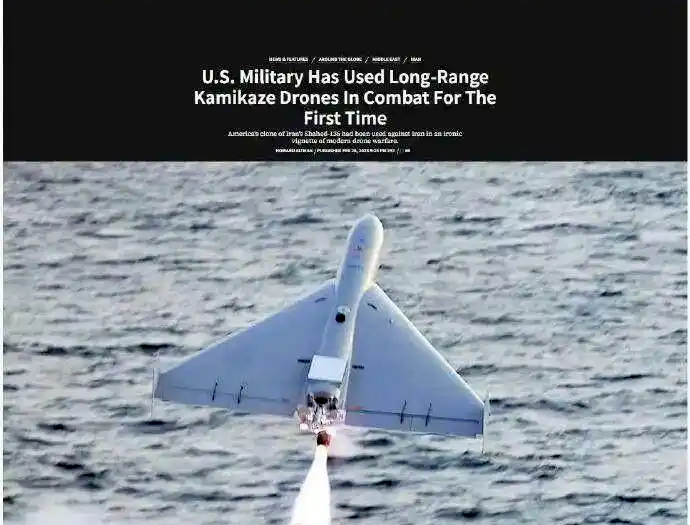
Image Source: Internet
Some institutions have also analyzed this. Tianfeng Securities stated that military AI is one of the important application scenarios of the artificial intelligence industry. AI is expected to play a key role in combat advisory assistance, equipment maintenance, situational awareness, and decision support, potentially accelerating the intelligent and unmanned evolution of military equipment and even triggering a new wave of military technological revolution. They suggest focusing on military AI-related industry chain targets.
In their research report, they provided seven investment directions: application products, physical AI, military policy, specialized computing power, data encryption, data chains, and smart equipment.
Conclusion
“Those holding crude oil commodities say the shipping lanes will be blocked, causing a surge; those holding gold and silver say the safe haven will surge; those holding photovoltaic storage say energy alternatives will surge; those holding AI big models say the war brain will surge; those holding electrical equipment say AI large infrastructure will surge; those holding domestic computing power say national defense security will surge... It feels like there will be a thousand stocks hitting the daily limit on Monday.”
After the outbreak of war, such a joke circulated among the masses, reflecting each investor's reaction to sudden events—worried about risks while eager to take chances.
However, how much international oil prices will rise, how the stock market will fluctuate, and the probability of economic recession... the answers to these questions ultimately depend on the objective course of the war. On the other hand, whether it is a black swan or a gray rhino, what really gives accounts "defensive capabilities" is still reasonable asset allocation and a risk management mechanism.
免责声明:本文章仅代表作者个人观点,不代表本平台的立场和观点。本文章仅供信息分享,不构成对任何人的任何投资建议。用户与作者之间的任何争议,与本平台无关。如网页中刊载的文章或图片涉及侵权,请提供相关的权利证明和身份证明发送邮件到support@aicoin.com,本平台相关工作人员将会进行核查。


