Original | Odaily Planet Daily (@OdailyChina)
Author|Golem (@web3_golem)
In the past year, more and more Web2 practitioners have begun to seriously consider entering Web3.
Whether due to layoffs in large internet companies, AI restructuring job roles, or the increasing popularity of the crypto industry, these factors are driving talent movement. However, at the same time, a reality has become increasingly evident: most people's understanding of the Web3 workplace still comes from fragmented personal experiences and highly polarized public discourse.
Unstable, non-compliant, high-pressure and other topic-laden negative labels often become the mainstream narrative; when information sources are highly decentralized, what is actually lacking is systematic sample observation.
Therefore, rather than discussing abstract evaluations, it is better to return to samples, presenting the real working conditions of employees at a Web3 company by interviewing current employees and cross-analyzing organizational structures and recruitment data. This time, we chose Gate as our observation target. Established in 2013, as one of the leading trading platforms globally, Gate is both scale-representative and has been at the center of public discourse.
When the narrative returns to specific companies, specific positions, and specific individuals, many judgments become naturally more three-dimensional.
Remote Work: Does Web3 Make Professionals Uneasy?
Every weekday morning, Olivia wakes up promptly at 9 a.m. She does not need to rush for the subway or scramble for the elevator, nor does she have to navigate the early morning rush hour in the city. After a simple wash-up, she walks into the fresh park downstairs and begins her day with 40 minutes of yoga. By the time she finishes breakfast slowly, it is 10 a.m., and Olivia sits back in front of her screen to join the departmental morning meeting, reviewing yesterday's work with colleagues from around the world and planning for the new day.
Olivia is not an executive at a large company; she is just an ordinary employee at Gate. Although Gate has nearly 3,000 global employees, it has basically achieved full remote work, with employees distributed around the world. However, in recent years, Gate has also begun to establish physical offices in licensed regions globally, such as Japan, Dubai, the United States, and Malta, extending online collaboration into offline physical layouts.
There is no clocking in and out system and no strict time control. Even though Olivia is in the fast-paced crypto industry, she can still enjoy life at any time. “Gate does not care where you work; you can work while taking care of your kids, looking after your family, or even while traveling — there is absolutely no problem,” said Gate founder Dr. Han in a certain interview when discussing the differences between Web3 and traditional industries.
Remote work is a common mode of work in Web3. A survey of the crypto industry workplace in 2025 shows that over 66.7% of Web3 companies support remote work.
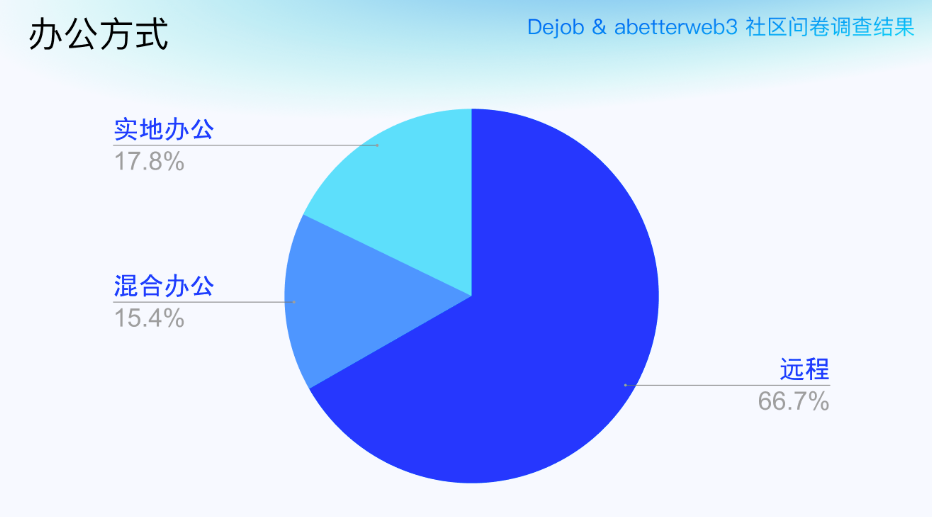
However, remote work is also a double-edged sword for employees; the high degree of freedom does indeed bring some conveniences but also increases the difficulty of discerning whether a company is reliable.
After all, remote work inherently diminishes an organization’s “visibility.” In traditional companies, employees can gauge the operational status of the company through daily observations, whereas in a remote environment, this perception is replaced by a screen.
If one has never been to the office and has never met the boss or colleagues, how can they determine whether the company is legitimate? In the 2025 crypto industry workplace survey, this concern was highlighted, as over 40% reported leaving Web3 due to worries about job instability and the mixed quality of Web3 companies.
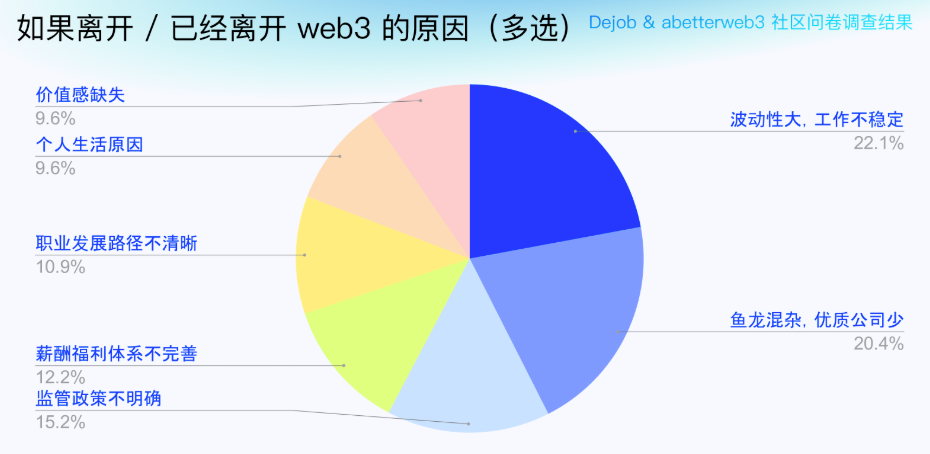
This concern has led to another direct outcome: talents are beginning to cluster around Web3 companies that exhibit long-termism.
Alex is currently in charge of global central operations at Gate. He has just completed one year with the company, having spent six years in the crypto industry prior to joining Gate. His lengthy experience in crypto has made Alex better at choosing a reliable Web3 company, “Gate has been established for 13 years, and there are many employees with over six to seven years of tenure, and some even from the very start, with more than 12 years of service. This is quite rare in Web3.”
One of the reasons Alex joined Gate was for the sense of security, “I don't have to worry that the company is just trying to make a big score and then run away.”
At the same time, a Web3 company's compliance can also eliminate some of the insecurity that remote work brings to employees and attract high-end talent from traditional finance.
According to official information, Gate has completed relevant regulatory registrations and license applications for multiple entities in Malta, the Bahamas, Japan, Australia, and Dubai.
Gate’s proactive push for compliance attracted high-end talent Kevin Lee from the traditional financial industry. Kevin had previously worked at JPMorgan Chase and is now the Chief Business Officer (CBO) at Gate. Before entering the Web3 industry, Kevin worked in traditional finance for about 15 years.
“Although we only announced our compliance licenses obtained in many countries last year, we had actually been preparing for this since 2018,” Kevin describes his career transition from traditional banking to a compliant exchange as perfectly aligning with Gate’s compliance goals, “At Gate, I can maximize my personal value.”
However, not everyone can adapt to remote work.
For professionals accustomed to the rhythm of physical offices, remote work often means higher self-discipline requirements. Without fixed working hours and face-to-face instant communication, some individuals may feel their rhythm disrupted, even experiencing isolation.
Especially since Web3 may encounter intense project phases or significant industry fluctuations, the cost of information synchronization in a remote environment can be higher, and employees’ anxiety may be amplified, turning collaborative work into “going solo” easily.
Therefore, remote work is not only a natural benefit of Web3 but also a job format that requires higher personal capability.
Another downside of remote work is the emotional distancing among departmental colleagues, leading to weakened team cohesion. To address this issue and eliminate barriers between employees from different regions and cultural backgrounds, the 2025 crypto industry workplace survey indicates that most people believe offline team-building activities are also crucial in addition to regular meetings.
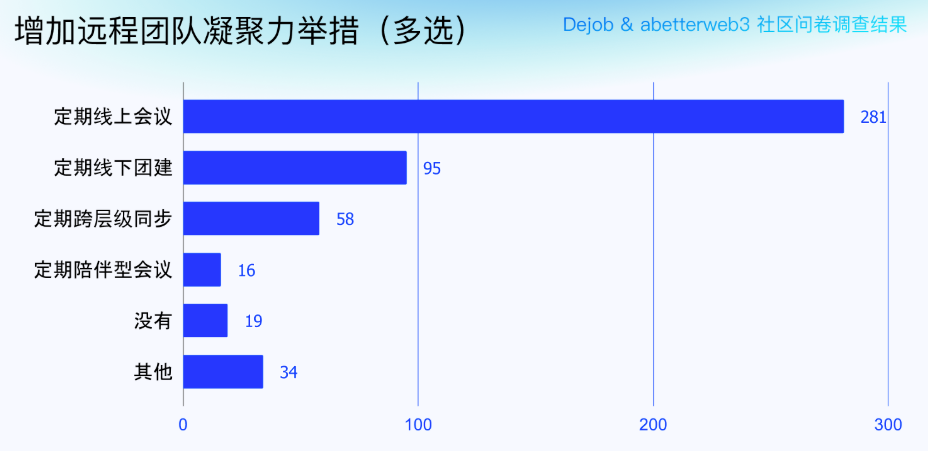
However, for Web3 companies that work remotely, offline team-building is indeed a “luxury.”
Olivia’s previous company was also a remote trading platform, but she did not participate in any offline team-building activities during her three years there. However, two months after joining Gate, she experienced her first team-building event. She found it very surprising, “This is my first time participating in a team-building activity.” After the event, Olivia also believed that when everyone comes out from behind the cold screens to meet in reality, it can indeed enhance relationships, “I feel like I know the team much better now.”
Why is Web3 Becoming a New Talent Hub?
For many job seekers, evaluating the potential of the industry/company and personal growth are priorities before joining a particular industry or company.
According to the latest exchange evaluation report released by CoinDesk, Gate has nearly 50 million global users. In January this year, it ranked third in the global centralized exchange spot market share and fourth in the derivatives market share, and was recognized as one of the fastest-growing mainstream trading platforms globally.
A platform with good development prospects and in a high growth phase will naturally attract top talents with professional skills and a willingness to grow.
From the perspective of talent structure, Gate's team shows a high degree of internationalization and educational attainment. Over 89.33% of employees hold a bachelor's degree or higher, with 22.33% holding a master's degree or higher and 4.6% holding a doctorate or higher. In terms of global educational background, over half of the international graduates come from universities ranked in the top 200 by QS, accounting for 5.2% of the workforce.
Although Web3 is viewed as an industry that does not make education a barrier, it still emphasizes the integration of rapid learning capabilities with interdisciplinary skills; high educational background and quality education typically indicate that job seekers have a strong foundation of professional training and an international perspective, which aligns seamlessly with the open and global characteristics of Web3.
Grace is a product designer responsible for the trading business line at Gate, having previously worked at Tencent. After a failed incubation project, she joined a top 5 crypto exchange in Web3 in 2021. In February 2025, she decided to switch to Gate.
The driving force behind Grace's decision was the potential for personal development, “By 2025, the crypto trading business at my previous company had stabilized, while Gate is still experiencing strong growth; I feel that there is more room for growth at Gate.” Grace highlighted that upon her first exposure to new listings at Gate, she noticed that compared to other exchanges, Gate's listing process is always quick and comprehensive.
Grace's transition to Gate was also influenced by the director of her direct department, “I joined Gate alongside him; at my previous company, I could only focus on the immediate work without the time to enhance my overall capabilities, whereas at Gate, while completing work, the company also provides some space for gaining experience and expanding horizons.” Grace noted that this was also one of the important reasons for their choice to join Gate.
We learned from a senior HRBP at Gate that even during the recruitment process, the company does not place too much emphasis on candidates’ past experiences; instead, self-motivation, passion for the industry, and innovative abilities are the key criteria for considering candidates. This has led to a large influx of Web2 talents applying to Gate.
Having worked at multiple exchanges, Alex believes there are more opportunities for growth in Web3. “Good operations require support from resources like products and development. Gate is particularly responsive in this regard; as long as it’s a good idea, the company will provide opportunities,” Alex remarks, which he considers one of the most attractive aspects of Web3.
On a solid ship moving full speed ahead, sailors are naturally reluctant to switch to other ships; this is also the true sentiment of Web3 employees when facing headhunters. “In terms of benefits and growth opportunities, I think Gate is already very competitive,” Olivia states, mentioning that she recently turned down a headhunter's request, choosing to stay at Gate.
Are Employee Incentives and Benefits in Web3 Reliable?
Besides industry outlook and personal growth potential, salary and benefits are also crucial factors for job seekers. According to the 2025 crypto industry workplace survey, the overall salary level in Web3 is not higher than that of most leading internet companies, with most people's monthly salaries ranging between $1,500 and $4,000 (approximately 10,500-28,000 yuan).
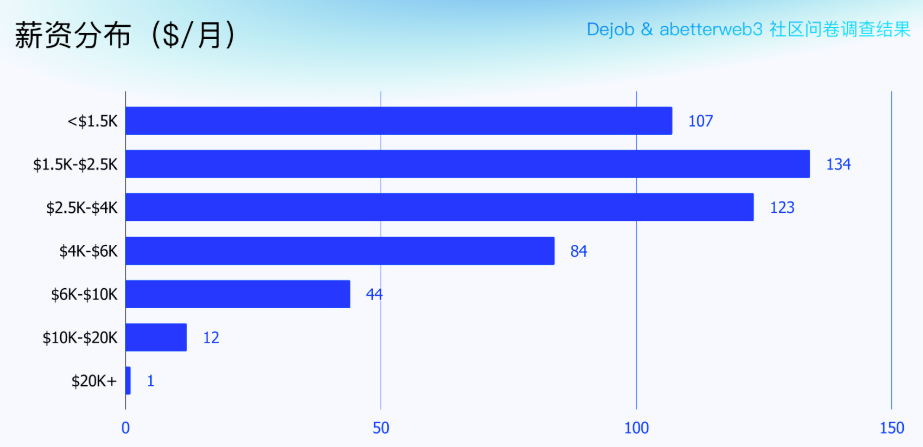
Although viewed in “absolute terms,” Web3's salaries do not have much advantage, if combined with “geographic arbitrage,” these salaries already surpass many others. Don’t be fooled by the high salaries of internet workers in large cities; the cost of living is also quite high there, while employees at Web3 companies can earn a big city salary and live in a smaller city. When considering living environment and city comfort level, Web3 employees may enjoy a more comfortable life under the same salary conditions.
In terms of benefits, according to an HR from Gate, although Gate's employees are spread across the globe, the company still pays taxes and arranges employee benefits according to local laws by establishing local entities.
Besides the basic legal employee benefits, Gate has also established a comprehensive employee welfare support system, such as providing holiday bonuses and growth allowances (like reimbursement for learning English, crypto industry knowledge, etc.) for employees in different regions. If employees encounter emergencies or unexpected situations, there is also an employee care fund to help them through tough times.
Regarding year-end bonuses, the Web3 industry has also kept up. Surveys indicate that Web3 companies with stable revenue sources, like exchanges and media companies, tend to provide year-end bonuses equivalent to at least one to three times the monthly salary.
Specifically, at Gate, it is reported that, on average, each employee can receive a year-end bonus of 2 to 6 times their monthly salary.
Gate founder Dr. Han announced at the Gate global annual meeting on February 6 that the company would continue to increase incentives for outstanding talents, with year-end rewards for employees rated SS reaching 20 months of salary.
During an interview, an HR also mentioned that in terms of talent mechanisms, Gate adheres to the incentive principle of “high effort equals high return.” By implementing a more transparent evaluation system and clear career paths, the company fosters a positive feedback loop between individual growth and platform development, centrally allocating resources to elite talent and long-term value. Besides year-end bonuses, there are also appropriate rewards for employees’ notable contributions and personal growth.
In March 2025, just a month after Grace joined Gate, she was rewarded for her outstanding contributions to the company’s 12th anniversary project. “Being recognized made me very happy,” Grace said, expressing that this incentive aligns closely with her realization of personal value.
Alex was also one of the beneficiaries of this incentive mechanism. When he joined Gate in February 2025, he was involved in a major project launch. Due to outstanding performance, Alex saw his salary increase by 20% less than six months into employment and transitioned from solely handling contract operations to overseeing multiple operational sectors, achieving a promotion.
Does Web3 Have to Be “996”?
The “996,” “007” work models have been widely criticized in Web2; thus, does the standardless remote work model in Web3意味着“always on duty”?
Gate itself has a significant workload because it is in the trading sector, and not trying to excel is not an option. On one hand, the crypto industry is inherently fast-paced, and on the other hand, the exchange operates 7*24 hours without a break, requiring the team to respond to the market at any time.
However, based on descriptions from Gate employees, we have come to a fact: even in such a high-intensity company in Web3, it is not necessary to work 996.
Objectively speaking, combined with the peculiarities of the remote work in Web3, no crypto professionals can genuinely split work and life into two segments. Olivia mentioned that although she usually finishes her work by 6-7 p.m., she is also willing to work if related tasks need attention, “It's impossible to completely separate from Web3 after work.”
Regarding working hours and freedom in Web3, Kevin, who comes from traditional finance, has his unique insights. Kevin mentioned that when he was a stock trader at a bank, he often needed to sit at a desk staring at six computer screens for ten consecutive hours. Compared to the “pain” of that time, although work at Gate is busy daily, it still provides him with great flexibility.
“Because of the extensive personal flexibility in daily work, even if there are urgent situations, I am willing to contribute a bit more for the company, even on my day off,” Kevin cited the example of launching a token, stating that even if the launch day fell on a Saturday, everyone on the team, including himself, chose to continue working. However, Kevin believes that emergencies do not occur every day in the crypto industry, so such quick responses cannot simply be equated to “996.”
Gate's results-oriented working methodology, paired with the “high effort, high return” incentive principle, can also provide accurate and substantial rewards for employees' extra contributions.
A Gate HRBP stated that besides sudden industry situations, when the platform has new features or projects launching, there indeed can be an increase in working hours for responsible employees at that time. Nevertheless, the company would arrange specific project bonuses during that period, along with year-end performance adjustments. Therefore, Web3 tends to emphasize “more work leads to more rewards”; blindly accumulating work hours is meaningless.
Rather than Trusting Rumors, It’s Better to Experience It Yourself
Although most employees rate Gate positively, there has indeed been quite a bit of criticism surrounding Gate in the past year, such as strict management and mass layoffs.
No company can meet every individual's requirements, so there will always be positive and negative evaluations. In this regard, Gate's Chief Business Officer Kevin believes that in the last three years, Gate has undergone significant organizational changes alongside rapid business growth; the number of employees has also rapidly expanded, thus management faces enormous challenges.
“The first challenge is the need to increase promotion of the Gate brand image, helping the market understand what the real Gate looks like; the second challenge is to enhance the dissemination of Gate’s organizational culture among employees, simply put, making sure every employee can represent Gate and convey the organizational culture to the outside world; the third challenge is to further strengthen upward communication and feedback channels for employees, ensuring that every employee's voice is heard by management,” Kevin also mentioned that Gate is already working on improvements in this area, but it cannot change overnight and will require time.
Alex stated that although the work at Gate indeed gets busy, the day-to-day team atmosphere is quite relaxed, “Having joined Gate for less than a year, I already have over two to three hundred memes from my colleagues on Lark.” Olivia also pointed out that when she entered Web3, she was not affected by these negative impressions.
Data feedback from Gate's HRBP also confirms that even in 2025, despite misunderstandings in the external image of Gate, the various recruitment metrics such as candidate inquiries and offer acceptance rates have not shown significant downward trends, nor have they affected the overall recruitment progress of the company.
It has been learned that Gate's recruitment completion rate for 2025 meets expectations, having recruited over a thousand new employees for junior, mid-level, and senior positions, achieving an iteration of talent quality to support new business developments, and the job elimination rate for 2025 remains at 5-10%.
In fact, even amidst Web3, Gate’s personnel changes tend to be comparatively stable. In an interview, Gate founder Dr. Han reminisced that during the major layoffs in the industry in mid-2022, many exchanges laid off 20% to 30% of staff. At that time, Gate only reduced about 5%. Dr. Han indicated that Gate has never been a company of “large openings and closings”; whether in recruitment or personnel adjustments, it adheres to a cautious and gradual rhythm.
However, in 2026, there may be an even larger wave of layoffs across Web3 and other fields, not due to a bear market, but because of AI.
On February 27, Twitter (now called X) founder Jack Dorsey’s fintech company Block announced a large-scale layoff plan, reducing its workforce from over 10,000 to fewer than 6,000 employees, with a layoff rate of 40%. The reason Jack Dorsey made this decision was that AI has already fostered an entirely new way of working, and rather than passively accepting change by gradually laying off staff over the coming months or years, it's better to actively seek transformation now.
The situation predicted in the widely shared article “2028 Global Intelligence Crisis,” which garnered over 30 million views, is now occurring in reality. As AI becomes integrated into corporate workflows, company profit margins expand, earnings exceed expectations, and stock markets soar, yet a large number of white-collar workers will be eliminated.
Gate founder Dr. Han also believes that up to 90% of traditional job capability models may face the risk of being reconstructed or eliminated by AI in the future. Therefore, efficiency and speed are becoming core competitive advantages, requiring companies to fully embrace AI and reshape product forms and user experiences, but the integration of AI and Web3 is not simply a functional overlay; it entails a systemic restructuring of financial infrastructure and value distribution methods.
This “intelligence crisis” is not a challenge faced solely by Web3, but a transformation that the entire tech industry must confront. However, the rapid evolution, open culture, and technology-driven characteristics of Web3 make it inherently suitable for AI integration. In a certain sense, Web3 may be one of the few areas in this era that is not replaced by AI but can actually see a new wave of employment benefits fueled by AI empowerment.
Gate is not only a microcosm of the Web3 industry but also a standard case of a Web3 company. As an exchange still in a rapid expansion cycle, just like the entire Web3 industry, Gate’s growth is destined to be accompanied by controversy, misunderstanding, and noise.
However, flaws do not obscure the merits; employees at Gate know what a real Gate looks like and also understand what a real Web3 workplace is like. Rather than hesitating as an outsider, it’s better to personally join a Web3 company and “experience it for yourself.”
免责声明:本文章仅代表作者个人观点,不代表本平台的立场和观点。本文章仅供信息分享,不构成对任何人的任何投资建议。用户与作者之间的任何争议,与本平台无关。如网页中刊载的文章或图片涉及侵权,请提供相关的权利证明和身份证明发送邮件到support@aicoin.com,本平台相关工作人员将会进行核查。


