Original | Odaily Planet Daily (@OdailyChina)
Author|Azuma (@azuma_eth)

Iran has become the focus of the entire world.
On February 28, a large-scale military strike was launched against Iran by the United States and Israel, targeting about 30 locations within Iran, including the Iranian presidential palace. Iran's supreme leader Khamenei confirmed he had died in the attack.
During this attack, the prediction market once again showed its intelligence value, distinct from traditional channels. In the hours before the airstrike, the probability in markets regarding “whether the U.S. military would attack Iran” had significantly increased, with new addresses on-chain betting heavily — in such globally watched public events, the fluctuations in prediction markets once again outpaced mainstream media reports.
This should have been a moment when the prediction market once again proclaimed a "victory declaration" after the 2024 presidential election, but Khamenei's death has plunged the industry into a major discussion on ethical boundaries.
Does death count as stepping down?
From a micro perspective, the focal point of the contradiction lies in the event of "whether Khamenei would step down as Iran's supreme leader." As the most observed dynamic in the Iranian situation, platforms like Kalshi and Polymarket had already provided betting options for related events long before. But the way Khamenei ended his rule (or the speed at which it ended) was clearly unexpected.
After Khamenei confirmed his death, Kalshi CEO Tarek Mansour was the first to express on social media opposition to profiting from individual death. “We will not list markets directly associated with death. When a market may yield a death outcome, we will establish rules to prevent people from profiting from death.”
Given that death is now a known fact, Kalshi will handle the event related to “Khamenei stepping down as supreme leader” as follows:
- All fees for this market will be refunded;
- The market will settle at the last trading price before the news of Khamenei's death was confirmed, with all positions, regardless of when opened, settling at that price;
- If users opened positions after Khamenei's death, Kalshi will fully compensate the difference in costs.
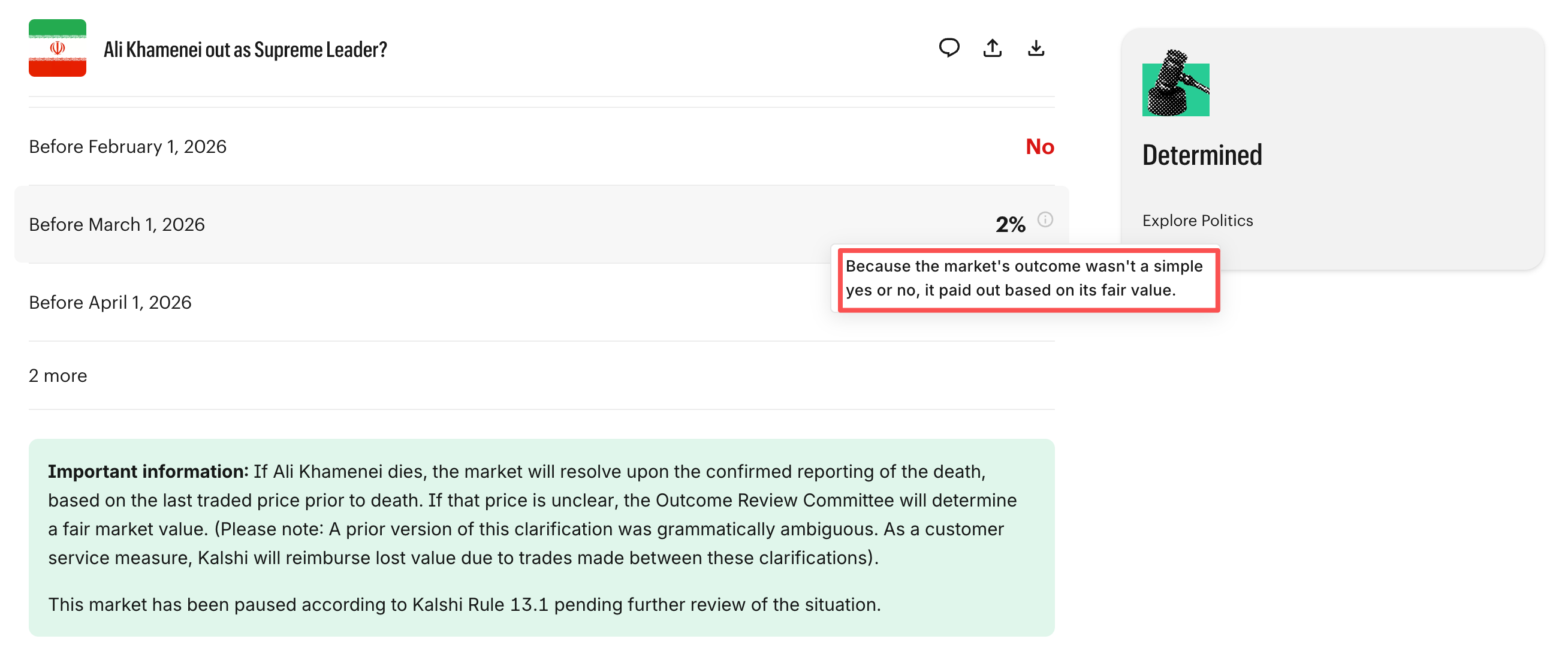
Opening the relevant event page on Kalshi shows that this event has been suspended for trading and marked accordingly; Kalshi has also noted that “because the market outcome is not simply YES or NO, it is compensated according to its fair value.”
Kalshi's approach has sparked intense discussion within the community.
- Supporters of Kalshi believe that avoiding events related to “death” aligns with mainstream values and regulatory constraints on commodity contracts (the regulatory framework under which prediction market events fall). Especially considering that prediction markets have exhibited a certain counteraction to the real world, if boundaries are not set, over time, betting may covertly encourage “bodily harm or murder,” leading prediction markets to gradually shift to dark web-like operations.
- Opponents of Kalshi argue that this move undermines the original trading fairness of the prediction market and damages the hedging value of prediction markets against real-world upheavals — those betting YES did not receive their expected returns; although Tarek Mansour claims “no user will lose even 1 dollar in this market,” those who bet NO and cut losses early do not receive corresponding compensation.
In contrast, Polymarket has yet to comment on this matter, and trading remains normal; currently, the price for YES on stepping down by March 31 is 99.9 cents, while NO is at 0.2 cents.
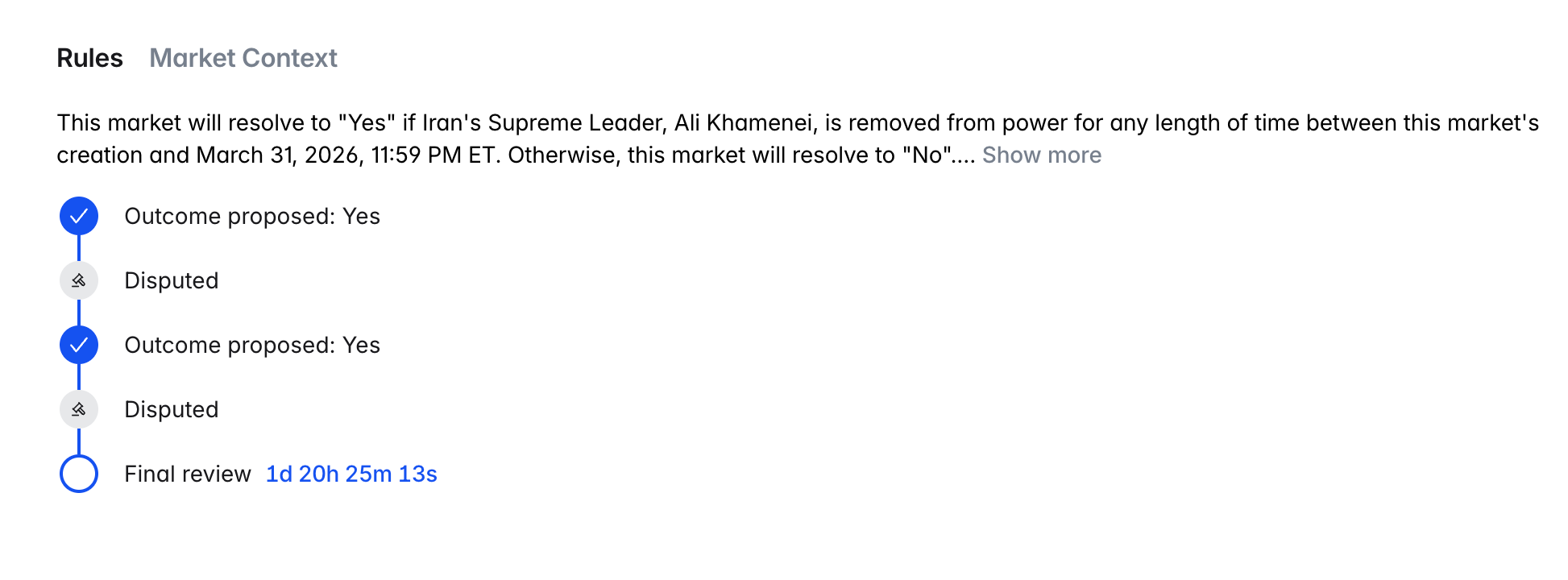
In Polymarket's rules for determining this event, it has stated “if Khamenei resigns, is detained, or otherwise loses his position or is unable to perform his duties as Iran's supreme leader within the specified timeframe of this market, it will be considered a stepping down,” which appears to cover the unexpected circumstance of death. However, there are still disputes emerging in the settlement process — clearly, there are disagreements within the community.
- Odaily Note: For more details on Polymarket's adjudication mechanism and processes after disputes arise, please refer to “Who Defines Facts? The Power Truth and Evil Space in Polymarket’s Adjudication Mechanism.”
Calls for Regulatory Bans
Discussions around whether prediction markets should list events related to “individual death” had already taken place on the regulatory side long before Khamenei's death drew widespread industry attention.
On February 24, just a few days before Khamenei's life ended, six Democratic senators, including Adam Schiff, jointly wrote to the Chairman of the U.S. Commodity Futures Trading Commission (CFTC), Michael Selig, demanding that the CFTC classify and ban any prediction market contracts that are contingent upon or highly related to personal death.
The legal basis cited in the letter is that under federal commodity regulation, the CFTC has already “classified and prohibited” contracts that involve or mention terrorism, assassination, war, or similar acts.
Adam Schiff and others expressed that such events would incentivize “bodily harm and even death,” constituting a “dangerous national security risk” — “these contracts may incentivize real-world harm as they create economic rewards for tumultuous events or bodily harm, encouraging actors to influence or facilitate these outcomes for personal gain.”
The CFTC did not respond publicly to the letter immediately. A few days later, the news of Khamenei's death quickly topped major media headlines, while Kalshi and Polymarket found themselves caught in a whirlpool of public opinion before regulatory stance was clarified.
Free Market vs. Social Responsibility
The prediction market provides a new pathway to utilize market mechanisms to glimpse the probability of future event occurrences, but that does not mean prediction markets are suitable for all events.
From the operational standpoint of prediction markets themselves, platforms tend to favor listing events that can clearly define outcomes and are difficult to manipulate at a single point, to avoid being mired in disputes about terms interpretation or fairness; from external influence and regulatory pressure, prediction markets need to avoid events that do not align with mainstream values. — if the setup of prediction markets leads people to disrupt social order or harm others for profit, then it easily faces ethical and legal challenges.
The controversy over whether “death” related events should be banned fundamentally boils down to a divergence in inclination between free markets and social responsibility. Those who emphasize free markets focus more on the unique advantages of prediction markets in pricing future events, unwilling to lose this ability due to any external restrictions; meanwhile, those weighing social responsibility worry that excessive leniency may gradually evolve into harm to public interest and social stability. This divergence consistently has a common resolution — as friction arises and deepens, both sides gradually find a suitable balance in negotiation and concession.
Like every emerging industry, the regulatory details and self-regulation of prediction markets won't emerge from thin air. The future of the industry will be shaped by participants, regulators, and society together. The path is paved by people, and Khamenei's death is prompting prediction markets to step out of the boundaries of ethics.
免责声明:本文章仅代表作者个人观点,不代表本平台的立场和观点。本文章仅供信息分享,不构成对任何人的任何投资建议。用户与作者之间的任何争议,与本平台无关。如网页中刊载的文章或图片涉及侵权,请提供相关的权利证明和身份证明发送邮件到support@aicoin.com,本平台相关工作人员将会进行核查。


